• About Us
    • What Is Street Harassment?
    • Why Stopping Street Harassment Matters
    • Meet the Team
      • Board of Directors
      • Past Board Members
    • In The Media
  • Our Work
    • National Street Harassment Hotline
    • International Anti-Street Harassment Week
    • Blog Correspondents
      • Past SSH Correspondents
    • Safe Public Spaces Mentoring Program
    • Publications
    • National Studies
    • Campaigns against Companies
    • Washington, D.C. Activism
  • Our Books
  • Donate
  • Store

Stop Street Harassment

Making Public Spaces Safe and Welcoming

  • Facebook
  • Instagram
  • Pinterest
  • Tumblr
  • Twitter
  • YouTube
  • Home
  • Blog
    • Harassment Stories
    • Blog Correspondents
    • Street Respect Stories
  • Help & Advice
    • National Street Harassment Hotline
    • Dealing With Harassers
      • Assertive Responses
      • Reporting Harassers
      • Bystander Responses
      • Creative Responses
    • What to Do Before or After Harassment
    • Street Harassment and the Law
  • Resources
    • Definitions
    • Statistics
    • Articles & Books
    • Anti-Harassment Groups & Campaigns
    • Male Allies
      • Educating Boys & Men
      • How to Talk to Women
      • Bystander Tips
    • Video Clips
    • Images & Flyers
  • Take Community Action
  • Contact

“Saying things like women ask for it”

April 29, 2014 By Contributor

The other night me and my girlfriend went to a party. It was in a suburb in the north of Paris, where I would never normally go as I know it can be dangerous, especially for women. We got out of the metro at about 8 p.m. and walked to the party which was a fifteen minute walk. It was typical of the area with groups of men hanging around in the streets. It made me very uneasy and I was then nervous about leaving the party and getting to the next party we had to get to further inside Paris.

When we went to leave at about 11 p.m. we asked the girl who lived there and she assured us she’d never had any problems walking to the station. We got almost to the station (criss-crossing the street to avoid groups of men) when a car with two young guys in it slowed down and drove next to us slowly. I ignored them, and my girlfriend did what she normally does in harassment situations and made crazy-looking faces at them.

Eventually I looked at them. They were making comments about us and pretending to masturbate. I told them they were ugly, and they said, “like you” and laughed. I knew that it could get serious, and that no one would help us if it did, so I pulled out my phone and pointed it right at the guys face and took a picture. He stopped laughing and sped off very quickly. We were worried they would be waiting for us somewhere so we ran across the road and into a little grocery store.

A man in there asked what had happened and we told him two nasty guys had harassed us. He then went into an aggressive and angry speech about how women always pretend to be harassed to get attention and how it is all lies. My girlfriend argued back talking about women getting raped and he was getting in her face and aggressive and saying things like women ask for it etc, and that we were lesbians so who would rape us anyway? Eventually he left and we walked really quickly down into the metro and onto the train. Not a fun way to start our night out.

Do you have any suggestions for dealing with harassers and/or ending street harassment in general?

After having very dangerous and serious harassment experiences in Paris, this is the first time I have ever taken out my phone and taken a picture of the harasser. It obviously wouldn’t work in every circumstance but it scared this guy and made him leave us alone quickly. I felt very empowered and would definitely use this approach again to be left alone.

– GracieParis

Location: Paris suburbs

Share your street harassment story for the blog.
Check out the new book 50 Stories about Stopping Street Harassers!
Share

Filed Under: Stories, street harassment

Scotland: Understanding the Male Harassers

April 28, 2014 By Correspondent

Rocío Andrés, Spain, SSH Blog Correspondent

Every time I have to write about a male harasser, a stalker, a molester, I would like to see just a neat crystal point to make it easier. Often, black over white – cross over tick, no over yes. But, instead, I see moiré.

I would like to be firm and forceful. And sure. I would like to be not contaminated by the whys. I strictly repeat “unjustifiable, inexcusable”, as if the human being couldn’t allow himself to spare any empathy for the violence and its acts, as if the violence were not human. However, after the impromptu furiosity and fuss, there is sadness and powerlessness and I, deep in me, see a sack of pretexts that a harasser might find to legimitate his actions, the long ache. Pretexts that, as in many other cases, turn into motives, like when you are in the middle of a sky dark black and, after a while, your blind eyes start to see tenuous lights.

Trying to be in another´s mind is often hardly difficult, but the work is far more complicated when we talk about being in a man´s who inferiorises your economic, social or living status because you are a woman, subordinates your rights to his self-interested understanding of your rights, doesn´t respect your body and your person, violentizes your mind, insults your human dignity, humiliates or mocks at your corporal strength, looks at you in the eyes and doesn’t see a woman, but a bitch or doesn’t find a connection in the fact that “excuse me, you and me – naked-, have arrived here at the same time”.

1) “What does your cunt like?”, a man in his sixties, maybe seventies, asked me recently just at the moment I took my seat during a flight from Spain to Scotland (obviously, no matter the age to be offensive, and however it provides with information to show the variety of harassers around the world). As I don´t like to turn everything into a drama, I threw to his nose a ball of paper that I always keep in my pocket just in case, which, somehow due to Murphy´s law, ended up landing back on my hair (how to predict a rubbery nose!) and so, I went straight to Facebook, where I updated my status as “critical”.

Minutes before, in the queue to enter the plain, another man at the same age, while his (I believe) wife was naively entertained reading a magazine, had obscenely been sticking his tongue out at me, as if he were eating an ice-cream of air.

2) “Hundreds of rapists and sex offenders are roaming the streets of Cairo, according to a leading human rights claims. The shocking International Federation for Human Rights (FIDH) report found that 250 reported cases of sexual assault and rape took place against female protestors during political demonstrations. None of the cases were ever prosecuted sparking fears than hundreds of sexual predators are still roaming Egyptian streets.” According to www.scoopempire.com, Egyptian street children is one of the most vulnerable groups exposed to sexual violence. “A study conducted by Lipincott Williams & Wilkins Inc. rounded up 857 homeless children in Cairo and found that 93% were sexually assaulted or raped (mostly by police officers and other homeless children) – 50% of whom were females”. In order to reduce the chances of being harassed or assaulted, girls stop showering or cover their bodies to hide their gender. http://scoopempire.com/violence-street-children-egypt/#.U1uYfxarPIf

3) “Dear Harvard: I am writing to let you know I give up. My assailant will remain unpunished, and life on this campus will continue its course as if nothing had happened. Today, Harvard, I am writing to let you know that you have won”. This was the beginning of an anonymous open letter sent to Harvard Crimson by a woman who had been sexually assaulted by “a friend.”

After all this, point at which the amount of violence traumatises the mind and your mouth becomes mute of adjectives, how can I possibly understand harassers? or, how can I possibly want to understand them? (Not to mention today, laws, measures or tools to eradicate these crimes).

Well, presuming that I am a common-sense person, I do. Here there are a few reasons why I think women should try to understand a harasser (not the same as to agree on the violence):

  1. because they are human beings. And that includes dads, granpas, brothers, cousins, uncles, boyfriends, neighbours, sons…
  2. because they have ability of thinking, which technically works in the same way as mine – not inferior, not superior-, and that raises hope for Indentification-Acceptation-Remorse-Change?
  3. I know a respectable amount of men who look for women´s equality (if you are one, click here https://stopstreetharassment.org/resources/male-allies/). Thus, equal gender is possible.
  4. Just by being acknowledged of the causes, I can help to solve them.
  5. I really yearn for our rights to be given and respected by men. And, whether I want it or not, that involves my effort in understanding harassers.
  6. We are partly responsible for education and the culture we live in. It is worthwhile to watch these videos of boys and girls giving their reasons why they think harassment happens in Egypt.


Of course, there is a huge exercise in wanting to understand a harasser, especially when you get used to suffering from harassment in the first place or even if you just read the deplorable news on the papers. On many occassions, I have to stop my readings, not before saying Objection! in order to calm down and start again.

Harassers, however, aren’t normally the focus of the news or academic studies, where, contrarily, the informative weight mostly falls on the woman´s presence, sensationalizing and highlighting her victim status and where, consequently, the harasser´s figure is pushed into the background, almost forgotten, deleted, or just presented as if it were lack of social or human roots.

Indeed, harasser´s representation is mainly characterised by de-humanization – the monster´s myth-, and depicted by the litres of blood shed – gory, pure predators (see the article I mentioned before referring to harassers/rapists as sexual predators). I wish it were that plain, so then we could just limit ourselves to call them animals and we  didn´t need to ask: what are we doing wrong?. But, as far as I know, being a man and lacking humanity (understood as part of the human race and not positive human attributes) cannot be separated. And here it is where I consider the bulk, the impact rests, in our acceptation of them as people, as men.

Once this is assumed, the writings of violent/harassing behaviours can go deep and spread, prioritising the social, economic and political components in which the harasser cohabitates over the innate ones, prioritising the man over the monster and understanding that behind such behaviours, it resides a greed of power, traditions, miseducation, a macho parade – in fact, all plastic, a fake.

Rocío Andrés holds a Bachelor´s degree in Audiovisual Communication, History of Art (both Universidad Complutense de Madrid, Spain) and a Master´s in Education (Universidad Rey Juan Carlos, Spain, 2010). She has six years experience as a TV and advertising producer.


Share

Filed Under: correspondents, street harassment

“Total humiliation”

April 28, 2014 By Contributor

15 minute walk to the train station before work this morning. Today – so far so good. Just about to cross the last road to my train station….cue car full of young guys shouting and leering out of the windows at me.

Right in front of the shops I have to pass every day to catch my train. Total humiliation.

I wondered if I’d get punished by taking my suit jacket off before these losers think it’s summer.

– SJJ

Location: Treforest Train Station, Wales, UK

Share your street harassment story for the blog.
Check out the new book 50 Stories about Stopping Street Harassers!
Share

Filed Under: Stories, street harassment

Kotex Can’t Tell the Difference Between Harassment and a Compliment

April 28, 2014 By Contributor

By: Lauren Schechter

(en Español a continuación)

When I arrived in Lima, Peru, as an American exchange student about two months ago, I thought I knew about street harassment. I had read about it, I had experienced a few catcalls here and there, and I had even had an egg thrown at me out the window of a moving car. But it had never been as constant as what women here experience every day. During my first of many ten-minute walks to school, I experienced endless “piropos” –  honking, whistles, and of course the infamous kissing noises that Limeña women are forced to endure each time they walk down the street alone (and sometimes otherwise).

But apparently Kotex Perú can’t tell the difference between street harassment and a nice compliment. Through the Facebook page of “Paremos el Acoso Callejero,” a Lima-based organization for fighting street harassment, I came into contact with the following Kotex Peru ad with the caption “¡Los piropos me alegran todo el día/tarde/noche!” (Catcalls cheer me up all morning/afternoon/night!)


Ad Translation:

“Kotex Test: If you are walking down the street and you are cat-called, you:

  1. Laugh at the situation and keep walking
  2. Stop and give a look that could kill to whoever is catcalling you
  3. Take your lipstick out of your purse, put it on, and blow him a kiss”

Clearly, the sentiment of this ad is that “piropos,” or catcalls, are a compliment, and something to be appreciated. Listen, Kotex. This is not flirting. This is street harrassment.

A “piropo” isn’t It’s not about the fact that this man thinks I’m pretty. He’s not trying to brighten my day. He’s not trying to pay me a compliment. The smirks and laughter that often accompany these expressions make it clear that they’re meant to make women uncomfortable for the harrasser’s own entertainment.

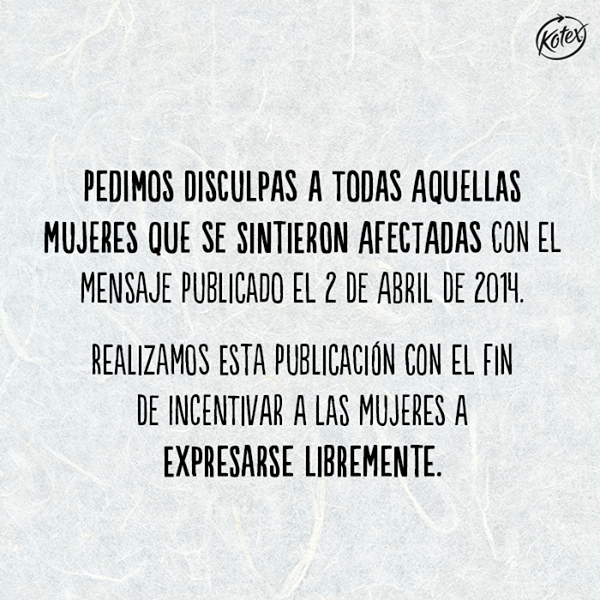
There was certainly an online backlash to this ad – on Kotex Perú’s facebook page, on Twitter, and on the page of the organization I mentioned above. The company, evidently fearing the bad publicity this might cause, published the following photo.

Apology Translation:

“We ask the forgiveness of all the women who felt affected by the message posted on April 2, 2014. We posted it with the goal of incentivizing women to express themselves freely.”

There are a few reasons why I think this apology isn’t satisfactory. First of all, the company didn’t even remove the original post. Second, they didn’t even acknowledge the fact that catcalls aren’t a compliment, they’re street harrassment.

But then they went a step further. I’m sorry, implying that street harrassment is a compliment, and that it should brighten my day, and that I should blow my harrasser a kiss is supposed to make me feel more able to express myself freely? I don’t think so.

You know what might make Limeña women feel more able to express themselves freely? Equal use of public spaces without fear of harrassment.

Let Kotex Perú know how you feel about their normalization and glorification of street harassment:

Facebook: www.facebook.com/KotexPeru

Twitter: @KotexPeru

Want to receive updates on Paremos el Acoso Callejero’s efforts to fight street harassment in Lima?

Facebook: https://www.facebook.com/paremoselacosocallejero

Twitter: @noacosocalles

Website: http://paremoselacosocallejero.wordpress.com

Lauren Schechter is a junior studying Economics at the University of Oklahoma. She is currently studying abroad in Lima, Peru. In her free time she likes to travel, make music, and volunteer with the OU Women’s Outreach Center.

_______________ en Español ___________________

Kotex No Sabe la Diferencia

Cuando llegué a Lima-Perú como estudiante de intercambio hace dos meses, creí que sabía mucho sobre el acoso callejero. Había leído mucho, había recibido algunos piropos hasta alguna vez alguien me tiró un huevo desde un carro. Pero jamás iba tan constante como lo que las mujeres en Lima tienen que soportar todos los días. Durante mi primer de muchos caminos a la universidad, que duran solo diez minutos, experimenté piropos sin límite – bocadizos, silbidos, y por supuesto los infames sonidos de besos – que las mujeres limeñas tienen que soportar cada vez que pasan solas (o no siempre solas) por la calle.

Parece que Kotex Perú no sabe la diferencia entre un elogio lindo y el acoso callejero. A través de la página Facebook de “Paremos el Acoso Callejero” una organización limeña que lucha contra este tipo de comportamiento, encontré el siguiente mensaje de Kotex Perú con el subtítulo “¡Los piropos me alegran todo el día/tarde/noche!”

Sin duda, el sentimiento de este mensaje es que piropos son elogios, algo de que las mujeres deben apreciar. Pero los piropos no son un a manera de coquetear. Son acoso callejero.

Un hombre no me manda un piropeo porque piensa que soy bonita. No intenta alegrarme. No intenta darme un elogio. Porque las risas y sonrisas afectadas muchas veces, acompañan los piropos, es obvio que tengan la intención de poner incómodas las mujeres, por nada más que el entretenimiento del piropeador.

Había una reacción fuerte de este mensaje en la página Facebook de Kotex Peru, en Twitter y en lá pagina de la organización que mencioné antes. Las limeñas no estaban entretenidas por este mensaje. La compañía, obviamente con miedo de la publicidad negativa, publicó la foto siguiente:


Hay varias razones por lo que pienso que la disculpa no es suficiente. La compañía dejó en su página el mensaje original y, además, no reconoció que piropos no son elogios, y que son acoso callejero.  Pero hubo algo más. Lo siento, pero al decir que el acoso callejero es un eligió, que debe alegrarme hasta mandar un beso a mi piropeador ¿me hace sentir más libre de expresarme? ¿En serio?

Kotex, ¿saben qué haría que las mujeres limeñas se sientan más libres de expresarse? El uso igualitario de espacios públicos, sin el acoso callejero.

¿Quieres avisar a Kotex Perú cómo te sientes sobre su normalización y glorificación del acoso callejero?

Facebook: www.facebook.com/KotexPeru

Twitter: @KotexPeru

¿Quieres recibir noticias sobre los esfuerzos de Paremos el Acoso Callejero contra el acoso callejero en Lima?

Facebook: https://www.facebook.com/paremoselacosocallejero

Twitter: @noacosocalles

Website: http://paremoselacosocallejero.wordpress.com


Share

Filed Under: offensive ads, street harassment

“I felt so uncomfortable”

April 27, 2014 By Contributor

I remember one day I was walking up the streets in the town of Rincon, Puerto Rico. There was a surfing contest going on and everybody had bathing suits as attire. I remember some cars stopped by to make inappropriate comments… I felt so uncomfortable. C’mon guys haven’t you seen a girl in a bathing suit?… I know I just kept walking and looked down the road…

– Anonymous

Location: Puerto Rico

Share your street harassment story for the blog.
Check out the new book 50 Stories about Stopping Street Harassers!
Share

Filed Under: Stories, street harassment

« Previous Page
Next Page »

Share Your Story

Share your street harassment story for the blog. Donate Now

From the Blog

  • #MeToo 2024 Study Released Today
  • Join International Anti-Street Harassment Week 2022
  • Giving Tuesday – Fund the Hotline
  • Thank You – International Anti-Street Harassment Week 2021
  • Share Your Story – Safecity and Catcalls Collaboration

Buy the Book

Search

Archives

  • September 2024
  • March 2022
  • November 2021
  • April 2021
  • March 2021
  • January 2021
  • April 2020
  • March 2020
  • February 2020
  • December 2019
  • November 2019
  • September 2019
  • August 2019
  • July 2019
  • June 2019
  • May 2019
  • April 2019
  • March 2019
  • February 2019
  • January 2019
  • December 2018
  • November 2018
  • October 2018
  • September 2018
  • August 2018
  • July 2018
  • June 2018
  • May 2018
  • April 2018
  • March 2018
  • February 2018
  • January 2018
  • December 2017
  • November 2017
  • October 2017
  • September 2017
  • August 2017
  • July 2017
  • June 2017
  • May 2017
  • April 2017
  • March 2017
  • February 2017
  • January 2017
  • December 2016
  • November 2016
  • October 2016
  • September 2016
  • August 2016
  • July 2016
  • June 2016
  • May 2016
  • April 2016
  • March 2016
  • February 2016
  • January 2016
  • December 2015
  • November 2015
  • October 2015
  • September 2015
  • August 2015
  • July 2015
  • June 2015
  • May 2015
  • April 2015
  • March 2015
  • February 2015
  • January 2015
  • December 2014
  • November 2014
  • October 2014
  • September 2014
  • August 2014
  • July 2014
  • June 2014
  • May 2014
  • April 2014
  • March 2014
  • February 2014
  • January 2014
  • December 2013
  • November 2013
  • October 2013
  • September 2013
  • August 2013
  • July 2013
  • June 2013
  • May 2013
  • April 2013
  • March 2013
  • February 2013
  • January 2013
  • December 2012
  • November 2012
  • October 2012
  • September 2012
  • August 2012
  • July 2012
  • June 2012
  • May 2012
  • April 2012
  • March 2012
  • February 2012
  • January 2012
  • December 2011
  • November 2011
  • October 2011
  • September 2011
  • August 2011
  • July 2011
  • June 2011
  • May 2011
  • April 2011
  • March 2011
  • February 2011
  • January 2011
  • December 2010
  • November 2010
  • October 2010
  • September 2010
  • August 2010
  • July 2010
  • June 2010
  • May 2010
  • April 2010
  • March 2010
  • February 2010
  • January 2010
  • December 2009
  • November 2009
  • October 2009
  • September 2009
  • August 2009
  • July 2009
  • June 2009
  • May 2009
  • April 2009
  • March 2009
  • February 2009
  • January 2009
  • December 2008
  • November 2008
  • October 2008
  • September 2008
  • August 2008
  • July 2008
  • June 2008
  • May 2008

Comment Policy

SSH will not publish any comment that is offensive or hateful and does not add to a thoughtful discussion of street harassment. Racism, homophobia, transphobia, disabalism, classism, and sexism will not be tolerated. Disclaimer: SSH may use any stories submitted to the blog in future scholarly publications on street harassment.
  • Contact
  • Events
  • Join Us
  • Donate
  • Facebook
  • Instagram
  • Pinterest
  • Tumblr
  • Twitter
  • YouTube

Copyright © 2026 Stop Street Harassment · Website Design by Sarah Marie Lacy