• About Us
    • What Is Street Harassment?
    • Why Stopping Street Harassment Matters
    • Meet the Team
      • Board of Directors
      • Past Board Members
    • In The Media
  • Our Work
    • National Street Harassment Hotline
    • International Anti-Street Harassment Week
    • Blog Correspondents
      • Past SSH Correspondents
    • Safe Public Spaces Mentoring Program
    • Publications
    • National Studies
    • Campaigns against Companies
    • Washington, D.C. Activism
  • Our Books
  • Donate
  • Store

Stop Street Harassment

Making Public Spaces Safe and Welcoming

  • Facebook
  • Instagram
  • Pinterest
  • Tumblr
  • Twitter
  • YouTube
  • Home
  • Blog
    • Harassment Stories
    • Blog Correspondents
    • Street Respect Stories
  • Help & Advice
    • National Street Harassment Hotline
    • Dealing With Harassers
      • Assertive Responses
      • Reporting Harassers
      • Bystander Responses
      • Creative Responses
    • What to Do Before or After Harassment
    • Street Harassment and the Law
  • Resources
    • Definitions
    • Statistics
    • Articles & Books
    • Anti-Harassment Groups & Campaigns
    • Male Allies
      • Educating Boys & Men
      • How to Talk to Women
      • Bystander Tips
    • Video Clips
    • Images & Flyers
  • Take Community Action
  • Contact

Queer in Public: Focusing on the Good

April 2, 2014 By Contributor

Guest Post by Court Baxter for International Anti-Street Harassment Week
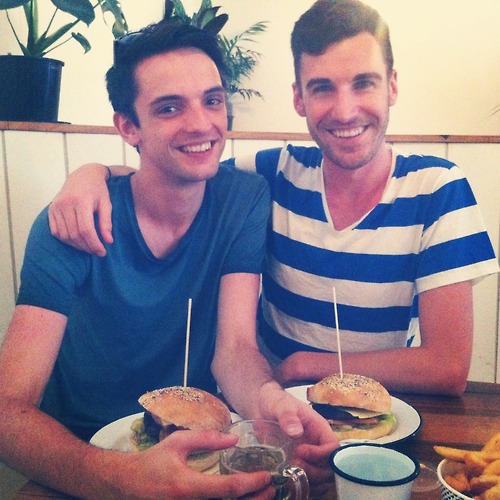
Photo by Eliza Buckley

“I bet you love to go down on each other. Do you eat her out?”

This was my welcome to New York.  Walking down the street in Union Square holding hands with my girlfriend, two hours after I had landed in New York City to visit her, a stranger whispered this close behind us as we crossed E. 17th street before swiftly disappearing.  The next night, another belligerent man yelled at us from across the square.  A month later, a man asking for money stood closely behind us as I refilled my metro card and whispered homophobic expletives.

That was my proverbial straw.  Now, I’ve never been much of a wallflower, but we — women, the queer community, minority groups–  are often taught that responding to the slew and sewage of street harassment isn’t always worth our time.  It is not always safe.  So despite my activist impulses, my inner rage, and the weight of deep sadness in which I felt I could do nothing to protect this person who I loved so wholeheartedly from that harassment (let alone protect myself), I stayed quiet.  I always stayed quiet.  I would cry later, after these incidents, and try to direct my anger in a way that felt healthy and cathartic.  It was a survival mechanism – figurative and literal – because as we know, responding in the moment isn’t always an option and in this day and age (despite swift cultural change)  fear of attack or death is alarmingly real.  So we learn to deal.  We internalize.  We do what we have to do.
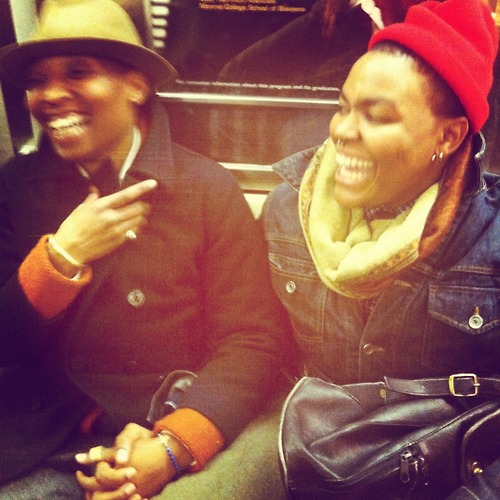
Photo by Court Baxter

It was soon after the man in the subway station when I decided that I couldn’t accept that reality.   Those moments with Phoebe replayed in my head every time I went to hold her hand in public. They resurfaced almost every time I saw a happy straight couple show affection in public.  I was angry.  The fact that these men and their vitriolic threats had tarnished what I saw as my very “normal” inclination to hold hands with the person I loved.  But I didn’t want to harbor this frustration every time I saw happy couples.  And I didn’t want to always feel like it was my responsibility to confront any other person who harassed us.  Besides, there were already organizations working so diligently to address this issue from that angle.  I decided I wanted to focus on the good.  I wanted to find couples, who despite daily fear of very real harassment, make the decision to love their partners anyway.  To kiss them goodbye on the corner of 86th and Lex anyway.  To hold their hands in Flatbush anyway.

Queer in Public, or QUIP, is a a crowd-sourced street photography initiative in which we take photographs of queer couples who show affection in public.  It’s an effort to familiarize and normalize queer affection, and archive the reality that people all over the world are standing up to harassment — simply by their refusal to be conditioned to stay invisible. We are a movement to transform “queer love” into plain old: “love”.  Or, as I like to sometimes describe it, a way of saying “fuck you” to the haters, “you can’t stop us.”
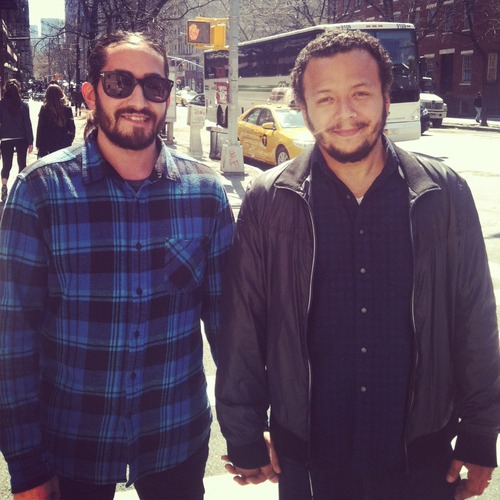
Photo by Court Baxter

For some, the threat of violence is too real, and the simple act of holding hands or kissing on a street corner would be unwise and unsafe. But for the rest of us, we have the capability to shift the tides by making ourselves visible.  I’m part of this movement because despite what can feel like a never-ending, dismal tunnel- I see that light.  I see couples day after day, in cities and towns all over the world, show love for the ones they love.  There is incredible work to be done, and QUIP is part of that work, but we are absolutely chipping away and for those of us who feel safe enough to do so, being queer in public gives us power by making us real.

Courtney Baxter is a professional rabble rouser. She is Chief of Staff at The OpEd Project, runs community initiatives at Feminsting, and is the Founder of Queer in Public. To be a part of the movement, join us here.

Share

Filed Under: LGBTQ, Stories, street harassment

“They Have Been Loved and Now They Are Missing”

April 2, 2014 By Contributor

By Britnae Purdy, First Peoples Worldwide, Cross-Posted with Permission

vamps by Teresa Burrows, artists from Thompson, Manitoba

In the past 20 years in Canada, over 600 mothers, daughters, sisters, grandmothers, cousins, aunts, and best friends have gone missing. That’s six hundred lives that have suddenly, mysteriously ended – no note, no motive, sometimes hardly even a clue, leaving behind questions, uncelebrated birthdays, motherless children, heartbroken partners, and emptiness. 600 Indigenous women have gone missing or been murdered, and often it seems as though nobody even cares.

Worse still? Though the publicly accepted number is 600, new data estimates that number to be closer to 900 women. And with the complications of underreporting, police mishandling of investigations, and other factors, it is likely the true number is much higher.

“There has been an awful silence around this,” says Otipemiswak/Michif Nation artist Christi Belcourt, of Espanola, Ontario. “There has been a silence by the government, by police and by dominant society; it’s as though Indigenous women’s lives aren’t considered important.”

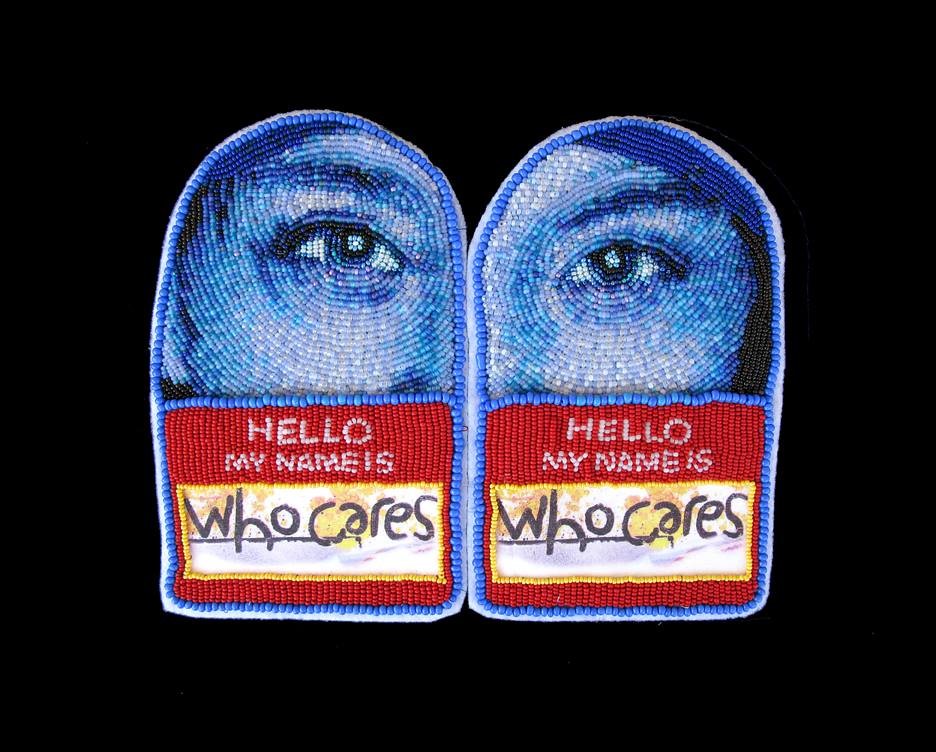
Belcourt’s newest art exhibit, “Walking With Our Sisters,” is hoping to visually demonstrate and bring attention to the hundreds of unsolved disappearances and murders of Indigenous women and girls across the United States and Canada. Belcourt’s idea is stunning and powerful – the exhibit features six hundred vamps, the top part of a moccasin, which is often the most decorated part of the shoe. Each vamp has been hand-beaded by a volunteer. Originally, Belcourt planned to create them all herself, but was daunted by the numbers. Within days of sending out a simple Facebook message, she had gotten commitments from over 200 people promising to help. The project’s Facebook page has grown to nearly 8,000 members, and the page is full of volunteers proudly showing off their exquisite beadwork. Some are veteran or professional beaders or members of beading groups; others are doing this for the very first time. But nearly all of them are dedicating their vamps to women that they have personally known that have gone missing, making this exhibit both a celebration of life and a collective outlet for mourning and remembrance. As Belcourt says, “each pair of vamps represents the unfinished life of one woman.”

To date, Belcourt has received 1725 hand-made vamps created by 1,372 volunteers. This exhibit is extremely interactive – the vamps are laid out on a 300 foot grey stretch of fabric, and visitors remove their shoes and walk alongside the vamps on red fabric. Tobacco will be available if guests wish to use it for prayer.

“The installation becomes a place for prayer,” Belcourt explains. “There is also sensory memory that people will take with them after leaving the exhibit. It’s not like walking into a space and just seeing work – you have to experience this.”

Indigenous women are 5-7 times more likely to die from violence than women of any other race, and experience 3.5 times higher rates of domestic violence and sexual abuse. Amnesty International, Canada, explains that the problem is multilayered and admittedly difficult to address, as “the scale and severity of the human rights violations faced by Indigenous women require a coordinated and comprehensive national response that addresses the social and economic factors that place Indigenous women at heightened risk of violence. Such a response needs to address the police response to violence against Indigenous women; the dramatic gap in standard of living and quality of life which increase the risks to Indigenous women; the continued disruption of Indigenous societies by the higher proportion of children put into state care; and the disproportionate rate of imprisonment of Indigenous women.”

Amnesty International recognize that the following systemic patterns contribute to the problem:

1. Racist and sexist stereotypes deny the dignity and worth of Indigenous women, and encourages some men to feel they can get away with violent acts of hatred against them
2. Decades of government policy have impoverished and broken apart Indigenous families and communities, leaving many Indigenous women and girls extremely vulnerable to exploitation and attack
3. Many police forces have failed to institute necessary measures – such as training, appropriate investigative protocols and accountability mechanisms – to eliminate bias in how they respond to the needs of Indigenous women and their families

The government has been largely unresponsive to the epidemic, and has only lately begun to show an interest in stopping in the rape and murder of Indigenous women. Grassroots organizations like Operation Thunderbird, frustrated with the lack of response from officials, have created crowd-source maps that allow people to compile information about missing loved ones.

“Women – who have been the future of the world in the form of its children – are being killed and tortured for rising up against those who oppress them, their children, and the earth we all share,” says the group. “Women that know about nurture and protection are being marginalized – told to sit down and shut up. Aboriginal women, who carry the wisdom, stories, and ancient teachings from long before the world became the civilized cesspool it is today, have little voice in their own governance. As people who care about others, we could only sit by and watch the horrors scroll in front of our eyes for so long before needing to take action. Operation Thunderbird is our contribution to the action of brave women all over the world who are Rising Up and demanding change.”

“Walking With Our Sisters” opened on August 23, 2013 at the Haida Gwaii Museum in British Columbia. The exhibit has thus far booked 28 exhibits across the United States and Canada, and plans to conclude in March of 2019 with a traditional ceremony in Kenora, Ontario.

“This project is about these women,” Belcourt concludes, “paying respect to their lives and existence on this earth. They are sisters, mothers, daughters, cousins, and grandmothers. They have been cared for, they have been loved, and now they are missing.”

Britnae is currently acting as the communications manager at First Peoples Worldwide, a nonprofit dedicated to supporting Indigenous communities, culture, and rights around the world. Britnae received her BA in International Affairs and Women’s and Gender Studies from the University of Mary Washington in 2013, and is now working on an MA in Global Affairs, with a specialization in Global Health, at George Mason University.

Share

Filed Under: anti-street harassment week, street harassment

“This incident brought on a panic attack”

April 2, 2014 By Contributor

As a woman I’ve grown up used to men shouting out of their cars, builders whistling and the like. Up until this week it has all been verbal. Recently, I was on a bus coming home from Uni with my boyfriend. The journey was fine until it was time to get off and a female passenger shouted ‘you have great tits’ and grabbed hold of them. She had a really strong grip on them until my boyfriend smacked her hands and escorted me off the bus.

It’s so silly but it felt like such a violation. I have social anxiety and this incident brought on a panic attack which was not pleasant on our 2 year anniversary.

The bus was packed and not a single person did or said anything aside from my disgusted boyfriend! I’m disappointed in myself that I did absolutely nothing to this woman. I was so shocked and only really processed what had happened once the bus had driven off. I thought beforehand that I was strong and could handle myself but the fear just being touched inappropriately brought me has made me worry for the future. I don’t want to live in a world where this could happen again.

– JW

Location: Lancaster, UK

Share your street harassment story for the blog.
Check out the new book 50 Stories about Stopping Street Harassers!
Share

Filed Under: Stories, street harassment

Day 3: #EndSHWeek 2014

April 1, 2014 By HKearl

Today was the third day of International Anti-Street Harassment Week!

Here are a few highlights:

The week got coverage in major media outlets like the New York Times | BuzzFeed | Ms. Magazine | Chicago Public Media

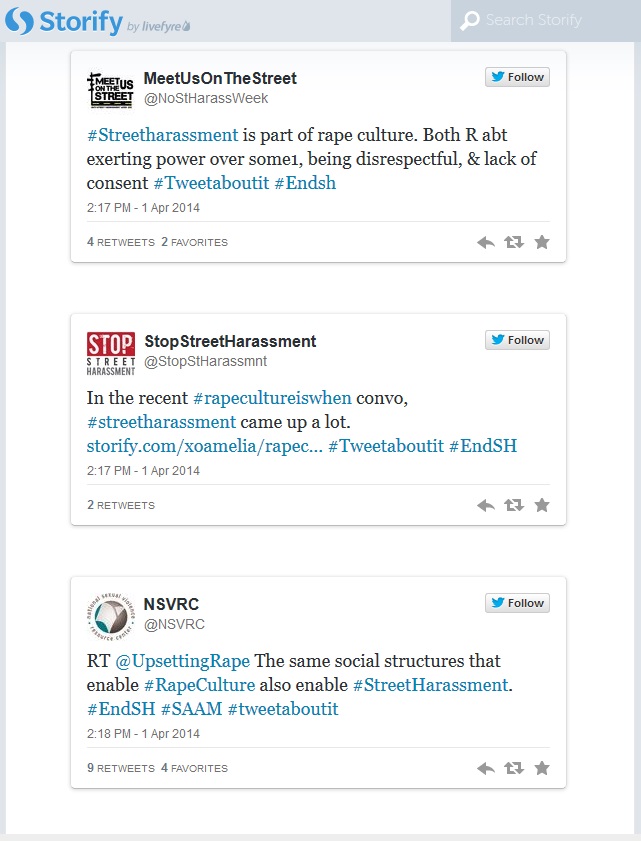
We held our second tweet chat with the National Sexual Violence Resource Center on the first day of Sexual Assault Awareness Month.

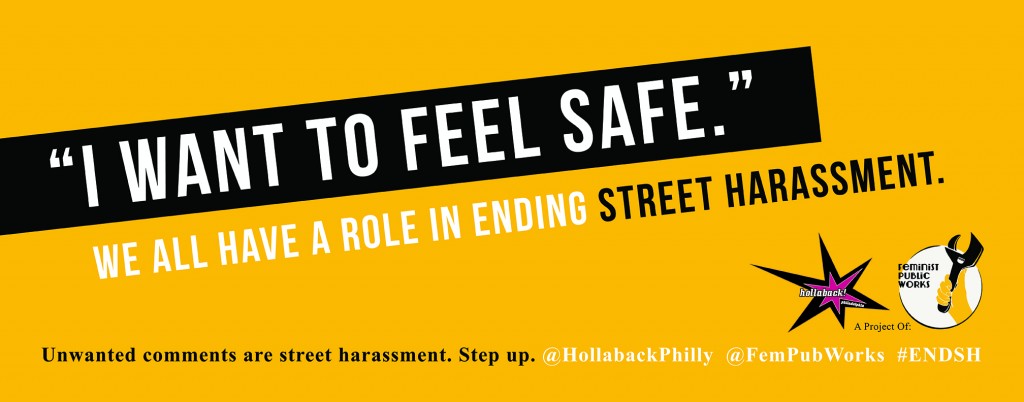
HollabackPHILLY, a project of Feminist Public Works, launched amazing new anti-harassment ads for the Philadelphia transit system in Pennsylvania.

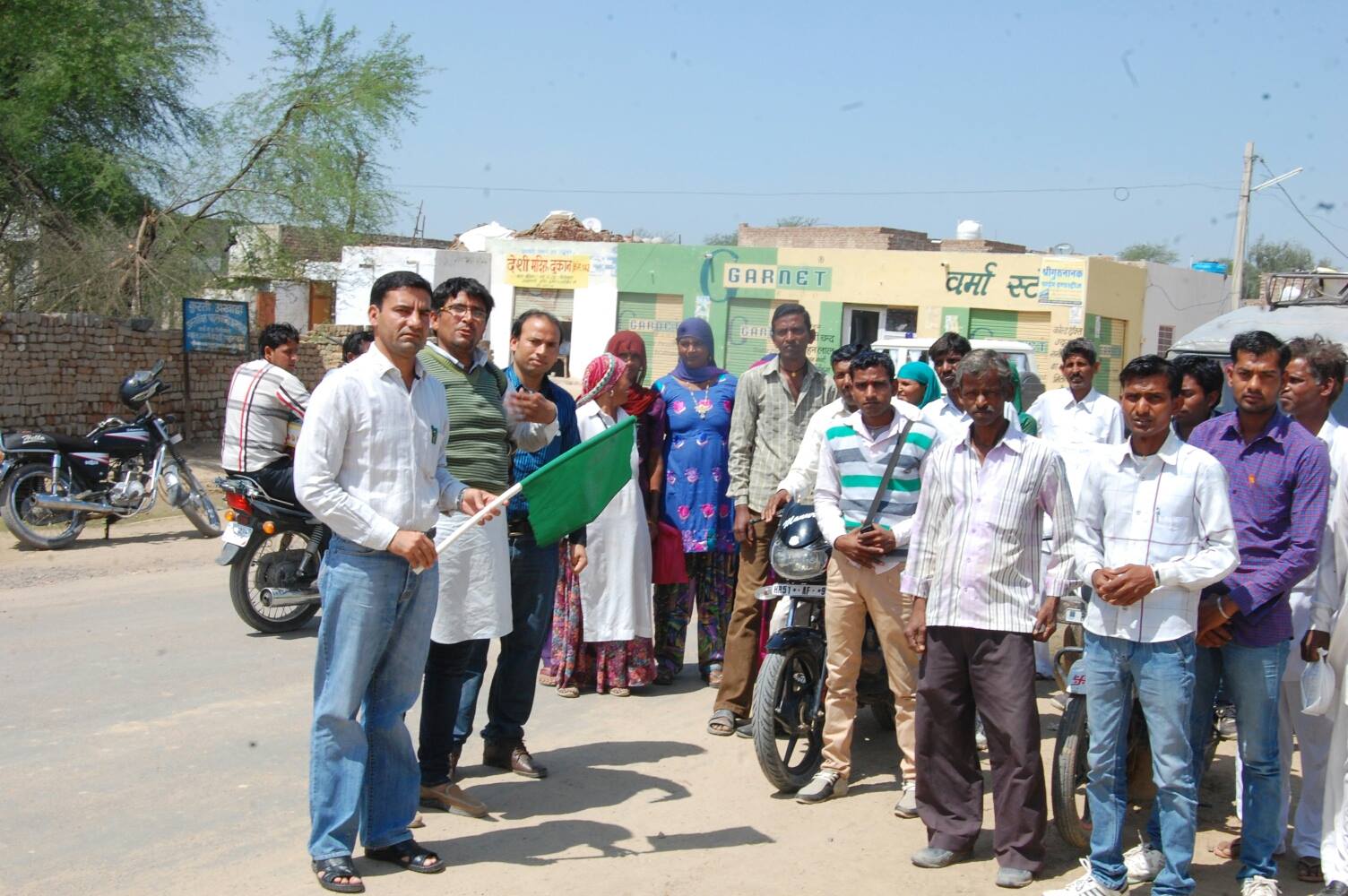
Safe Delhi/Jagori hosted a Street Cafe in Delhi, India.

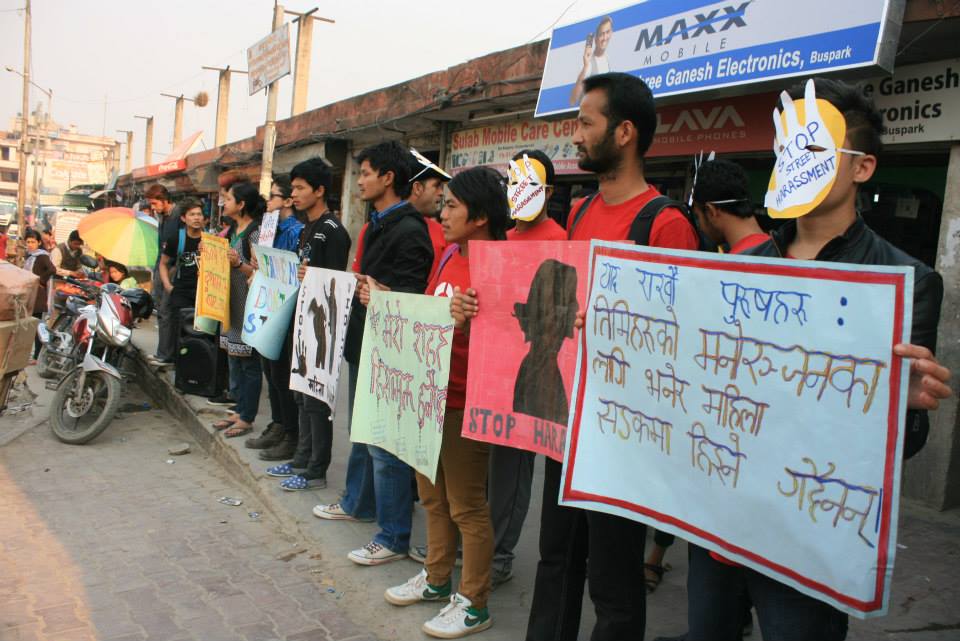
Safe City Nepal held a dance performance and handed out flyers at various locations in Kathmandu.

Bristol University Feminist Society organized a discussion about street harassment in Bristol, UK.

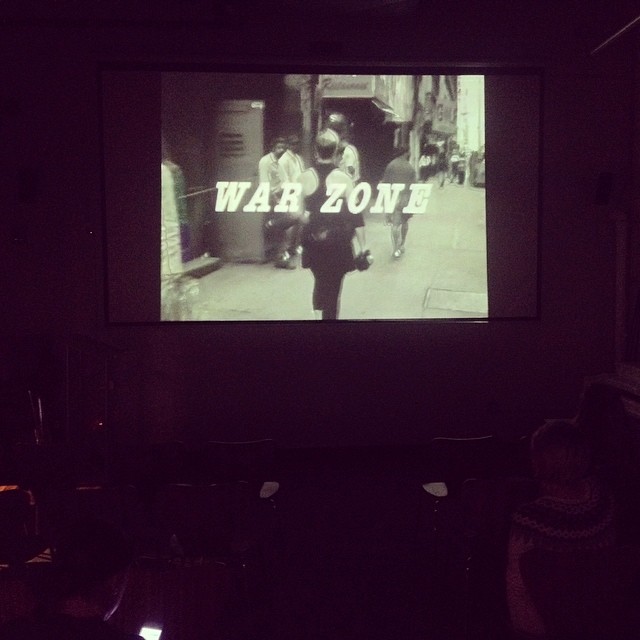
Observatorio Paremos el Acoso Sexual Callejero held a screening of War Zone with a discussion led by Humanities professor Victoria Guerrero at Pontificia Universidad Católica del Perú, in Lima, Peru.

In Massachusetts, Hollaback! Boston held a film screening of the documentary War Zone

Zerlina Mazwell gave a campus talk at the University of Illinois about rape culture, sexism and racism, and street harassment.

Brooklyn Technical High School held a talk on street harassment in New York.

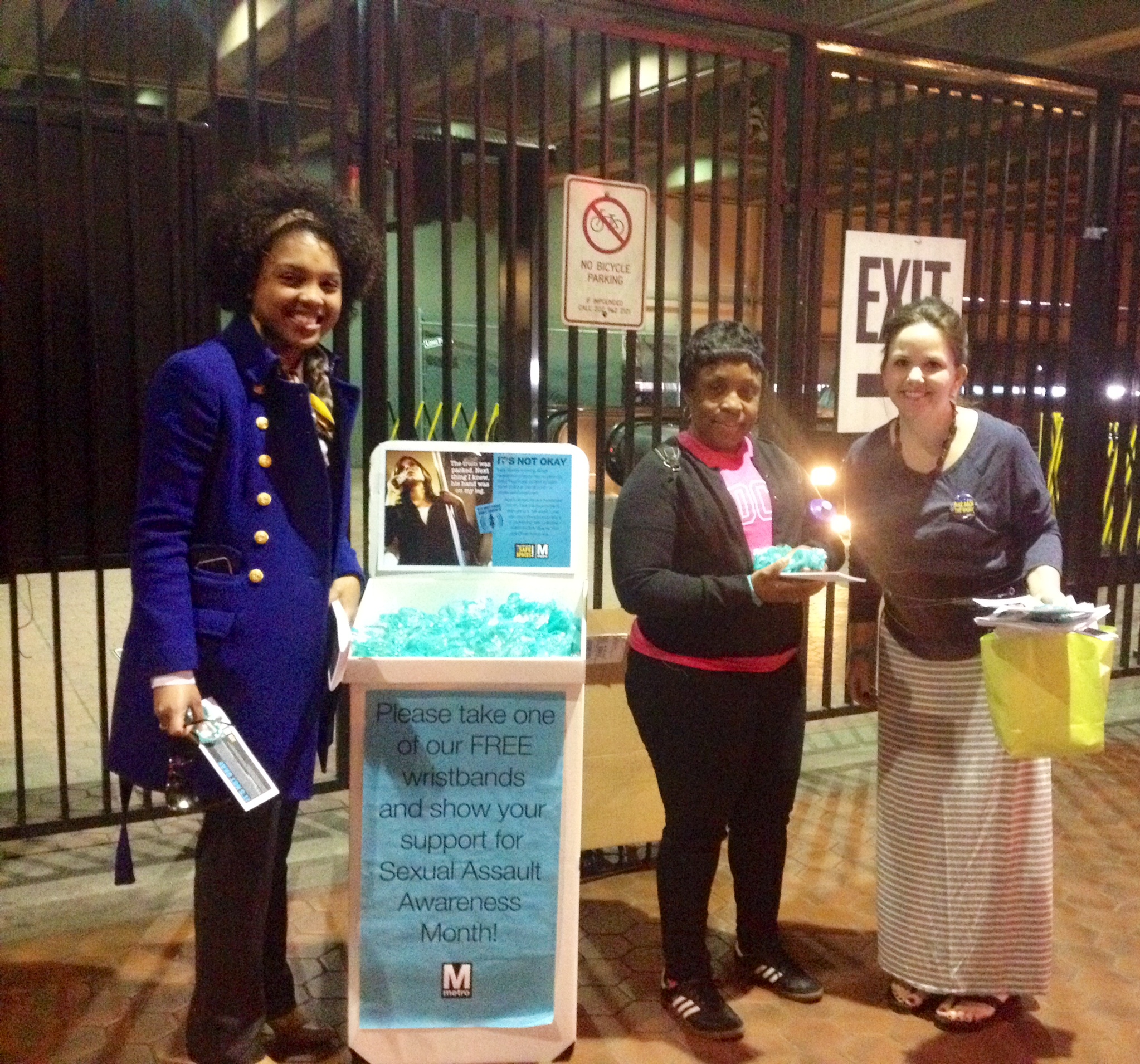
Several of our volunteers, the organizers of the Rally Against Rape and the Washington Metropolitan Area Transit Authority handed out anti-harassment flyers at the Rosslyn Metro station in Arlington in Virginia.

The University of Scranton in Pennsylvania held a “Violence Free Zone” workshop focused on forms of gender violence, how to intervene, and resources.

****************************

See the photo album of events.

Our next Tweet Chat is tomorrow at 12 p.m. ET with Everyday Feminism and Fem2Pt0 who will talk about the connections between street harassment and sexism, homophobia and transphobia.

We have a new Tweet Chat scheduled for 3 p.m. ET tomorrow with Every Day Health and Hollaback!

And at 8 p.m. ET there will be a chat by Secular Woman about harassment at conferences. Woo!

#EndSH

Share

Filed Under: anti-street harassment week, street harassment

“Hey turn around come back over here.”

April 1, 2014 By Contributor

I live across the street from a park and take my dog on regular walks around it. A lot of the time I feel pretty safe when I have my dog with me, he’s a rottweiler and very protective of me.

One day I decided that we would go on a walk around the entire park which means walking down to the end of my street to the closest main road and continuing on the main road until the other side of the park. It was summer and very hot so I decided to wear shorts. When we turned onto the main road a car drove passed but very slow. I didn’t pay much attention until I saw them stop and turn around and drive passed me again very slowly.

I was pretty freaked out and started walking faster. They did this yet again but this time drove in the bike lane right next to the sidewalk, they rolled down their windows and three guys all stuck their heads out and stared at me, whistled, starting calling for me saying, “Hey turn around come back over here.”

I was scared. I started running, this had never happened on a walk with my dog before. I didn’t even bring my phone with me that day so I had no one to call, no one else was around. I was worried they would follow me back to my house. Luckily we ran fast and got home as quickly as we could.

– Taylor M.

Location: Greenbriar Park, Fort Collins, CO 80524

Share your street harassment story for the blog.
Check out the new book 50 Stories about Stopping Street Harassers!


Share

Filed Under: Stories, street harassment

« Previous Page
Next Page »

Share Your Story

Share your street harassment story for the blog. Donate Now

From the Blog

  • #MeToo 2024 Study Released Today
  • Join International Anti-Street Harassment Week 2022
  • Giving Tuesday – Fund the Hotline
  • Thank You – International Anti-Street Harassment Week 2021
  • Share Your Story – Safecity and Catcalls Collaboration

Buy the Book

Search

Archives

  • September 2024
  • March 2022
  • November 2021
  • April 2021
  • March 2021
  • January 2021
  • April 2020
  • March 2020
  • February 2020
  • December 2019
  • November 2019
  • September 2019
  • August 2019
  • July 2019
  • June 2019
  • May 2019
  • April 2019
  • March 2019
  • February 2019
  • January 2019
  • December 2018
  • November 2018
  • October 2018
  • September 2018
  • August 2018
  • July 2018
  • June 2018
  • May 2018
  • April 2018
  • March 2018
  • February 2018
  • January 2018
  • December 2017
  • November 2017
  • October 2017
  • September 2017
  • August 2017
  • July 2017
  • June 2017
  • May 2017
  • April 2017
  • March 2017
  • February 2017
  • January 2017
  • December 2016
  • November 2016
  • October 2016
  • September 2016
  • August 2016
  • July 2016
  • June 2016
  • May 2016
  • April 2016
  • March 2016
  • February 2016
  • January 2016
  • December 2015
  • November 2015
  • October 2015
  • September 2015
  • August 2015
  • July 2015
  • June 2015
  • May 2015
  • April 2015
  • March 2015
  • February 2015
  • January 2015
  • December 2014
  • November 2014
  • October 2014
  • September 2014
  • August 2014
  • July 2014
  • June 2014
  • May 2014
  • April 2014
  • March 2014
  • February 2014
  • January 2014
  • December 2013
  • November 2013
  • October 2013
  • September 2013
  • August 2013
  • July 2013
  • June 2013
  • May 2013
  • April 2013
  • March 2013
  • February 2013
  • January 2013
  • December 2012
  • November 2012
  • October 2012
  • September 2012
  • August 2012
  • July 2012
  • June 2012
  • May 2012
  • April 2012
  • March 2012
  • February 2012
  • January 2012
  • December 2011
  • November 2011
  • October 2011
  • September 2011
  • August 2011
  • July 2011
  • June 2011
  • May 2011
  • April 2011
  • March 2011
  • February 2011
  • January 2011
  • December 2010
  • November 2010
  • October 2010
  • September 2010
  • August 2010
  • July 2010
  • June 2010
  • May 2010
  • April 2010
  • March 2010
  • February 2010
  • January 2010
  • December 2009
  • November 2009
  • October 2009
  • September 2009
  • August 2009
  • July 2009
  • June 2009
  • May 2009
  • April 2009
  • March 2009
  • February 2009
  • January 2009
  • December 2008
  • November 2008
  • October 2008
  • September 2008
  • August 2008
  • July 2008
  • June 2008
  • May 2008

Comment Policy

SSH will not publish any comment that is offensive or hateful and does not add to a thoughtful discussion of street harassment. Racism, homophobia, transphobia, disabalism, classism, and sexism will not be tolerated. Disclaimer: SSH may use any stories submitted to the blog in future scholarly publications on street harassment.
  • Contact
  • Events
  • Join Us
  • Donate
  • Facebook
  • Instagram
  • Pinterest
  • Tumblr
  • Twitter
  • YouTube

Copyright © 2026 Stop Street Harassment · Website Design by Sarah Marie Lacy