• About Us
    • What Is Street Harassment?
    • Why Stopping Street Harassment Matters
    • Meet the Team
      • Board of Directors
      • Past Board Members
    • In The Media
  • Our Work
    • National Street Harassment Hotline
    • International Anti-Street Harassment Week
    • Blog Correspondents
      • Past SSH Correspondents
    • Safe Public Spaces Mentoring Program
    • Publications
    • National Studies
    • Campaigns against Companies
    • Washington, D.C. Activism
  • Our Books
  • Donate
  • Store

Stop Street Harassment

Making Public Spaces Safe and Welcoming

  • Facebook
  • Instagram
  • Pinterest
  • Tumblr
  • Twitter
  • YouTube
  • Home
  • Blog
    • Harassment Stories
    • Blog Correspondents
    • Street Respect Stories
  • Help & Advice
    • National Street Harassment Hotline
    • Dealing With Harassers
      • Assertive Responses
      • Reporting Harassers
      • Bystander Responses
      • Creative Responses
    • What to Do Before or After Harassment
    • Street Harassment and the Law
  • Resources
    • Definitions
    • Statistics
    • Articles & Books
    • Anti-Harassment Groups & Campaigns
    • Male Allies
      • Educating Boys & Men
      • How to Talk to Women
      • Bystander Tips
    • Video Clips
    • Images & Flyers
  • Take Community Action
  • Contact

USA: Halloween costumes can be clever, not just “sexy”

October 25, 2013 By Correspondent

By: Taylor Kuether, Minnesota, USA, SSH Blog Correspondent

“Sexy” Hamburger, Image via Yandy.com

While it is one of my favorite holidays, Halloween is also hard. As a feminist against street harassment, I think women should be able to wear whatever they want and not be harassed for it, but as a feminist against cultural appropriation and heteronormativity, I think there are some costumes that are hurtful, degrading, and demeaning.

Consider the popular skeleton costume with a tape measure around the waist, “playfully” called “Anna Rexia.” Such a costume trivializes a real disease that hurts thousands of people. Or what about dressing up as sexualized Disney princesses, which both infantilizes women by dressing them up in costumes traditionally reserved for very young girls and hurts said young girls by showing them highly sexualized versions of otherwise innocent children’s characters. And how many countless costumes are there that – literally – objectify women by turning them into objects? Sexy USB Port (with matching USB Stick for your boyfriend…)? Sexy Brick House (and, of course, Brick Layer for the guy…how clever…)? And of course, Sexy Hamburger, which literally turns a woman into a piece of meat.

Yes, these costumes are harmful, reducing women to sexualized objects. Even worse, though, are costumes that make fun of other cultures. Halloween is a time to dress up and pretend to be someone you’re not – but why do we need to try on other races and nationalities for size? Some examples include Native American, Mexican, and Asian “costumes,” all shown here. Commodifying an entire culture to dress up in it for Halloween devalues the richness and history of that culture.

So just don’t do it. Pick something else, please.

I value creative, clever, or funny Halloween costumes. I value Halloween costumes that allow you to dress up as someone you admire (Audrey Hepburn in Breakfast at Tiffany’s, anyone?). And I especially appreciate costumes that bend gender binaries – rather than the predictable presentation of Paul Bunyan and Babe the Blue Ox, characters from one of my favorite American folk tales, last year it was I who dressed as Paul Bunyan (faux-beard and all!) and my then-boyfriend went as Babe. This year, I’m excited to dress up as Tobias Funke from the popular TV series “Arrested Development,” and one of my gal pals is going as his wife Lindsey. It’ll be fun and funny, and I know we’ll have a great time and make some people laugh.

That’s what Halloween should be about. It’s a holiday that’s meant to be fun – for children, that means trick-or-treating, for adults, that means dressing up and handing out candy or attending a Halloween party. It’s not meant to be serious or stuffy, but that doesn’t mean we shouldn’t carefully consider our costume choices.

This Halloween, I implore you to pick the funny, clever costume over the “sexy” one. Try it; you’ll probably end up having a blast.

Taylor Kuether is a senior journalism student at University of Wisconsin-Eau Claire in northwestern Wisconsin. She has previously written for The Washington Post and Minneapolis’ Star Tribune, worked as a reporter at her city’s daily newspaper, The Leader-Telegram, and its arts and culture publication, VolumeOne, hosted a local-music centered radio show on Wisconsin Public Radio, and worked as Editor-in-Chief at her student newspaper, where she enjoyed writing biting, slightly rant-y columns about feminist issues.

Share

Filed Under: correspondents, street harassment Tagged With: Costumes, halloween

UNiTE to Make Public Places Safer!

October 25, 2013 By HKearl

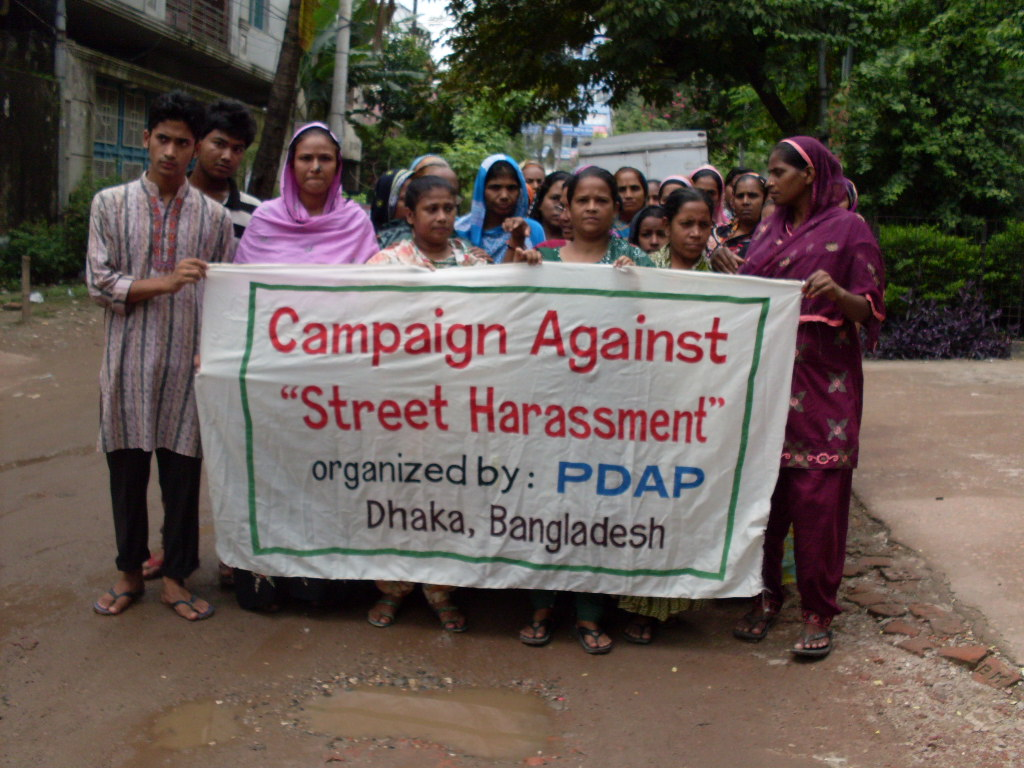
Community Members in Bangladesh recently met to discuss how to make their public places safer for girls & women.

On the 25th of every month, the UNiTE to End Violence against Women campaign focuses on different types of violence against women and girls. Today they are focusing on harassment and violence in public places and how we can make those spaces safer for women and girls. This is something we at Stop Street Harassment strive to do every day and we are happy to support the campaign!

From the UNiTE’s website:

“Violence and the fear of violence reduces women’s freedom of movement and rights to access education, work, recreation, and essential services, and can restrict their participation in political life. It also negatively affects their health and well-being. Despite these wide-ranging consequences, violence against women and girls in public spaces remains a neglected area, with few laws or policies in place to prevent and address it.

At the 57th Session on the Commission of the Status of Women, governments made specific commitments directed towards making public spaces safer for women and girls.

For the first time the Commission on the Status of Women, the highest global normative body on women’s rights, during its 57th Session specifically included several clauses in its Agreed Conclusions document devoted to safety of women and girls in public spaces, and particularly, in the cities.  It expressed “deep concern about violence against women and girls in public spaces, including sexual harassment, especially when it is being used to intimidate women and girls who are exercising any of their human rights and fundamental freedoms.”  (23, p4)

It called on the States “to increase measures to protect women and girls from violence and harassment, including sexual harassment and bullying, in both public and private spaces, to address security and safety, through awareness-raising, involvement of local communities, crime prevention laws, policies, programmes such as the Safe Cities Initiative of the United Nations. (ZZ, p13)“

What YOU can Do:

1. Learn more about the issue, why it matters, and what you can do about it. Here is an article I wrote for Ms. Magazine’s blog about how street harassment can escalate to assault – and three ideas for what we can do to change our culture so street harassment is no longer acceptable.

2. Join the Tweet chat throughout the day, led by UN Women and UN Habitat (#OrangeDay). Our friends at the Huairou Commission are hosting it at 10 a.m. EDT.

3. Donate to Stop Street Harassment — we’re working to fund the first-ever national study on street harassment. This data is sorely needed before we can adequately tackle the problem. We also do a lot of other work that is solely funded by donations.

 Update: Read what groups around the world did to speak out in support of space public spaces for women and girls!

Share

Filed Under: SSH programs, Stories, street harassment

UK: What am I supposed to do when I get harassed?

October 24, 2013 By Correspondent

By: Levi Grayshon, Manchester, England, SSH Correspondent

When you hear someone’s street harassment story, it is very easy to tell them “you should have…” or “If I was you, I would…”, but most of the time, it is not so simple.

Reacting in a certain way can only antagonise the harasser, placing the victim in a much more dangerous and/or hostile situation. In addition to this, it may be frightening for the victim to challenge their harasser, especially with aggression, particularly if they are alone and are being targeted by multiple people.

When harassed, it is easy to feel as though you are at fault. When a stranger is shouting lewd comments at you, or touching you, or wolf whistling at you, it is easy to feel small, hurt and under threat. It is hard to remember that it the harassers problem, and not yours. We are told as women to be polite, and that it happens because men are trying to show us that they find us attractive, but when telling friends about situations in which we were harassed we get asked why we didn’t act more assertively, so it’s little wonder that figuring out how to react to harassment is often so confusing, as well as scary.

Something that can make harassment situations a lot easier to handle is the involvement of allies in the street. When other men tell the harasser what he is doing wrong, it can soothe the problem. It is not ideal (and a world when harassers actually listen to the victim – wait, a world where there are no harassers – would be much better), but educating the harasser is a much better way to ease the problem, rather than fighting it with more aggressive behaviour. The recent youtube video, “Shit Men Say to Men Who Say Shit to Women in the Street” highlighted that not all men are on the same team as men who harass, and are willing to speak up against them. Unfortunately, in a lot of instances, bystanders feel uneasy about becoming involved.

Some more helpful Stop Street Harassment tips are to be firm with the harasser, and avoid being apologetic, whilst calling them out on their unsavoury behaviour, but without insulting them. Following on from this, try to avoid engaging further with the harasser (as tempting as it may be if they try to argue with you), and to keep moving, detaching yourself from the situation. As well as this, it may prove helpful to report the harasser, for instance, if they are wearing a uniform, or driving in a company vehicle. Even threatening to report them (especially to their employer) can encourage the harasser to see what they are doing wrong.

Even some institutions are going out of their way to ensure that women feel safer in public. For instance in Tokyo, women’s only carriages were introduced on the problematic Saikyo line a few years ago, the route used by many schoolgirls, and labelled a “gropers paradise” by many. Even male commuters welcomed the changes. But is segregation the answer? Would education not work better?

There is no right or wrong answer to the question “what should I do when I am harassed in the street?”, but there is one thing to remember– you are not the one in the wrong.

[Check out the new book 50 Stories about Stopping Street Harassers for more ideas.]

Levi graduated from university with a degree in Film and TV screenwriting this summer. As a freelance writer, she has been writing for The F-Word and Gamer-UK. You can follow her rants and ramblings on Twitter, @part_heart.

Share

Filed Under: correspondents, Stories, street harassment

Saudi Arabia: Men Harass Women at Shopping Mall

October 23, 2013 By HKearl

This week, a group of young men harassed a group of young women outside a shopping mall in Saudi Arabia and many people who have seen the video footage blame the women — for not covering their faces, for wearing makeup, and for not having a male chaperon. Learn more from a Global Voices article.

This is not okay. Women all over the world deserve equal access to public spaces and should be safe from harassment!

Share

Filed Under: News stories, street harassment

Important Discussion with GBTQQI Men in D.C.

October 23, 2013 By Contributor

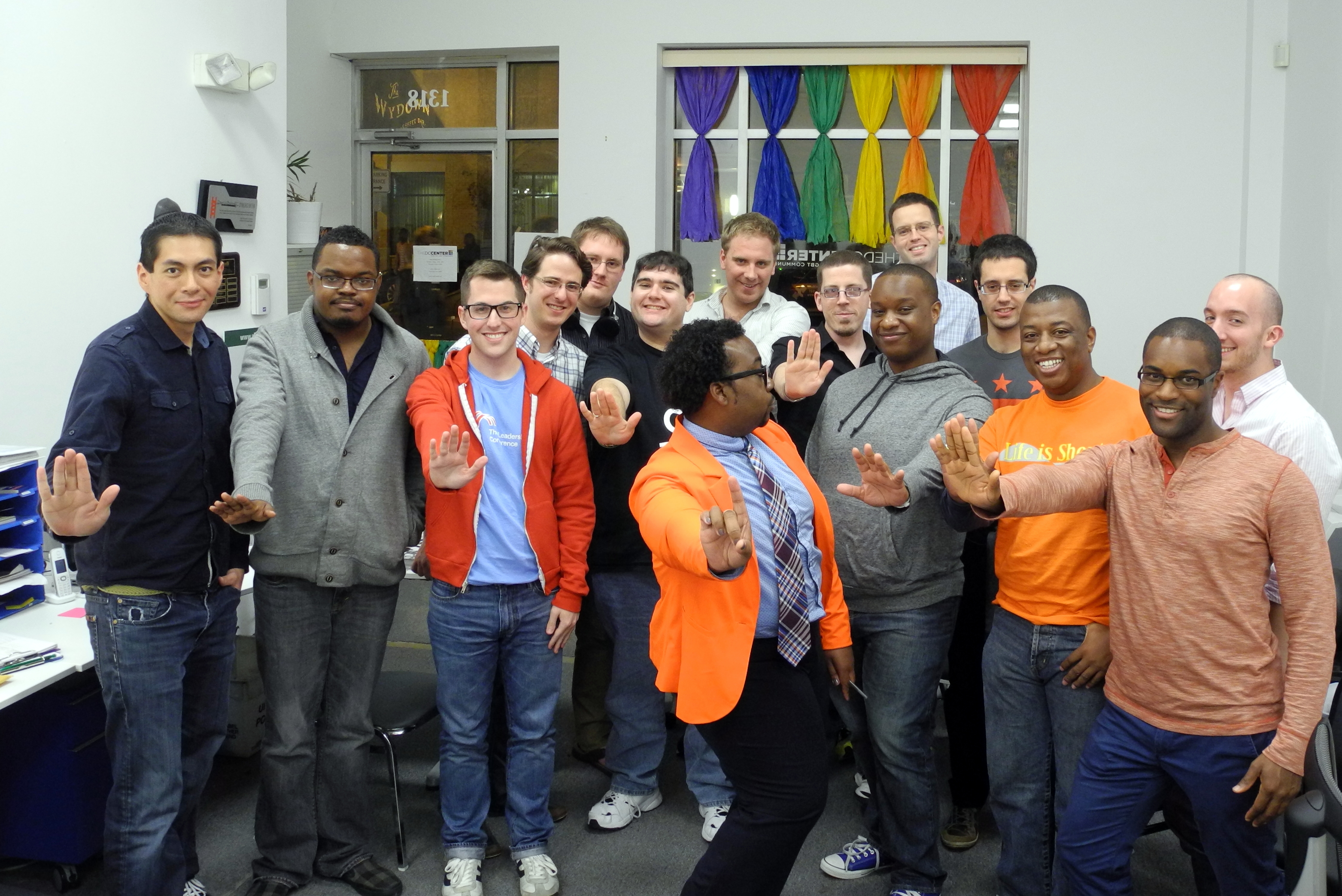
The Gay District says NO to harassment!

By: Patrick Ryne McNeil

On Friday, October 18, I joined Holly Kearl to co-facilitate a discussion group at Gay District, a “social and discussion group for 18-35-year-old GBTQQI men” that meets twice each month in Washington, D.C.

The discussion focused on sexual harassment and sexual violence experienced in public spaces specifically by this community of men in D.C. Stories about particular incidents of street harassment, how these experiences impact the way these men navigate public spaces, and solutions – both in D.C. and beyond – were of particular interest during the discussion.

I was incredibly appreciative for the number of men who attended this important discussion and was struck by just how many of them had stories to share. They underscored for me both how common this issue is for so many men in D.C. and just how many separate venues it permeates – not just on the street, but in stores, at bus stops, on the bus and on metro. And it starts so early. Several men discussed being harassed at alarmingly young ages, well before they identified as gay or some other non-normative identity.

One solution discussed that is specific to D.C. was making sure everyone knows they have access to WMATA’s anti-sexual harassment ad campaign, something that many men thought was really (perhaps exclusively) for the use of women. In addition, ensuring that everyone knows where they can report harassment is critical; one participant who experiences harassment at his bus stop was unaware that he could report harassment at that location, which is in fact an option on WMATA’s reporting page.

Friday’s discussion is one of ten taking place across the United States with various demographics as part of Stop Street Harassment’s national study on street harassment.

My master’s thesis focuses on how gay and bisexual men experience street harassment. To learn more about my research in particular, you can check out my op-ed from this year’s International Anti-Street Harassment Week, or contact me at patrickryne@gmail.com.

Patrick McNeil is finishing his master’s thesis at The George Washington University in Washington, D.C., where he is pursuing his Master’s in Women’s Studies. His work focuses on whether and how gay and bisexual men experience street harassment and how this form of harassment intersects with and diverges from the gender-based street harassment of women. Follow him on Twitter at @patrickryne.

Share

Filed Under: LGBTQ, SSH programs, Stories, street harassment

« Previous Page
Next Page »

Share Your Story

Share your street harassment story for the blog. Donate Now

From the Blog

  • #MeToo 2024 Study Released Today
  • Join International Anti-Street Harassment Week 2022
  • Giving Tuesday – Fund the Hotline
  • Thank You – International Anti-Street Harassment Week 2021
  • Share Your Story – Safecity and Catcalls Collaboration

Buy the Book

Search

Archives

  • September 2024
  • March 2022
  • November 2021
  • April 2021
  • March 2021
  • January 2021
  • April 2020
  • March 2020
  • February 2020
  • December 2019
  • November 2019
  • September 2019
  • August 2019
  • July 2019
  • June 2019
  • May 2019
  • April 2019
  • March 2019
  • February 2019
  • January 2019
  • December 2018
  • November 2018
  • October 2018
  • September 2018
  • August 2018
  • July 2018
  • June 2018
  • May 2018
  • April 2018
  • March 2018
  • February 2018
  • January 2018
  • December 2017
  • November 2017
  • October 2017
  • September 2017
  • August 2017
  • July 2017
  • June 2017
  • May 2017
  • April 2017
  • March 2017
  • February 2017
  • January 2017
  • December 2016
  • November 2016
  • October 2016
  • September 2016
  • August 2016
  • July 2016
  • June 2016
  • May 2016
  • April 2016
  • March 2016
  • February 2016
  • January 2016
  • December 2015
  • November 2015
  • October 2015
  • September 2015
  • August 2015
  • July 2015
  • June 2015
  • May 2015
  • April 2015
  • March 2015
  • February 2015
  • January 2015
  • December 2014
  • November 2014
  • October 2014
  • September 2014
  • August 2014
  • July 2014
  • June 2014
  • May 2014
  • April 2014
  • March 2014
  • February 2014
  • January 2014
  • December 2013
  • November 2013
  • October 2013
  • September 2013
  • August 2013
  • July 2013
  • June 2013
  • May 2013
  • April 2013
  • March 2013
  • February 2013
  • January 2013
  • December 2012
  • November 2012
  • October 2012
  • September 2012
  • August 2012
  • July 2012
  • June 2012
  • May 2012
  • April 2012
  • March 2012
  • February 2012
  • January 2012
  • December 2011
  • November 2011
  • October 2011
  • September 2011
  • August 2011
  • July 2011
  • June 2011
  • May 2011
  • April 2011
  • March 2011
  • February 2011
  • January 2011
  • December 2010
  • November 2010
  • October 2010
  • September 2010
  • August 2010
  • July 2010
  • June 2010
  • May 2010
  • April 2010
  • March 2010
  • February 2010
  • January 2010
  • December 2009
  • November 2009
  • October 2009
  • September 2009
  • August 2009
  • July 2009
  • June 2009
  • May 2009
  • April 2009
  • March 2009
  • February 2009
  • January 2009
  • December 2008
  • November 2008
  • October 2008
  • September 2008
  • August 2008
  • July 2008
  • June 2008
  • May 2008

Comment Policy

SSH will not publish any comment that is offensive or hateful and does not add to a thoughtful discussion of street harassment. Racism, homophobia, transphobia, disabalism, classism, and sexism will not be tolerated. Disclaimer: SSH may use any stories submitted to the blog in future scholarly publications on street harassment.
  • Contact
  • Events
  • Join Us
  • Donate
  • Facebook
  • Instagram
  • Pinterest
  • Tumblr
  • Twitter
  • YouTube

Copyright © 2026 Stop Street Harassment · Website Design by Sarah Marie Lacy