• About Us
    • What Is Street Harassment?
    • Why Stopping Street Harassment Matters
    • Meet the Team
      • Board of Directors
      • Past Board Members
    • In The Media
  • Our Work
    • National Street Harassment Hotline
    • International Anti-Street Harassment Week
    • Blog Correspondents
      • Past SSH Correspondents
    • Safe Public Spaces Mentoring Program
    • Publications
    • National Studies
    • Campaigns against Companies
    • Washington, D.C. Activism
  • Our Books
  • Donate
  • Store

Stop Street Harassment

Making Public Spaces Safe and Welcoming

  • Facebook
  • Instagram
  • Pinterest
  • Tumblr
  • Twitter
  • YouTube
  • Home
  • Blog
    • Harassment Stories
    • Blog Correspondents
    • Street Respect Stories
  • Help & Advice
    • National Street Harassment Hotline
    • Dealing With Harassers
      • Assertive Responses
      • Reporting Harassers
      • Bystander Responses
      • Creative Responses
    • What to Do Before or After Harassment
    • Street Harassment and the Law
  • Resources
    • Definitions
    • Statistics
    • Articles & Books
    • Anti-Harassment Groups & Campaigns
    • Male Allies
      • Educating Boys & Men
      • How to Talk to Women
      • Bystander Tips
    • Video Clips
    • Images & Flyers
  • Take Community Action
  • Contact

“Annoying immature pricks file”

October 20, 2013 By Contributor

I was with my son, aged 7 at the time, during this summer and we were at a local beauty spot only a few minutes walk from where we live. My son was down a small embankment next to a stream and I was standing at the top on the pathway watching him play and talking to him. There was a man, woman and small child sitting on a bench about 200 yards away to my right. I heard people talking to my left and glanced up. I registered 3 young guys aged about 25ish walking down the towards me with cans of beer in their hands. I registered them but truly this was all the attention my brain gave them and I turned back to my son to hear one of them say in a kinda sing-song voice…and I’m quoting, “Oh look they’re drinking and there’s children about, won’t stop me putting my dick in her mouth!” to which his mates started laughing.

I retorted by saying to him “Obviously no-one allows you to put your dick anywhere mate if you have to say that to random strangers.”

His mates then started the predictable “Woohoo.” My son by this point starting looking worried and asking me what they were saying as he could see I looked angry but I managed to calm down and the guys walked past. This was around 2 p.m. in the afternoon and we had already altered our walk because there was another group of young guys drinking at a particular spot, no doubt their friends. I felt angry, humiliated and vulnerable.

Do you have any suggestions for dealing with harassers and/or ending street harassment in general?

To be honest, at the time it happened and immediately thereafter, if I had had a baseball bat I would have set about the guy. That is how angry and outraged I was at the time, however, I’m not a violent person in any away and I basically just filed the incident away in my ‘annoying immature pricks’ file. Definitely something that could be addressed in schools more as I know our schools in Scotland promote as part of their curriculum, kids growing and becoming more responsible citizens. With regard to dealing with the here and now, it should fall under the umbrella of something like breach of the peace or even harassment or stalking law. Teaching kids how to act socially also begins at home and I’ll certainly be bringing my son up accordingly.

– Anne Clifford

Location: The Saltings, Old Kilpatrick, West Dunbartonshire, 60, Scotland

Share your street harassment story for the blog.

Share

Filed Under: Stories, street harassment

USA: New Yorkers Share Their #Harassmentis Stories

October 20, 2013 By Correspondent

By: Maggie Freleng, NYC, USA, SSH Correspondent

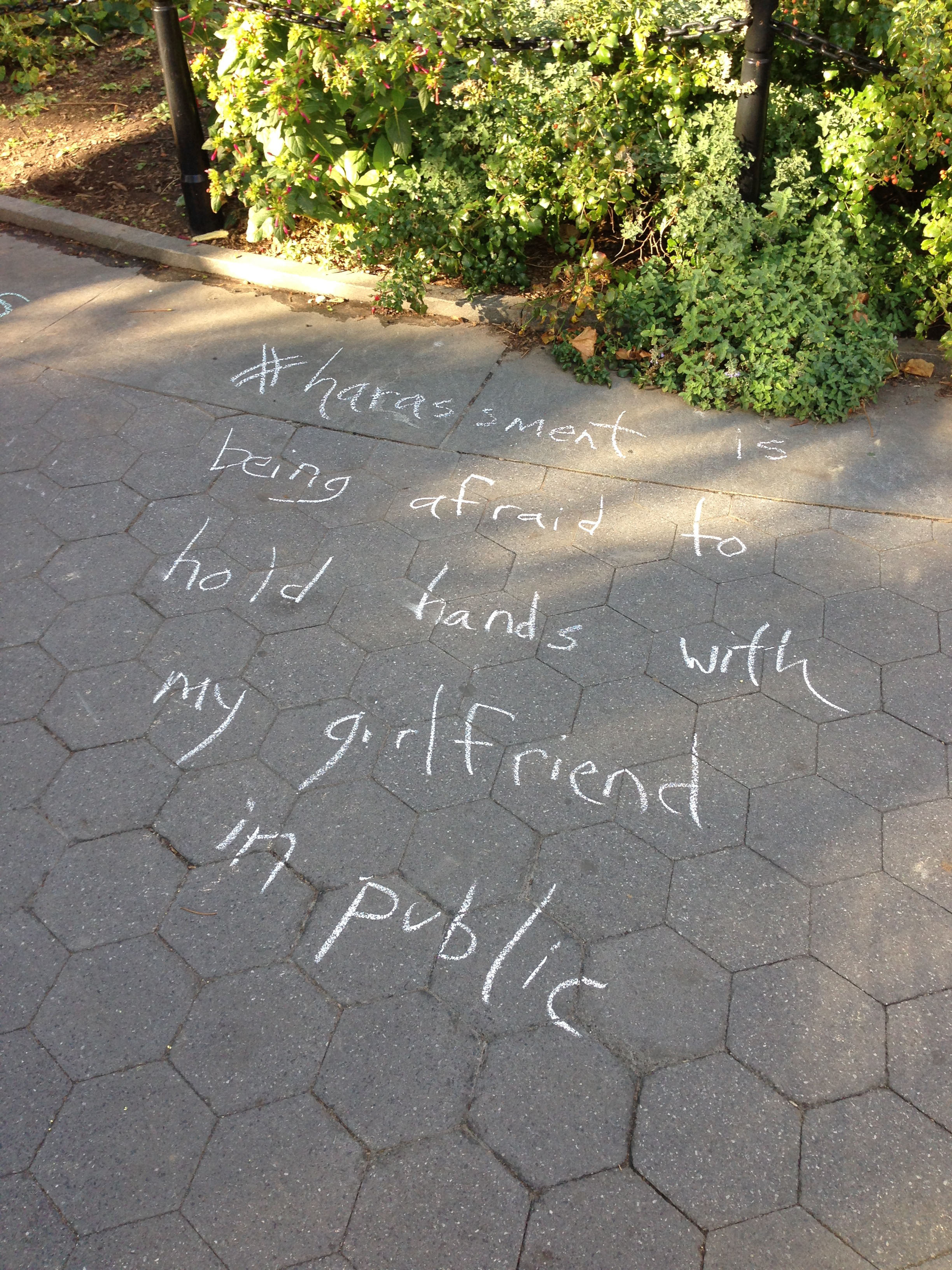
HarassmentIs Chalking in NYC

“#Harassmentis being called a terrorist because I wear a Hijab,” one slogan said.

This was just one of dozens written in chalk on the pavement in Washington Square Park in New York for the #Harassmentis chalk walk hosted by Hollaback!, an international organization to end street harassment.

In an effort to raise awareness of how different people are affected by street harassment, Hollaback! launched their newest publication “#HarassmentIs: An exploration of identity and street harassment.”

Proceeding the launch, Hollaback! also hosted a tweetup on Twitter, encouraging people to share their experiences with street harassment.

In addition, the chalk walk  was also meant to inspire people to join the conversation around street harassment.

“Chalk walking is a way for people to get together to express their views in public spaces and engage with community,” Debjani Roy, deputy director of Hollaback! said.

She said the chalk walk was a way to promote the #harassmentis guide while engaging the community in the conversation and raising awareness about street harassment publically.

The #Harrassmentis guide is a way to further explore how harassment affects different people. The guide is a way to make stories that already existed on the Hollaback! blog accessible and presentable to everyone.

“We wanted to put the stories in terms that everyone can understand globally,” Roy said, who also noted they were particularly trying to reach a younger generation. .

About 30-35 people showed up on Friday to participate in the chalk walk. However, Roy said she was most impressed with how many bystanders joined in.

Most people were excited to join in after reading the statements and asking questions about what was going on.

Harassment is something many people can relate to no matter who you are: race, religion, gender, etc.

“#Harassmentis trying to walk like a man for fear of assault,” another slogan said.

The chalk walk was a success and on that beautiful day in a New York park, intersectionality, harassment and the consequences of harassment were shared with the world.

“It was very interactive,” Roy said. “People showed a lot of interest.”

If you weren’t in New York and want to share your experience, hashtag “Harassmentis” on Twitter and keep the conversation going.

Maggie is a Brooklyn based freelance writer and photographer focusing on social justice and women’s issues. She currently writes for Vitamin W. Maggie graduated with a B.A in Journalism and English from the University of Massachusetts, Amherst in 2011, concentrating on dystopian literature. You can read more of her writing on her blog or follow her on Twitter, @dixiy89.

Share

Filed Under: correspondents, street harassment

Simple Pickup REALLY Needs To Go: Breast Cancer Edition

October 18, 2013 By HKearl

A few weeks ago, SSH social media volunteer Julie Mastrine began a Change.org petition against Simple Pickup.

She wrote, “Simple Pickup is a YouTube channel that features three guys as they harass, sexualize and often downright grope women on the street, all in the name of “picking up girls” and “giving you tips to help guys like you, get laid,” according to the user description. Unfortunately, the channel has over a million subscribers, and the message it sends is clear: it’s totally okay to harass women on the street, sexualize them, make them uncomfortable, and touch them without their consent.”

The petition has 30,000 signatures and asks YouTube to take down this offensive channel. (Please sign!)

Today I found out that the guys at Simple Pickup have reached a new low… they filmed themselves “motorboating” random women on the street (they pressed a woman’s breasts together and shook their face back and forth between them, to make the sound of a motorboat) and then they tried to make this offensive act “better” by donating $20 per motorboat to the Breast Cancer Research Foundation. Once the Foundation learned about the origin of the funds, they refunded the donation, telling media:

“We appreciate efforts to raise money to advance breast cancer research, but out of respect for the community we serve, we have asked Simple Pickup to cease all references and associations to our organization and are refunding their donation immediately.”

Good for them. As Audra at the Daily Dot writes, “objectifying women was a disgraceful way to support the cause.”

I’m really alarmed that the Simple Pickup guys continue to make offensive videos that millions of people choose to watch. Sexually objectifying women, disrespecting them, and portraying street harassment as cool and okay is problematic, harmful and needs to end. I’m also disappointed in YouTube for continuing to host and support these videos.

Please, sign the petition, share the petition and tweet at @YouTube that this channel has to go!

H/T Renee at Collective Action for Safe Spaces

Share

Filed Under: SSH programs, street harassment Tagged With: petition

Canada: Street Harassment in Ontario A Century Ago

October 18, 2013 By Correspondent

By: Lisane Thirsk, Ottawa, Canada, SSH Correspondent

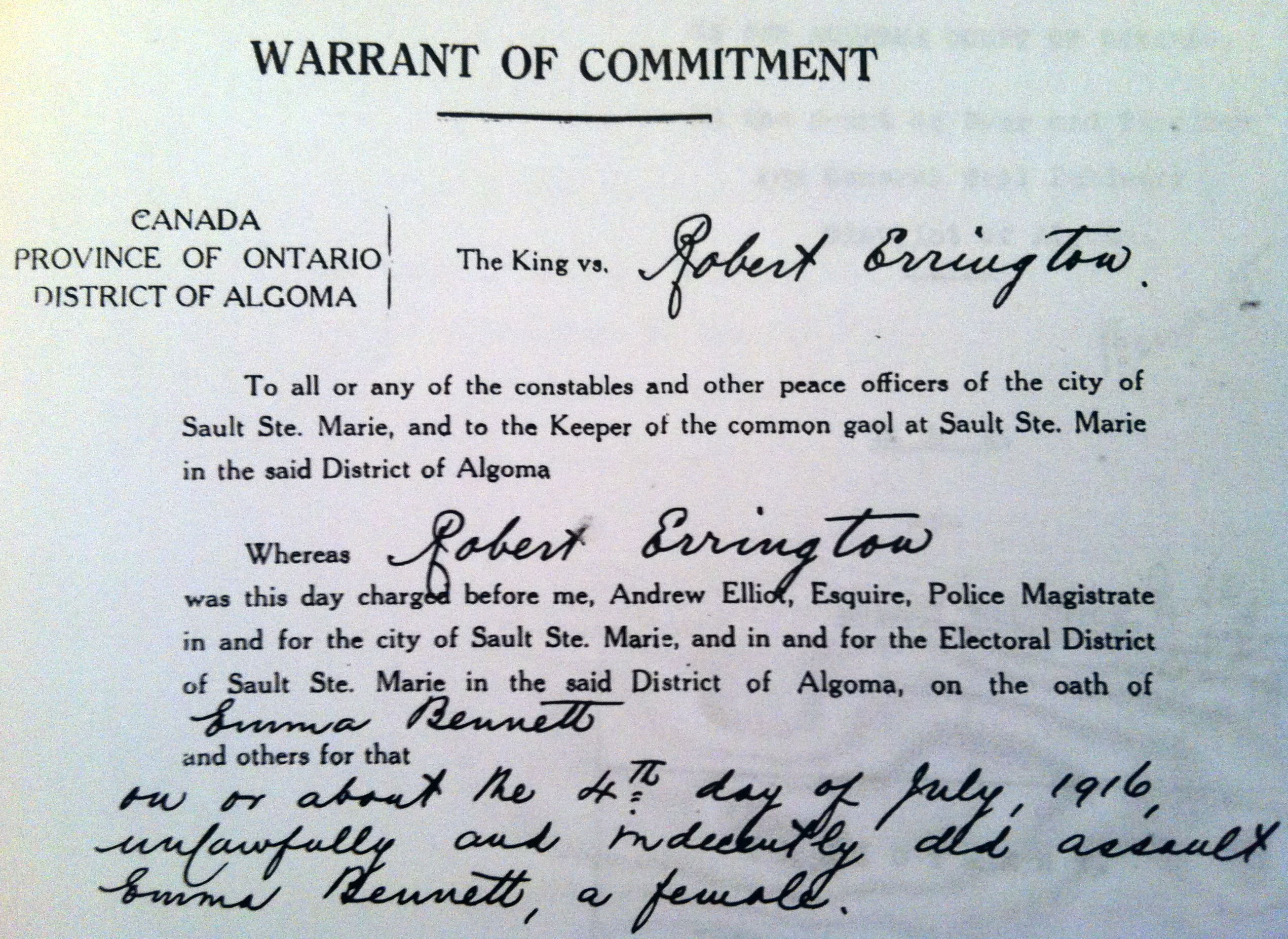
Criminal Assize Indictment, Algoma District, 1916. Available at the Archives of Ontario.

After reading SSH blog posts earlier this month about the history of street harassment in the U.S. (book review, author interview, and 100 years of activism), I was inspired to dig up some research I did a couple years ago for my master’s degree. For one assignment I went to the Archives of Ontario and uncovered criminal case files about street harassment around the turn of the 20th century.

According to historians, this period was characterized by “moral panic” in Canada. Social anxiety surrounded immigration, urban growth, and women’s shifting roles in public life.

My search at the Archives was guided by Karen Dubinsky’s Improper Advances: Rape and Heterosexual Conflict in Ontario, 1880-1929. I recommend this book to anyone interested in the history of street harassment – particularly Chapter Two on “The Social and Spatial Settings of Sexual Violence” in rural and northern areas of the province.

The legal records cited in Dubinsky’s book, as well as those I examined on microfilm reels at the Archives, provide vast documentation of sexual violence committed by strangers outdoors.

In rural communities, rape and sexual assault were often reported by women who had been attacked while walking through isolated farm fields. On small-town roads, women more often reported offences such as being chased, insulted or grabbed.

Just like in the U.S., street harassment was known as “mashing” at that time, and it was viewed as undesirable behaviour. The records show that these assaults didn’t just occur at night or when women were walking alone.

Panic emerged in numerous communities in Ontario. Mashers were stereotypically imagined as strangers in berry patches, tramps from Montreal, taxi drivers, and Indigenous men.

One of the most infamous predatory figures was known as Jack the Hugger, the nickname of a serial sexual assaulter (or more likely, several assaulters) appearing in the records from 1894 to 1916.

When confronted by a street masher, women were quite often assertive and resourceful. They defended their right to the street with defiant words, an umbrella, or by slapping the perpetrator.

Meanwhile, the prevalence of street harassment led commentators, including judges, to call for harsher punishment in the name of women’s freedom of mobility. And it was not uncommon for women – at least those who show up in the archives as “respectable” – to successfully pursue justice through legal avenues.

In her book Dubinsky reveals that the willingness of authorities to hold mashers accountable was due in part to the growth of the labour movement in Ontario.

As it became more acceptable for single women to migrate to towns and cities for jobs, scrutiny shifted to young lower-class men harassing female factory workers. Men’s public idleness and aggression were seen as threats to the values of self-control, restraint and productivity.

Below are the basic facts from one of the case files from Sault Ste. Marie that I examined at the Archives. It included statements from the complainants, the accused, and witnesses; and it illustrates some of Dubinsky’s conclusions about mashing in early 20th century Ontario.

* Around 7:30 a.m. in July 1916, Robert E. began following Emma B., a young woman who lived at a boarding house and was on her way to work at a tailor’s shop. Emma had been alerted to the Jack-the-Hugger stories circulating in her community, so she turned onto a busier street. Robert caught up to her, grabbed her hip, and said, “You would make good fucking.” He ran away, but Emma caught up to him and told him to keep his hands off her and to mind his own business.

* A few days later, Robert assaulted Louise P. around 5:15 in the evening. In her deposition Louise reported, “a young man caught hold of me by the bre[a]st … He turned around and put his hands down the front of his pants … I asked him what the devil he meant, and I started to follow him up, and then he ran.”

* In September 1916, Robert was charged with two counts of Indecent Assault on a Female. His defence focused on him having been steadily employed at the Steel Plant.

When we look back on the history of sexual violence, we tend to assume one of two things.

We either believe that in “the good old days” women were more respected in public and harassment wasn’t as explicit. Emma and Louise’s stories, along with many others I encountered at the Archives of Ontario, would suggest otherwise.

Or else we believe that as a society we’ve come a long way from the prejudiced thinking of the past. By reading between the lines in documents like Robert E.’s indictment, Dubinsky shows that it wasn’t always women’s wellbeing or principles of social equality that guided the prosecution of street harassers.

If we look carefully at today’s responses to street harassment – legal or otherwise – we might find many of these same patterns playing out.

Lisane works in the non-profit communications sector and supports local anti-street harassment advocacy through Hollaback! Ottawa. In 2012, she completed a Master’s in Socio-Legal Studies at York University in Toronto, where she wrote her Major Research Paper on gender-based street harassment. She holds a B.A. in Latin American Studies and Spanish from the University of British Columbia.

Share

Filed Under: correspondents, SH History, Stories, street harassment

“something to look at but not much to see”

October 17, 2013 By Contributor

I. Shame
I want to teach myself to not feel sick with guilt
when I tell you to shut the fuck up, and
I wish I could take back the quiet “thank you”
I politely whisper when you won’t leave me alone
and I don’t know what else to say.

II. Anger
“Smileformeyoungladylookingsobeautiful, canyougiveasmileforme?”
it’s a command given in two breaths.
May it subtract two of your last inhalations
for every time you’ve said it to me, every time you’ve seen me.

III. Violence
If you think my ass is yours to grab,
then I think your eye sockets are a good place
for me to jab my middle fingers, and twist.
I don’t want you to see—even in your mind’s eye—
the things you say you’d do to me if you could take me home.

IV. Shame
I’m told I “should be flattered”
As if I’m incorrect to feel
uncomfortable, unsafe, and degraded.
As if I lack emotional agency, and it’s somehow up to others
to decide how to respond to my body
with no regard for my brain.

Erica Motz is a third-year student at UW-Madison.  You can talk with her about street harassment, street respect, gender performativity, music, or making weird art at this address: ericarosemotz AT gmail.com.

Share

Filed Under: Stories, street harassment

« Previous Page
Next Page »

Share Your Story

Share your street harassment story for the blog. Donate Now
From the Blog

  • #MeToo 2024 Study Released Today
  • Join International Anti-Street Harassment Week 2022
  • Giving Tuesday – Fund the Hotline
  • Thank You – International Anti-Street Harassment Week 2021
  • Share Your Story – Safecity and Catcalls Collaboration

Buy the Book

Search

Archives

  • September 2024
  • March 2022
  • November 2021
  • April 2021
  • March 2021
  • January 2021
  • April 2020
  • March 2020
  • February 2020
  • December 2019
  • November 2019
  • September 2019
  • August 2019
  • July 2019
  • June 2019
  • May 2019
  • April 2019
  • March 2019
  • February 2019
  • January 2019
  • December 2018
  • November 2018
  • October 2018
  • September 2018
  • August 2018
  • July 2018
  • June 2018
  • May 2018
  • April 2018
  • March 2018
  • February 2018
  • January 2018
  • December 2017
  • November 2017
  • October 2017
  • September 2017
  • August 2017
  • July 2017
  • June 2017
  • May 2017
  • April 2017
  • March 2017
  • February 2017
  • January 2017
  • December 2016
  • November 2016
  • October 2016
  • September 2016
  • August 2016
  • July 2016
  • June 2016
  • May 2016
  • April 2016
  • March 2016
  • February 2016
  • January 2016
  • December 2015
  • November 2015
  • October 2015
  • September 2015
  • August 2015
  • July 2015
  • June 2015
  • May 2015
  • April 2015
  • March 2015
  • February 2015
  • January 2015
  • December 2014
  • November 2014
  • October 2014
  • September 2014
  • August 2014
  • July 2014
  • June 2014
  • May 2014
  • April 2014
  • March 2014
  • February 2014
  • January 2014
  • December 2013
  • November 2013
  • October 2013
  • September 2013
  • August 2013
  • July 2013
  • June 2013
  • May 2013
  • April 2013
  • March 2013
  • February 2013
  • January 2013
  • December 2012
  • November 2012
  • October 2012
  • September 2012
  • August 2012
  • July 2012
  • June 2012
  • May 2012
  • April 2012
  • March 2012
  • February 2012
  • January 2012
  • December 2011
  • November 2011
  • October 2011
  • September 2011
  • August 2011
  • July 2011
  • June 2011
  • May 2011
  • April 2011
  • March 2011
  • February 2011
  • January 2011
  • December 2010
  • November 2010
  • October 2010
  • September 2010
  • August 2010
  • July 2010
  • June 2010
  • May 2010
  • April 2010
  • March 2010
  • February 2010
  • January 2010
  • December 2009
  • November 2009
  • October 2009
  • September 2009
  • August 2009
  • July 2009
  • June 2009
  • May 2009
  • April 2009
  • March 2009
  • February 2009
  • January 2009
  • December 2008
  • November 2008
  • October 2008
  • September 2008
  • August 2008
  • July 2008
  • June 2008
  • May 2008

Comment Policy

SSH will not publish any comment that is offensive or hateful and does not add to a thoughtful discussion of street harassment. Racism, homophobia, transphobia, disabalism, classism, and sexism will not be tolerated. Disclaimer: SSH may use any stories submitted to the blog in future scholarly publications on street harassment.
  • Contact
  • Events
  • Join Us
  • Donate
  • Facebook
  • Instagram
  • Pinterest
  • Tumblr
  • Twitter
  • YouTube

Copyright © 2026 Stop Street Harassment · Website Design by Sarah Marie Lacy