• About Us
    • What Is Street Harassment?
    • Why Stopping Street Harassment Matters
    • Meet the Team
      • Board of Directors
      • Past Board Members
    • In The Media
  • Our Work
    • National Street Harassment Hotline
    • International Anti-Street Harassment Week
    • Blog Correspondents
      • Past SSH Correspondents
    • Safe Public Spaces Mentoring Program
    • Publications
    • National Studies
    • Campaigns against Companies
    • Washington, D.C. Activism
  • Our Books
  • Donate
  • Store

Stop Street Harassment

Making Public Spaces Safe and Welcoming

  • Facebook
  • Instagram
  • Pinterest
  • Tumblr
  • Twitter
  • YouTube
  • Home
  • Blog
    • Harassment Stories
    • Blog Correspondents
    • Street Respect Stories
  • Help & Advice
    • National Street Harassment Hotline
    • Dealing With Harassers
      • Assertive Responses
      • Reporting Harassers
      • Bystander Responses
      • Creative Responses
    • What to Do Before or After Harassment
    • Street Harassment and the Law
  • Resources
    • Definitions
    • Statistics
    • Articles & Books
    • Anti-Harassment Groups & Campaigns
    • Male Allies
      • Educating Boys & Men
      • How to Talk to Women
      • Bystander Tips
    • Video Clips
    • Images & Flyers
  • Take Community Action
  • Contact

Philadelphia Survey, City Council Hearing & More

October 2, 2013 By HKearl

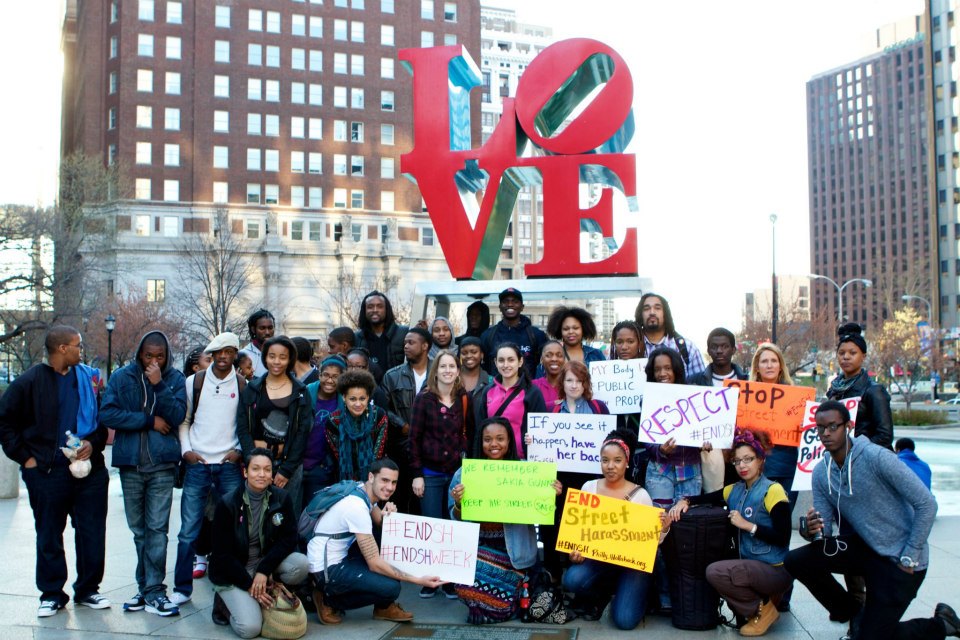
Hollaback! Philly, FAAN Mail and other groups took part in International Anti-Street Harassment Week in April 2013. Photo by Craig Carpenter.

From comic books to subway ads about street harassment, Hollaback! Philly regularly undertakes creative and compelling work. Here are a few current and upcoming things they’re doing!

1 – Survey:

Right now, they’re conducting an online survey for Philadelphia residents — please take it if you live in Philadelphia!

2 – Event with SSH:

On November 6, they will join me and FAAN Mail at the Wooden Shoe Book Store at 7 p.m. for a community discussion about street harassment. The comic book artist will be signing copies of it and I’ll be talking about/signing copies of my book 50 Stories about Stopping Street Harassers. RSVP for the free event.

3 – City Council Hearing:

The most exciting news of all is that they are working with the City Council to hold a street harassment hearing!!

The hearing will be held on November 7, 10 a.m. and Hollaback! Philly will present their survey results. Many members of the public have already signed up to share their stories. One of the main recommendations they’ll all make is for the City Council to sponsor community safety audits.  I will also testify to bring a national and international context to the issue.  Stay tuned for more information closer to the date.

4 – iReport:

Finally, check out this CNN iReport about Hollaback! Philly’s awesome work!

Share

Filed Under: News stories, SSH programs, street harassment

“I will never stop fighting”

October 2, 2013 By Contributor

By Dienna Howard

Dienna interviewing Moor Mother Goddess at SlutWalk DC in Aug. 2013 with the help of volunteer Dario Baguena.

On September 20, 2013, I went outside to enjoy the weather and have lunch. I was having a stressful day and thought that being outside in the warm weather would give me a chance to clear my head. As I walked to Freedom Plaza, I passed by a man who appeared to be in his 50s who was with a group of people. As I walked past him, he said, “Hey, beautiful” at me. Whenever a man who is a stranger to me makes a comment like that, it doesn’t make me feel beautiful. It makes me feel tense, guarded, and uncomfortable that I’m being appraised by my appearance. He sat there looking at me as if he demanded a response.

“The only person I want to hear ‘hey, beautiful’ from is my man,” I said. “Not some random man on the street.” I’m not in a relationship, but if I were, that hypothetical boyfriend would be the only man I’d want to hear something like that from. And I made that comment because while I don’t like being seen as someone else’s property, oftentimes men who think like this only back off if they think that the woman is with someone else.

With this guy, it didn’t work. He went from calling me “beautiful” to calling me “ugly,” calling me a “bitch,” saying that I was “white” (because in his twisted mind, a black woman who wants nothing to do with a stranger who happens to be the same race is a “race traitor”), saying I was on Ritalin, and the ultimate insult, telling me that I “suck white man’s dick.” All this is the reason why I don’t accept compliments from men I don’t know – it’s never a compliment, it’s all about power and control.

When this happened, I lost my appetite and it was suddenly too hot to be outside. I managed to record as much as the incident as possible on a new phone that I was still learning how to use. I stood my ground, telling him that he should’ve risen up above being a black male stereotype, that he was a stranger to me and I don’t accept compliments from strangers, and that as many vulgar names as he used against me, I never did the same in return. Upset as I was, I did not stoop to his level. Another man who was with the harasser apologized on his behalf, though the harasser should’ve apologized. He even tried to get the harasser to stop it. The harasser told me that I should’ve said, “Thank you, brother” to him for a compliment that I never asked for. When the harasser looked like he was going to follow me, I called the police, though his friend begged me not to.

As I spoke with the dispatcher, I felt that nothing would come from the call. I wanted to move away from where the harasser was, but the 911 dispatcher gave me the impression that I should’ve stayed close by. I said that I needed to get back to the office, but there was no estimated time as to when the police would arrive. Knowing that I could risk being late to return to work and that the harasser would’ve been long gone by that point, I apologized for “wasting DC government resources” and told them to cancel the call.

I decided to head back to the office, the harassment adding to the stress that I was feeling prior to the incident. On the way back a man on the street tried to give me a rose (I noticed that he does not offer his roses to men who pass him by) and I said “no” a few times until he got the hint. Another man referred to me as “Boo-Boo,” a term that I find dumb and childish. I said that my name was not “Boo-Boo” and that he was to refer to me as “Miss or Ma’am.” He did not get the hint.

When I returned to the office, I was worn out. My body felt tense, my teeth were clenched, and I had to  internalize that for the remainder of the day. I used the little power left in my phone to update my Facebook status about the lunchtime harassment, but didn’t get to see the responses until after work since my phone died and I don’t log onto Facebook with my work computer. I kept my office door (in my case, a curtain) closed as much as possible, feeling the hurt and pain of this virulent and violent form of verbal harassment, and needing to be alone as much as possible to work through it.

This incident was not the first time I was harassed, nor will it be the last. I have been harassed since I was 16 years old, before I knew that there was a word for it. When I was younger I did not have the strength or the tools to stand up against it. I remember being in my late teens or early 20s and riding the bus, and a man old enough to be my grandfather sat next to me. He started talking to me, talking about how attractive I was, and I chose to ignore it. He assumed that I was deaf, so he started speaking in a more lewd manner and speaking about me in sexual terms. Since I was “deaf” I couldn’t break my facade and had to sit there and listen to his sexual commentary, yet even if I chose to break my facade, I was too fearful to.

I have been followed by men in their cars, physically threatened (one man threw punches close to my face because I dared to ignore him and tell him why), chased, and called every sexist and racist name in the book. The older I got and the more harassment that I experienced, I became more angry and started fighting back. Sometimes I’d yell back. Sometimes I’d curse. Sometimes I’d take photos and videos of the harassers. I’d even take more benign approaches, like ignoring them, or calmly explaining why I don’t like their behavior, or just giving a simple “no.” Sometimes these methods worked, sometimes they didn’t. My reactions depended on my mood, the time of day, and my safety level. Even with the number of anti-harassment trainings out there giving the tools on what to do and say when encountering a harasser, there’s no one correct way to handle street harassment – it’s about what works best for a person at that moment. That’s why I have no regrets on how I handled the recent harassment – I don’t take back anything I said, I don’t regret calling the police, nor do I regret canceling the call. Other people will nitpick my actions, but the only person’s opinion that’s important on the matter is my own.

People tend to blame the recipient of harassment. When sharing my stories, I get lots of feedback from people who support me and who get it. But the voices of those who don’t support me and who don’t get it are louder. I cannot count the number of times I’ve been told that I bring upon my own harassment. It’s because I’m beautiful. Because I should’ve accepted his compliment. Because I’m petite and look like an easy victim. Because I’m too hard on men. It’s because of how I was dressed. It’s because I’m a woman. Or I get told what I should’ve done. If I ignore it, I get told that I should’ve said something, but if I say something, I get told that I should’ve ignored it.

I also deal with the erasure of my stories. When I talk about dealing with intraracial harassment as a black woman, white women will dismiss my stories with, “It doesn’t only happen to black women.” That’s obvious. But instead of just listening, they interject into black women’s stories and try to make it about them. I can only speak from my experience as a black woman facing harassment, and these women should let me have the podium. White women’s stories are not universal, and everyone should have the freedom to talk about being harassed without being dismissed. Being harassed is hard enough in itself, and they don’t need to add to that feeling.

I have no idea why I get harassed so frequently, and trying to figure it out would be like blaming the victim. What I do know is that it’s taking its toll on me – I can only take unwanted attention turned insults from random men for so long before it wears on my psyche. I’ve been called “bitch” so many times that people would think it was my given name. I try to act tough but it gets to me. I’m always guarded, wearing my shades even when the sun’s not out, listening to an MP3 player to tune harassers out, and have my harassment radar set on high. Harassment makes me feel anxious and uncomfortable.

I live in a world where people aren’t comfortable with letting me be because I don’t conform to a group mentality. My identity and opinions are erased and people try to put their own labels on me. It’s this same mentality that gets me labeled “cold” because I’m not big on small talk and happy hours. One where racist people write me off as being “stupid” because of the color of my skin. Or one where others call me “mean” because I’m not a delicate woman who grins like an idiot. It’s the same mentality that has a harasser calling me a “bitch,” because when I defend my right to walk freely in a public space, I’m no longer an object to him, but an individual with thoughts and ideas, and he finds that threatening.

I became a member of Arlington Independent Media late last year. AIM is a nonprofit organization that provides its members with the tools to create their own public access programming. Since taking many classes at AIM, I’ve become active in volunteering on different productions while getting the feel for their camera equipment. When I passed a certification test to use the organization’s field equipment I was ready to produce my own content. I thought that my first production would be short and lighthearted (I’ve always wanted to do sitcoms), but summer was starting up and I felt that that would be the best time to do a documentary on street harassment. I spent hours interviewing different people and organizations active in the fight against street harassment, had volunteer crews come out with me to tape different anti-harassment events, and inadvertently got video footage of my harassers in action (such as the above-mentioned harassment incident).

The documentary will be edited soon and won’t be out until the end of the year. While dealing with harassment is beyond tiresome, getting together to talk about it will never become old. We need to keep telling these stories and keep sharing these stories. And as worn out and mentally beaten as I am from being harassed so frequently, I will never stop fighting in the battle against it.

Dienna Howard is an artist who recently had work featured at the Target Gallery and Convergence, both in Alexandria, VA. Dienna is a volunteer/producer for Arlington Independent Media, and through that organization is currently producing her first documentary, one on the issue of street harassment.

Share

Filed Under: Stories, street harassment

USA: Anti-Flirt Club and Hassle-Free Zones, 100 Years of Activism

October 1, 2013 By Correspondent

By Lauren McEwen, Washington, D.C., USA, SSH Correspondent

A while back, I read an interesting post by a male ally about street harassment in which he attempted to explain to other cis men why gendered harassment in public spaces is not OK. It basically amounted to him saying, “Hey, I know it’s hard to understand that some of the social norms we were spoon-fed as kids isn’t OK, but it’s the 21st century, and we now officially know that street harassment is unacceptable.”

While I appreciate all positive support for something I believe in, here’s the thing: the anti-street harassment movement is not a new phenomenon. It can be argued that street harassment has been a problem since women began moving through public spaces on their own. There have been studies conducted, books written and protests waved to fight against street harassment for generations.

Today’s anti-street harassment movement has something that all of the other efforts did not – the power of the Internet. Each day, I come across about three to five stories about street harassment. I see tweets from people affected by it venting and comforting each other, in turn. The saturation of news and opinions and anecdotes about street harassment all over the web can make it seem like street harassment has been tolerable up until this new generation of overly sensitive, politically correct kids came of age, but it’s not.

This post is about times in the past 100 years when street harassment was both documented and fought.

Early 1900s: Mashing

Street harassment was called “mashing” in the early 1900s, and some women decided to take matters in their own hands, stabbing mashers with their hatpins, and punching or hitting harassers across the face with their handbags. They also reported harassment to the police and in some cases, were successful in getting the masher arrested.

While it’s not advisable to get into physical altercations with street harassers, these accounts prove that there was not a time when street harassment was universally viewed as a “compliment.” It was threatening enough in the 1930s for these women to attack their harassers, and one can only assume that the actual words and actions that present-day street harassers employ are can be even more vulgar than those used by their predecessors.

[Editor’s Note: Stanford professor Estelle Freedman’s new book Redefining Rape includes a chapter about mashers/street harassers from the 1880s to 1920s.]

1920s: The Anti-Flirt Club

In the 1920s, a group of D.C. women formed the Anti-Flirt Club and held the first and only Anti-Flirt Week. During World War I, it became common practice for men to offer female pedestrians rides when they saw them walking down the street as part of their civic duty. But soon, those offered rides became tainted by aggressive flirting on the part of the driver. Although the group’s secretary acknowledged that here were other “flirts” about, the drivers were the most worrisome.

The Atlantic reprinted excerpts from a 1920s Washington Post article that detailed the rules of the Anti-Flirt Club, and although some of the advice seems sound enough, (“Don’t accept rides from flirting motorists—they don’t all invite you in to save you a walk.” “Don’t let elderly men with an eye to a flirtation pat you on the shoulder and take a fatherly interest in you. Those are usually the kind who want to forget they are fathers.”) some of the rules were tinged with slut-shaming (“Don’t flirt; those who flirt in haste oft repent in leisure.” “Don’t use your eyes for ogling—they were made for worthier purposes.”)

The trouble with the Anti-Flirt Club was that, once again, the onus for preventing “flirting” (or rather, street harassment) was once again placed on women. Don’t make eye contact. Don’t smile. But be sure to keep your options open, because you never know where your future husband may be hiding.

The Manhattan-based version of the Anti-Flirt Club was run by men, and placed the burden of ending street harassment on women in another, slightly less oppressive, way. They wanted “to educate public opinion to the point where a woman will consider it her duty to prosecute the masher who attempts to force his attentions upon her. The association intends to have its own counsel, who will aid in prosecuting all masher cases.” (More on “mashers” in a bit.)

According to The Atlantic, it isn’t clear what charges could have been drawn against these early 20th century street harassers, but interestingly, two politicians tried (and failed) to get anti-street harassment bills passed in 1897, and in 1931, the Chicago Tribune quoted the Acting Police Commissioner John Alock saying, “This street flirting has got to stop in Chicago. No longer may young men in automobiles edge over to the curb and honk their horns at pretty girls on the sidewalk. They must quit ogling women from loafing places in front of drug stores, cigar stores and other public hangouts.”

Eventually, the efforts seemed to fizzle – fewer articles were written about the anti-flirt movement – but police and politicians from generations ago at least appeared to take sexual harassment seriously. Seems like we have regressed quite a bit over the years.

1940s: “Hands Off! Self Defense for Women”

In 1942, a book by Major W.E. Fairbairn was published that sought to teach women “basic methods of attack and defense” in order to help them defend themselves should they be attacked. It served as a sort of wartime manual to teach readers some of the self-defense tactics Fairbairn picked up while serving with the Shanghai Municipal Police.

In the foreword, Fairbairn explained what motivated him to write the book. As more American women began to work outside of the home, taking the places of men who were away at war, they would be in new and unfamiliar situations, and should be able to defend themselves in case their safety was threatened.

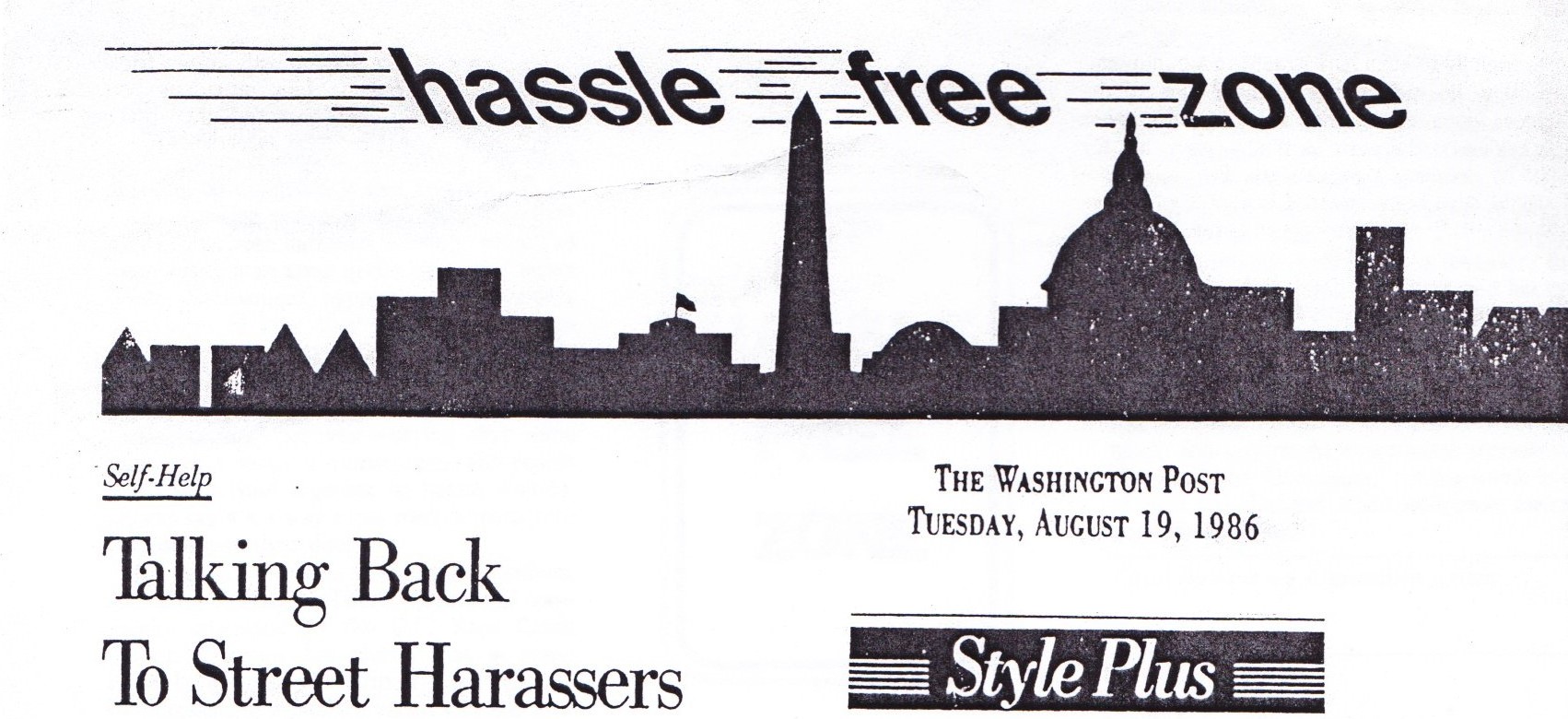
1980s: The Hassle-Free Zone Campaign

In 1985, several community organizations, including the D.C. Rape Crisis Center (the first rape crisis center in the U.S.), the D.C. Women’s Law Center and D.C. Men Against Sexual Violence teamed up to organize an effort to convert the District into a “hassle-free zone.”

Marty Langelan, the former president of the D.C. Rape Crisis Center and the author of Back Off: How to Confront and Stop Sexual Harassment and Harassers, detailed the 1985 campaign in her book and talked to me about it in an interview.

Posters and flyers were created by Linda Leaks and the African American Women’s Committee for Community Education, local law students researched ways to potentially prosecute harassers and self defense instructors from the D.C. Rape Crises Center taught women confrontation classes.

In September 1985, they focused on street harassment during the Take Back the Night March and the annual Anti-Rape Week program, and got then-Mayor Marion Barry to issue a proclamation asking that all Washingtonians strive to make the District a Hassle-Free Zone. A resolution supporting the campaign was passed by the City Council.

The following spring, the campaign hosted speakouts in street harassment hotspots, like parks and Metro Stations, after work and during lunchtime, when there would be more people on the street. There were skits, speeches and “open mike sessions to give women a chance to sound off about their harassment experiences.” They held their final public speakout during October 1986.

It’s hard to say if it is inspiring or disheartening to realize that groups have been fighting to end street harassment for generations. It does, however, serve as a reminder that we are not battling a non-issue, but something that has hindered the happiness and safety of people for longer than we would like to imagine.

Lauren is a recent graduate of Howard University where she majored in print journalism with a minor in photography. You can check out more of her work at laurenmcewen.weebly.com and follow her on Twitter at @angrywritergirl.
Share

Filed Under: correspondents, SH History, street harassment

South Africa: Harassment of Women within Political and Activist Movements

October 1, 2013 By Correspondent

By: Gcobani Qambela, South Africa, SSH Correspondent

**Trigger Warning**

A few days ago, I was shocked when I woke up to a tweet from a colleague who works in youth activist circles with me. In the tweet he said: “Activism without facts is like winking at a girl in the dark. No one knows you’re doing it #Factivism”. I was shocked that he would tweet this because he is a man working in youth activist circles that seek to especially advance women and especially young girls from the harmful ravages of patriarchy in Africa.

I was thus surprised that someone working in these spaces that promote not only gender parity in Africa, but also seeks to create an open African society where young women do not have to contend with harassment from men winking at them whether in the dark or public sphere without express permission to do so.

A few days after, I would encounter the same misogynistic type of tweet being retweeted into my timeline by someone who is a member of the new controversial political party, Economic Freedom Fighters (EFF) in South Africa. The young man who was retweeted, Khaya Caluza, maintains close links to the African National Congress (ANC), the governing political party in South Africa. In the tweet Caluza, using violently patriarchal languages, relegates women back to being alive only to look after and please men sexually.

These might appear to be isolated incidents, but misogyny and harassment of women (and sometimes LGBTIQ people) in heteronormative activist and political circles in South Africa, and Africa more broadly is a serious problem. The tweets and retweets by these young activist young men reminded me that even in activists’ and political movements, where women are supposed to be united with men for a common purpose, women also often have to contend with the extra-burden of not only doing activist and political work, but also combating patriarchal, sexual and misogynist attitudes and harassment from some of their fellow men. These attitudes carried by these men that a woman’s place is in the kitchen doing the dishes, or that winking at women is cool, especially when it is seen by others, is worrying because it means these attitudes also infiltrate into the gender dynamics of the work that must be done.

In The Guardian’s “Top 10 sexist moments in politics” is included the case of South Africa’s Lindiwe Mazibuko who constantly receives sexist comments in the course of her political work. Earlier in the year for instance she was criticized at a budget debate by two ANC MP’s for her dress sense. Writing for the Mail and Guardian, Nomalanga Mkhize, Mathe Maema, Babalwa Magoqwana and Siphokazi Magadla note that while Lindiwe is famous because of her political position in (South Africa’s main opposition party) the Democratic Alliance, they note that “Mazibuko’s case is only the latest in a number of public incidents where women are dismissed on the basis of body, age and dress – that age old language of reminding women that even when we [as women] have our right to leadership, we are not truly to be taken seriously in the public sphere.”

The tweets by these young men remind me that while we must tackle the harassment that women experience in public and in the streets, we also need to devote attention to the harassment women activists and politicians are subjected to.

Political and activist spaces are supposed to be spaces where all of us in our different genders and sexualities are supposed to come together, be free and united in common purpose of carving a positive change in society. However, because of harmful heteropatriarchy in South Africa, many women find themselves fighting what South African researcher and gender activist, Rethabile Mashale, calls a “dual war” for women.

She tells me “the dual war is unrelenting, and what is further troubling is the extent to which not only men, but also women nowadays in South Africa have become complicit in perpetuating deep misogyny against women like Mazibuko and not recognising the interconnectedness of our struggles as women. It’s not only sad, but deeply worrying.” I couldn’t agree with Mashale more. I hope that as all men (and women) in the activist and political movements especially, that we will start examining and correcting the ways in which our internalised (patriarchal) attitudes and words are harmful against many of our fellow men, women and LGBTIQ family in the anti-patriarchy and anti-street harassment movement.

Gcobani is completing his Masters in Medical Anthropology through Rhodes University, Grahamstown, South Africa. His research centres around issues of risk, responsibility and vulnerability amongst Xhosa men (and women) in a rural town in South Africa living in the context of HIV/AIDS. Follow him on Twitter, @GcobaniQambela.

Share

Filed Under: correspondents, street harassment

USA:The Many Ugly Heads of Street Harassment

October 1, 2013 By Correspondent

By Nikoletta Gjoni, Maryland, USA, SSH Correspondent

My mom always says that the more choices someone is offered, the harder it is to decide—whatever that decision may be about. In a strange way, that could very well apply to street harassment as well. Just follow me for a minute here. The term street harassment sounds very straightforward and is obvious as to what it refers to. It doesn’t leave much room for interpretation as to what would be considered street harassment vs. what wouldn’t be. However in today’s day and age, it’s becoming grayer, trickier, and harder to confine the definition of street harassment and where and how it can be encountered.

In my first article, I wrote about the reasons for and ramifications of using technology in public in an effort to thwart harassment. I focused on the use of ear buds, cell phones, and laptops as a means to deter men from communicating with women, but a recent article featured in the New York Times made me consider how technology itself encourages harassment on the Internet that can or cannot manifest into harassment encountered on the street.

In “Victims Push Laws to End Online Revenge Posts,” new light is shed on the ever growing problem with “revenge porn”—sites that cater to vindictive exes, overwhelmingly male exes, who post nude photos of ex-girlfriends/ex-wives/ex-lovers, sometimes with phone numbers, home addresses, and employment addresses attached to them.

Aside from the very obvious fact that this is intrusive and formulaically vengeful, it can spark, and in fact already has sparked, a slew of problems for the women whose pictures are posted—loss of jobs, alienation from friends and/or family, and not least of all, exposure to stalkers.

Ms. Taschinger, the twenty-three-year-old profiled in the article whose ex-boyfriend shared a dozen or so nude photos of hers on the Internet, states that on many occasions upon coming home from work, she would spot a man sitting in a car outside of her house. She eventually quit her job at a restaurant. Others have also experienced getting approached and hassled in public spaces.

“Sometimes I want to get into a fetal position and cry,” says Taschinger.

The Women’s Center states that 1 in 20 women will be stalked in their lifetime; 79% of women know their stalkers, 50% of women have been in a relationship with the stalker, and 80% of those relationships were abusive.

While it’s important to note that yes, these women did willingly give their then boyfriends/husbands/lovers their photographs, it is immeasurably more important to recognize that they did not agree to having them shared with the Internet world, a fact that seems to fall through the cracks of empathy and land right into the gutter of blame.

While street harassment is recognized as an unwelcome sexual advance, either verbal or physical, that occurs in real life while out on the street, I start to wonder whether or not that could and should include the Internet. Through the use of cell phones, laptops, and tablets we are exposed to Facebook, Twitter, Tumblr, Instagram—blog sites, porn sites, private sites, and public sites—free sites and sites that charge.

For a lot of us, ‘real life’ weaves on and off the Internet and everything we post becomes a reflection of our every day lives. In a world so highly charged and high speed where the sense of privacy diminishes a little more with each new piece of technology that is unveiled and every new app that is downloaded, I wonder if street harassment can be stretched out to encompass and define the pixelated paths of every WWW site we may encounter, particularly when they in turn create the kind of street harassment we typically classify as such.

Someone who isn’t brave enough to holler on the street may take the route of anonymity the Internet oftentimes provides. Someone who feels jilted can take to the Internet to post private photos without the photographed knowing.

Choices. And though they always existed in the simple form of you can either be the person who harasses or you can be the person who doesn’t, it has now become more complicated than that. You can holler; you can click and share; you can click and forward; you can click and view. Who is guilty of harassing? Who is guilty of perpetuating, and is perpetuating on the Internet the same as perpetuating on the street?

And if not—well, why not?

Nikoletta Gjoni graduated from UMBC in 2009 with a B.A. in English Literature. After graduation, she did almost four years of freelance work in a D.C. broadcast station, in addition to having worked as a literacy and linguistics assessor for pre-k classrooms in D.C.’s charter schools.  To get to know her better, she can be tracked on both her creative blog and Twitter, @nikigjoni.

Share

Filed Under: correspondents, street harassment

« Previous Page
Next Page »

Share Your Story

Share your street harassment story for the blog. Donate Now

From the Blog

  • #MeToo 2024 Study Released Today
  • Join International Anti-Street Harassment Week 2022
  • Giving Tuesday – Fund the Hotline
  • Thank You – International Anti-Street Harassment Week 2021
  • Share Your Story – Safecity and Catcalls Collaboration

Buy the Book

Search

Archives

  • September 2024
  • March 2022
  • November 2021
  • April 2021
  • March 2021
  • January 2021
  • April 2020
  • March 2020
  • February 2020
  • December 2019
  • November 2019
  • September 2019
  • August 2019
  • July 2019
  • June 2019
  • May 2019
  • April 2019
  • March 2019
  • February 2019
  • January 2019
  • December 2018
  • November 2018
  • October 2018
  • September 2018
  • August 2018
  • July 2018
  • June 2018
  • May 2018
  • April 2018
  • March 2018
  • February 2018
  • January 2018
  • December 2017
  • November 2017
  • October 2017
  • September 2017
  • August 2017
  • July 2017
  • June 2017
  • May 2017
  • April 2017
  • March 2017
  • February 2017
  • January 2017
  • December 2016
  • November 2016
  • October 2016
  • September 2016
  • August 2016
  • July 2016
  • June 2016
  • May 2016
  • April 2016
  • March 2016
  • February 2016
  • January 2016
  • December 2015
  • November 2015
  • October 2015
  • September 2015
  • August 2015
  • July 2015
  • June 2015
  • May 2015
  • April 2015
  • March 2015
  • February 2015
  • January 2015
  • December 2014
  • November 2014
  • October 2014
  • September 2014
  • August 2014
  • July 2014
  • June 2014
  • May 2014
  • April 2014
  • March 2014
  • February 2014
  • January 2014
  • December 2013
  • November 2013
  • October 2013
  • September 2013
  • August 2013
  • July 2013
  • June 2013
  • May 2013
  • April 2013
  • March 2013
  • February 2013
  • January 2013
  • December 2012
  • November 2012
  • October 2012
  • September 2012
  • August 2012
  • July 2012
  • June 2012
  • May 2012
  • April 2012
  • March 2012
  • February 2012
  • January 2012
  • December 2011
  • November 2011
  • October 2011
  • September 2011
  • August 2011
  • July 2011
  • June 2011
  • May 2011
  • April 2011
  • March 2011
  • February 2011
  • January 2011
  • December 2010
  • November 2010
  • October 2010
  • September 2010
  • August 2010
  • July 2010
  • June 2010
  • May 2010
  • April 2010
  • March 2010
  • February 2010
  • January 2010
  • December 2009
  • November 2009
  • October 2009
  • September 2009
  • August 2009
  • July 2009
  • June 2009
  • May 2009
  • April 2009
  • March 2009
  • February 2009
  • January 2009
  • December 2008
  • November 2008
  • October 2008
  • September 2008
  • August 2008
  • July 2008
  • June 2008
  • May 2008

Comment Policy

SSH will not publish any comment that is offensive or hateful and does not add to a thoughtful discussion of street harassment. Racism, homophobia, transphobia, disabalism, classism, and sexism will not be tolerated. Disclaimer: SSH may use any stories submitted to the blog in future scholarly publications on street harassment.
  • Contact
  • Events
  • Join Us
  • Donate
  • Facebook
  • Instagram
  • Pinterest
  • Tumblr
  • Twitter
  • YouTube

Copyright © 2026 Stop Street Harassment · Website Design by Sarah Marie Lacy