• About Us
    • What Is Street Harassment?
    • Why Stopping Street Harassment Matters
    • Meet the Team
      • Board of Directors
      • Past Board Members
    • In The Media
  • Our Work
    • National Street Harassment Hotline
    • International Anti-Street Harassment Week
    • Blog Correspondents
      • Past SSH Correspondents
    • Safe Public Spaces Mentoring Program
    • Publications
    • National Studies
    • Campaigns against Companies
    • Washington, D.C. Activism
  • Our Books
  • Donate
  • Store

Stop Street Harassment

Making Public Spaces Safe and Welcoming

  • Facebook
  • Instagram
  • Pinterest
  • Tumblr
  • Twitter
  • YouTube
  • Home
  • Blog
    • Harassment Stories
    • Blog Correspondents
    • Street Respect Stories
  • Help & Advice
    • National Street Harassment Hotline
    • Dealing With Harassers
      • Assertive Responses
      • Reporting Harassers
      • Bystander Responses
      • Creative Responses
    • What to Do Before or After Harassment
    • Street Harassment and the Law
  • Resources
    • Definitions
    • Statistics
    • Articles & Books
    • Anti-Harassment Groups & Campaigns
    • Male Allies
      • Educating Boys & Men
      • How to Talk to Women
      • Bystander Tips
    • Video Clips
    • Images & Flyers
  • Take Community Action
  • Contact

“This is a classic case of blaming the victim”

October 1, 2013 By Contributor

On a very hot summer day, my friend and I (both female) went for iced coffee, and sat on the patio of the cute restaurant we were visiting. I was wearing a cute shorter skirt. In the 30 minutes we spent on the patio, two different men driving by yelled catcalls at us. It was very uncomfortable.

Later that evening, I relayed the story to another (female) friend. “Were you wearing that skirt?” she asked. When I replied that yes, I had been wearing the same skirt, she scoffed, “Well no wonder.” I felt embarrassed, self conscious of my long legs, and responsible for attracting the catcalls.

This is a classic case of blaming the victim.

– Anonymous

Share your street harassment story for the blog.

Share

Filed Under: Stories, street harassment

Canada: Judging the Book by its Cover

September 30, 2013 By Correspondent

By: Lisane Thirsk, Ottawa, Canada, SSH Correspondent

I have a habit of holding off on consuming popular culture and trends. Only once the hype is over do I go back and indulge to see what the craze was about.

By the time I’m in the middle of whatever it is I resisted (Harry Potter, Pinterest, Breaking Bad, etc.), people tend not to be eager to chat about it, since by then it’s old news and has already been analyzed to death. Yet I enjoy being able to evaluate what I really think about the latest book/TV show/film/technology with less of the mainstream hype around it.

A few weeks ago I needed another book for my commute to downtown Ottawa, so, in a typical move, I picked up a tattered copy of The Girl with the Dragon Tattoo from the Thrift Store.

On my way home from work the other day I was reading my new-old book on a bench while waiting for a transfer bus. Suddenly, I was on my guard after a young man sat down too close to me on the long and otherwise vacant bench.

As buses pulled up and I glanced over to see if it was my bus, I caught glimpses of my seat neighbour. He was a teenager, maybe seventeen years old.

Suddenly he turned to me and said, “Can I ask you something?”

At this point I admit saying in my head: No, I don’t feel like making small talk because you’re bored and feel entitled to interrupt me with a comment about my appearance. No, I don’t care to justify the fact that I enjoy reading. No, you can’t have my phone number, little boy.

I closed my book and turned to him with a somewhat icy look in anticipation of what I thought was coming. Still, I said, “Sure.”

“On a scale of one to ten, how good is that book?”

My shoulders relaxed. As a matter of fact, I’d just been pondering how I felt about it.

I gave it a four and explained why. I watched him closely as I gave him an earful of a response, throwing out references to other guilty-pleasure thriller reads from the past few years, which he caught.

We talked a little longer about bestsellers from past years before he got on a bus that pulled up.

The chat actually improved my mood for the rest of the trip home. I interpreted this particular encounter as positive, despite my initial unease with him sitting so close.

What had I been expecting, based on my experience in similar situations? Street harassment.

No matter which city I’m in, it’s not uncommon for men and even boys I don’t know to intrude on my space and time in a way women never do. This is especially true on and around public transit in all the cities I’ve spent time in.

And I’m usually supremely annoyed by men who use what I’m reading in public as an excuse to start a conversation that quickly becomes unwelcome. In my opinion this is generally solid advice: See a Woman Reading? Leave Her Alone.

At the same time, I like people watching and I’m always interested in strangers carrying around books instead of e-readers (and why I adore the Underground New York Public Library project). My commute is more interesting when out of the corner of my eye I see someone reading an unexpected title.

This particular day, based on a combination of factors, I felt it was acceptable to be interrupted with that question; I was happy to spend a few minutes chatting about a paperback bestseller from a few years ago.

Why not celebrate interactions with strangers that make life enjoyable? That’s why I love the Street Respect Stories on the Stop Street Harassment blog. The brief conversation with a teenager at a bus stop was neutral, if not pleasant, compared to what I had braced myself for.

The relief I felt at not having to deal with harassment during my commute that day was anything but neutral, of course. It was based on my personal experiences, gendered socialization, and the power dynamics present in all street interactions.

The bottom line, though, is that it’s time for street respect to be the rule, not the exception for women reading – or doing anything – in public.

Lisane works in the non-profit communications sector and supports local anti-street harassment advocacy through Hollaback! Ottawa. In 2012, she completed a Master’s in Socio-Legal Studies at York University in Toronto, where she wrote her Major Research Paper on gender-based street harassment. She holds a B.A. in Latin American Studies and Spanish from the University of British Columbia.

Share

Filed Under: correspondents, Stories, Street Respect

USA: Hollaback! Boston Releases State of the Streets

September 30, 2013 By Correspondent

By: Delia Harrington, Massachusetts, USA, SSH Correspondent

“I Hollaback because I shouldn’t ride my bike in order to avoid harassment.” – Nai

Hollaback! Boston released their State of the Streets report today, based on data collected from over 500 Bostonians during the month of August.  A startling 88% of respondents had experienced street harassment, proving that there is absolutely a place in Boston for the work of organizations like Hollaback!, Everyday Feminism, and of course Stop Street Harassment.

As readers may know, Hollaback! was co-founded in New York City by Emily May, and has since become a worldwide movement.  The organization strives to end street harassment; conducting workshops and campaigns, and empowering those affected by street harassment by gathering and sharing their stories.

The Boston chapter was co-founded by current leaders Britni de la Cretaz and Kate Ziegler in 2011.  While each branch operates autonomously, they share strategies with one another.  According to today’s Report, the Boston branch was inspired by Hollaback! Ottawa’s own fact-finding.  Similarly, some recommendations mention the successes of other Hollaback! branches.

The report details how Bostonians define harassment, where and how often they experience it, how it makes them feel, as well as recommendations moving forward from Hollaback!  According to the report, Hollaback! Boston decided to collect information not only to see the scope of the issue in Boston, but also to educate others.  While the site leaders hear stories of street harassment often, many others don’t.  As they say in the report,

“We wanted to find a way to communicate this fact to people, especially people that may not think that street harassment is really a problem or people that don’t experience street harassment themselves. We wanted to put the reality of what we face when we walk out the doors and out onto the streets of Boston in black and white.”

Respondents to the survey were overwhelmingly women (86%) and  people in the LGBTQIA community (31%).    Of those respondents, 87% were female-identified,  90% were LGBTQIA-identified, 94% identified as a person of color, 96% identified as both LGBTQIA & POC,  and 90% identified as being a person with a disAbility, reported experiencing street harassment.  This supports the notion long held among those attempting to end street harassment that POC, LGBTQIA folks and those with a disAbility experience particularly high levels of street harassment.

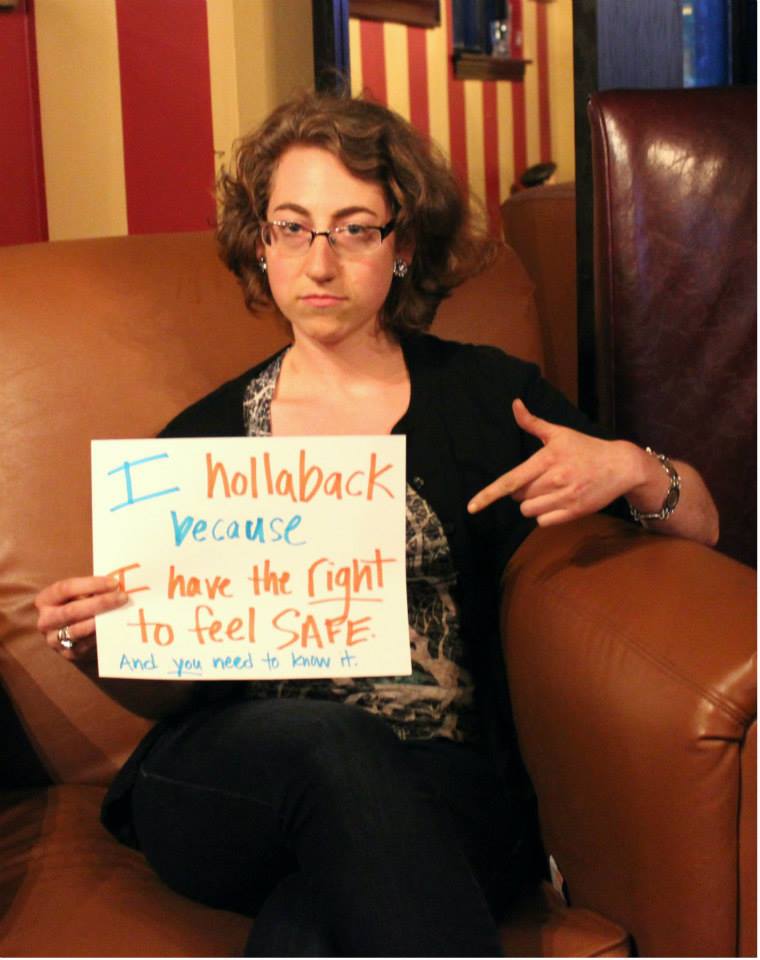
“I Hollaback because I have the right to feel safe. And you need to know it.” – Becca

Harassment is largely taking place on the street (97%), on the MBTA (63%),  in bars or clubs (37%),  in public parks (32%), and at  school (14%).  Not surprisingly, those respondents experiencing harassment said it made them feel angry (85%), nervous (80%) , annoyed (78%), disgusted  (72%) , and scared (64%).   And for  those who claim street harassment is enjoyable for the victim, or that it is not a big deal, only 14% of respondents said  they were ‘flattered’, and only4% said street harassment ‘didn’t bother’ them.  While the report refrained from editorializing, I’d like to note that while some respondents were flattered or not bothered, it is impossible to tell whether the person you’re seeing on the street will be nervous or flattered by the attention, so it’s best to err on the side of caution (and the numbers) and treat everyone as though they wouldn’t like it.

Like many working in this space, Hollaback! Boston sees bystander intervention as a key tool to combat street harassment.  Unfortunately, only 14% of respondents reported an instance of someone intervening on their behalf.   As a result, Hollaback! suggests the, “creation of a public education campaign that focuses on tangible ways that people can safely intervene.”

The data is likely unsurprising to readers of this site and fans of Hollaback’s work, but it is incredibly valuable to have hard statistics to show to potential partners moving forward.  For example, given that 63% of respondents reported feeling harassed on the MBTA, the report’s suggestion of an ad campaign (similar to that created by Hollaback! Philadelphia and run on SEPTA trains), training for MBTA employees on how to respond to street harassment, and an awareness campaign (à la “See Something, Say Something”) about available reporting mechanisms may all be seen as higher priorities by MBTA officials.  Moreover, while Hollaback! makes several suggestions moving forward, they are all constructive and include next steps for themselves as an organization.  Hopefully this approach will continue to be successful as they use their model of presenting a problem and a potential solution that includes their assistance at the same time.

I hope that other Hollaback! branches and similar organizations are able to conduct a similar survey in the future, so other cities can wield statistics that accurately reflect the unique picture of street harassment in their area.  I hope Hollaback! Boston continues to receive good local press coverage, which could pressure businesses and city officials to prioritize street harassment.  Congratulations to Hollaback! Boston, and we look forward to the implementation of the recommendations.

Delia Harrington is a recent graduate of Northeastern University and calls Boston home. In recent years, she has found herself studying, working, and volunteering in Egypt, Cuba, France, Benin, the Dominican Republic, Turkey, Germany, and Greece.  You can read more of her writing on her blog, or follow her on Facebook and Twitter, @deliamary.

Share

Filed Under: correspondents, News stories, Resources, Stories

Report: Street Harassment in Boston

September 30, 2013 By HKearl

Hollaback! Boston surveyed more than 500 people about street harassment. Check out their survey results.

Read more in the Metro. and via SSH Blog Correspondent Delia’s article.

Share

Filed Under: Resources, street harassment

Kyrgyzstan: Construction Worker Harassers

September 30, 2013 By Correspondent

By: Salidat Hamilova, in collaboration with Aikanysh Jeenbaeva, Bishkek, Kyrgyzstan, SSH Correspondents

English version:

Image via http://kloop.kg/

Among the many forms of street harassment in Bishkek, the one that deserves special attention is harassment by workers at the city’s numerous construction sites. Bishkek is currently experiencing a construction ‘boom’ (or to be more precise – a construction bubble) and the central part of the city is being rapidly developed with new ‘elite’ residential buildings, shopping malls and business centers that make these neighborhoods inaccessible to common inhabitants and push out people who have been living and working there for decades. However, this is another topic for later.

Every time you pass near one of the buildings under construction, you can count on receiving an unwanted share of attention from workers sitting above you at the level of a 3-6th floor. Upon seeing a female passerby, they express their agitation with shouts, squeals, sexist remarks, obscene gestures and sounds. You are walking along the fence separating you from the building to the accompaniment of whistles and shouts and all you want to do at that moment is for the earth to swallow you up and block out the sounds and the satisfied faces leering down at you. Actually, no. What you want at that moment is for the building to collapse and bury the harassers under its ruins.

What can explain this urge of construction workers to harass passing women and girls beside the usual sexist attitudes and beliefs? Probably, the feeling of impunity and inaccessibility granted to them by the height at which they are working. Indeed, it is highly unlikely that you would attempt to climb up the scaffolding to punish the harassers.

I am not trying to accuse all construction workers of harassing women and girls, as I am perfectly aware that many builders would never behave in such a way. Nevertheless, this kind of harassment happens regularly to the majority of women and girls. When sharing their indignation over the behavior of construction workers with me, my sisters told me that some builders even throw pebbles and pieces of rubble at them and, sometimes, splash the girls walking below with dirty water. One is forced to give these spots a wide berth to keep one’s nerves, my sisters admitted.

There are plenty of these stories: any girl/woman can talk about tens/hundreds/thousands of similar instances of harassment on the streets. However, we often simply swallow insults, suppress our anger and humiliation and try to forget about it as quickly as possible. In the end, universal suppression and disregard make street harassment invisible and thwart the fight against it.

We must stop keeping silent and running away from yet another “complimenting pebble”, we must stop avoiding “unsafe” places and limiting our space and the right to the city. Fighting against harassment on one’s own is extremely hard, therefore, Bishkek, we need to unite!

Salidat is an undergraduate student at Kyrgyz National University and a dedicated volunteer at the Bishkek Feminist Collective SQ. Aikanysh graduated from the University of Freiburg with a degree in European Literatures and Cultures and recently from the Diplomatic Academy of the KR with a degree in International Relations. Aikanysh is a co-founding member and coordinator of the Bishkek Feminist Collective SQ.

Bishkek Feminist Collective SQ was founded in 2012 by activists from various communities of Bishkek city. Follow BFC SQ on Twitter, @bish_feminists and on Facebook.


Russian version

На русском языке:

Среди многочисленных видов уличных домогательств в Бишкеке стоит особо выделить домогательства со стороны работников на стройках города. В Бишкеке сейчас идет строительный “бум” (точнее пузырь) и центральная часть города стремительно застраивается новыми “элитными” жилыми домами, торговыми и бизнес-центрами, таким образом делая эти районы недосягаемыми для простых обывателей, а также постепенно вытесняют из центра людей, которые жили и работали там десятилетиями. Но это – другая тема и о ней позже.

Так вот, каждый раз, проходя мимо очередной стройки, можно смело рассчитывать на то, что ты не останешься без ненужной доли внимания со стороны незнакомых рабочих, сидящих где-нибудь на уровне 3-6 этажа. При виде очередной прохожей они выражают свое возбуждение криками, повизгиванием, сексистскими замечаниями, непристойными жестами и звуками. А ты идешь вдоль забора, отделяющего тебя от стройки под аккомпанемент этого визга и свиста и больше всего тебе хочется провалиться под землю, чтобы ничего не слышать и не видеть эти довольные, ухмыляющиеся лица. Хотя нет, больше всего тебе хочется, чтобы здание тотчас же рухнуло и придавило всех этих крикунов под своими руинами.

Чем можно объяснить такое стремление работников строек приставать к проходящим мимо девушкам и женщинам, помимо обычных сексистских убеждений? Возможно, оно усиливается чувством безнаказанности и недосягаемости, которое дает им высота. Действительно, ведь не полезешь по лесам на верхние этажи, чтобы надавать идиотам по лицу?

Я не стремлюсь обвинять всех строителей Бишкека, так как знаю, что среди них есть и те, кто никогда не позволят себе такое поведение. Но, тем не менее, домогательства со стороны строителей происходят регулярно и почти со всеми девочками, девушками, женщинами. Моя сестренки, делясь со мной своим возмущением по поводу строителей, рассказывали, что некоторые из них кидаются камешками и мелким строительным мусором и обрызгивают проходящих девушек грязной водой. Приходится обходить эти места во избежание траты своих нервов, признались сестренки.

Таких историй полным полно: любая девушка/женщина может рассказать о десятке/сотни/тысячи случаях домогательства на улицах. Но очень часто мы просто проглатываем обиду, подавляем злость и унижение и пытаемся поскорее забыть о происшедшем. Всеобщее замалчивание и игнорирование, в итоге, делают домогательства невидимой проблемой и крайне затрудняют борьбу с ними.

Мы должны перестать молчать и убегать в то время как в нас летит очередной “камень-комплимент”, прекратить обходить «небезопасные места», ограничивая себя в пространстве и праве на город. Бороться с пониманием домогательства как нормы в одиночку очень сложно, поэтому, Бишкек, давай объединяться!

Салидат, в сотрудничестве с Айканыш.


Share

Filed Under: correspondents, Stories

« Previous Page
Next Page »

Share Your Story

Share your street harassment story for the blog. Donate Now

From the Blog

  • #MeToo 2024 Study Released Today
  • Join International Anti-Street Harassment Week 2022
  • Giving Tuesday – Fund the Hotline
  • Thank You – International Anti-Street Harassment Week 2021
  • Share Your Story – Safecity and Catcalls Collaboration

Buy the Book

Search

Archives

  • September 2024
  • March 2022
  • November 2021
  • April 2021
  • March 2021
  • January 2021
  • April 2020
  • March 2020
  • February 2020
  • December 2019
  • November 2019
  • September 2019
  • August 2019
  • July 2019
  • June 2019
  • May 2019
  • April 2019
  • March 2019
  • February 2019
  • January 2019
  • December 2018
  • November 2018
  • October 2018
  • September 2018
  • August 2018
  • July 2018
  • June 2018
  • May 2018
  • April 2018
  • March 2018
  • February 2018
  • January 2018
  • December 2017
  • November 2017
  • October 2017
  • September 2017
  • August 2017
  • July 2017
  • June 2017
  • May 2017
  • April 2017
  • March 2017
  • February 2017
  • January 2017
  • December 2016
  • November 2016
  • October 2016
  • September 2016
  • August 2016
  • July 2016
  • June 2016
  • May 2016
  • April 2016
  • March 2016
  • February 2016
  • January 2016
  • December 2015
  • November 2015
  • October 2015
  • September 2015
  • August 2015
  • July 2015
  • June 2015
  • May 2015
  • April 2015
  • March 2015
  • February 2015
  • January 2015
  • December 2014
  • November 2014
  • October 2014
  • September 2014
  • August 2014
  • July 2014
  • June 2014
  • May 2014
  • April 2014
  • March 2014
  • February 2014
  • January 2014
  • December 2013
  • November 2013
  • October 2013
  • September 2013
  • August 2013
  • July 2013
  • June 2013
  • May 2013
  • April 2013
  • March 2013
  • February 2013
  • January 2013
  • December 2012
  • November 2012
  • October 2012
  • September 2012
  • August 2012
  • July 2012
  • June 2012
  • May 2012
  • April 2012
  • March 2012
  • February 2012
  • January 2012
  • December 2011
  • November 2011
  • October 2011
  • September 2011
  • August 2011
  • July 2011
  • June 2011
  • May 2011
  • April 2011
  • March 2011
  • February 2011
  • January 2011
  • December 2010
  • November 2010
  • October 2010
  • September 2010
  • August 2010
  • July 2010
  • June 2010
  • May 2010
  • April 2010
  • March 2010
  • February 2010
  • January 2010
  • December 2009
  • November 2009
  • October 2009
  • September 2009
  • August 2009
  • July 2009
  • June 2009
  • May 2009
  • April 2009
  • March 2009
  • February 2009
  • January 2009
  • December 2008
  • November 2008
  • October 2008
  • September 2008
  • August 2008
  • July 2008
  • June 2008
  • May 2008

Comment Policy

SSH will not publish any comment that is offensive or hateful and does not add to a thoughtful discussion of street harassment. Racism, homophobia, transphobia, disabalism, classism, and sexism will not be tolerated. Disclaimer: SSH may use any stories submitted to the blog in future scholarly publications on street harassment.
  • Contact
  • Events
  • Join Us
  • Donate
  • Facebook
  • Instagram
  • Pinterest
  • Tumblr
  • Twitter
  • YouTube

Copyright © 2026 Stop Street Harassment · Website Design by Sarah Marie Lacy