• About Us
    • What Is Street Harassment?
    • Why Stopping Street Harassment Matters
    • Meet the Team
      • Board of Directors
      • Past Board Members
    • In The Media
  • Our Work
    • National Street Harassment Hotline
    • International Anti-Street Harassment Week
    • Blog Correspondents
      • Past SSH Correspondents
    • Safe Public Spaces Mentoring Program
    • Publications
    • National Studies
    • Campaigns against Companies
    • Washington, D.C. Activism
  • Our Books
  • Donate
  • Store

Stop Street Harassment

Making Public Spaces Safe and Welcoming

  • Facebook
  • Instagram
  • Pinterest
  • Tumblr
  • Twitter
  • YouTube
  • Home
  • Blog
    • Harassment Stories
    • Blog Correspondents
    • Street Respect Stories
  • Help & Advice
    • National Street Harassment Hotline
    • Dealing With Harassers
      • Assertive Responses
      • Reporting Harassers
      • Bystander Responses
      • Creative Responses
    • What to Do Before or After Harassment
    • Street Harassment and the Law
  • Resources
    • Definitions
    • Statistics
    • Articles & Books
    • Anti-Harassment Groups & Campaigns
    • Male Allies
      • Educating Boys & Men
      • How to Talk to Women
      • Bystander Tips
    • Video Clips
    • Images & Flyers
  • Take Community Action
  • Contact

Harassed in Fort Wayne, IN

July 27, 2012 By Contributor

While street harassment is pretty common for me now (unfortunately), this situation continues to make me uncomfortable and is escalating into fear. This happens in many places, but mostly before or after school.

There is an older boy (a junior or senior) in my marching band that decided to hit on me last year. I told him to get lost, but he continues to hit on me even though I’ve made it clear I dislike him. He stares at me constantly, even when I’m not wearing anything flattering, follows me on occasion, messages me consistently, and tries to control me verbally. He started out trying to be nice, but his behavior has become more disturbing, his staring more obvious, and he’s becoming very verbally aggressive. While I could easily hold my own in a verbal battle, the fact that I am the only girl he hasn’t given up on and speaks to venomously is troubling for me. As he plays tuba, he could very easily outpower me (an alto saxophone player). I do not feel safe around the band at all, especially if he’s nearby.

I think it would be very helpful if the school would take it more seriously. People have put keys down my top during class and stared at my bust an entire class and the school didn’t do anything, even when I reported. It’s very disturbing.

– Anonymous

Location: Fort Wayne, Indiana

Share your street harassment story today and help raise awareness about the problem.
Find suggestions
for what YOU can do about this human rights issue.

Share

Filed Under: Stories

Egyptians Mobilize Against Sexual Harassment

July 27, 2012 By HKearl

Photos from the event:

“On a hot Sunday night in Cairo, a woman wearing jeans, a loose black sweater, and a white hijab stood on an outdoor stage, quietly speaking into a microphone to share her experiences of sexual violence. Only by standing with her back to the audience of more than 100 people could she muster the courage to talk. As soon as she left the stage, her friends surrounded her, hugging her, and comforting her. Then, another woman took the stage to tell her story.

During a recent trip to Egypt, I saw dozens of brave women and their male allies share their stories and thoughts about sexual violence, especially street harassment, at an event organized by Darb 1718, BuSSy, HarassMap, and Mashrou3 Mareekh. Using spoken word, song, and an open mic session, they clearly moved the audience, more than a third of them men. May Shehab, the director of Darb 1718, said she heard a number of men say they felt angry and wanted to do take action.

Their consciousness was also raised through visual art as in an exhibit entitled “Enough.” Before the spoken word began, people clustered together to view commentary about sexual harassment in mediums of chalk, colored pencils, photographs and videos.

“I’m a firm believer in using art as a vehicle for activists. It’s a way to start dialogues,” said Heba Habib, a HarassMap volunteer and co-organizer of “Enough.” Shehab agreed, calling art “one of the most effective ways to tackle harassment [because]…it evokes thought and debate.”

For Shehab, a photographic piece by Nahla Sebaei entitled “Burning Soul” was the most compelling. In four frames, a partially nude woman dressed in paper clothing is covered with flaming hand marks where harassers touched her. The caption reads, “When someone harasses me…he is burning my soul and that leaves scars in my mind and my feeling and my soul.” Shehab said she heard several people say the image perfectly captured how street harassment makes them feel.”

This is an excerpt from an article I wrote for the Women’s Media Center. Read the full article on their website.

Video from the event:

Share

Filed Under: street harassment

Belgium Documentary: “Femme de la rue”

July 27, 2012 By HKearl

College student Sofie Peeters decided to focus her thesis on sexism in the streets of Brussels (AKA street harassment) and created a documentary about it. Here is a preview of it, Femme de la rue.

Share

Filed Under: street harassment Tagged With: belgium, documentaries, street harassment

“Then of course they harassed us”

July 26, 2012 By HKearl

Around midnight on Saturday, a new female friend and I walked one block to a pub in Elmswell, UK, so we could use the restroom. We were back early from a wedding reception to “decorate” our friend’s (the bride) camper and we were locked out of the house until everyone else returned.

We chatted and laughed as we walked until a group of 10 drunk teenage boys loitering along the road talked to us. At first all they said were hello’s and even though I felt like they were about to harass us, we politely said hello back. And then of course they harassed us. It was the typical “yeah baby,” and “ooh sexy” crap.

I paused and shouted, “Hey, don’t harass us,” and then there was silence. But then one of them said (I think), “That’s a shit haircut.” Which is funny since our hair looked great since we’d just left a wedding (though we were no longer in wedding attire, just sweatshirts and pants). Maybe he said something else. I don’t know. We just kept walking.

After using the restroom, we met up with three other friends who’d walked to the Pub separately, including two men. When we told them what happened (and I said, see, that’s what I’m always speaking out against!) they said we needed to walk back together in a group, strength in numbers, blah blah.  So we did.

The harassers started off with their hello’s again, but this time we did not fall for it and ignored them and they basically left us alone. Oh except one of them started following us. We turned into our friend’s long driveway and watched from the shadows to make sure he kept on going.

I studied abroad in the UK seven years ago, and I eventually stopped going out with my flatmates to pubs and clubs because I got so sick of the harassment. At the clubs, many men had no problem grabbing you or grinding on you without warning or asking for your consent. I was in the UK just over 48 hours on this visit and I was disappointed I had to deal with some of the same crap.

I was also sorry that the woman I was harassed with (a very nice mutual friend of the bride I had not met before), who runs and travels alone a lot, was so resigned to the behavior. “There are places I know I can’t go alone as a woman,” she said. And I said, “But isn’t that messed up? Shouldn’t we be allowed to go anywhere and not have to worry about harassment or assault? Why is that just accepted?” And she thought about it and agreed.

– Holly

Location: Elmswell, Suffolk, UK

Share your street harassment story today and help raise awareness about the problem.
Find suggestions
for what YOU can do about this human rights issue.
Share

Filed Under: Stories, street harassment

I Rode the Ladies-Only Subway Car in Cairo

July 25, 2012 By HKearl

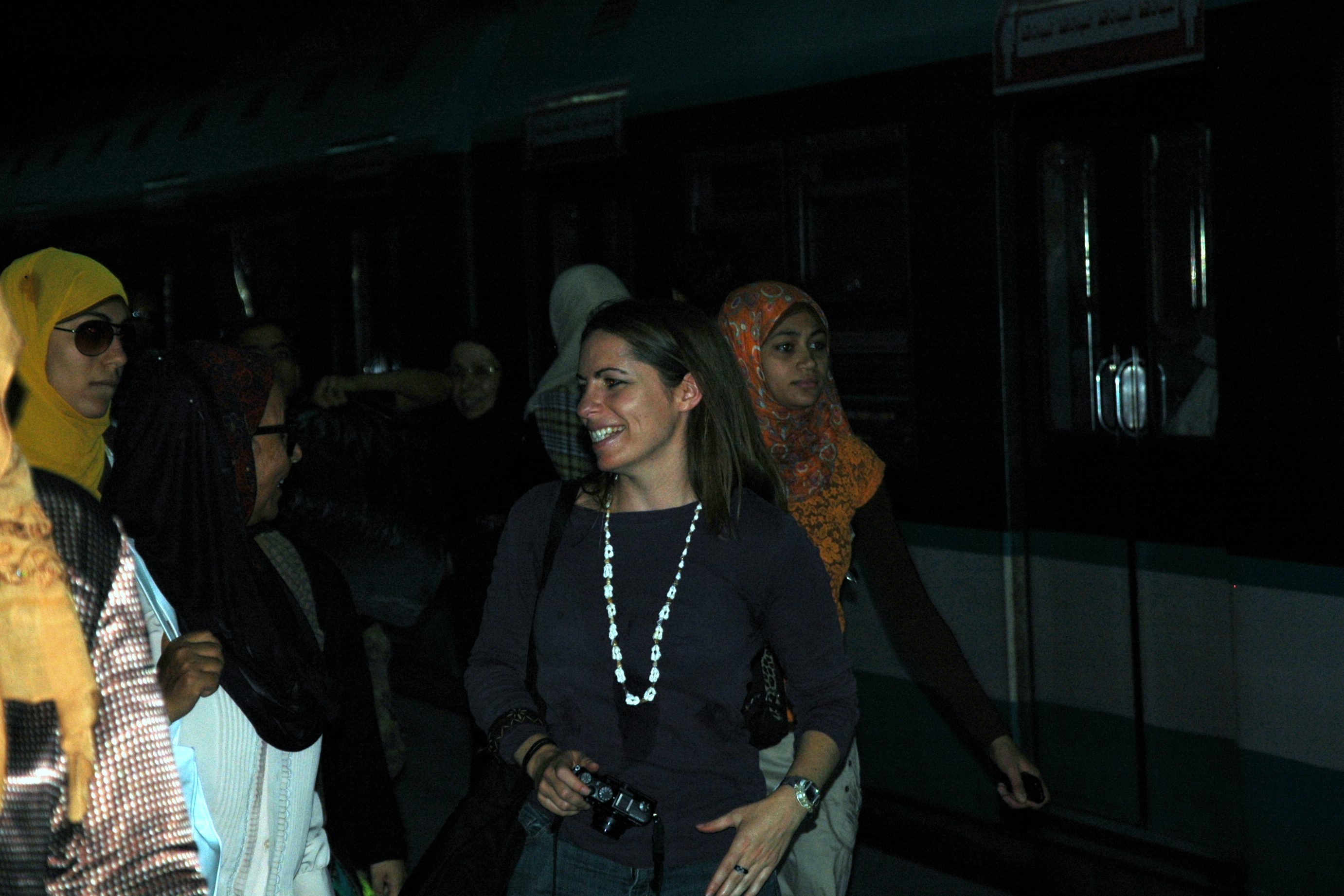
Women ahead of me board the Ladies-Only Car in Cairo

Recently I went to Egypt for a vacation with my dad. It was a great trip full of history, culture, and meetings with anti-street harassment activists. When we had two hours free on our last afternoon, I suggested we take a subway ride.

I’ve spoken, read, and written about women-only public transportation for years, but I’d never actually seen one before. I wanted to. I knew Cairo had women-only subway cars.

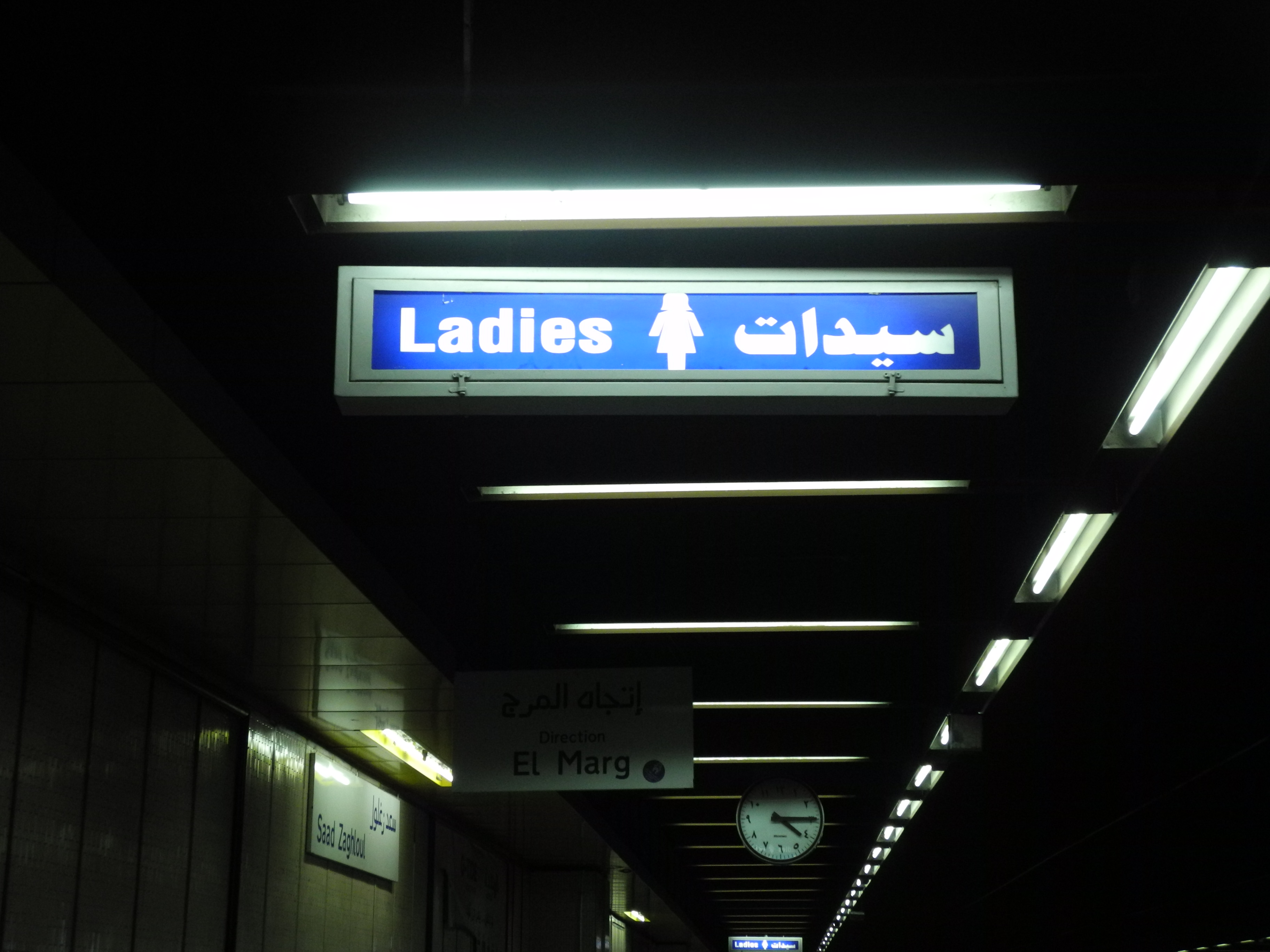
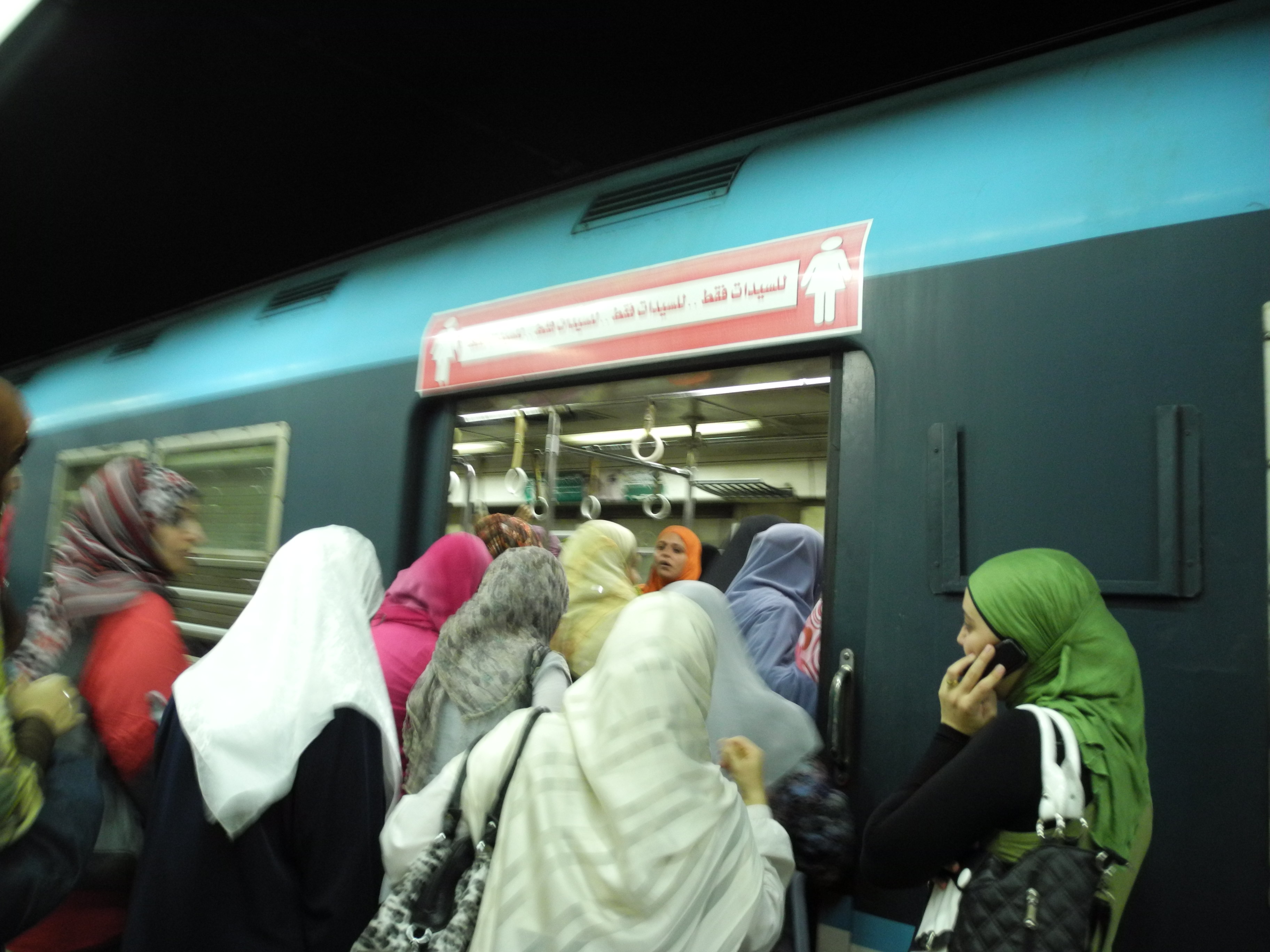
On a crowded subway platform in downtown Cairo on a Wednesday afternoon, groups of Egyptian women clustered together under brightly lit blue signs that read, “Ladies,” while men and a few women spread out across the rest of the platform. Once a subway train arrived, everyone rushed to board. Most women piled into the “Ladies Only” cars, designated by red signs above the doors. I joined them.

A few women assisted me when my bag got stuck in the closing doors. While it is not unusual to see women without head coverings on the streets, on the subway, as I looked around, every woman was wearing a hijab. Sweat poured from our faces because the car had no air conditioning on a 110 degree day. No one talked, but one woman, who was getting off at the next stop, gestured to offer me her seat. I thanked her, but I didn’t take the seat as I got off at the next stop too.

Talking with the nice woman who wished me a good visit when I got off the Ladies-Only car

Leaving the train, masses of bodies churned past each other. One woman sought me out and spoke to me in English, asking where I was from and wished me a nice stay.

Next, I rode in a regular car where I was one of only three women among a mass of men. The two other women were accompanied by men who protectively wrapped their arms around them. I felt much less comfortable there than I did in the ladies-only car, in part because I was so out of place. While most men left me alone, one man standing next to me stared at me the entire two minutes. I avoided making eye contact with him and was relieved to leave the train at the next stop.

Most people in the United States are shocked when I tell them that other countries have resorted to women-only public transportation because sexual harassment is so bad. From the research I did for my book about street harassment, I know that countries ranging from Japan and Mexico to India and Egypt have subway cars and/or buses reserved just for women in their major cities.

While I’ve heard women say they are glad when they can ride in the women-only cars and take a break from being on guard and wary of male passengers, I don’t believe it should be the solution. The solution should be an end to harassment!

First, logistically, segregation does not solve the problem of harassment. Often the women-only transportation is only offered during rush hour and on major lines, throughout the day and city, most women must use the regular trains and buses. Platforms and bus lines are not fully sex segregated, nor are the streets people walk to reach the buses or subways, so there are plenty of opportunities to endure harassment. Sometimes men just get on the women-only cars anyway. (An Egyptian woman on Twitter just told me that a group of feminists in Egypt take videos of men who ride in the ladies-only car and post them on this YouTube Channel.)

The platform sign in Cairo

Second, from a gender equality standpoint, it’s a frustrating that governments think the solution is gender segregation. Don’t we want integration and equality? Would segregation ever be considered a solution for race-based harassment? Why is it when it comes to men sexually harassing women? (If we do have to have sex segregation, should it be to segregate the harassers into their own subway cars and buses? Once you harass, you get stamped so everyone knows where you belong?!)

Instead, I think the governments and community groups should focus more effort on teaching respect in the schools, holding awareness campaigns, encouraging people to report harassers, and enforcing punishments for the worst perpetrators.

In Washington, DC, I am proud that I recently helped pressure the transit authority to do something about sexual harassment on our Metro train and bus system. At the suggestion of myself and others organized by Collective Action for Safe Spaces, the transit authority launched an anti-harassment public service announcement campaign, improved their employee trainings, and created an email address and online report form for incidents of harassment. These tactics do not place the onus on women alone to stay safe (e.g. some men say if women aren’t in the women-only cars, they’re “fair game” for harassment) and they provide people with constructive ways to deal with harassment.

What are your thoughts about women-only public transportation?

Share

Filed Under: street harassment Tagged With: Cairo, Egypt, ladies-only, women-only public transportation

« Previous Page
Next Page »

Share Your Story

Share your street harassment story for the blog. Donate Now

From the Blog

  • #MeToo 2024 Study Released Today
  • Join International Anti-Street Harassment Week 2022
  • Giving Tuesday – Fund the Hotline
  • Thank You – International Anti-Street Harassment Week 2021
  • Share Your Story – Safecity and Catcalls Collaboration

Buy the Book

Search

Archives

  • September 2024
  • March 2022
  • November 2021
  • April 2021
  • March 2021
  • January 2021
  • April 2020
  • March 2020
  • February 2020
  • December 2019
  • November 2019
  • September 2019
  • August 2019
  • July 2019
  • June 2019
  • May 2019
  • April 2019
  • March 2019
  • February 2019
  • January 2019
  • December 2018
  • November 2018
  • October 2018
  • September 2018
  • August 2018
  • July 2018
  • June 2018
  • May 2018
  • April 2018
  • March 2018
  • February 2018
  • January 2018
  • December 2017
  • November 2017
  • October 2017
  • September 2017
  • August 2017
  • July 2017
  • June 2017
  • May 2017
  • April 2017
  • March 2017
  • February 2017
  • January 2017
  • December 2016
  • November 2016
  • October 2016
  • September 2016
  • August 2016
  • July 2016
  • June 2016
  • May 2016
  • April 2016
  • March 2016
  • February 2016
  • January 2016
  • December 2015
  • November 2015
  • October 2015
  • September 2015
  • August 2015
  • July 2015
  • June 2015
  • May 2015
  • April 2015
  • March 2015
  • February 2015
  • January 2015
  • December 2014
  • November 2014
  • October 2014
  • September 2014
  • August 2014
  • July 2014
  • June 2014
  • May 2014
  • April 2014
  • March 2014
  • February 2014
  • January 2014
  • December 2013
  • November 2013
  • October 2013
  • September 2013
  • August 2013
  • July 2013
  • June 2013
  • May 2013
  • April 2013
  • March 2013
  • February 2013
  • January 2013
  • December 2012
  • November 2012
  • October 2012
  • September 2012
  • August 2012
  • July 2012
  • June 2012
  • May 2012
  • April 2012
  • March 2012
  • February 2012
  • January 2012
  • December 2011
  • November 2011
  • October 2011
  • September 2011
  • August 2011
  • July 2011
  • June 2011
  • May 2011
  • April 2011
  • March 2011
  • February 2011
  • January 2011
  • December 2010
  • November 2010
  • October 2010
  • September 2010
  • August 2010
  • July 2010
  • June 2010
  • May 2010
  • April 2010
  • March 2010
  • February 2010
  • January 2010
  • December 2009
  • November 2009
  • October 2009
  • September 2009
  • August 2009
  • July 2009
  • June 2009
  • May 2009
  • April 2009
  • March 2009
  • February 2009
  • January 2009
  • December 2008
  • November 2008
  • October 2008
  • September 2008
  • August 2008
  • July 2008
  • June 2008
  • May 2008

Comment Policy

SSH will not publish any comment that is offensive or hateful and does not add to a thoughtful discussion of street harassment. Racism, homophobia, transphobia, disabalism, classism, and sexism will not be tolerated. Disclaimer: SSH may use any stories submitted to the blog in future scholarly publications on street harassment.
  • Contact
  • Events
  • Join Us
  • Donate
  • Facebook
  • Instagram
  • Pinterest
  • Tumblr
  • Twitter
  • YouTube

Copyright © 2026 Stop Street Harassment · Website Design by Sarah Marie Lacy