• About Us
    • What Is Street Harassment?
    • Why Stopping Street Harassment Matters
    • Meet the Team
      • Board of Directors
      • Past Board Members
    • In The Media
  • Our Work
    • National Street Harassment Hotline
    • International Anti-Street Harassment Week
    • Blog Correspondents
      • Past SSH Correspondents
    • Safe Public Spaces Mentoring Program
    • Publications
    • National Studies
    • Campaigns against Companies
    • Washington, D.C. Activism
  • Our Books
  • Donate
  • Store

Stop Street Harassment

Making Public Spaces Safe and Welcoming

  • Facebook
  • Instagram
  • Pinterest
  • Tumblr
  • Twitter
  • YouTube
  • Home
  • Blog
    • Harassment Stories
    • Blog Correspondents
    • Street Respect Stories
  • Help & Advice
    • National Street Harassment Hotline
    • Dealing With Harassers
      • Assertive Responses
      • Reporting Harassers
      • Bystander Responses
      • Creative Responses
    • What to Do Before or After Harassment
    • Street Harassment and the Law
  • Resources
    • Definitions
    • Statistics
    • Articles & Books
    • Anti-Harassment Groups & Campaigns
    • Male Allies
      • Educating Boys & Men
      • How to Talk to Women
      • Bystander Tips
    • Video Clips
    • Images & Flyers
  • Take Community Action
  • Contact

“You changed your mind about the bus? I was coming back for you!”

March 19, 2012 By Contributor

“Standing at the bus stop in the middle of 51st st, i must really look like the rose that grew from concrete. Ninjas in cars ninjas on corners say things meant to pass for compliments. I wonder would they know what to do with a garden or would they snatch and pluck the petals cuz they aint had nuthin nice before.”

That was my Facebook status last Saturday. I wasn’t wearing anything low cut, tight fitting, “inviting”, nor was I naked, but somehow I ended up feeling totally exposed.

I’m not the thickest crayon in the box or the most gorgeous of them all mirror on the wall, but sometimes–like when I’m standing at the bus stop with men yelling and honking from their cars, or watching me from across street corners and the bus conveniently decides to run beyond behind schedule–I wish I was a little more unpretty.

The other day, I asked a friend of mine for a ride because I was wearing make up that day and told him that it wasn’t a good idea for me to be on public transportation and traveling on foot around my neighborhood looking too cute. I think he may have thought I was joking, but I was serious.

I have no problem with compliments, or even a SHORT lustful glance, but with some men it doesn’t stop there. Some will circle the block…walk with (err, follow?) you…stand with you…invade your personal space while engaging in unwarranted conversation.

I remember being a little girl and ignoring the cat calls while I was walking to the store or out playing. It only takes so many times of hearing, “Well f**k you then!” or “B***h!” before you figure out that maybe ignoring the problem won’t make it go away. I learned to speak and be friendly (because God forbid my lack of acknowledgment be misconstrued as an overall dismissal of the BLACK MAN and I am the ANGRY BLACK WOMAN, oh no).

But even in speaking, extending that common courtesy of speaking when spoken to is sometimes interpreted as an invitation. I just want to get on the bus, man. I just want to get where I’m going and look how I look. And I want that to be okay. Even dressing “down” isn’t enough. I’d have to dress down to looking like a crackhead, I suppose.

Walking these streets, I think a lot about little girls. I think about little girls with grown women bodies who are getting the same attention I get when I’m at the bus stop. Those thoughts scare me. Our little girls just want to get to school. Or to their Granny’s house.They just want to get where they’re going and look how they look. And they want that to be okay. I want that for them.

When I saw a bus coming in the opposite direction, I ran across the street to catch it. Figured it’d be better to go out of my way and ride it all the way back around than stand on that corner waiting for it to circle back. Before I got on, a dude yelled out, “You changed your mind about the bus? I was coming back for you!”

When the bus circled back, he was standing at the bus stop where I had been.

Originally published on ChicagoNow.com in my blog, My So-Called Writer’s Life.

– Sandria Washington

Location: Chicago, IL, South Side bus stop in 2011

Share your street harassment story today and help raise awareness about the problem.
Find suggestions
for what YOU can do about this human rights issue.

Share

Filed Under: anti-street harassment week, Stories, street harassment

Street harassment and the dehumanization of sex workers

March 19, 2012 By Contributor

Editor’s Note: This guest blog post is written by Jessie Nicole, the current director of Sex Workers Outreach Project – Los Angeles, a nonprofit dedicated to ending violence and stigma against everyone in the sex industry and a co-sponsor of International Anti-Street Harassment Week. She earned her BA in English Literature from Florida State University and her MA in Humanities, focusing on the literature of Social Justice, from the University of Chicago. She lives in Los Angeles with her partner and their turtle, Walter.

Though I’ve experienced street harassment periodically since the time I hit puberty, one of my most memorable incidents occurred in 2009, the summer after I finished my MA. I had a cold, and was waiting in line at the bank with unkempt hair and snot dripping from my nose. An older man behind me started making small talk about the muggy Chicago weather, and despite my obvious refusal to engage in conversation, then suggested that he could increase the zeroes on my deposit slip if we came to a sort of “arrangement”. His tone and expression left little doubt what kind of arrangement he was referring to.

What this man had no way of knowing was that I was working as a full time escort at the time of that encounter. I bitterly wondered if I had a neon “whore” sign above my forehead only visible to the rest of the world. Though I was working in the sex industry at the time, this was not a professional situation. In retrospect, I can’t help but wonder how he would have reacted had I brazenly informed him of my rates. But I was ill and therefore taking time off work. This was not a consensual negotiation, nor a conversation I had entered willingly. And that is what made it harassment. I did not consent to engage in any sort of sexual negotiation.

Consent does not fluctuate depending on what someone does for a living (or is wearing, or has said previously, or chooses sexually). Whether or not someone works in the sex industry has no bearing on their ability to consent to sexual attention. While this incident in the bank was relatively minor, it is representative of a larger assumption about the accessibility of bodies, particularly sex workers’ bodies. There is a difference between consensual sex work and sexual assault, and it should not be difficult to distinguish between them. Jill Brennerman’s account of her experience as a sex worker and rape victim explicitly shows the line between a consensual sexual transaction and rape (trigger warning : graphic description of sexual assault).

The myth that sex workers cannot be sexually harassed or assaulted is rooted in the misperception that sex workers are not fully rounded people, but rather defined solely by the industry they work in. And that perception has very real and dangerous consequences. Alana Evans, when speaking about her experience with the LAPD as a rape victim, tells how she was dismissed based on her occupation.  A quick scan of the comments on the video shows that this seems to be a common perception. Because she is a sex worker, she is somehow “unrapeable.”

The dehumanization of sex workers only intensifies for people of color, those participating in outdoor sex work, and trans* or queer folk. This violence and harassment is not only socially sanctioned, but institutional. A 2006 survey conducted by a DC outreach organization that focuses on outdoor sex workers revealed that “90 percent of 149 respondents had experienced violence… and almost half said that they had been treated badly when they had sought help from somewhere (not just from police.)” While the jump from street harassment to violence against sex workers may seem extreme, the commonality of violence against sex workers should illustrate how for our community, street harassment is deeply threatening.

I should not have contemplated what I had done for a man I had never met to proposition me at the bank. It shouldn’t matter to this story that I was obviously sick and wearing sweat pants and an old t-shirt. No one should have to expect to experience sexual harassment in public as I and many others do. Sometimes it is less scary than others. Sometimes I am angrier than others. But being a sex worker has given me an entirely new perspective. I’m frequently told that I have no right to that fear or anger in response to harassment. I have nothing but rage and contempt for the underlying system that labels some bodies as having more value, and the bodies of sex workers as public domain.

Share

Filed Under: anti-street harassment week Tagged With: street harassment, SWOP-LA

Anti-Street Harassment Week Day 1 – Blogs

March 18, 2012 By HKearl

(These are a few posts I saw today…I know I must have missed a lot so please add a link in the comments if you posted on 3/18 for anti-street harassment week!)

Chicago NOW:

“…For some men, I think being female is enough to warrant
their attention. During my same walk through Oak Park, I got “holla’d” at by a group of men that were gathered at least a block and a half away from where I was walking. A block and half. Who does that? Apparently those dudes. They couldn’t see my face to gauge my attractiveness. I was wearing a long Maxi dress, with a jacket tied around my waist, so they really couldn’t see my figure. The ability to see me from that distance and make out that I was a woman was enough to garner all types of “Hey ma! Hey ma! Yooooooo! Slow up!” from them.

I lived to tell about it, but 16-year-old Adilah Gaither wasn’t so lucky. Black Woman Walking is dedicated to the memory of young Adilah, who was shot and killed in 1998 while standing at a bus stop because she wouldn’t give a boy who was trying to holla her phone number. Almost as heartbreaking as the incident itself is the fact that there is very little information about Adilah’s story on the Internet. In 1998, social media wasn’t a phrase in most people’s vocabulary, so it’s not surprising. It is still very unfortunate, nonetheless.

I hope that during this 2012  observance of International Anti-Street Harassment Week (March 18-24) women and men will take time to talk candidly about street harassment and send a prayer up for Adilah and all the young girls and women like her just trying to walk through life unharmed.”

Black Feminist UK:

“Since puberty – not adulthood, PUBERTY- I have been routinely subject to sexual, agressive comments by men in the street, on public transport, in the workplace, day and night. Walking home from work, I run a gauntlet of barber shops, pubs, cafes, bookies, outside each one a group of men smoking, watching, staring, every day every day (please please please don’t notice me, please don’t say anything to me)…

Sometimes, men have touched me around my waist, breasts, arse… often, without speaking to me (not that it makes a difference). Once, in a bar a man grabbed me between my legs – labia, everything – then laughed when I turned around: “I was only joking…you’re really fit…”

NYE man also probably thought he was paying me a compliment of some sort. Or maybe he thought that because I was walking down the street (our streets!) on my own I was also up for a shag. I don’t know. Someone explain it to me please. Where are the men – the good ones, right? the ones I’m mates with, yeah? – speaking to other men and calling them out for what this is? HARASSMENT.”

Makings of Me:

“…So my experience last week brought me back to that place as a young 12 year old girl afraid of the leering eyes of adult men.  Devising different ways to walk home to avoid the harassment. Internalizing the cat calls and blaming myself, thinking “maybe if I would not have worn those pant, he would not have said that to me”. Believing my worth lied in how I was shaped and nothing more. But above all else feeling violated, ashamed and unsafe. This cycle must end. We must hold each other accountable. We must create sisterhoods and brotherhoods among each other where safe spaces exist.”

International Planned Parenthood Federation Western Hemisphere Region:

“…Based in Argentina and coordinated by Redmujer, the Cities Without Violence Against Women, Safe Cities For All project is being carried out in several urban areas throughout Latin America — such as Brazil, Chile, Colombia, El Salvador, Guatemala, and Peru. “The project is based on an assessment that shows that public safety policies in Latin America do not take into account violence against women in both the public and private spheres,” said Liliana Rainero.

After the assessment is complete, Redmujer will present city officials with concrete strategies on how to design safer cities. In the meantime, they are also engaged in public awareness campaigns and provide safety training for women, young people, and the police. Some local organizations involved in the project have also started neighborhood revitalization and public art projects to bring the community together to fight violence against women.”

The Broken Doll House:

“…Now, 16 years on, I am openly furious about street harassment. For me this has included whistling, staring, shouting, whispering and following. I’m one of the lucky ones, I have not been physically groped as far too many women have…or worse (because wolf whistling is the thin end of a much bigger, more sinister wedge). On the occasion where I have mentioned my disgust at this to others, I have on far too many times been met with ‘but you like it really don’t you?’, ‘take it as a compliment’, or ‘it’s just flattery’. (*SCREEEAAAMMMS!!!!!*) NO! NO! and NO! NO, no, no, no, no, no, no!!!

I don’t like it. It is not a compliment. It is not flattering. It makes me feel intimidated. It makes me feel uncomfortable and unsafe. It is uninvited and unwelcome. It is disrespectful. It is derogatory. It is sexist. It is humiliating. It is reducing me to something for you to look at and makes me feel like a piece of meat. It is not how you’d want your mother/sister/daughter/wife/girlfriend to be treated. It intrusive. It is rude. It is power play. It makes me feel like less than I am.”

Feminist Peace Network:

“…From March 18-24, 2012, thousands of women and men across the United States and throughout the world in cities such as Cairo, Delhi, Istanbul, Montreal, Oslo, and Sana’a will participate in International Anti-Street Harassment Week to collectively raise awareness about gender-based street harassment.

By age 12, nearly 1 in 4 girls worldwide experience unwanted sexual comments, leers, touches, and stalking in public places by strangers. Nearly 90 percent of women have that experience by age 19″


Share

Filed Under: anti-street harassment week

The stories behind the art work from Trinidad and Tobago

March 18, 2012 By Contributor

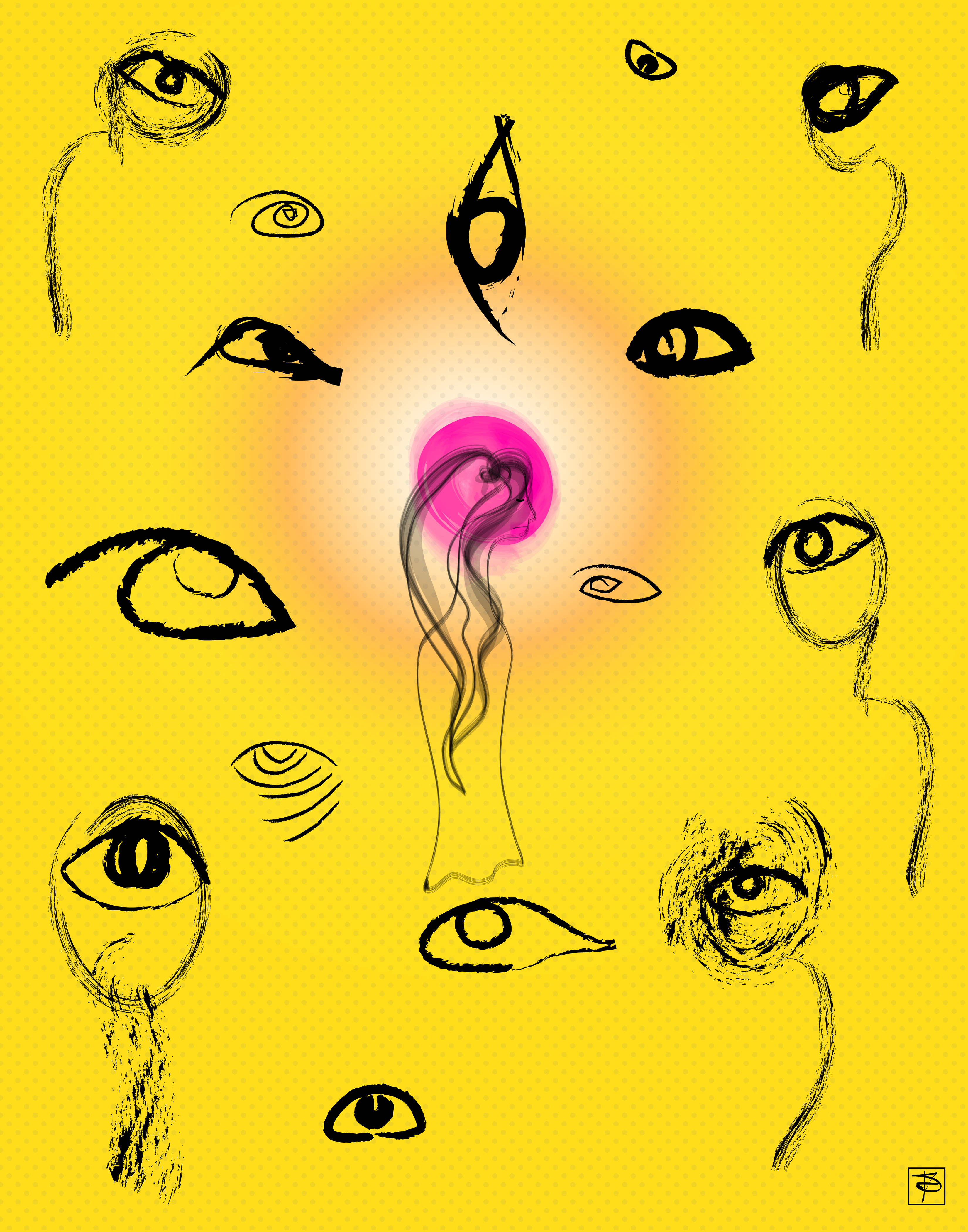
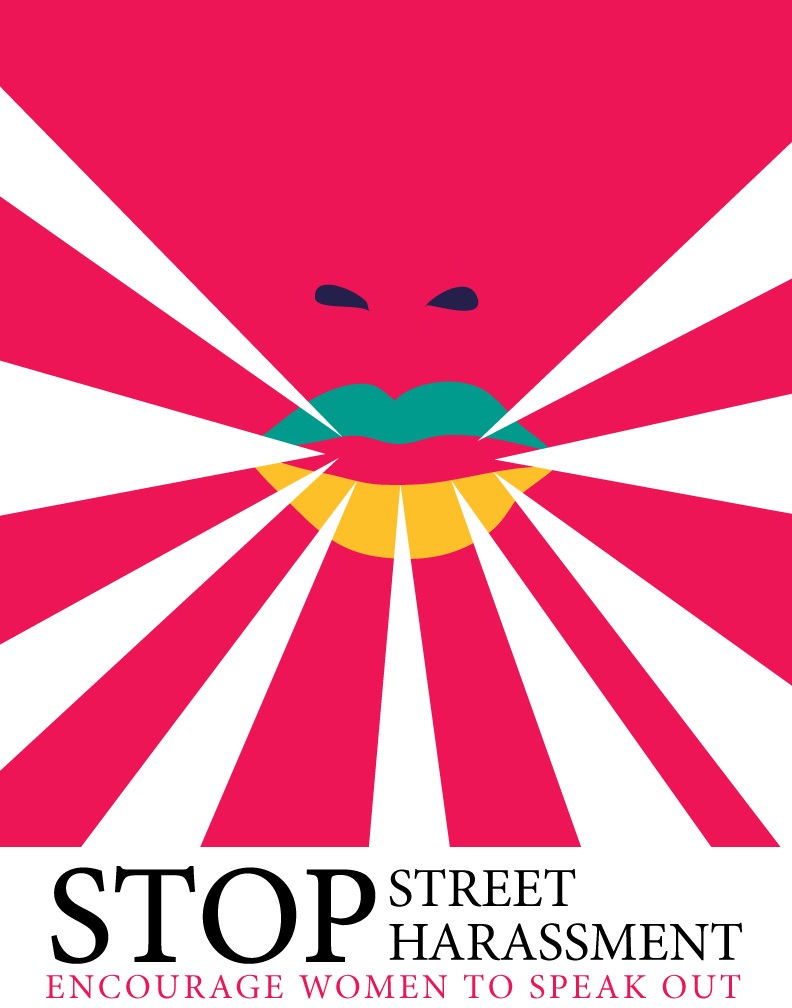
Editor’s Note: Today in Washington, DC, I’m co-curating an art exhibit on street harassment for International Anti-Street Harassment Week with the Deaf Abused Women’s Network. There are 35 pieces, including art work by high school students and from activists as far away as Yemen and Afghanistan. Tracey Chan and Stephanie Leitch each submitted work electronically for the exhibit. They guest wrote this post about their submissions.

My name is Tracey Chan and I’m a Trinidadian interdisciplinary visual artist and writer whose disciplines include drawing, illustration, and installation. I’m also involved in graphic design and art event management.

In 2011, I created an illustration as part of Simona Lee’s WomenSpeak project. I created an updated version called “Eyes” for this exhibition, which examines the daily challenges women face on the street and the negative feelings that arise with harassment incidents. It also represents my feelings of insecurity, and a stigma attached to simply walking around my own neighbourhood.

My latest project, with my art collective is an all women’s exhibition, Women Make Art: Home & Away (WOMA). WOMA 2011 celebrated International Women’s Day and was the first women’s art exhibition in Grenada. The current show, now in its second year, opens on 31st March in St. George’s, Grenada.

My name is Stephanie Leitch and I’m a social activist and conceptual artist. My work focuses on issues of gender equality both through performance and organizing. My 2011 International Women’s Day event evolved into an ongoing space for Caribbean feminist voices, WoMantra and the place where the collaboration for this project was hatched.

“Even though I got word of this project only two or three days before the deadline, it hit way too close to home for me to ignore. I have been dealing with public harassment since I was 12 years old and still in my primary school uniform. I remember a friend telling me once that she would no longer walk in the street with me because of how much attention I would get all the time. This is not a point of pride or ego booster but a sick social practice that I have had to endure for more than half my life. It has affected me deeply in many ways, from valuing it in earlier years to despising it and as a response changing aspects of my aesthetic to detract male attention. Some of these methods have stayed with me, most noticeably my decision to never wear my hair down.”

The collaborative series was created when Stephanie requested help to put several of her ideas and tags into visual format for the exhibition. Tracey then designed an image using one tag, “Encourage Women to Speak Out,” using bright colours and minimalist design to attract attention with the simple, powerful message. We will develop a series of posters from the remaining tags that may be used in future events or projects.

Share

Filed Under: anti-street harassment week

Day 1: Anti-Street Harassment Week 2012

March 18, 2012 By HKearl

2011 March at Delhi University, India, against street harassment and rape

Antaraashtriya Sarvajanik Sthal Yaun Utpiran Virodhi Saptah
“قابلونا في السارع: الأسبوع العالمي لمناهضة التحرش الجنسي
١٨-٢٤ مارس ٢٠١٢”
Encuéntranos en las calles: Semana en contra del acoso en las calles: Del 18 al 20 de Marzo del 2012
Retrouvez-nous dans la Rue: La Semaine Contre le Harcèlement dans la Rue, | le 18-24 mars 2012
Wir sehen uns auf der Strasse: Anti-Street-Harassment Woche / 18. – 24. März 2012
آئیےہمارے ساتھ معاشرے کے ہراساں کرنے والے عوامل کے خلاف ایک ہفتہ منائیں
Spotkajcie nas na ulicy: Tydzień świadomości nękania na ulicach, 18-24 Marca 2012
هفته‌ی مبارزه با آزار‌های خیابانی – ۱۳۹۰
תפגשו אותנו ברחוב: שבוע נגד הטרדה ברחוב ,מרס 18-24 2012
Повстречай нас на улице: неделя против приставаний в общественных местах / 18-24 марта 2012
Kom og møt oss på gata! 18. – 24. i mars, 2012

It’s here! It’s the first day of International Anti-Street Harassment Week and I hope you’re ready to share stories, speak out, and take action to bring attention to this human rights issue.

Here are a few of the events occurring during Day 1. If you’re in the area, the link has the location and other details, so feel free to join in!

* In Arizona, the Southern Arizona Center Against Sexual Assault will display youth-created art opposing street harassment and sexual violence in multiple library locations across the week.

* In Baltimore, MD, sidewalk chalking the city at 2 p.m.

* In Washington, DC, attending a screening and discussion of “Walking Home” at 11 a.m. and attending an art exhibit from 3-9 p.m.

* In Philadelphia, PA, attending a free self-defense class at 5 p.m.

There are several new online initiatives, too. For example:

* In the UK, there’s a new an online campaign focused on the slogan, “Flirting. Harassment. Real men Know The Difference.”

* In Malaysia, the Pixel Project launched a new section of their website about street harassment.

* In India, Breakthrough launches a bystander hero poster campaign.

* In the UK, Black Feminists published their first of 7 posts about street harassment

There will be more posts later in the day about other initiatives.

As the first day of the week begins, I want to quickly reflect on how the week came to be and thank those who made it possible:

After a great day of awareness on March 20, 2011, surveys and focus groups conducting in April led to the creation of International Anti-Street Harassment Week because people wanted more flexibility for when to hold their events.

As I have a full time job that is not focused on street harassment, this week of awareness would not be possible without a lot of help. Please see the list of names at the end of the about page for some of my main helpers. Numerous other friends offered advice on issues such as where to pitch the story, groups to reach out to, and ideas for activism. I am so grateful.

A global change requires a global effort, and that’s what’s happening. You’re part of it.

Share

Filed Under: anti-street harassment week

« Previous Page
Next Page »

Share Your Story

Share your street harassment story for the blog. Donate Now

From the Blog

  • #MeToo 2024 Study Released Today
  • Join International Anti-Street Harassment Week 2022
  • Giving Tuesday – Fund the Hotline
  • Thank You – International Anti-Street Harassment Week 2021
  • Share Your Story – Safecity and Catcalls Collaboration

Buy the Book

Search

Archives

  • September 2024
  • March 2022
  • November 2021
  • April 2021
  • March 2021
  • January 2021
  • April 2020
  • March 2020
  • February 2020
  • December 2019
  • November 2019
  • September 2019
  • August 2019
  • July 2019
  • June 2019
  • May 2019
  • April 2019
  • March 2019
  • February 2019
  • January 2019
  • December 2018
  • November 2018
  • October 2018
  • September 2018
  • August 2018
  • July 2018
  • June 2018
  • May 2018
  • April 2018
  • March 2018
  • February 2018
  • January 2018
  • December 2017
  • November 2017
  • October 2017
  • September 2017
  • August 2017
  • July 2017
  • June 2017
  • May 2017
  • April 2017
  • March 2017
  • February 2017
  • January 2017
  • December 2016
  • November 2016
  • October 2016
  • September 2016
  • August 2016
  • July 2016
  • June 2016
  • May 2016
  • April 2016
  • March 2016
  • February 2016
  • January 2016
  • December 2015
  • November 2015
  • October 2015
  • September 2015
  • August 2015
  • July 2015
  • June 2015
  • May 2015
  • April 2015
  • March 2015
  • February 2015
  • January 2015
  • December 2014
  • November 2014
  • October 2014
  • September 2014
  • August 2014
  • July 2014
  • June 2014
  • May 2014
  • April 2014
  • March 2014
  • February 2014
  • January 2014
  • December 2013
  • November 2013
  • October 2013
  • September 2013
  • August 2013
  • July 2013
  • June 2013
  • May 2013
  • April 2013
  • March 2013
  • February 2013
  • January 2013
  • December 2012
  • November 2012
  • October 2012
  • September 2012
  • August 2012
  • July 2012
  • June 2012
  • May 2012
  • April 2012
  • March 2012
  • February 2012
  • January 2012
  • December 2011
  • November 2011
  • October 2011
  • September 2011
  • August 2011
  • July 2011
  • June 2011
  • May 2011
  • April 2011
  • March 2011
  • February 2011
  • January 2011
  • December 2010
  • November 2010
  • October 2010
  • September 2010
  • August 2010
  • July 2010
  • June 2010
  • May 2010
  • April 2010
  • March 2010
  • February 2010
  • January 2010
  • December 2009
  • November 2009
  • October 2009
  • September 2009
  • August 2009
  • July 2009
  • June 2009
  • May 2009
  • April 2009
  • March 2009
  • February 2009
  • January 2009
  • December 2008
  • November 2008
  • October 2008
  • September 2008
  • August 2008
  • July 2008
  • June 2008
  • May 2008

Comment Policy

SSH will not publish any comment that is offensive or hateful and does not add to a thoughtful discussion of street harassment. Racism, homophobia, transphobia, disabalism, classism, and sexism will not be tolerated. Disclaimer: SSH may use any stories submitted to the blog in future scholarly publications on street harassment.
  • Contact
  • Events
  • Join Us
  • Donate
  • Facebook
  • Instagram
  • Pinterest
  • Tumblr
  • Twitter
  • YouTube

Copyright © 2026 Stop Street Harassment · Website Design by Sarah Marie Lacy