• About Us
    • What Is Street Harassment?
    • Why Stopping Street Harassment Matters
    • Meet the Team
      • Board of Directors
      • Past Board Members
    • In The Media
  • Our Work
    • National Street Harassment Hotline
    • International Anti-Street Harassment Week
    • Blog Correspondents
      • Past SSH Correspondents
    • Safe Public Spaces Mentoring Program
    • Publications
    • National Studies
    • Campaigns against Companies
    • Washington, D.C. Activism
  • Our Books
  • Donate
  • Store

Stop Street Harassment

Making Public Spaces Safe and Welcoming

  • Facebook
  • Instagram
  • Pinterest
  • Tumblr
  • Twitter
  • YouTube
  • Home
  • Blog
    • Harassment Stories
    • Blog Correspondents
    • Street Respect Stories
  • Help & Advice
    • National Street Harassment Hotline
    • Dealing With Harassers
      • Assertive Responses
      • Reporting Harassers
      • Bystander Responses
      • Creative Responses
    • What to Do Before or After Harassment
    • Street Harassment and the Law
  • Resources
    • Definitions
    • Statistics
    • Articles & Books
    • Anti-Harassment Groups & Campaigns
    • Male Allies
      • Educating Boys & Men
      • How to Talk to Women
      • Bystander Tips
    • Video Clips
    • Images & Flyers
  • Take Community Action
  • Contact

Attacked While Jogging

January 6, 2009 By HKearl

The New York Times reports that a woman was jogging in a park in NYC on Sunday when a man slashed her forehead with a knife and then walked away. It sounds like she went into shock and then was taken to the hospital. No one saw the attack happen and the assailant is still at large.

What a horrific experience! And all it takes is one attack like that to scare other women from going to that park or going running alone, especially since he hasn’t been caught yet. To naysayers, street harassment can be very insidious and does impact women – directly and indirectly – in the choices they make.

Also worth noting, women are much more likely to be attacked or hurt by someone they know (not true for men), but, random acts of violence against women by strangers in public like this obviously happen. The randomness does a great job of scaring women into trying to avoid places they think they will be more vulnerable (when in actuality, many of them are safer on the street than in their own home).

Will women who read this story be advised by concerned friends & family to not run alone or decide themselves not to go running alone? Probably. Will any men be advised or feel the need not to go running alone because of this story? Probably not, yet statistically, they’re more at risk of stranger attacks than women. Funny, huh?

Anyway, I hope the woman who was attacked will be okay and that the  man will not attack anyone else!

Share

Filed Under: Stories Tagged With: gracie mansion, jogging, New York City, new york times, running, slashed jogger, stranger attacks, street harassment

When your harasser is a customer or client

January 5, 2009 By HKearl

After the Rose Bowl, football player Rey Maualug went up behind Erin Andrews, a sideline reporter for the ESPN College Football Saturday telecast, and did a sexual sort of dance – without touching her – before walking on past.

[youtube=http://www.youtube.com/watch?v=4ds-Mrp0wl4]

Reading comments in the blogosphere, it is clear that (like lots of other kinds of harassment) many people saw nothing wrong with this behavior. I disagree because she obviously didn’t know it was happening and he wasn’t about to inform her, thus it was in no way a mutual sort of celebration, but one he enforced on her without her permission or awareness.

As both individuals are known to each other, I wouldn’t exactly classify his actions as street harassment or public harassment, which I tend to define as harassment between strangers in public, but I don’t know that it quite qualifies as workplace sexual harassment either.

This example illustrates a very pervasive kind of harassment that many women deal with in their jobs — harassment by customers or clients (and in this case, the people being interviewed or reported on for a story). What can someone do about a sexually harassing customer s/he is supposed to be serving without jeopardizing her/his job?

I worked in a few retail jobs as a teenager and I had my fair share of getting “hit on” by male customers (most of whom were years to decades older than me).  What could I do but giggle nervously and just hope they would go away soon? The customer is always right, right?

I just did a quick online search for any information on sexual harassment by customers, and among the few webpages I found included this: “Q: Does sexual harassment law apply to harassment by customers? A:Yes, as long as the employer knows about the offensive behavior and has a chance to fix the problem. Customer harassment is a lot like co-worker harassment. Until you speak up, the employer may not have enough reason to suspect that the company’s client is harassing you and making your job miserable.”

But how many employers are in the position to regulate customers? Unless someone is threatening or stalking an employee, in which case I could see an employer banning that person from the area, what would an employer do? Tell the customer to stop “flirting with” or harassing its employees? Will they risk losing a customer when they can probably easily find another hourly worker who won’t complain?

Have you experienced sexual harassment from customers, clients & non-coworkers/supervisors while on the job? Do you know about legal remedies for dealing with it or is it in the same realm as street harassment and is something we’re all supposed to “live with”?

Share

Filed Under: Uncategorized Tagged With: customer harassment, Erin Andrews, ESPN, ESPN College Football, Rey Mauaulug, Rose Bowl, sexual harassment, street harassment

Got a Harasser Kicked Off the Bus

December 29, 2008 By Contributor

I’ve had some pretty horrible experiences even in my (relatively) nice neighborhood. This one isn’t too bad, but it ended especially well. Once I was wearing a strapless dress on the bus. The guy behind me was obviously drooling over me and he kept saying, “boy is it ever HOT in here, WOW!” while blowing on the back of my neck. After the 3rd time (3 times too many) I turned around, smacked him across the face and told him to keep his distance. The bus driver noticed the commotion, and stopped the bus to ask us what was going on. I told him, and he took down the guy’s information, kicked him off the bus, and told me he’d report him. Yay!

Share

Filed Under: Stories Tagged With: catcalling, gendered harassment, public harassment, public transportation, sexual harassment, street harassment

New Study on Street Harassment

December 23, 2008 By HKearl

The following is from a presentation given at the annual conference of the Association for Women in Psychology entitled, “Gender-based public harassment: Avoidance, objectification, and self esteem” by Tracy Lord.

“Limited research on gender-based public harassment suggest there are multiple individual and societal effects of this harassment: increasing women’s fear of men; decreasing trust between men and women; making women ashamed of their bodies; and contributing to women’s self-objectification. Women who are objectified by men begin to self-objectify. The theories of why public harassment occurs include the male bonding theory, the social-structural theory, the sociocultural theory, and the social control theory.

The current study addressed gaps in our understanding of women’s experience of and reactions to street harassment. Women college students (n=125) from the subject pool responded to questions regarding: their public harassment experiences; the frequency with which they occur; and the feelings women have about these incidents. Participants also completed: Rosenberg Self-Esteem Scale; the Multidimensional Body-Self Relations Questionnaire – Appearance Scales; the Objectified Body Consciousness Scale; and the Mobility Inventory for Agoraphobia. Preliminary analyses indicated that street harassment in mild and moderate forms were common experiences. Women reported a range of reactions to street harassment. The complete data analysis will be reported.”

None of these findings surprise me. I look forward to reading the full report, especially the theories cited for explaining why it happens.

Share

Filed Under: Administrator Tagged With: association for women in psychology, bonding theory, gender-based public harassment, objectification, self esteem, social-structure theory, sociocultural theory, street harassment, tracy lord

Virtual Street Harassment?

December 15, 2008 By HKearl

Virtual Street Harassment?

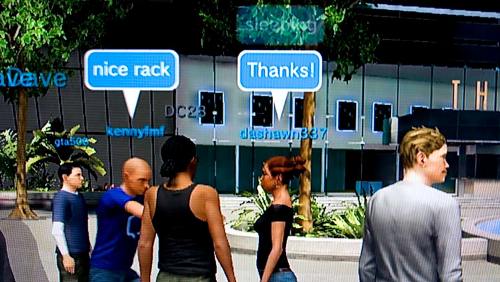
Number five on Gizmodo.com’s “10 Things You Need to Know About PlayStation Home” says “There are lots of dudes. Lots of them.” And it includes this screenshot of a male avatar saying “nice rack” to the only female avatar in the shot, who says, “thanks.”

This post would be an essay if I started analyzing that screen shot alone, so I’ll just say I think it really odd that a random guy is going to comment on a woman’s virtual breasts (that are not real – they are virtual!) and by doing so reduces even an avatar to (fake) body parts.

Also on Gizmodo, I watched two youtube video clips filmed by males playing  the recently released Sony “Home.” The site says, “In it, we see two female avatars being surrounded by male avatars doing little dances. Apparently this is happening all over the service. A lot.”

And indeed, in the video clips there are two or three female avatars surrounded by about five to seven male avatars. Some of the time the women in the first clip (i’m only going to talk about the first one for brevity’s sake) are dancing too and presumably they could leave if they were uncomfortable (I’ve never played this game) so I don’t want to say they are being victimized, especially given that this is a virtual world, but the whole situation is quite odd, as is the commentary from the videotaper. And it’s all the more disturbing/odd if it’s happening a lot.

What I think is especially striking about the dancing is how it is groups of men versus one or two women. Just like a lot of real world street harassment, the online dancing seems to be a form of male bonding or a way to prove one’s masculinity to one’s male peers. In fact, in one of the videos showing the male avatars dancing around the women, the male who was videotaping the incident at first voiced reservations about what he was seeing and passed by, but then he said, “I’m not gay,” and went back and joined the other male avatars in dancing around the female avatars.

If this is a common occurrence, how likely is it that people with female avatars will get tired of being surrounded by males and danced with and so either change into a male avatar or stop playing?

If you’re a gamer, have you ever witnessed this, done this, or been the target of it? If you answered yes to any of those questions, what happened, how did you feel, etc?  What have been the experiences of people who use female avatars?

(thanks, mark for sharing these links with me:))
Share

Filed Under: News stories Tagged With: avatars, catcalling, gamers, gizmodo, online sexism, playstation home, second life, sexism, sony home, street harassment, virtual street harassment

« Previous Page
Next Page »

Share Your Story

Share your street harassment story for the blog. Donate Now

From the Blog

  • #MeToo 2024 Study Released Today
  • Join International Anti-Street Harassment Week 2022
  • Giving Tuesday – Fund the Hotline
  • Thank You – International Anti-Street Harassment Week 2021
  • Share Your Story – Safecity and Catcalls Collaboration

Buy the Book

Search

Archives

  • September 2024
  • March 2022
  • November 2021
  • April 2021
  • March 2021
  • January 2021
  • April 2020
  • March 2020
  • February 2020
  • December 2019
  • November 2019
  • September 2019
  • August 2019
  • July 2019
  • June 2019
  • May 2019
  • April 2019
  • March 2019
  • February 2019
  • January 2019
  • December 2018
  • November 2018
  • October 2018
  • September 2018
  • August 2018
  • July 2018
  • June 2018
  • May 2018
  • April 2018
  • March 2018
  • February 2018
  • January 2018
  • December 2017
  • November 2017
  • October 2017
  • September 2017
  • August 2017
  • July 2017
  • June 2017
  • May 2017
  • April 2017
  • March 2017
  • February 2017
  • January 2017
  • December 2016
  • November 2016
  • October 2016
  • September 2016
  • August 2016
  • July 2016
  • June 2016
  • May 2016
  • April 2016
  • March 2016
  • February 2016
  • January 2016
  • December 2015
  • November 2015
  • October 2015
  • September 2015
  • August 2015
  • July 2015
  • June 2015
  • May 2015
  • April 2015
  • March 2015
  • February 2015
  • January 2015
  • December 2014
  • November 2014
  • October 2014
  • September 2014
  • August 2014
  • July 2014
  • June 2014
  • May 2014
  • April 2014
  • March 2014
  • February 2014
  • January 2014
  • December 2013
  • November 2013
  • October 2013
  • September 2013
  • August 2013
  • July 2013
  • June 2013
  • May 2013
  • April 2013
  • March 2013
  • February 2013
  • January 2013
  • December 2012
  • November 2012
  • October 2012
  • September 2012
  • August 2012
  • July 2012
  • June 2012
  • May 2012
  • April 2012
  • March 2012
  • February 2012
  • January 2012
  • December 2011
  • November 2011
  • October 2011
  • September 2011
  • August 2011
  • July 2011
  • June 2011
  • May 2011
  • April 2011
  • March 2011
  • February 2011
  • January 2011
  • December 2010
  • November 2010
  • October 2010
  • September 2010
  • August 2010
  • July 2010
  • June 2010
  • May 2010
  • April 2010
  • March 2010
  • February 2010
  • January 2010
  • December 2009
  • November 2009
  • October 2009
  • September 2009
  • August 2009
  • July 2009
  • June 2009
  • May 2009
  • April 2009
  • March 2009
  • February 2009
  • January 2009
  • December 2008
  • November 2008
  • October 2008
  • September 2008
  • August 2008
  • July 2008
  • June 2008
  • May 2008

Comment Policy

SSH will not publish any comment that is offensive or hateful and does not add to a thoughtful discussion of street harassment. Racism, homophobia, transphobia, disabalism, classism, and sexism will not be tolerated. Disclaimer: SSH may use any stories submitted to the blog in future scholarly publications on street harassment.
  • Contact
  • Events
  • Join Us
  • Donate
  • Facebook
  • Instagram
  • Pinterest
  • Tumblr
  • Twitter
  • YouTube

Copyright © 2026 Stop Street Harassment · Website Design by Sarah Marie Lacy