• About Us
    • What Is Street Harassment?
    • Why Stopping Street Harassment Matters
    • Meet the Team
      • Board of Directors
      • Past Board Members
    • In The Media
  • Our Work
    • National Street Harassment Hotline
    • International Anti-Street Harassment Week
    • Blog Correspondents
      • Past SSH Correspondents
    • Safe Public Spaces Mentoring Program
    • Publications
    • National Studies
    • Campaigns against Companies
    • Washington, D.C. Activism
  • Our Books
  • Donate
  • Store

Stop Street Harassment

Making Public Spaces Safe and Welcoming

  • Facebook
  • Instagram
  • Pinterest
  • Tumblr
  • Twitter
  • YouTube
  • Home
  • Blog
    • Harassment Stories
    • Blog Correspondents
    • Street Respect Stories
  • Help & Advice
    • National Street Harassment Hotline
    • Dealing With Harassers
      • Assertive Responses
      • Reporting Harassers
      • Bystander Responses
      • Creative Responses
    • What to Do Before or After Harassment
    • Street Harassment and the Law
  • Resources
    • Definitions
    • Statistics
    • Articles & Books
    • Anti-Harassment Groups & Campaigns
    • Male Allies
      • Educating Boys & Men
      • How to Talk to Women
      • Bystander Tips
    • Video Clips
    • Images & Flyers
  • Take Community Action
  • Contact

Northern Ireland: Catcalling is Not a Compliment. Men Know It.

January 26, 2017 By Correspondent

Elaine Crory, Belfast, Northern Ireland, SSH Blog Correspondent

Often in discussions about how to tackle street harassment, there are suggestions that it should be a criminal offense, perhaps even a hate crime. And in response, inevitably far too many men clamour to defend the practice and share collective horror at the idea that mere words should be a crime, that they should be restricted in this way because of “snowflake” women, taking offense to a bit of banter.

That’s disingenuous though, and I think men know it. Street harassment, the verbal kind consisting of catcalling or comments on appearance, are not genuinely motivated by a desire to get to know the woman. They are about social status and control.

“All the world’s a stage”, Shakespeare once wrote, “and all the men and women merely players”. When we’re young and finding our way in the world, it certainly can feel as though we are trapped in roles, reading lines we have not written for ourselves, particularly where gender roles are concerned. For young men under patriarchy, this often consists of vigorously demonstrating their red-blooded, usually heterosexual, manliness; a performance of manhood, as much for the benefit of their male peers as for any young women. Gender theorists have argued for decades that gender is performative, and never is it more obvious that in adolescence. So, some young men find themselves catcalling women, laughing along with the dubious behaviour of the ‘alpha’ of their group as he skirts acceptable behaviour, playing a role for all he’s worth. With time and self-awareness many young men grow out of this and distance themselves from that kind of black and white thinking. Many, however, do not.

These are the men clogging newspaper comments sections with fury when catcalling is called out for what it is. They are the ones who use alcohol as an excuse to get a little too loose with words and sometimes with their hands on a boy’s night out. They are the ones who defend “locker room” talk and the behaviour it implies as “alpha male boasting”. They know that it’s about social control, but they will not admit it. They don’t expect women to turn and swoon as they tell sexual obscenities from doorways and moving cars. A recent viral video, where a woman pretends to take a man up on his sleazy offer, shows this amply. That’s not what they want, anyway. They want women to look down and scurry away, feeling ashamed and self-conscious. Or to shout angrily, maybe even with tears in her eyes; to feel violated and exposed.

They want you to know that your appearance in public makes you their property and that they are the real owners of the streets, you are allowed there on their terms only.

It’s not a compliment, and they know it, including because they don’t only dole out “positive” comments. My own very first experience of street harassment taught me that. I was only thirteen and already bowed by self-consciousness. I carried myself as though to shrink through a crack in the pavement. I was crossing the main square in my small town when I found myself in the path of three young men, probably a decade older than me, and much taller and larger. One of them deliberately put himself in my path and dodged further into my way when I tried to walk around him. He leaned down and made a show of looking me up and down. “F*ck, you’re ugly”. He spat the words out. I scurried away. I wasn’t angry or defensive. I believed him. There’s that role playing again.

It took many years before I saw this for what it is, and many conversations with people who had had other abuse of that kind thrown their way while navigating the public sphere, including racial abuse, being called fat, homophobia and transphobia, even abuse on the basis of belonging to a visible subculture like goth or punk. I get it now; these men think they own public space, and we must meet their aesthetic standards in order to take up space there. Our job as activists against street harassment is to show them how wrong they are.

Elaine is a part-time politics lecturer and a mother of two. She is director of Hollaback! Belfast, co-organises the city’s annual Reclaim the Night march, and volunteers with Belfast Feminist Network and Alliance for Choice to campaign for a broad range of women’s issues.

Share

Filed Under: correspondents, street harassment

Romania: Street Harassment in Winter Time is Business as Usual!

January 25, 2017 By Correspondent

Simona-Maria Chirciu, Bucharest, Romania, SSH Blog Correspondent

First of all, this is my second time as a SSH Blog Correspondent and I am so happy to have this honour.

I am in charge of Hollaback! Romania and I am working on a PhD thesis regarding gender-based street harassment in Romania, so I am involved 24/7 in the awesome fight for safe spaces.  I really think that together we are powerful and fierce and we can support others to find their strength, too.

Right now in Romania we are having a tough winter. The weather is so cold and nobody wants to stay out for a long time. But still, street harassers do not take a break in winter. Business as usual, right?

Stories represent a vital tool in fighting street harassment and link together harassed people. I want to share three different stories of street harassment in this winter. The first story is mine.

I know already that women can’t have a break from street harassment, even if outside it’s -10 Celsius degrees. I remain a street harassment target (in my harassers’ eyes) and a fighter year after year, winter after winter.  A couple of days ago I was barely walking because of the glazed frost. Walking in winter time is quite an adventure if you don’t have a car or money for taxi. I was sick and moody but I had to go to work. I crossed the street, when a driver honked and then stopped his car near me, open the other door and ask me to go in the car with him! His lewd smile made me sick on my stomach. A 45-50 years old man harassing a young woman in the street instead of minding his own business.

I said, ”You are such an idiot! Leave me alone!” He was surprised because I had the nerve to answer him and then drove off. Harassers act powerful but they take this power from us. We are the ones to decide if we accept this, or we hold on to our power and fight them back.

Since the last year I have noticed many girls and women are posting their street harassment experiences on social media. This is quite a surprise for me, as a researcher and as a activist so I try to do my best in encouraging girls and women to do so: to use their voice and to tell their stories.

The second story is of Mihaela from Bucharest. She shared her story on the Hollaback! Romania Facebook page  using #harassmentinthebus (#hartuireinratb) on 8th December 2016,.

Her story goes like this:  ”Bucharest, Rahova neigbourhood. I was walking to the classes with the tram 32. Beside one seated lady was a man standing. At the next stop she left and I took her seat. That man comes near me and using the excuse he wanted to make room for another person to cross, he almost was brushing his groin to my face. I sighed loudly to show my disapproval. He backed off. I knew he did this on purpose but my first thought was, ”I am wrong to think this. I am the one guilty.”

Then, someone wanted to cross again and this time he did the same thing. I was so close to touching his genitals with my face. But this time he was not moving back from my face, so I started to show my disgust. Nothing! I badly wanted to scream at him to back off but I was afraid of his reaction and the reaction of bystanders as well. I was worried that people will say that I am the one wanting to get close to him and do something with him  …. So often the victim is the one to blame.”

Yes! The victim is the one to blame… Why? Because we are living in a rape culture, in a patriarchal society that teaches girls and women to be quiet, to know and accept their place and to please boys and men. Their voices, their experiences, their rights are not so important. And if men are sexist, violent or abusive, always the blame is on women.

So often I hear this from girls and women: ”I was too afraid … I don’t know, maybe it’s my fault.. Maybe I did something to make him react like this …” and so on. The blame is not on us, it’s on the perpetrators and harassers! Always! Full stop!

The third and the last story is of one of my friends and a former colleague, K., as she was leaving Bucharest. She is a feminist and is a strong woman. I care for her and I was so upset hearing this but I asked for her consent to write her story. When she said to me what happened to her, I was so surprised: she was harassed and sequestered by a taxi driver. I heard a similar story from another woman two years ago and it was very bad indeed. The good news is that we managed to fight for justice and that taxi driver is in prison… I know harassment and sexual violence are so common, so prevalent. But let’s back to my friend, K.

”It was New Year’s Eve. I was at a party in a local pub. I was searching for a taxi. I found one but because it was night, he overcharged me. I was in the cab with one of my girl friends. The taxi driver was ok, he was quiet and serious. I dropped off my friend in front of her house. Then, he drove to my place but when I wanted to get off, he blocked the doors. He wanted me to give him my phone number or my Facebook account and asked if maybe if I can go to a coffee with him at 6 am in that morning.  So I said to him, ‘Look, mister! I want you to let me out of the car. In the second place, you are working now, and your job is not to insist I give you my contact. Moreover, you saw I was with my boyfriend when I approached you.’

He was insisting even harder so I texted a message on Whatsapp to find someone to help me escape from him. I was a hostage in his car! I texted to a friend and he called me. He tried to make me feel ok. ‘Please, talk to me. In this way, the driver will know someone knows you are not safe right now,’ he said. So, I was talking to this friend and the taxi driver refused to let me go. After some time, he started to panic and opened the doors, but only after mentioning that ‘I don’t know what a good catch I am losing’. After I was home and safe, I talked to my boyfriend and he said to me that if he knew this, he wouldn’t let me go alone, but I think this is so stupid: in 2017, a woman is not able to ride alone?!”

Yes, maybe it sounds stupid, but this is the reality of many women and LBTQ folks: you don’t know if you are safe from harassment and violence even when you choose to pay and go for a taxi, instead of public transportation.

One day, I was talking to a friend and I made a funny but real comparison: “Harassers are like cockroaches!” because they are intruders, they are many, they are tough, they are everywhere. But we are the one to decide if we accept the harassers in our space or if we fight them back (not with insecticide, of course, but with action!).

Even when we are feeling too small or too weak to create a change, when we are scared and traumatized by our experiences, when we are all alone and we try to resist and fight this back, we can make it! Our bad experiences do not define who we really are. Our actions do! So it’s good to keep in mind that our actions can bring change for us and for others.

Stay safe, strong and be super-fighters against street harassment this winter!

Simona-Marie is a Ph.D. Student in Political Sciences, working on a thesis on gender-based street harassment in Romania. She is an activist and organizes numerous public actions (marches, flash-mobs, protests) against sexual violence and street harassment against women. Now she is part of an working-group trying to improve by public policies the situation of young homeless people in Romania. You can find her on Facebook.

Share

Filed Under: correspondents, Stories Tagged With: winter

Philippines: City of Stars Has ‘Anti-Catcalling Ordinance’

January 24, 2017 By Correspondent

Ken Rodrigo, Makati City, Philippines, SSH Blog Correspondent

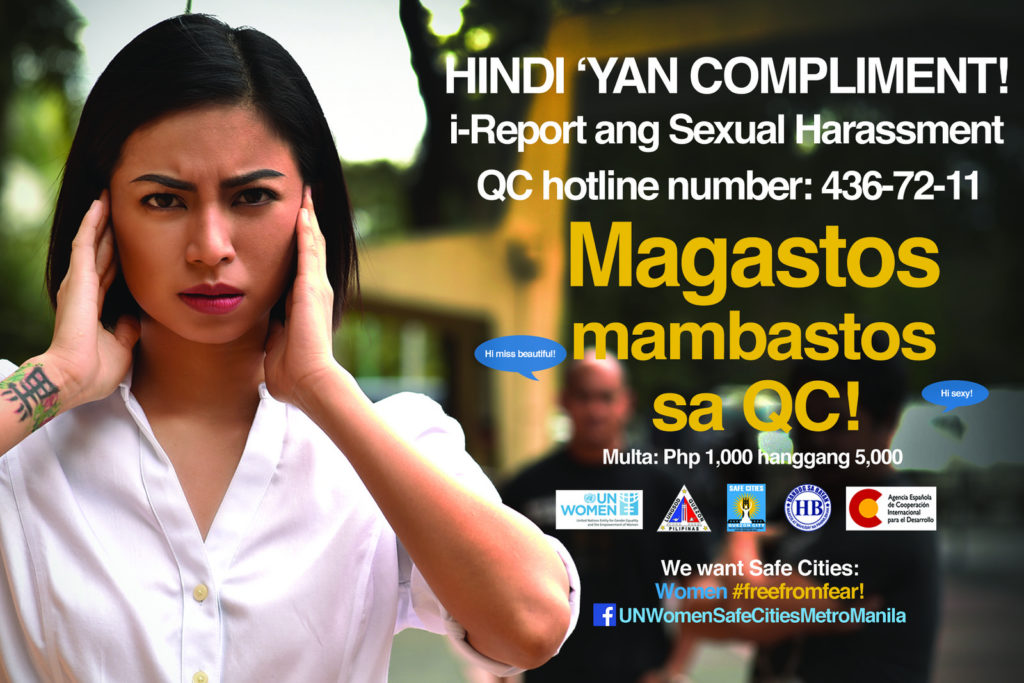
More than being the Philippines’ Hollywood and Metro Manila’s largest city, Quezon City recently made its mark as the first local government to enact a law penalizing street-level harassment. Enacted last May, the ‘Anti-Catcalling Ordinance’ intends to protect and empower women by imposing a fine and prison term for acts constituting sexual harassment in public spaces. While only women (and girls) may be victims under the local law, the offender may be of any sex.

The ordinance proposed by lady councilor Lena Mari Juico is part of the Safe Cities and Safe Public Spaces Initiative of UN Women.

The ordinance divides violations into light, medium and severe.  A person may be fined or jailed up to a month for committing light violations such as cursing, catcalling, repeatedly asking the subject for a date or her contact number, or taunting a woman with constant talk about sex. With the same penalties as light, medium violations include stalking, making offensive mouth, hand or body gestures with intention to demean or threaten a woman.

Acts such as unnecessary touching, pinching or brushing against the subject’s body, public masturbation or lascivious exhibition directed at a woman, or inserting any object into the genitalia, anus or mouth of a victim regardless of sex constitute severe violations which carry a higher fine or jail term from one month to a year. Corresponding penalties are also provided for repeated violations.

Victims may file a complaint at the women’s desk of police precincts or seek assistance by calling the Quezon City Police Department (QCPD) hotline. Other implementation measures were also set such as strengthening the ‘barangays’ or community administrations.

The attention gained by the ordinance allowed Filipinos to discuss the important yet neglected issue of street harassment. Some were delighted by the city’s initiative and called other cities to follow suit. There were others who wished for the policy to be a national legislation. However, those who disapproved criticized the ordinance’s penal provisions arguing that a jail term is disproportionate to the offense, and expressed concern about the vagueness of the acts constituting harassment, the feasibility of implementation, and the possibility of the abuse of the ordinance by women against men. While the breakthrough ordinance spells hope for the anti-street harassment movement, it also reflects the movement’s struggle with breaking misogynist culture.

The City of Stars shines bright with this safe public spaces initiative. It champions women’s rights and serves as a model for other cities. Next, the national government should include street harassment in its human rights agenda in order to meaningfully promote safe cities and public spaces throughout the country.

Ken is a teacher of international studies at a university in Manila. After law school, she traveled to Denmark and eventually studied in Malmö University in Sweden where she earned her master’s in Human Rights. You can contact her at krnrdrg@gmail.com or on Facebook.

Share

Filed Under: correspondents, News stories, street harassment Tagged With: law, ordinance, philippines, quezon city

Meet the New Blog Correspondents of 2017!

January 16, 2017 By HKearl

Since 2013, cohorts of people from around the world write monthly articles about street harassment and activism efforts in their communities. Read their articles.

Meet the New Blog Correspondents of the First Cohort of 2017

Libby AllnattLibby Allnatt, Phoenix, AZ, USA

Libby is a student at Arizona State University. Originally from Salt Lake City, Utah, she is majoring in journalism with a focus on print. She also is minoring in psychology and women’s studies to pursue her passion for understanding human behavior and combating gender-based injustice. She has particular interest in how media messages affect gender socialization and the psychology behind gender-based violence. Libby is passionate about raising awareness of street harassment because she believes everyone has the right to walk down the street with peace of mind. Street harassment is a culmination of gender violence and objectification, and she refuses to stop talking about it. One of her main goals in life is to help young girls realize their full potential. When she’s not talking about feminism, she’s usually running, writing, doing yoga, or trying to find a cat to pet. You can follow her on Twitter @libbyallnattasu and Instagram @LibbyPaigeA.

Simona-Maria ChirciuSimona-Maria Chirciu, Bucharest, Romania

Simona-Marie is a Ph.D. Student in Political Sciences, working on a thesis on gender-based street harassment in Romania. She has a BA in Political Sciences from the Faculty of Political Sciences, NSPSPA (National School of Political Sciences and Public Administration), with a theme on Islamic Fundamentalism in Iran and Communist Ideology in China (2012) and a Master Degree in Policy, Gender and Minorities, Faculty of Political Sciences, NSPSPA, with a thesis on street harassment in Bucharest (2014). Simona’s main research interests are in gender-based street harassment, sexual violence and other forms of violence against women, gender and poverty, gender equality and equal opportunities, social justice. In the past she worked as a gender equality expert and sexual violence expert. Also, she is an activist and she organizes numerous public actions (marches, flash-mobs, protests) against sexual violence and street harassment against women. Now she is part of an working-group trying to improve by public policies the situation of young homeless people in Romania. You can find her on Facebook.

Elaine CoyleElaine Crory, Belfast, Northern Ireland

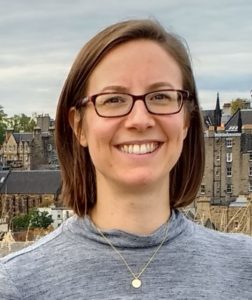
Elaine is a part-time politics lecturer and a mother of two. Originally from rural Cavan, she studied and worked in Dublin for a decade before coming to Belfast, where she started a family and met a network of committed activists. She is director of Hollaback! Belfast, co-organises the city’s annual Reclaim the Night march, and volunteers with Belfast Feminist Network and Alliance for Choice to campaign for a broad range of women’s issues. She is passionate about community organising and activism as a way to bring intersectional feminism to life, and especially interested in street harassment as the first way in which many young people encounter sexism in their lives. In her spare time she enjoys cooking, reading and strategic napping.
Annabel LaughtonAnnabel Laughton, Gloucestershire, UK

Annabel is a passionate feminist who strives to constantly learn more about feminism, patriarchy, misogyny, racism and sexism. She is involved in campaigns for human rights, mental health, environmental issues and social justice. She is inspired by many incredible women activists, and by her friends. Her favourite quote is from Maya Angelou: “You will face many defeats in your life, but never let yourself be defeated”. Annabel has an honours degree in Classical Studies, a diploma in counselling, and works in Higher Education. She spends her free time running, swimming, hiking, and reading about ancient Greek epic.


Karen RodrigoKen Rodrigo, Makati, Philippines

Ken is a teacher of international studies at a university in Manila. After law school, she traveled to Denmark and eventually studied in Malmö University in Sweden where she earned her master’s in Human Rights. Her experience in progressive countries influenced her views of society. She wishes to contribute to her home country by advocating social movement for meaningful social change. You can contact her at krnrdrg@gmail.com or on Facebook.


Share

Filed Under: correspondents, SSH programs, street harassment

Spain: How the Media Reports Sexual Violence

December 19, 2016 By Correspondent

Alice C.R., Barcelona, Spain SSH Blog Correspondent
Trigger Warning – Rape

dones-valentesWhen I was a little girl in France I was told to get informed, seek information, follow what was going on in the world. I remember our teacher from primary school recommending us not to go to bed before the end of the news segment on TV. Later on, in high school, our teachers told us to read different media, from different perspectives in order to better form our own opinion. We were taught to question the info we receive, to ask ourselves whether a media was serious or not, was trying to convince us, manipulate us or was positioned.

I loved to read newspapers from different sides and it was very interesting to see the difference. Sometimes, the same news appeared to be completely distinct from one newspapers to another. Sometimes, from one journalist to another. Especially about political issues. That was sometimes quite funny, but sometimes very disturbing.

But there is one topic, only one, I could never really find any difference in the way it was reported: violence against women, including sexual violence (sexual violence towards children and men as well).

I remember reading headlines such as “ Tragedy of love” or “Family tragedy” for cases of domestic violence and murder intra-family. I remember reading the word “seducer” to describe an alleged rapist, “a tentative to hit on” to qualify a deadly aggression. I remember how the facts were often sugarcoated by the use of euphemisms like non consensual sex or imposed sexual relation instead of using the word rape. I remember reading many details of the alleged victim’s sexual life (while I am sure I have never ever read any details about how much donation an alleged victim of robbery might have given to a charity organization). I remember reading horrific details about an aggression. Well, everything I was reading seemed to be written either to horrify the reader and to warn the victims: “You will never recover from that” or to sugarcoat the brutality and seriousness of a crime and put the suspicions on the victims.

The words we use are very important. They define a situation. They define a reality.

We all agree here that calling any catcall or fact of harassment as a “compliment” is very upsetting. The aim of a compliment is to make the person feel happy and confident. I love compliments actually. I love people making me feel good and worthy. Curiously, I never felt comfortable with catcalls or so called compliments that make me feel like a piece of fresh meat. But in many case, when you report it, one of the most common answer you get is, “But that was a compliment! Just take it as it is!”

Harassment vs compliment, seducer vs rapist, tragedy of love vs murder.

Then, how can someone report an aggression when the first words that pop up in her/his mind are the words read and heard in the media? Can someone go the police saying, “Good morning. I met a seducer who started to compliment me before to impose me a sexual relation.” ?

The impact can be huge for the victim. It is like living in two different worlds, two different realities.

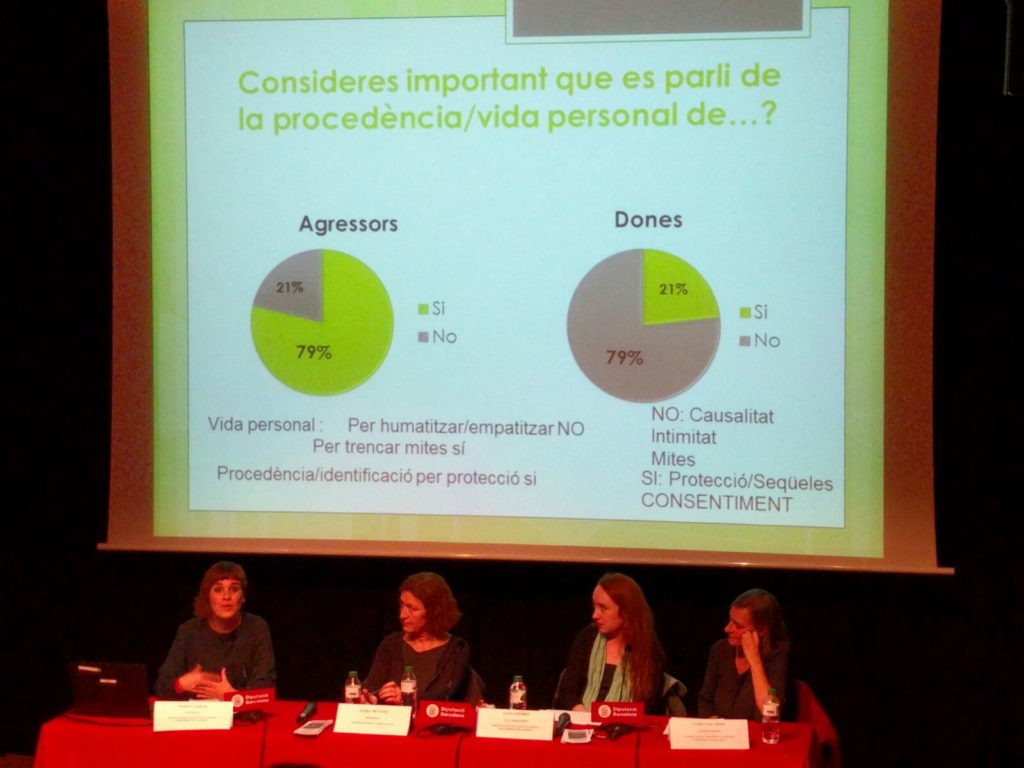
When I learned about a new project launched in Barcelona about how the media cover cases of sexual violence and how people who experienced this kind of violence react to their coverage, I was very interested in it. I read daily news and various French, UK, US and Spanish media and it is very interesting to compare them and see their differences and similarities. So far, I have never read about an imposed sexual relation in Spanish media for instance (I might have missed it, I can’t read everything but it is a relief yet) but I have read about some assault details. The project is organized by Aadas and Master Gender and communication with the collaboration of Barcelona city council and support of the Generalitat with the aim then to be presented during the 25th November International Day of Violence Against Women program.

It consisted first in reading articles from local newspapers both in Spanish and Catalan and explaining what could be triggering, disturbing and how it could be written instead. The aim is to rise awareness of this important issue as media are the ones that first inform us about a case and the words they choose, the way they relate the news influence us. The group of volunteers, all women between 18 and 60 years old, met in July to read a selection of news and take part in the project. All of them suffered sexual violence and accepted to voluntarily read very upsetting and highly triggering news.

The results are not really surprising: all of them felt upset and outraged, 72% felt misunderstood, 93% think these facts of violence are not covered with the seriousness and rigor that should be required. Few of them, only 2, felt strong from reading the news. But this state of strength should not be misunderstood: they felt strong to be part of the project and read such triggering material.

It was clear that a lot of articles were written by journalist who didn’t know anything about the reality of sexual violence, about all of the consequences and sequels it can have. Could we imagine an article about the last basketball competition written by someone who did not know how many players are required to play? So why is it okay to write about sexual violence without having the most basic knowledge about it?

The results were publicly presented the 22nd of November and the project received an Honorary distinction at the 9th Price of 25 November from the city council.  This specific Price is very important for the future of the project. One next step would be to organize meetings between the journalists who wrote the incriminated articles and the organizers of the project and women who took part in it.

We believe in a better understanding of the issue by listening to the ones who suffered from it and the ones who work and help them. This would change a lot of the general perception of sexual violence in our society.

Alice likes researching, analyzing and writing about Women’s Rights, gender bias, and intersectionalism with a special focus on sexual violence, rape, rape culture, the impact of street harassment and how the media deals with these issues. She is currently working on a new project focused on how some media participate in the revictimization of victims. Follow her and her projects on her Facebook page and via Twitter @Alyselily.

Share

Filed Under: correspondents, street harassment Tagged With: media coverage

« Previous Page
Next Page »

Share Your Story

Share your street harassment story for the blog. Donate Now

From the Blog

  • #MeToo 2024 Study Released Today
  • Join International Anti-Street Harassment Week 2022
  • Giving Tuesday – Fund the Hotline
  • Thank You – International Anti-Street Harassment Week 2021
  • Share Your Story – Safecity and Catcalls Collaboration

Buy the Book

  • Contact
  • Events
  • Join Us
  • Donate
  • Facebook
  • Instagram
  • Pinterest
  • Tumblr
  • Twitter
  • YouTube

Copyright © 2026 Stop Street Harassment · Website Design by Sarah Marie Lacy