• About Us
    • What Is Street Harassment?
    • Why Stopping Street Harassment Matters
    • Meet the Team
      • Board of Directors
      • Past Board Members
    • In The Media
  • Our Work
    • National Street Harassment Hotline
    • International Anti-Street Harassment Week
    • Blog Correspondents
      • Past SSH Correspondents
    • Safe Public Spaces Mentoring Program
    • Publications
    • National Studies
    • Campaigns against Companies
    • Washington, D.C. Activism
  • Our Books
  • Donate
  • Store

Stop Street Harassment

Making Public Spaces Safe and Welcoming

  • Facebook
  • Instagram
  • Pinterest
  • Tumblr
  • Twitter
  • YouTube
  • Home
  • Blog
    • Harassment Stories
    • Blog Correspondents
    • Street Respect Stories
  • Help & Advice
    • National Street Harassment Hotline
    • Dealing With Harassers
      • Assertive Responses
      • Reporting Harassers
      • Bystander Responses
      • Creative Responses
    • What to Do Before or After Harassment
    • Street Harassment and the Law
  • Resources
    • Definitions
    • Statistics
    • Articles & Books
    • Anti-Harassment Groups & Campaigns
    • Male Allies
      • Educating Boys & Men
      • How to Talk to Women
      • Bystander Tips
    • Video Clips
    • Images & Flyers
  • Take Community Action
  • Contact

Ireland: My Body, My Choice: From Reproductive Rights to Sexual Harassment

October 29, 2016 By HKearl

Grace Gageby, Dublin, Ireland, SSH Blog Correspondent

In 1983, the 8th Amendment, a ban on abortion that gave the “right to life of the unborn with due regard to the equal life of the mother” was voted into the Irish constitution. The youngest person who voted in the referendum then is now 51.

Between the implementation of the 8th Amendment and the present day, a pro-choice movement has been struggling to secure a woman’s right to control her own body in Ireland. This September saw the 5th annual March for Choice, in which (despite bus strikes and abysmal weather) 25,000 people took to the streets of Dublin to call on the conservative political establishment to trust women to make their own choices.

Women and men of all ages marched through the city with signs declaring ‘My body, my choice’, ‘Get your rosaries off my ovaries”, ‘Woman, not vessel’, ‘Not the Church, not the State, women must decide their fate’, and, in reference to Ireland’s victory in the Marriage Equality campaign, ‘Choice: you gave it to the gays, now give it to the girls.’ Speeches at the end of the march drew attention to how Ireland’s abortion ban affects the most vulnerable women in society, for example, asylum seekers.

A tribute was paid to the 12 women a day who are forced to travel to England for abortions, in this moving rendition of the traditional song, ‘Trasna na Donnta’ (Irish for ‘Across the Waves’).

The past few months have seen a big focus on repealing the amendment. Sweaters with merely the word ‘repeal’ printed on them sold out in one day in a pop-up shop in Dublin city centre. All proceeds were given to the Abortion Rights Campaign, and across the country, men and women of all ages literally wore their beliefs on their chests.
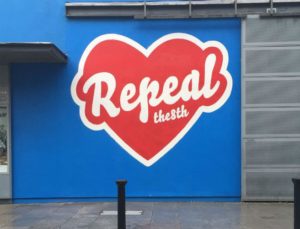
repealthisStreet artist, Maser, graffitied a large red and white heart bearing the words “Repeal the 8th” on the wall of Dublin’s Project Art’s centre. The mural was painted over after Dublin City Council received complaints, which sparked mass outrage and indignation over this threat to freedom of speech. At a protest, I spoke to countless men and women who wanted to make the message abundantly clear: the issue of reproductive rights in Ireland cannot be covered up with a bit of blue paint.

People in Ireland are no longer accepting the quintessential Irish problem of shoving matters under the carpet, and exiling women to England to receive medical treatment their own country refuses to provide. Since being painted over, the mural has become iconic, popping up all over the city on bags, shirts, badges, in shop windows, and even on donuts made by the fabulous Aungier Danger! In its suppression, the painting over of the mural spawned insurgence and sparked a conversation that cannot be muted by a backward establishment determined to dominate women’s sexual and personal decisions.

Unfortunately, Ireland’s history of silencing women’s oppression goes back further than the 8th amendment. In fact, the 8th was built on the legacy of the Magdalene Laundries, institutions run by the Catholic Church to house ‘fallen women’. The Magdalene Laundries were motivated by not only a desire for free labour, but, according to Frances Finnegan (author of Do Penance or Perish: A Study of Magdalene Asylums in Ireland), a need to “maintain moral and social order within the bounds of a patriarchal structure.” An estimated 30,000 women were confined in these laundries in the 19th and 20th century. Historically, there has been a culture of secrecy surrounding the laundries, and the abuse women faced within them. While Taoiseach Enda Kenny (Prime Minister of the Republic of Ireland) issued a formal apology in 2013, the religious institutions such as the Sisters of Mercy refused demands from the Irish government, UN Committee on Rights of the Child and the UN Committee Against Torture to contribute to the compensation fund for victims of the laundries.

With this history of oppression and silence, it is hardly surprising the archaic 8th amendment is currently in place in Ireland. It stems from centuries of Church and State control over women’s bodies.

Despite this, a youthful, vibrant pro-choice movement in Ireland is flourishing, having taken inspiration from the Yes Equality Campaign that legalised gay marriage in 2015.  This victory was not only a joyous occasion for Ireland, but also for politicized sections of LGBT people, women and the working class who are currently at the forefront in the struggle for reproductive rights in Ireland.  The sheer momentum behind the pro-choice movement in Ireland has created a massive drive for challenging sexism in all its facets.

If we want to achieve true gender equality in Ireland, we cannot and will not have a law policing women’s bodies in our constitution. If women are not equal in the eyes of the law, how can we expect the same thing in the hearts and minds of our citizens? Women’s bodies are not commodities: not vessels for children, not possessions of the State and not objects for the male gaze. We need to reject a culture of silencing oppression and of not listening to women’s stories, whether they be stories of assault, harassment, or being criminalized for having a say in their own reproductive rights. The current appetite for social change and challenging sexism in all it’s forms has created a platform from which women can be heard, and given Ireland’s history, it’s about time.

Grace is a student. She writes regularly for her school newsletter and yearbook, and has been published in Inis Magazine. Grace is currently involved with the socialist feminist group ROSA (for Reproductive rights, against Oppression, Sexism & Austerity), and their campaign for abortion rights in Ireland.

Share

Filed Under: correspondents Tagged With: repeal, reproductive rights, women's rights

Spain: Including Harassment and Sexual Abuse in Laws

October 24, 2016 By Correspondent

Alice C.R., Barcelona, Spain SSH Blog Correspondent

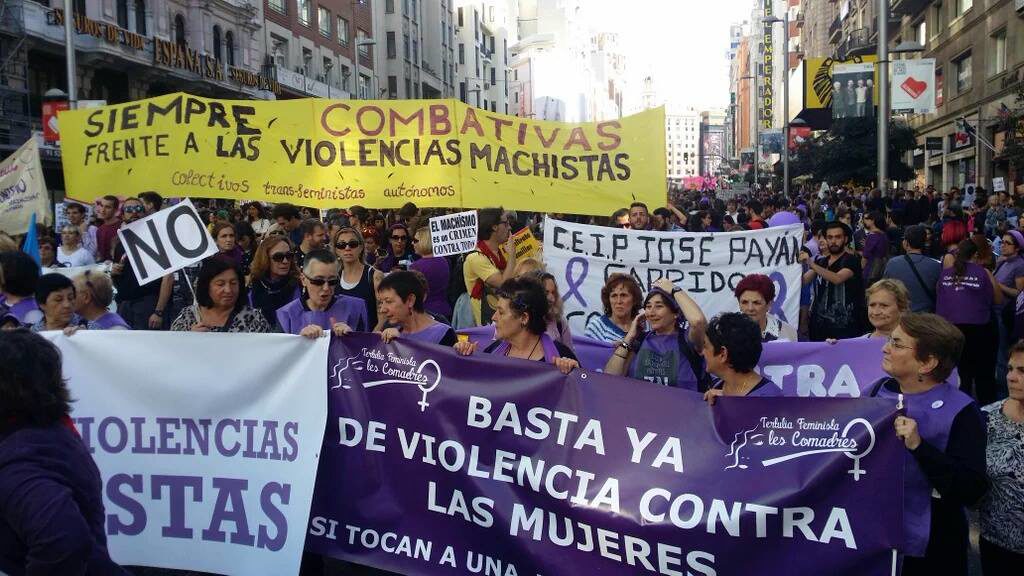
7n-manifestacionRecently, the Nottingham police in the UK decided to treat misogyny, ranging from street harassment to physical attack, as a hate crime. This marks a step forward in the fight against violence against women and stopping street harassment. Some initiatives had already been launched to tackle violence and harassment in public transportation in London in 2013. In Paris, street harassment is sadly common and considered as a “séduction à la française,” and a 2015 study shows that 100% of the women interviewed said they suffered at least one case of harassment. This “French lover” culture is so ingrained, accepted, valorized and glamorized that the decision to institute a plan of action has been virulently criticized and even rejected. Many voices, mainly male voices, raised against this plan arguing it was anti-male and even anti-social. In their arguments, the difference between harassment and even physical assault and an attempt to pick up is shockingly blurred and ignored.

This is especially alarming given how such harassment can escalate to violent crimes like physical assault and rape and even death. In December 2014, a woman was killed with a screwdriver for rejecting sexual advances in a Parisian street close to Bastille. There was also the case of a young woman being harassed, threaten and groped by a man in the Lille metro which has been widely commented on the media. The man admitted he hit on the woman. Cases like this are not unique at all and such frightening stories have been shared by women everywhere in France. Just have a look at Project Crocodiles for example.

Actually, I have to admit that my decision to leave France has been, among others reasons, motivated by the harassment I had to face on a daily basis from the age of 10. Harassment occurred by day, in crowded spaces and while I wrote large trousers and large shirts. Of course I am not saying that harassment is acceptable if we wear skirt or short or a bralette, I just want to emphasize that what we wear does not help to prevent harassment. I always carried a whistle, had my mobile phone ready for calling the police, and held my keys strongly between my fingers. At some point, it was so bad that I asked my boyfriend to come to pick me up at work. That was just unbelievable and such a restriction of movement which I never faced in others countries where I lived. I still feel very unsafe, uncomfortable and, somehow, scared when I have to travel there.

In Barcelona, I found a friendlier environment. I remember being positively surprised to see posters at the entrance of supermarkets indicating what to do in case of domestic violence, to walk down the street and discover new poster from a new public campaign, to get leaflets in the metro explaining how to recognize gendered violence and what to do. I never suffered the same level of harassment here as in France, even when alone at night and wearing a skirt.

I was not yet in Spain in 2004 when the organic law which integrated measures to prevent and fight violence against women was adopted, but I heard a lot about it as a model to follow. This law demonstrates a recognition and an awareness of the issue. But (unfortunately, there is always a “but”) it does not mean that everything is perfect here. It is not.

For too many people, gendered violence means physical domestic violence, but in reality, gendered violence is not limited only to this kind of violence, yet it seems that others violence are a bit excluded. As a matter of fact, if almost everyone agrees that it is not okay to hit someone, it seems that psychological violence, verbal harassment and sexual abuses do not provoke the same reaction. I say “almost” because some people still think it is okay to hit, especially women. This year so far, there have been 35 women killed by their intimate partner and there are 83 if we add women killed by non-intimate partner. And that is the point. A woman who is attacked by her partner is considered to be a victim of gendered violence. A woman who is attacked by a stranger is not and she won’t be allowed to benefit from some measure of protection.

Sexual violence and abuse neither. In fact, they are not included in the organic law of 2004 and associations and organizations like 7N, Stop Violencia Sexual and l’Aadas ask for its inclusion right now. The recent event of San Firmin rape case re-opened the debate.

This law is a good tool to fight violence against women but it needs to include all kind of form of violence. As long as something is not recognized, it is a bit like if it does not really exist or is not very serious. But we all know the impact of such kind of violence. And it is very serious.

Alice likes researching, analyzing and writing about Women’s Rights, gender bias, and intersectionalism with a special focus on sexual violence, rape, rape culture, the impact of street harassment and how the media deals with these issues. She is currently working on a new project focused on how some media participate in the revictimization of victims. Follow her and her projects on her Facebook page and via Twitter @Alyselily.

Share

Filed Under: correspondents, News stories, Street Respect Tagged With: france, law, spain, UK

Canada: How to Make Cities More Inclusive and Safer for Women (Part 1)

October 24, 2016 By Correspondent

wci_4
The photos are from Women in Cities International’s 2016 Anti-Street Harassment Week activities

A talk with Kathryn Travers from Women in Cities International on Street Harassment and Urban Development

Alexandra Jurecko, Montreal, Canada, SSH Blog Correspondent

“Montreal is a lot safer than other cities, for women in particular,” says Kathryn Travers, “I can walk home alone, be at the office late, go by myself, and that’s a real privilege and freedom I have here.” However, daily forms of street harassment, such as catcalls and unwanted comments, are still a common occurrence. “We all know it. It starts off as a comment but where does it go next? It’s that quick moment when you think you’re given a compliment that, if the expectation that comes with it is not met, turns into anger and could quickly turn into violence.”

wci_2Kathryn is the executive director of Women in Cities International, a Montreal-based international network promoting gender equality and inclusion in urban environments. With a Bachelor’s degree in Criminology and Sociology and a Master’s in International Peace Studies and Conflict Resolution, Kathryn says she’s always been interested in gender issues. Then, while working at the International Centre for Prevention of Crime in Montreal from 2004 to 2006, Kathryn was introduced to Women in Cities International (WICI). In 2008, she officially joined WICI’s ranks and has stayed ever since: “The thing with working on gender issues, and specifically on women’s safety issues and street harassment is once you open your eyes to it, you can’t close them. Your understanding of what in our culture enables those things becomes broader and broader and then you just get more pissed off.”

wci_1WICI knows the importance of documenting street harassment. As part of their Gender Inclusive City Program (2009-2012), the organization has collected some of the first data on street harassment as it relates to the lack of women’s safety in urban contexts. “That was ground-breaking and really quite alarming,” says Kathryn. In looking at contributing factors of gender exclusion in urban contexts, WICI highlights women’s experiences of sexual assault and harassment in public spaces.
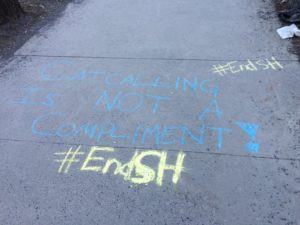
“In Montreal, street harassment seems more subtle than in some places, but definitely, there are a lot of comments. During International Anti-Street Harassment week this year,” remembers Kathryn, “I walked into the metro and this guy with his hands down his pants told me ‘Smile, Beautiful’, and I was like, ‘Really? On this day of all days?’ It was like scripted”.

wci_3Street harassment starts at a young age. During the 2014 Anti-Street Harassment Week, WICI conducted workshops with elementary school girls in Montreal. According to Kathryn, “much of the conversation was about street harassment. They were in grade 5, so about eleven years old, and all of them had stories. It was pretty shocking actually.”
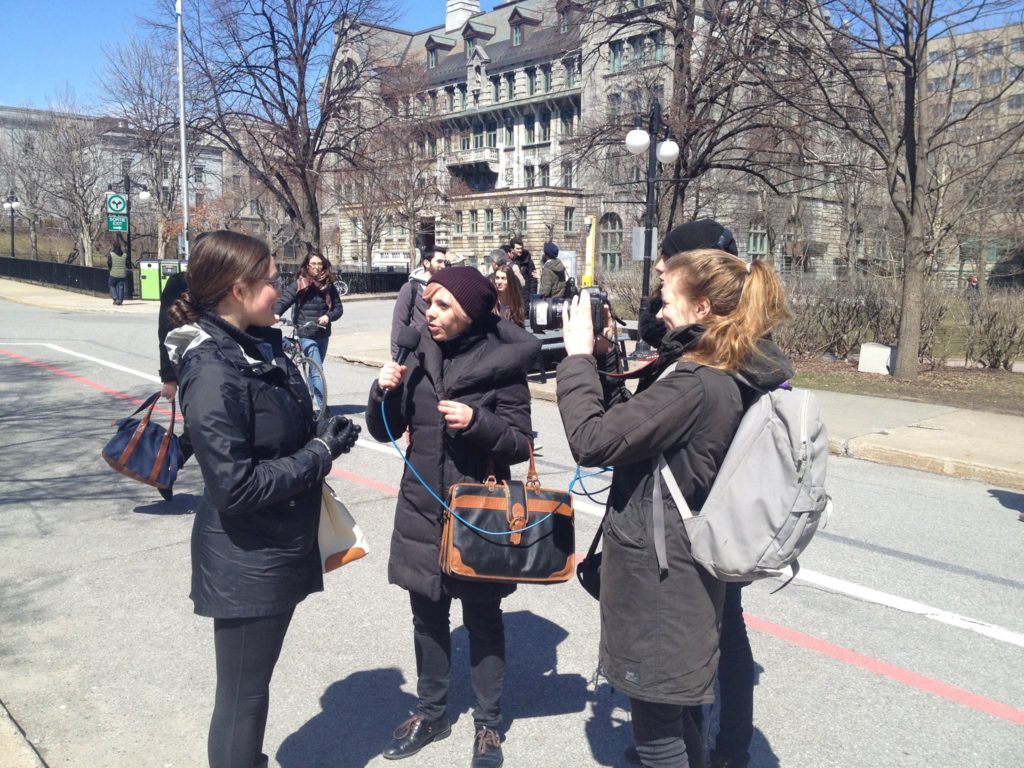
“Being followed, not feeling safe, walking alone. Everyone has their own techniques, like crossing the street when you see someone walking your way, keeping your phone in hand or your keys. Virtually all women have a series of things they do, but men don’t and never even think about it,” explains Kathryn stressing that talking about these experiences can be eye opening.

Noémie Bourbonnais, Lucie Pagès and Kathleen Ellis from Women in Cities International interview Montrealer’s on their experiences with street harassment during the 2016 Anti-Street Harassment Week

“One thing we usually do with this kind of work, even with adolescents, is we separate boys and girls for this conversation,” says Kathryn. Afterwards, the points of discussion are shared within the entire group, and the boys are shocked: “They have no idea that how they speak to girls makes them feel the way it does. There is a huge disconnect. The sense of vulnerability that girls and women feel isn’t something that is shared by many men and boys.”

Kathryn sees many of the reasons for sexual harassment grounded in our culture: “I feel like we almost teach this to our kids. The whistling, for example, that’s even in cartoons. There is a level of ignorance there, but I think it’s cultural. I think it is the way our culture is and it’s by not speaking about these issues, by not making people aware and by not making people understand how others feel as a result of them”. For Kathryn, opening the conversation and introducing issues like street harassment into the dialogue is vital: “Acknowledgement is the first step. Of course, there is much work to do. It’s everywhere in your everyday, even in a city like Montreal.”

Alexandra is a freelance writer and recent graduate of Heidelberg University in Germany, where she earned a BA in South Asian Studies and English Literature. Having moved across the pond to live and work in Montreal, she now focuses on refreshing her French skills while volunteering her time to various community-outreach programs. You can follow her on twitter @alexjurecko.

Share

Filed Under: correspondents, street harassment Tagged With: canada

South Africa: The Safe Ride Campaign

October 23, 2016 By HKearl

Nyasha Joyce Mukuwane, Johannesburg, South Africa, SSH Blog Correspondent

taxi3
Pictures courtesy of Sonke Gender Justice

taxiAbusive male passengers and taxi drivers can make riding public transport in Johannesburg a harrowing experience for a woman. More often than not, a woman faces harassment or sexual abuse aboard a taxi. Taxi drivers and the queue marshals have a notorious reputation for this and there have been many recorded and unrecorded incidents of verbal abuse, harassment, physical violence, sexual assault and rape of girls and women whilst using taxis. One lady spoke to me about how some men thought it funny to poke her breast and how paralysed with fear she felt as she could not stand up and leave the taxi. The other passengers simply looked on and ignored that she was being harassed.

Fortunately, there is a new campaign to change this.

taxi4taxi2Sonke Gender Justice is a NGO working  across Africa to strengthen government, civil society and citizen capacity to promote gender equality, prevent domestic and sexual violence, and reduce the spread and impact of HIV and AIDS. On the 17th of  August 2016, they partnered with the South African National Taxi Council (SANTACO), with support from the Danish Embassy, to launch the Safe Ride campaign. The goal of the campaign is to prevent and respond to the abuse of women and girls at the hands of taxi personnel, including drivers and queue marshals.

The Johannesburg launch of the campaign was the beginning of a year-long programme that will traverse the country to educate the taxi community about how they can help prevent and stop harassment and sexual violence against women and children. Over the next year, supported by funding from the Danish Embassy, the Safe Ride campaign will host events with taxi drivers, queue marshals and commuters in all nine provinces. They are also planning a few three day intensive training sessions for drivers and their assistants on gender-based violence, how to report such incidents and where survivors can go to for help.

This is one of the most innovative campaigns in Johannesburg to challenge patriarchal beliefs, change the way that taxi drivers deal with street harassment, and promote active citizenry against street harassment.

Nyasha is the public awareness coordinator at the Nisaa Institute for Women’s Development in Johannesburg, South Africa, where the main goal is counselling and sheltering survivors of domestic abuse. She has edited two books by survivors that are available to download for free from the website www.nisaa.org.za.

Share

Filed Under: correspondents, Resources, street harassment Tagged With: campaign, taxi, transport

USA: New Orleans Takes A Stand Against Gender Violence

September 30, 2016 By Correspondent

Sequoya La Joy, Louisiana, USA, SSH Blog Correspondent

As a woman, street harassment is nothing new to me. I can remember being whistled at in the Chicago suburb I grew up in when I ran into the gas station to get cream sodas and my mother pumped gas. I can remember being on road trips with my mother and watching her dodge the strange men at rest stops and road side cafes who tried to talk to us both. I commuted to and from work and school for four years via foot, bike, or city buses. Men have groped me as I have gotten on and off the bus, followed me to my job, followed me to my stop, and screamed at and touched on the bus and the street. However, just a few months ago, I bought a car.

I was delighted at being able to get to one place and the next without having to look up bus times, call a cab, or wait for the street car. I felt so protected in my 1998 navy blue Mercedes Benz, surrounded by metal, glass, and old leather. I was in my own bubble in the beginning. As the summer progressed and the temperatures rose, I rolled the windows down instead of waiting for the AC to kick in. I had a sunroof for the first time and I often drove with the sunroof and front windows open. However, rolling the windows down removed a thin but very real barrier to the outside world. Less than one eighth of an inch of fiber glass separated me in my bubble of leather, metal, and glass and all of the motorists and people that occupied the streets of New Orleans.

Men came up to me when I was stopped at traffic lights to ask for my number or ask for money or a ride. I men yelled from their windows asking for my snapchat name was or if I had a boyfriend. They may have been doing this all along, but when I rolled down the windows, I erased the barrier that kept me oblivious to what these men were saying.

I was in the passenger seat of my father’s car this summer at a stop light when I noticed a man who had been begging walking up to a SUV next to me. A woman was driving and what looked like her young teenage daughter sat in the passenger seat. I thought it was interesting that he was walking up to the pair and wondered if he were a family member they were picking up. I watched the man reach for the door handle and try to rip the door open. It was then, I realized this wasn’t a family member and the women weren’t there to pick them up. I watched the mother scream and reach over and shut the door as my father noticed and honked his horn. The light turned green and they drove off. It was then that I started to make sure my doors were locked when I started driving my car and only rolled down my drivers window and cracked the passenger’s window.

Since I’ve been driving, I’ve also been harassed by other motorists even with my windows up. Just this past weekend, I was on the interstate driving to a relative’s house and heard a car beeping at me. I ignored the beep as I could see a man in a muscle car out of the corner of my eye and didn’t want to engage. The man continued to beep five more times and I looked over, thinking I may have left my gas tank open or that something was wrong with my car, just to see the man making a lewd gesture with his tongue at me. This was the first time this had happened on the highway. I honestly feared that another car could have hit me or I could have hit another car during this interaction. I had no idea why this man felt entitled to slow down the entire interstate and do this. My windows were up and I was supposed to be wrapped in my protective bubble of glass, metal, and leather and yet I felt very unsafe.

New Orleans is a city that is not always safe for women.

diamond
Devin Diamond. Image via The Advocate

In fact, this summer, Erica Davis, a young black woman in the LGBT community was murdered on her way to work. Weeks later, Devin Diamond, a black trans woman was found murdered and burned alive. Street harassment and gun violence run rampant in this city and it can be a dangerous place for all people but women and gender nonconforming and LGBT folks are at a very high risk of violence in this city.

On October 27th, local organizations and universities will join forces and celebrate New Orleans’ 25th Annual Take Back The Night Event. Take Back The Night originally started in protest of the murder of young microbiologist Susan Alexander Speeth, who was stabbed to death one block from her home while walking home alone at night. The event will start at Loyola University New Orleans and there will be community organizations set up and offering resources, a speech, and then a candle light vigil and march that will take participants onto Tulane University’s Campus for a open mic.

Take Back The Night is a international event that has happening for over 40 years and is an event that aims to end gender violence and violence of all kinds and aims to make the night a safe space again for women and other victims of violence.

tbtnnolaThis event is to honor those who have experienced violence and assault and to empower survivors. The New Orleans Take Back The Night march will involve Loyola University, Tulane University, Dillard University, Holy Cross, Xavier University, University of New Orleans as well as organizations like New Orleans Family Justice Center, Louisiana Foundation Against Sexual Assault, Metropolitan Center for Women and Children, Sexual Assault Nurse Examiners and Sexual Trauma Awareness and Response. If you have experienced street harassment and would like to share your story, you can submit your story and also find a list of resources such as hotlines,
counseling, and events.

Sequoya is a Native American and Italian woman from Chicago who fell in love with New Orleans. She’s currently a Sociology Major at Loyola University New Orleans and supports her higher education habit by slinging drinks to the masses. She aspires to attain a PhD and write a best seller. She currently operates a small blog.

Share

Filed Under: correspondents, Stories, street harassment Tagged With: cars, murder, street harassment, take back the night

« Previous Page
Next Page »

Share Your Story

Share your street harassment story for the blog. Donate Now

From the Blog

  • #MeToo 2024 Study Released Today
  • Join International Anti-Street Harassment Week 2022
  • Giving Tuesday – Fund the Hotline
  • Thank You – International Anti-Street Harassment Week 2021
  • Share Your Story – Safecity and Catcalls Collaboration

Buy the Book

  • Contact
  • Events
  • Join Us
  • Donate
  • Facebook
  • Instagram
  • Pinterest
  • Tumblr
  • Twitter
  • YouTube

Copyright © 2026 Stop Street Harassment · Website Design by Sarah Marie Lacy