• About Us
    • What Is Street Harassment?
    • Why Stopping Street Harassment Matters
    • Meet the Team
      • Board of Directors
      • Past Board Members
    • In The Media
  • Our Work
    • National Street Harassment Hotline
    • International Anti-Street Harassment Week
    • Blog Correspondents
      • Past SSH Correspondents
    • Safe Public Spaces Mentoring Program
    • Publications
    • National Studies
    • Campaigns against Companies
    • Washington, D.C. Activism
  • Our Books
  • Donate
  • Store

Stop Street Harassment

Making Public Spaces Safe and Welcoming

  • Facebook
  • Instagram
  • Pinterest
  • Tumblr
  • Twitter
  • YouTube
  • Home
  • Blog
    • Harassment Stories
    • Blog Correspondents
    • Street Respect Stories
  • Help & Advice
    • National Street Harassment Hotline
    • Dealing With Harassers
      • Assertive Responses
      • Reporting Harassers
      • Bystander Responses
      • Creative Responses
    • What to Do Before or After Harassment
    • Street Harassment and the Law
  • Resources
    • Definitions
    • Statistics
    • Articles & Books
    • Anti-Harassment Groups & Campaigns
    • Male Allies
      • Educating Boys & Men
      • How to Talk to Women
      • Bystander Tips
    • Video Clips
    • Images & Flyers
  • Take Community Action
  • Contact

USA: The Normalization of Street Harassment in Childhood Television

July 15, 2016 By Correspondent

Mariel DiDato, NJ, USA, SSH Blog Correspondent
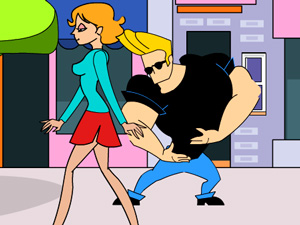
johny-bravo-s-flirts
Johnny Bravo

As a child-turned-adult Pokémon fanatic, I have succumbed to the hype of Pokémon-Go. While basking in my nostalgia, I decided to watch some early episodes of the iconic cartoon. Watching childhood television shows as an adult, I often catch things that I didn’t pick up on as a kid. Certain jokes now make sense, while other things don’t seem as funny. One example of a less-funny aspect of Pokémon is Brock’s persistent advances towards almost every female character besides Misty, and the continued response of female annoyance or rejection. I wouldn’t necessarily claim this show is sexist, as they feature multiple female characters in leadership roles. However, the repeated romantic attempts towards much of these characters, played off with the “boys will be boys” narrative, is something I did not appreciate.

This prompted me to think about the other shows I watched as a child that normalized this kind of behavior. I realized that Pokémon is hardly the worst offender. Johnny Bravo is a show that features catcalling and female rejection as the main source of humor. Even more infamous is Pepe LePew, a male skunk whose storyline involves chasing and grabbing onto a female skunk who, very obviously, does not want to be approached or touched by him.

Although this harassment and female rejection is repeatedly portrayed as comical, the real-life version of this experience is far from laughable. On the Pokémon end of the spectrum, Brock takes rejection with a blushed face, and then moves onto the next woman. Johnny Bravo’s objects of affection sometimes even strike him, leading him to simply move on to his next target, like Brock. However, the reality of female rejection often leads to male escalation, with women receiving a spectrum of responses that can range from insults, threats, and actual violence. Women are aware of this fact; smiling and receiving compliments from harassers is often misconstrued as acceptance and openness, when it is really a method of de-escalation. It is sad to see this portrayed to young children as something to be laughed about. Even while LePew’s victim can be seen struggling to break free from his arms as he kisses her, the whole situation is trivialized to the point of comedy. It is as though harassment is seen as nothing more than a mere annoyance, generally harmless to the women it affects.

More and more data reveal that street harassment is anything but funny or harmless to its victims. Studies show that the continued street harassment most women face before the age of 18 is linked to a multitude of negative effects. One 2008 study found street harassment to be correlated with self-objectification and fear of rape. This, in turn, can lead women to fear travel of any distance, restricting their freedom of movement. In addition, there is evidence that continued and frequent abuse, such as the street harassment women can be subjected to virtually any time they leave their homes, can be more harmful than experiencing one traumatic event.

However, in these cartoons, sexual harassment is shown to be a trivial event that can be laughed off. Young boys are potentially learning that, while ineffective, street harassment is an acceptable way to pick up women. In each of these shows, there is an example of the male “getting the girl.” This might send the message that harassing multiple women is okay. Eventually, one will say “yes” and it will all be worth it. Plus, the women who say no will walk away irritated, but intact. On the other hand, young girls are potentially being taught that objectification and harassment is an appropriate and acceptable part of being female.

Street harassment was a problem prior to the invention of television. Misogynistic cartoon characters did not create the larger problem of sexism in society, but they are instrumental in keeping these messages alive and normalizing them for younger generations. It’s easy to criticize outright sexism on television, but it is also important to pick up on these more discreet messages that people of all ages are receiving. I don’t think I’m going to stop watching shows like Pokémon, but I will definitely be more aware of these indirect messages in the media. I will also be supporting shows that depict healthy relationships, instead of normalizing deeply harmful social interactions. I encourage others to do the same, and hopefully future generations will enjoy cartoons that don’t rely on sexism for their laughs.

Mariel is a recent college graduate, feminist, and women’s rights activist. Currently, she volunteers for a number of different organizations, including the Planned Parenthood Action Fund of New Jersey and the New Jersey Coalition Against Sexual Assault. You can follow her on Twitter at @marieldidato or check out her personal blog, Fully Concentrated Feminism.


Share

Filed Under: correspondents, street harassment Tagged With: cartoons, catcaling, female rejection, kids, messages, objectification, trivialization

USA: How much of Sexual Harassment of Women is Media’s Responsibility?

July 8, 2016 By Correspondent

Manish Madan, Ph.D, USA, SSH Blog Correspondent

Note-Card-CapableA few weeks ago, I participated in a panel discussion on street harassment. My fellow participants included a lifelong advocate on gender rights and women’ safety in India, Dr. Sharada Jayagopal – part of Women Graduate-USA, a physician by profession, and the TV personality, Ms. Renee Mehrra who is also a well-known activist for women’s right. Renee asked me about my views on the role of media (particularly Bollywood movies) in regards to the sexual harassment of women. I think as a society we need to ask this question more often given the wide-reach of media, its permeability in our society, and how it shapes our opinions and beliefs.

So for the purpose of this post, I will revisit some of the research about media’s role influencing the sexual harassment of women. The presentation of women often based solely on their physical appearance, including certain manners inviting sexual innuendos, is often noted in the research. In some cases, media shows women to be submissive.

Media cultivation theory states, “The views shown on the television media is mostly taken as the messages and beliefs that are real and valid’” and will argue that the consistent portrayal of women in a sexually objectifying manner or as someone who can be harassed and will remain submissive when harassed, is likely to be taken as a reality outside the “idiot box” as well.

Naturally, the media content varies within the genres, such as music videos, soap operas, comedies, action movies, dramas, etc. Some genres attract more objectification than others. For instance, Selena Gomez’s song Good for You will be strikingly different from CNN Erin Brunnet’s Out Front — unless it involves Chris Matthews at CNBC “Hardball” (no pun intended!) asking her to come close to the screen during a video interview just so her could tell her, “You look great!”

In a study from Italy, Silvia Galdi and her co-authors examined the relationship between the objectification of women as sexual objects and the likelihood of sexual harassment occurring using Italian TV Programs. The authors used three sets of video clips depicting, i) objectified women, ii) non-objectified women, and iii) no women in the video. The study showed participants’ higher harassment penchant after watching the objectification TV program compared to watching the non-objectified women professionals or the ones where there were no women in the video.

The study also noted that male participants reported greater intentions to engage in sexual coercion and a higher likelihood to engage in harassment behavior as a result of viewing TV programs that depicted objectified women. Interestingly, participants who watched objectified programs were also more likely to conform with the traditional masculinity norms regarding dominance (used as a symbol of sex and power), and aggression.

The question thus goes back to the initial discussion, does the media create new social realities or is it a mere transmitter of existing social certainties? Thoughts?

Either way, such realities or certainties that comprises one gender or makes their existence vulnerable in a public space must be addressed.

There is also evidently some research that shows that the amount of time a youth spends consuming some form of the media is much more than the time spent in school or having interpersonal communications with parents. That said, if I view our social structure that enables an environment of sexual harassment as a jigsaw puzzle, then media will perhaps be one vital piece that has some role in this puzzle. Expanding the landscape of women portrayal in media with shows like #Quantico with a female lead charting her own course is probably a good change going forward where the women are not seen as mere sexual objects.

Do you think someone will consider sexually harassing the FBI recruit, #AlexParrish?

As a civilized society formed on principles of equality and respect, the media does have a role in either condoning or monitoring the objectification (often sexual in nature) of women, and having a larger role to play in our society’s struggle toward addressing the sexual harassment of women.

In conclusion, while I discussed the role of media in gender objectification, I also want to offer caution in singularly blaming it for the gender harassment as it will lead us to a reductionist approach. It is not only media nor is it all media, but perhaps there is a little bit of everything. Media is one bit of the puzzle and we also need to focus on various social, cultural, patriarchal and environmental factors that also promulgate the concept of gender harassment in our society.

Please use #MediaRoleinSH to share your views. I will look forward to reading and commenting on it!

#SexualHarassment #Masculinity #Dominance #MediaPortrayalofWomen #Italy

Manish is a Professor of Criminal Justice at Stockton University where his research focuses on examining sexual harassment, gender empowerment, spousal abuse and policing issues. You can follow him @Prof_Madan or reach out to him at www.manishmadan.com.

Share

Filed Under: correspondents, street harassment Tagged With: media, sexual objectification

USA: A FedEx Driver Harassed Me

June 25, 2016 By Correspondent

Ginger Skinner, NY, USA, SSH Blog Correspondent

Image via photopin
Image via photopin

Last May, just seconds after hopping on my bike in front of my Brooklyn apartment, I hear, “Mmm. Can I go with you?” I slow my bike and turn around to see a FedEx driver staring back at me. I yelled, “You really shouldn’t harass people while you’re on the job.” His response: “F**k you.” Followed by several more “f**k you’s.”

The driver’s comments were no different than those hurled at me almost daily from row house stoops, in corner stores, supermarkets, parks, gyms, and on and around public transit. “Hey baby’s,” “How you doing’s,” and “Mmm mmm mmm’s,” that seem innocuous, yet too often leave long-term side effects: anger, anxiety, shame, and hypervigilance. Still those men had not delivered packages to my home. Packages I regularly signed for. I worried that my speaking up and defending myself might have inadvertently encouraged more harassment.

Five minutes later, I was on the phone with a FedEx “specialist.” After opening a claim that included a detailed description of the delivery person, the specific location, and time of day, she repeatedly assured me that FedEx would handle the situation according to their policies, and that they’d follow up with me. She ended the call with “FedEx takes these matters very seriously.” Weeks passed. No follow up.

Had I done the right thing in reporting the harassment? Yes. I think so. Street harassment is often a precursor to more aggressive forms of violence. Had I really wanted the driver to lose his job? Certainly not. What outcome had I expected? At the very least, I knew that I wanted to be listened to and believed—and for FedEx, as promised, to take the matter seriously.

A basic search of Twitter turned up people who clearly wanted the same. A jogger who was catcalled by a FedEx driver. A woman aggressively catcalled by a FedEx worker inside her apartment building. A man whose wife was sexually harassed by two FedEx drivers. A woman who tweeted at FedEx after one of their drivers made kissing sounds at her. Another woman who upon calling FedEx to complain about harassment was “pretty much laughed at” by the customer service rep. This story. And this one. And here’s one about a UPS driver.  And this incredibly disturbing story about a U.S. Postal Service worker.

No complain alert line for customers?

Like most companies, FedEx has an employee policy in place that addresses workplace sexual harassment. The anti-harassment policy on the company’s website states that:

Unwelcome sexual advances and other inappropriate personal conduct are prohibited. We strictly prohibit, and will not tolerate, any type of harassment or any acts that create the potential for harassment, either in terms of individual employee morale or in violation of applicable laws.

There’s also a mechanism for reporting violations – the FedEx Alert Line.

I wondered, did the same policy apply to customers? So I reached out to FedEx’s media department, but after two weeks and no response, I ended up on the phone with Dave from Customer Advocacy. I asked, “Does FedEx have policies or other measures in place that protect customers and communities members from harassment by FedEx employees?” Dave responded, “We are not able to reveal FedEx policies over the phone or on our website. Our policies are confidential.” Then a long pause, and, “We will deal with a situation when we have one.”

I ended the call with Dave, disappointed, but with a clear message for FedEx and other companies that claim to take harassment seriously:

Whether or not it affects to your bottom line, your employees’ actions directly impact your company’s reputation. At the end of the day, the employee that harassed me is wearing a uniform and driving a truck clearly marked with your company’s name. I urge you to consider stronger policies that discourage harassment by your employees and protect the communities you serve. By not addressing it, your company is essentially doing its part to preserve rape culture.

Ginger is a full-time reporter and long-time New Yorker with over 10 years of experience writing about health and wellness. Ginger is also a member of Brooklyn Movement Center’s No Disrespect anti-street harassment team, and is dedicated to deepening the conversations surrounding the causes of gender-based harassment and violence, and the intersections of race. Follow Ginger on Twitter at @ginger_skinner.

Share

Filed Under: correspondents, Stories, street harassment Tagged With: FedEx

USA: #ListenToUs: Why Men Need to Listen to Women’s Stories of Sexual Violence

June 21, 2016 By Correspondent

Mariel DiDato, NJ, USA, SSH Blog Correspondent

I Believe SurvivorsRecently, I was out with a friend for a night on the town. When the night was over, we were waiting for our ride home on the sidewalk outside of our favorite late-night food spot. We happened to overhear a conversation between three men standing near us on the sidewalk. They were discussing a rape case, and talking about how “the girl was definitely lying about the rape.”

“Do you hear these guys?” I said to my friend.

“Seriously,” she replied, “Of course they think she lied.”

We began discussing about how normal sexual violence is for women. How some men think “no” means “convince me,” or how others think that rape can only be committed by a stranger in a dark alley.

My friend and I experienced that normalcy just that afternoon on the beach. A man had been staring at and following us up and down the shoreline. We were oblivious to this until two women sitting nearby let us know we had a stalker. They said they were calling him “The Hawk.” My friend and I walked back and forth a few times to test it out, and sure enough, we realized he was tailing our every move. The four of us laughed together about how creepy it was.

Perspective: we laughed about a potential predator following us. That’s how much we are used to this kind of behavior.

While my friend and I were discussing this on the sidewalk, a different man came up to us and scolded us for suggesting that sexual violence was normalized. I told him that he should listen to women when we talk about our experiences. Instead, he made a joke, and tried to convince us that we were overreacting.

“I volunteer with survivors of sexual assault,” I said. “I’m also a woman. I know what I’m talking about.”

“Yeah, of course you do,” he replied under his breath. As if I wasn’t to be trusted. As if I was lying just to win an argument with an irrelevant stranger. As if women regularly lie about how we’ve been attacked by men for the sake of spite. As if a man knows a woman’s experience better than a woman.

Why does this sound so familiar? Maybe it was because when Hollaback posted a video about a woman being catcalled in NYC, men told women that we are overreacting and that we should accept strange men’s compliments. Maybe it was because of #NotAllMen, where some (not all!) men become more upset about the semantics in women’s testimonies of violence than they do about the actual violence. Maybe it was because in the cases of Bill Cosby, Dr. Luke, Johnny Depp, and even in the random group of boys standing next to us on the sidewalk, there is always the assumption that the woman must be lying about her assault.

When women are upset about catcalling, we just need to lighten up and smile. When women are talking about how men abuse us, we are automatically condemning the entire gender. When women choose to report a highly under-reported crime, it must be because they have ulterior motives. The fact that only 2 to 8% of reports of sexual assault are false seems to be insufficient evidence for the majority of women who won’t be believed.

We’re just devious. We’re just emotional. We’re just overreacting.

This mistrust of women occurs at each stage of the violence pyramid. No matter what a woman’s complaints are, they‘re minimized or discounted by someone. It’s irritating, but relatively harmless, when it’s a drunken stranger on a sidewalk who tells me that I’m thinking incorrectly about my own experiences with violence. It’s another thing when a survivor’s report of sexual assault is met with disbelief, and even retaliation. It’s a systematic problem when not only friends and family, but judges and police officers, are more likely to think that a survivor is lying about being harassed or assaulted than they are to believe their story. I’ve seen both personally, and professionally. This has to stop.

If you’re reading this and saying, “Hey, wait! I listen to women, this article is unfair!” It’s not about you. Stop derailing the conversation, and listen.

If you hear a woman say she’s uncomfortable with catcalling, put yourself in her shoes. Walking down the street as a man and hearing a compliment is not the same as hearing a sexually-aggressive comment from someone that is, on average, 50 pounds larger than you. We’re not overreacting. You need to listen.

If you hear ANYONE talking about rape and you automatically assume that she or he is lying, you’re part of the problem. For their sake, and the sake of survivors everywhere, listen.

Take #ListenToUs to Twitter to share a time when your experience with sexual harassment or violence was minimized or not believed.

Mariel is a recent college graduate, feminist, and women’s rights activist. Currently, she volunteers for a number of different organizations, including the Planned Parenthood Action Fund of New Jersey and the New Jersey Coalition Against Sexual Assault. You can follow her on Twitter at @marieldidato or check out her personal blog, Fully Concentrated Feminism.

Share

Filed Under: correspondents Tagged With: believing survivors, sexual assault, violene

Jordan: Article 308 and the Human Cost of Honour

June 17, 2016 By Correspondent

Minying Huang, Amman, Jordan, SSH Blog Correspondent

TW: Rape, sexual violence, honour killings

Article 308 - Rand Abdul Nour
Article 308 – By artist Rand Abdul Nour

Barely discernible beneath heavily patterned fabrics – those used at weddings, funerals, and parliamentary elections – are the faint figures of women who have been raped. Silent and caged in tradition, the obscured female presence is at once a sign of oppression and a mark of resilience as she fights to retain her identity, refusing to disappear.

Earlier this year, I attended Rand Abdul Nour’s first solo art exhibition at Artisana & Gallery 14 in Amman, the capital of Jordan. ‘Woman II: Adorned with Jasmin’ offered a powerful visual commentary on how pervasive concepts of ‘honour’ hurt communities of women in Jordanian society. In her work, the artist condemns a brutal and rigid honour code enshrined in – and thus championed by – law: her paintings, beautifully rendered in oil on canvas, are a direct criticism of Article 308 of the Jordanian Penal Code which controversially allows rapists to go unpunished if they marry their victim and stay with them for a minimum of five years.

Lacking social support and legal protection, victims of rape and other forms of sexual abuse are left vulnerable and isolated. The dangers they face are twofold: honour killings* carried out by other family members are a widespread phenomenon in Jordan due to the severe social stigma surrounding sexual activity out of wedlock, the culture of victim blaming, and the way in which the identities and behaviours of a man’s female relatives have come to be bound up in both his own sense of male worth and societal conceptions of masculinity and morality; meanwhile, the legal structures in place at the moment – including those relating to abortion and parental lineage – not only endorse marriage to one’s attacker as a means of preserving the reputation of the victim and their family, but can also be said to strip victims of any real choice. Women’s rights activists in the country say that the majority of rape cases that do not result in pregnancy go unreported because revealing the truth is considered too great a risk; there is too much to lose and little certainty of a fair outcome. It has been estimated that 95% of rapists face no punishment for their crimes.

Four years ago, hundreds of Jordanians gathered together to form a human chain in the streets of Amman demanding basic rights for women, protesting against Article 308 in addition to the prevalence of honour crimes, harassment, and nationality discrimination in society. Last year, the Sisterhood Is Global Institute/Jordan (SIGI/J) launched a campaign, along with a civil coalition, with the aim of eliminating Article 308 and securing better psychological and legal provisions for those affected by sexual violence. The results of a study they conducted on local attitudes to rape and impunity showed that in reality many Jordanians are against Article 308 and believe that rapists should be punished regardless of whether or not they intend to marry their victims. After these findings were presented, the Legislation and Opinion Bureau in Amman finally began to review the article and consider SIGI’s proposals.

In April this year, it was announced that the Cabinet was in favour of cancelling the clause in Article 308 that permits perpetrators of sexual assault to walk free if they marry their victims and that the draft laws were being forwarded to Parliament for review. This important move towards achieving justice and equality comes after years of lobbying and campaigning on the part of various civil community organisations, legal experts, journalists, and activists. Progress is being made, thanks to the persevering spirit of communities of women fighting to reclaim control of their own bodies.

However, whilst change looks to be on the horizon, there is still much cause for concern. Today, in spite of the recent amendments, people continue to campaign for the complete cancellation of the article. As it stands, the article maintains that in cases of consensual sex with female minors aged 15 to 18 men may escape conviction through marriage. But it is especially difficult to differentiate between forced and consensual sex when the victim is underage. Furthermore, this remaining clause dangerously puts young girls under vast amounts of pressure to accept marriage as a resolution so as to avoid bringing dishonour and social disgrace upon themselves and their families.

Lubna Dawany, president at SIGI Jordan, has received heart-breaking letters from young girls coerced into – and now trapped in – these marriages: they detail the trauma they have sustained and their prolonged suffering at the hands of their rapists and their families; they urge other girls to resist, to never to agree to marriage under similar terms. She comments, “The new proposed change in law, which suggests that the clause be deleted but kept in place for girls under 18 years old, is unacceptable. How can it be allowed that perpetrators of sexual violence marry their teenage victims who are not treated as adults in any other aspects of their lives? On the contrary, I think that this is the age where we should support them and not leave them to such a vague future. Girls this age are still children and under no circumstances should we let them get married even to decent men, let alone their abusers.”

There is no honour in pardoning a rapist, nor is there any honour in sentencing a young girl – or a grown woman – to live in the same house as the man who abused her, to be wed to a man who would do her harm, and to be subject to his will. SIGI’s survey is a testament to the fact that traditional surface attitudes do not reflect the shifting realities within Jordanian society. We should celebrate the strength and resilience of the individuals and communities petitioning for systematic reform, unafraid to make their voices heard. Artists and activists alike are committed to redefining social values in the face of adversity and raising awareness of the issues at hand. An important and much-needed conversation on female agency in a patriarchal society has been started; hopefully increasing numbers of people will join the discussion, push for change, and help put an end to the numerous human rights violations carried out against women in the name of ‘honour’.

Here in Jordan, women are breaking the silence and painting themselves back into the narrative.

*For more information, read Rana Husseini’s book Murder in the Name of Honour.

Minying is a 19-year-old British-born Chinese student from Cambridge, England. She is studying for a BA in Spanish and Arabic at Oxford University and is currently on her Year Abroad in Amman, Jordan. You can follow her on Twitter @minyingh.

Share

Filed Under: correspondents Tagged With: art, honor killing, jordan

« Previous Page
Next Page »

Share Your Story

Share your street harassment story for the blog. Donate Now

From the Blog

  • #MeToo 2024 Study Released Today
  • Join International Anti-Street Harassment Week 2022
  • Giving Tuesday – Fund the Hotline
  • Thank You – International Anti-Street Harassment Week 2021
  • Share Your Story – Safecity and Catcalls Collaboration

Buy the Book

  • Contact
  • Events
  • Join Us
  • Donate
  • Facebook
  • Instagram
  • Pinterest
  • Tumblr
  • Twitter
  • YouTube

Copyright © 2026 Stop Street Harassment · Website Design by Sarah Marie Lacy