• About Us
    • What Is Street Harassment?
    • Why Stopping Street Harassment Matters
    • Meet the Team
      • Board of Directors
      • Past Board Members
    • In The Media
  • Our Work
    • National Street Harassment Hotline
    • International Anti-Street Harassment Week
    • Blog Correspondents
      • Past SSH Correspondents
    • Safe Public Spaces Mentoring Program
    • Publications
    • National Studies
    • Campaigns against Companies
    • Washington, D.C. Activism
  • Our Books
  • Donate
  • Store

Stop Street Harassment

Making Public Spaces Safe and Welcoming

  • Facebook
  • Instagram
  • Pinterest
  • Tumblr
  • Twitter
  • YouTube
  • Home
  • Blog
    • Harassment Stories
    • Blog Correspondents
    • Street Respect Stories
  • Help & Advice
    • National Street Harassment Hotline
    • Dealing With Harassers
      • Assertive Responses
      • Reporting Harassers
      • Bystander Responses
      • Creative Responses
    • What to Do Before or After Harassment
    • Street Harassment and the Law
  • Resources
    • Definitions
    • Statistics
    • Articles & Books
    • Anti-Harassment Groups & Campaigns
    • Male Allies
      • Educating Boys & Men
      • How to Talk to Women
      • Bystander Tips
    • Video Clips
    • Images & Flyers
  • Take Community Action
  • Contact

USA: Popularizing Safe Spaces through Corporate Responsibility

June 7, 2016 By Correspondent

Turquoise A. Thomas (Morales), Kansas, USA, SSH Blog Correspondent

Trigger Warning: Rape and other sexualized violence
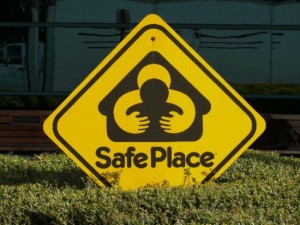
635825453101623820-774336591_7.1201882740.09-safe-place-signIt should be very clear to those involved with or interested in the prevention of street harassment and sexualized violence that there is a clear intersection between sex trafficking and street harassment. The U.N. and other global forces are even developing task forces and support groups specifically to combat sex trafficking and sexualized violence.

It’s an abhorrently common habit of those in the U.S. to say that certain women are targeted for street harassment because they “look like a hooker”; furthermore when women are dressed this “certain way” in lower income neighbors they are told to expect street harassment and solicitation because it’s the “norm”.  Regardless of a woman’s style of dress or the neighborhood she’s in, no one deserves or should expect to be harassed. The idea that women or children should expect sexual advances from strangers in public (or private) based on their dress and location reeks of victim blaming and further allows those who walk among us everyday with a predatory eye to have the ability to move through society unchecked.

It’s widely accepted that traveling and stopping at a gas station can be a very dangerous act in and of itself. Gas stations are a hot spot for street harassment, particularly those adjacent to interstate highways. Highways are widely known in the U.S. as a lucrative tool of sex traffickers. In 2014, Sacramento and Oakland were named two of the largest sex trafficking hubs in the world by National Public Radio. Both cities are located directly along the heavily traveled Interstate 80 which spans from San Francisco, CA, into New York City, NY, allowing predators who harass, stalk, and traffic women to move almost effortlessly across the states.

Violent incidents involving street harassment, trafficking and domestic violence occur at gas stations. Women and children have commonly been kidnapped, molested, raped  or even at gas stations, rest stops and truck stops. With this information in mind, some gas station companies have developed on site “safe spaces.”

In the Midwest, Quiktrip (QT) is one of those companies. As summer approaches, festivals and other events occur, schools are out and families are traveling in higher frequency than during any other season creating more opportunities for people who seek to harass or traffic others.

Arguably, companies like Quiktrip are leading social responsibility in their industry by providing a bonafide safe space. Simply knowing that QT has this space available means more individuals or families can plan safe trips with QT safe spaces on their route. We need other companies to follow suit and join the fight against street harassment; safe spaces should be widely available in commercial spaces like gas stations, grocery stores and other places where people are street harassed. Non-profit organizations like United Way can easily assist corporations in building these spaces, but it’s up to us to demand they do so, after all…the customer’s always right!

Turquoise is a 26-year-old freelance journalist, a program manager at the Wichita Women’s Initiative Network, and a junior at Wichita State University. She is the founder of SHERO Coalition (SHERO Co) and you can follow her on twitter @anthroisms.


Share

Filed Under: correspondents, public harassment, Resources

USA: My Literary Introduction to Street Harassment

May 31, 2016 By Correspondent

Deborah D’Orazi, NY, USA, SSH Blog Correspondent

VWoolfThe first time I remember reading about street harassment and recognizing it for what it was was in Virginia Woolf’s iconic essay, A Room of One’s Own, when I turned 17. In the essay, Woolf sets out on a momentous task to speak on women and literature and ends up writing about her journey searching for women in literature, women who write literature, and why women are not more prudently featured within the realm of literature since they are so often portrayed as the inspiration for what are deemed some of the greatest and most romantic written words in the English language. To her dismay, Woolf finds little evidence of women in literature (outside of the occasional female ruler or writer and the consistent muse or romantic interest—typically always written by men). She is then determined to journey and figure out why. Ultimately, she comes to a remarkably economic conclusion stating that “a woman must have money and a room of her own if she is to write fiction”. What is even more profound is that Woolf demonstrates that this economic necessity for a woman’s career and independence within the private sphere is not at all possible without uncompromised, safe access to the public sphere, or public spaces without harassment or the threat of it.

This subject is explored early on in Woolf’s essay when she is beginning to contemplate and research her ideas. While Woolf encounters the beginning of an idea on a walk and starts to chase it she is promptly interrupted when “instantly a man’s figure rose to intercept me”.  Woolf is instantly aware of the power dynamics. She is a woman visiting a man’s college, thus despite the space being open for her and others to walk in, she must remain on the gravel while male college members walk on the turf. She notes that this territorial power play did not actually physically harm her, but she did lose her thoughts and ideas that were so precious to her.

I am sure many would argue that this incident was not street harassment because it took place in a seemingly private space or that this incident was just a mere a sign of the times Virginia Woolf lived in. However, this indicates the importance of understanding the very definition of street harassment.

At Stop Street Harassment we use the following definition: “unwanted comments, gestures, and actions forced on a stranger in a public place without their consent and is directed at them because of their actual or perceived sex, gender, gender expression, or sexual orientation.”

Virginia Woolf, who undoubtedly came from a very privileged background and lived a very privileged life, was still looked down up, criticized, and harassed because she was a woman taking up space within the public realm, where typically men dominated and still dominate today. As Woolf notes in her essay, “The only charge I could bring against the Fellows and Scholars of whatever the college might happen to be was that in the protection of their turf” which sent her ideas into oblivion.

Yet, how many ideas, leisure and social activities, or mere existences of women, racial and ethnic groups, religious minorities, LGBTQIA individuals, differently abled people, etc. have been disrupted because the public sphere is, in fact, not so public. It is important to note this intersectionality because women inhabit all of them and as women and other disenfranchised groups gain rights and visibility within the public sphere, harassment remains a constant. This constant serves as a reminder that people must remain within a social constructed role, no matter how much it inhibits or oppresses them. And it is often quite effective in limiting and changing where people travel geographically, whom they socialize with, and where a person may go for services. For example, if a girl is harassed on her way to school, depending on her individual situation, she may have to change her route, endure the harassment, or stop going to school all together. All of these situations create a legacy of trauma and undue economic burdens that disenfranchise an individual, community, and population. It is not at all uncommon for women to consider changing their routine or way they lived to avoid street harassment. As documented by a Penn, Schoen and Berland Associates survey from 2000 it was discovered that 84 percent of women would “consider changing their behavior to avoid street harassment.”  How much economic opportunity have women and other communities lost because of harassment? How much safety? Too much for my liking.

So, what should we do? Educate, advocate, organize, speak out, protest, create policy, listen, and support each other. Many people have experiences, some similar and some different, but recognizing the reasons for street harassment and the many forms it takes for different people and communities is important for an inclusive movement. It is a hard journey, but combating street harassment in its many forms as misogyny, racism, classism, homophobia, transphobia xenophobia, abelism, etc. is just as important as speaking out. So many have been harassed into silence, trauma, injury, hurt, and death in public spaces throughout countless years that it is important to note the many reasons why. Without this understanding and cooperation more people will be oppressed and more people will continue to be left out of public spaces and, consequently, public life.

Street harassment is a push back towards oppression and objectifying. Let us strive to make a world where people’s private and public lives can thrive and where people can have safe access to safe places and safe public and private lives. As Virginia Woolf wrote in another essay, “Thoughts on Peace in an Air Raid”, “mental fight means thinking against the current, not with it” and we must continue fighting against the current in order to achieve justice and equality for everyone to use public spaces freely.

Deborah is a recent MSW graduate who also received certification from American University’s Women and Politics Institute and Rutgers’ Center on Violence Against Women and Children. In addition to social work, Deborah is looking to pursue an MPP/MPA and she is also extremely passionate about the arts (theater, writing, film, television, fine art, poetry, performance art), history, and Hamilton.

Share

Filed Under: correspondents, street harassment Tagged With: literature, Virginia Woolf

USA: Clinic-Specific Street Harassment

May 25, 2016 By Correspondent

Mariel DiDato, NJ, USA, SSH Blog Correspondent

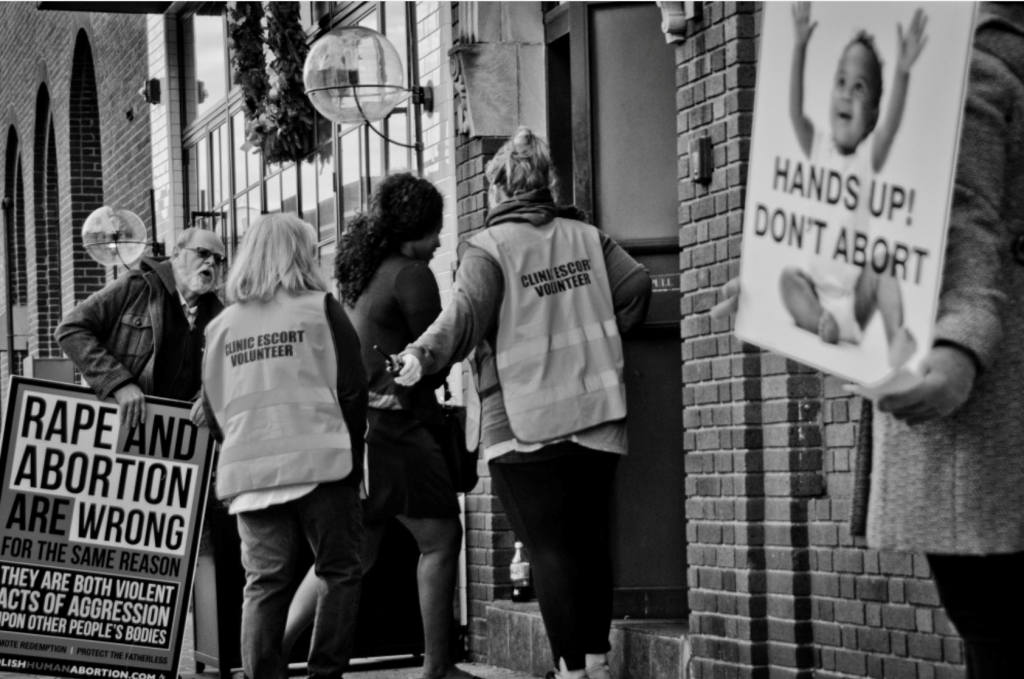
Protestors harass a patient outside of a women’s healthcare clinic. Photo by and courtesy of Wendi Kent.

Whenever a woman is in a public space, there is always a chance she will be shouted at, followed, or recorded without her permission. However, there is one place where that harassment is almost guaranteed.

Women’s health clinics have seen a rise in harassment and violence since the first murder of an abortion provider in 1993. This rate especially has risen within the past few years. The climate is so bad for these clinics that there are volunteer clinic escort teams simply to help patients walk from the sidewalk or parking lot to the front door. As a clinic escort myself, I have seen the extent of this problem first-hand.

Each clinic’s atmosphere is different, as each state has different political leanings, religious influences, and laws surrounding women’s healthcare. In general though, the themes are the same. Patients must walk through numerous, large posters depicting gory, aborted fetuses. They have their personal space violated by anti-choice protestors who follow them and try to convince them not to go inside the clinic. When they finally get to the door, there are protestors preaching loudly, sometimes through megaphones, chastising these women for going inside. It gets so bad that even some of the more peaceful pro-life demonstrators criticize the protestors who scream at and follow patients. To make matters worse, the sound of the megaphones permeates the clinic walls, so that patients inside have to listen to these protests for the entirety of their appointment. Oftentimes, the loudest of the protestors are men, who think they know what women should do with their bodies and health better than the women trying to receive care.

In addition to clinic escort teams, many clinics have been awarded legal buffer zones. Protestors cannot step foot in these areas, so that patients can feel safer in walking to the clinic. Although political buffer zones have been easily enacted in other scenarios, such as political polls, it is difficult to obtain a buffer zone for women’s healthcare clinics. Even when they are obtained, they may not be enforced, depending on the religious or political beliefs of the on-duty police officers. Anti-choice groups often try to repeal these buffer zones by citing of freedom of speech. Although freedom of speech does not protect harassment and intimidation, these cases often swing in the favor of the anti-choice movement. Just recently, anti-choice protestors were even given permission to violate the city noise ordinance in Portland, Maine.

A clinic in Madison, Wisconsin obtained a “floating buffer zone,” in which people within 160 feet of the facility have an eight-foot boundary that protestors cannot cross. Other buffer zones have spanned as wide as 35 feet. These boundaries allow protestors to practice their freedom of speech without causing any physical or emotional harm to patients trying to access the clinic. However, in most other places, the buffer zone can be as little as just eight square feet in front of the clinic entrance. This gives protestors more freedom to the sidewalk than the patients, who may not even be going to the clinic for an abortion. In many places like Richmond, Virginia, or Louisville, Kentucky, there is still no buffer zone at all.

These protests go beyond freedom of speech. The last time I escorted for a clinic, three different women were crying by the time they got inside. This is not an uncommon occurrence. These women and their companions are slut-shamed, insulted, and even threatened. Protestors sometimes violate the buffer zone, but these infractions are hard to prove. Oftentimes, since our focus is on the safety of the patients and not necessarily on the bad behavior of the protestors, we can only pull our cameras out to record after a threat has been made or the buffer zone has been invaded. For the safety and security of the patients, we also never take any photos or videos that could be used to identify them. On the other hand, this is something that anti-choice protestors are not afraid to do.

This issue is not pro-life verses pro-choice. Regardless of one’s stance on abortion, most people should agree that women deserve the right to feel safe on their way to the doctor. The clinic that I volunteer at received their buffer zone through clinic escorting, documenting harassment from protestors, lobbying, emailing weekly reports to the city council (as well as the city and clinic attorneys and the chief of police), and partnering with the local National Organization of Women chapter to draft buffer zone legislation. Buffer zones create harassment-free environments for patients. I urge you to fight for a buffer zone in your area. It can mean the difference between women being scared away from their doctor’s appointments, and women feeling safe enough to receive the care that they need.

Mariel is a recent college graduate, feminist, and women’s rights activist. Currently, she volunteers for a number of different organizations, including the Planned Parenthood Action Fund of New Jersey and the New Jersey Coalition Against Sexual Assault. You can follow her on Twitter at @marieldidato or check out her personal blog, Fully Concentrated Feminism.

Share

Filed Under: correspondents, public harassment Tagged With: clinics, reproductive rights

Part 2: Sexual Harassment of Women in India: A Violation of Personal and Public Space

May 25, 2016 By Correspondent

Manish Madan, Ph.D, USA, SSH Blog Correspondent

[This is continued from Part 1]

The next part of my write-up is on a recent research study that I conducted with my co-author Mahesh K. Nalla, understanding the nature of sexual harassment of women in public places with a focus on the capital city, New Delhi, India. I enumerate a few of the key findings below:

  • Nearly 2 out of 5 women (40 percent) reported to being sexually harassed (from being catcalled, whistled at to being physically groped, poked etc.) in the year prior, and
  • About 3 out of 5 women (about 58 percent) had experienced the harassment at least once in their lifetime.
  • Nearly 56 percent of the women said, they knew someone (friend/family) who has been harassed at least once in their lifetime.
  • About 80 percent of the women reported to have experienced victimization while waiting for a bus at a bus-stop, and about 60-70 percent reported victimization at a roadside; pubic park/public areas such as market place, shopping complex etc.
  • Majority of the women had experienced it in the daytime compared to after dark hours. This in our view was not too surprising given that the most women tend to access public spaces or use the public transportation for their daily business during the daytime.
  • Women find public mode of transportation (busses, metro etc.) and public spaces as less accommodating for them compared to the men.
  • Women were less likely to report feeling of safety in public spaces compared to men.
  • Finally, there is a significant gap in how men and women view sexual harassment.

Most of these finding should find much attention with policy makers in Delhi government or with the Delhi Women Commission given the context of the study post Delhi Gang Rape that questioned the women’s safety in the capital city.

Interestingly, there was not much gap in women’s experience of actual victimization versus their perception of victimization at specific public locations – call it a woman’s instinct, and on a much serious note, admit our inability in ensuring a safer and/or accommodating environment for women.

The significant gap in gender views on sexual harassment opens an important array of discussion points given the dynamics of sexual harassment. For example, nearly one-third to one-fourth of the men did not view whistling, catcalling, brushing up against a women or leaning closely as a constituting sexual harassment while nearly all women found them to be very serious instances of sexual harassment. It is therefore an important take-home for us – the education, awareness needs to be initiated in identifying actions that constitute sexual harassment. We have to be on the same page.

The UN Millennium Project suggested eight goals that quantify as well as qualify toward “basic human rights – the rights of each person on the planet to health, education, shelter, and security.” Promoting gender equality and empower women is one of those eight basic human rights goal that the large gathering of world leaders adopted as part of the UN Millennium Declaration in September 2000. Just like any project deadline, the participating nations committed to the deadline of 2015. Are we there yet, or do we really need a deadline extension in ensuring women safety?

The 2013 Charter of Public Space recently adopted in Rome stated public spaces to be as accessible and enjoyable by all for free … “Public spaces are a key elements of individual and social well-being, the places of a community’s collective life, expression of the diversity of their common natural and cultural richness and a foundation of their identity.” Can we ask the Government to ensure that public spaces are equitable and inclusive to all genders? I see a prominent role of urban city planners, who also understand the concepts of gendered spaces and can advise the government in relevant light.

Finally, as suggested by the study, the inadequate or distressed access of public space to women is not only contrary to the UN Millennium Development Goal on the Status of Women but at a fundamental level challenges the constitutional and basic human rights of women in our society. Eight out of 10 women waiting at a bus stop recognize that they will likely be experiencing or witnessing some form of sexual harassment. Is it supposed to be the new normal? I believe we as a community of responsible citizens can do better, isn’t it?

The Road Ahead

Like any other social menace, sexual harassment of women in public spaces is an issue that needs a collective effort where all stakeholders such as government, legislators, urban planners, criminal justice system, advocacy groups, NGOs, schools, media, researchers and finally, men and women work together. The remedial may not be prompt but with sustained efforts backed by research, we can hope to have lesser instances of sexual harassment.

Citizen-driven initiatives backed by organizations, government will be at the heart of this, in my view. As clichéd as it may sound, I am neither the first one nor will be last to say, the public discourse on sexual harassment must initiate at an early educational level within schools and within homes. Furthermore, attitudinal change is a must toward gender sensitization. Every time there is an instance of sexual harassment, someone’s right to personal and public space is getting violated. Someone’s constitutional right to be a free citizen is getting violated and it is not cool.

I encourage initiating cross-gender dialogue #WhatIsSexualHarassment to understand and raise awareness about what indeed sexual harassment is. Trust me, there will be far too many definitions emerging from this proposed dialogue, however, my hope will be the sensitization and education of many men and women alike about what all constitutes sexual harassment.

Sexual harassment of women is not a women’s issue anymore. As a society we have to work collectively toward addressing the prevalence of sexual harassment and envision a community that refuses any form of violence against women. I do want to put a special emphasis that this article is put in no way to single out one gender over another or to draw a generalization of men versus women. I hope you all join my vision.

Manish is a Professor of Criminal Justice at Stockton University where his research focuses on examining sexual harassment, gender empowerment, spousal abuse and policing issues. You can follow him @Prof_Madan or reach out to him at www.manishmadan.com.

Share

Filed Under: correspondents Tagged With: India, research

Part 1: Sexual Harassment of Women in India: A Violation of Personal and Public Space

May 24, 2016 By HKearl

Manish Madan, Ph.D, USA, SSH Blog Correspondent

Benjamin Franklin once said, “In this world nothing can be said to be certain, except death and taxes.” If he were a woman in current times, I wonder if this adage would have been stated as, “… nothing is certain except for death, taxes and sexual harassment.” Such is the prevalence of sexual harassment for women not only in the US, but globally.

Various research studies have reported the pervasiveness of sexual harassment within schools, colleges, workplace including in the US military. There are also documented reports of sexual harassment in public spaces worldwide, for example in France, China, Pakistan, Egypt, London, India, and Iran to name a few.

Sexual harassment of women influences job satisfaction, anxiety, depression, physical and mental health, constant stress leading to burnout. Research has also shown evidence of sexual harassment’s association with negative emotions such as fear, shame, anger, and guilt. There is a growing body of literature highlighting sexual harassment’s role in alleviating one’s helplessness to developing post-traumatic stress (PTS) symptoms and posttraumatic stress disorder (PTSD). Needless to say, women are the primary victims and males are mostly the offenders.

In India, the horrific Delhi Gang-Rape of 2012 resulted in the 23-year old woman losing her life. If there is anything positive that resulted from this incident – it is perhaps that this brought the crime against women to the forefront, a much needed impetus.

In my view, it also gave the feminist movement a big push where the young, old, men and women alike were on the streets demanding a basic human right, that is, “safety and security in public spaces.” In the same breath, I am very apologetic for finding a positive in this gruesome event, a human life is far too valuable to be sacrificed for people to start ruffling their feathers toward an important social change.

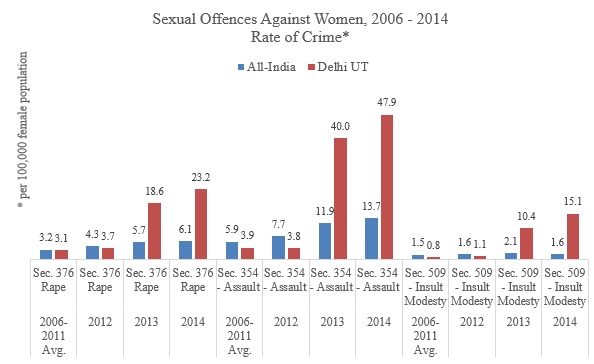
Notwithstanding my personal position, one thing is apparent that since this incident, the sexual offenses (from rape to assault to insulting the modesty of a women) have alarmingly increased, both at a national level and within the capital city. Do we take pride in a higher reporting and that law enforcement is perhaps taking more complaints, or we feel just about ashamed at these growing numbers and do nothing? Or chart a future course with policy-driven initiatives grounded in empirical evidence?

Indiasexoffense

Source: National Crime Record Bureau (India): 2006–2014.

Let me assert that the problem in India is not the laws or its lack thereof. According to the Indian Penal Code (IPC), sexual offences comprise rape (Sec. 375, Sec. 376 IPC); attempt to commit rape, assault on women with intent to outrage her modesty (Sec. 354 IPC) and insult to the modesty of women (Sec. 509 IPC). An offence of rape under sec 376 warrants a fine with rigorous imprisonment of a term not less than seven years, but may also extend to imprisonment for life. The Indian legal system does provide protection and remedial against sexual harassment including many serious sexual offenses. However, the pervasive occurrence of sexual violence in India exists for reasons that are beyond the mere existence of the laws. A Washington Post story attributed it to a few female police officers, a sluggish court system, few convictions, and low status of women in the Indian society among several other factors. For the purpose of this write up, it is my hope that both men and women become aware of the pertinent laws.

Read Part 2.

Manish is a Professor of Criminal Justice at Stockton University where his research focuses on examining sexual harassment, gender empowerment, spousal abuse and policing issues. You can follow him @Prof_Madan or reach out to him at www.manishmadan.com.

Share

Filed Under: correspondents Tagged With: India

« Previous Page
Next Page »

Share Your Story

Share your street harassment story for the blog. Donate Now

From the Blog

  • #MeToo 2024 Study Released Today
  • Join International Anti-Street Harassment Week 2022
  • Giving Tuesday – Fund the Hotline
  • Thank You – International Anti-Street Harassment Week 2021
  • Share Your Story – Safecity and Catcalls Collaboration

Buy the Book

  • Contact
  • Events
  • Join Us
  • Donate
  • Facebook
  • Instagram
  • Pinterest
  • Tumblr
  • Twitter
  • YouTube

Copyright © 2026 Stop Street Harassment · Website Design by Sarah Marie Lacy