• About Us
    • What Is Street Harassment?
    • Why Stopping Street Harassment Matters
    • Meet the Team
      • Board of Directors
      • Past Board Members
    • In The Media
  • Our Work
    • National Street Harassment Hotline
    • International Anti-Street Harassment Week
    • Blog Correspondents
      • Past SSH Correspondents
    • Safe Public Spaces Mentoring Program
    • Publications
    • National Studies
    • Campaigns against Companies
    • Washington, D.C. Activism
  • Our Books
  • Donate
  • Store

Stop Street Harassment

Making Public Spaces Safe and Welcoming

  • Facebook
  • Instagram
  • Pinterest
  • Tumblr
  • Twitter
  • YouTube
  • Home
  • Blog
    • Harassment Stories
    • Blog Correspondents
    • Street Respect Stories
  • Help & Advice
    • National Street Harassment Hotline
    • Dealing With Harassers
      • Assertive Responses
      • Reporting Harassers
      • Bystander Responses
      • Creative Responses
    • What to Do Before or After Harassment
    • Street Harassment and the Law
  • Resources
    • Definitions
    • Statistics
    • Articles & Books
    • Anti-Harassment Groups & Campaigns
    • Male Allies
      • Educating Boys & Men
      • How to Talk to Women
      • Bystander Tips
    • Video Clips
    • Images & Flyers
  • Take Community Action
  • Contact

USA: A FedEx Driver Harassed Me

June 25, 2016 By Correspondent

Ginger Skinner, NY, USA, SSH Blog Correspondent

Image via photopin
Image via photopin

Last May, just seconds after hopping on my bike in front of my Brooklyn apartment, I hear, “Mmm. Can I go with you?” I slow my bike and turn around to see a FedEx driver staring back at me. I yelled, “You really shouldn’t harass people while you’re on the job.” His response: “F**k you.” Followed by several more “f**k you’s.”

The driver’s comments were no different than those hurled at me almost daily from row house stoops, in corner stores, supermarkets, parks, gyms, and on and around public transit. “Hey baby’s,” “How you doing’s,” and “Mmm mmm mmm’s,” that seem innocuous, yet too often leave long-term side effects: anger, anxiety, shame, and hypervigilance. Still those men had not delivered packages to my home. Packages I regularly signed for. I worried that my speaking up and defending myself might have inadvertently encouraged more harassment.

Five minutes later, I was on the phone with a FedEx “specialist.” After opening a claim that included a detailed description of the delivery person, the specific location, and time of day, she repeatedly assured me that FedEx would handle the situation according to their policies, and that they’d follow up with me. She ended the call with “FedEx takes these matters very seriously.” Weeks passed. No follow up.

Had I done the right thing in reporting the harassment? Yes. I think so. Street harassment is often a precursor to more aggressive forms of violence. Had I really wanted the driver to lose his job? Certainly not. What outcome had I expected? At the very least, I knew that I wanted to be listened to and believed—and for FedEx, as promised, to take the matter seriously.

A basic search of Twitter turned up people who clearly wanted the same. A jogger who was catcalled by a FedEx driver. A woman aggressively catcalled by a FedEx worker inside her apartment building. A man whose wife was sexually harassed by two FedEx drivers. A woman who tweeted at FedEx after one of their drivers made kissing sounds at her. Another woman who upon calling FedEx to complain about harassment was “pretty much laughed at” by the customer service rep. This story. And this one. And here’s one about a UPS driver.  And this incredibly disturbing story about a U.S. Postal Service worker.

No complain alert line for customers?

Like most companies, FedEx has an employee policy in place that addresses workplace sexual harassment. The anti-harassment policy on the company’s website states that:

Unwelcome sexual advances and other inappropriate personal conduct are prohibited. We strictly prohibit, and will not tolerate, any type of harassment or any acts that create the potential for harassment, either in terms of individual employee morale or in violation of applicable laws.

There’s also a mechanism for reporting violations – the FedEx Alert Line.

I wondered, did the same policy apply to customers? So I reached out to FedEx’s media department, but after two weeks and no response, I ended up on the phone with Dave from Customer Advocacy. I asked, “Does FedEx have policies or other measures in place that protect customers and communities members from harassment by FedEx employees?” Dave responded, “We are not able to reveal FedEx policies over the phone or on our website. Our policies are confidential.” Then a long pause, and, “We will deal with a situation when we have one.”

I ended the call with Dave, disappointed, but with a clear message for FedEx and other companies that claim to take harassment seriously:

Whether or not it affects to your bottom line, your employees’ actions directly impact your company’s reputation. At the end of the day, the employee that harassed me is wearing a uniform and driving a truck clearly marked with your company’s name. I urge you to consider stronger policies that discourage harassment by your employees and protect the communities you serve. By not addressing it, your company is essentially doing its part to preserve rape culture.

Ginger is a full-time reporter and long-time New Yorker with over 10 years of experience writing about health and wellness. Ginger is also a member of Brooklyn Movement Center’s No Disrespect anti-street harassment team, and is dedicated to deepening the conversations surrounding the causes of gender-based harassment and violence, and the intersections of race. Follow Ginger on Twitter at @ginger_skinner.

Share

Filed Under: correspondents, Stories, street harassment Tagged With: FedEx

USA: #ListenToUs: Why Men Need to Listen to Women’s Stories of Sexual Violence

June 21, 2016 By Correspondent

Mariel DiDato, NJ, USA, SSH Blog Correspondent

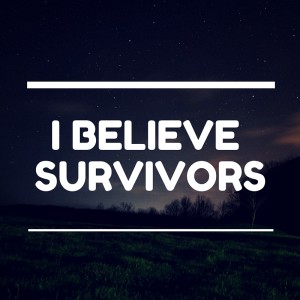
I Believe SurvivorsRecently, I was out with a friend for a night on the town. When the night was over, we were waiting for our ride home on the sidewalk outside of our favorite late-night food spot. We happened to overhear a conversation between three men standing near us on the sidewalk. They were discussing a rape case, and talking about how “the girl was definitely lying about the rape.”

“Do you hear these guys?” I said to my friend.

“Seriously,” she replied, “Of course they think she lied.”

We began discussing about how normal sexual violence is for women. How some men think “no” means “convince me,” or how others think that rape can only be committed by a stranger in a dark alley.

My friend and I experienced that normalcy just that afternoon on the beach. A man had been staring at and following us up and down the shoreline. We were oblivious to this until two women sitting nearby let us know we had a stalker. They said they were calling him “The Hawk.” My friend and I walked back and forth a few times to test it out, and sure enough, we realized he was tailing our every move. The four of us laughed together about how creepy it was.

Perspective: we laughed about a potential predator following us. That’s how much we are used to this kind of behavior.

While my friend and I were discussing this on the sidewalk, a different man came up to us and scolded us for suggesting that sexual violence was normalized. I told him that he should listen to women when we talk about our experiences. Instead, he made a joke, and tried to convince us that we were overreacting.

“I volunteer with survivors of sexual assault,” I said. “I’m also a woman. I know what I’m talking about.”

“Yeah, of course you do,” he replied under his breath. As if I wasn’t to be trusted. As if I was lying just to win an argument with an irrelevant stranger. As if women regularly lie about how we’ve been attacked by men for the sake of spite. As if a man knows a woman’s experience better than a woman.

Why does this sound so familiar? Maybe it was because when Hollaback posted a video about a woman being catcalled in NYC, men told women that we are overreacting and that we should accept strange men’s compliments. Maybe it was because of #NotAllMen, where some (not all!) men become more upset about the semantics in women’s testimonies of violence than they do about the actual violence. Maybe it was because in the cases of Bill Cosby, Dr. Luke, Johnny Depp, and even in the random group of boys standing next to us on the sidewalk, there is always the assumption that the woman must be lying about her assault.

When women are upset about catcalling, we just need to lighten up and smile. When women are talking about how men abuse us, we are automatically condemning the entire gender. When women choose to report a highly under-reported crime, it must be because they have ulterior motives. The fact that only 2 to 8% of reports of sexual assault are false seems to be insufficient evidence for the majority of women who won’t be believed.

We’re just devious. We’re just emotional. We’re just overreacting.

This mistrust of women occurs at each stage of the violence pyramid. No matter what a woman’s complaints are, they‘re minimized or discounted by someone. It’s irritating, but relatively harmless, when it’s a drunken stranger on a sidewalk who tells me that I’m thinking incorrectly about my own experiences with violence. It’s another thing when a survivor’s report of sexual assault is met with disbelief, and even retaliation. It’s a systematic problem when not only friends and family, but judges and police officers, are more likely to think that a survivor is lying about being harassed or assaulted than they are to believe their story. I’ve seen both personally, and professionally. This has to stop.

If you’re reading this and saying, “Hey, wait! I listen to women, this article is unfair!” It’s not about you. Stop derailing the conversation, and listen.

If you hear a woman say she’s uncomfortable with catcalling, put yourself in her shoes. Walking down the street as a man and hearing a compliment is not the same as hearing a sexually-aggressive comment from someone that is, on average, 50 pounds larger than you. We’re not overreacting. You need to listen.

If you hear ANYONE talking about rape and you automatically assume that she or he is lying, you’re part of the problem. For their sake, and the sake of survivors everywhere, listen.

Take #ListenToUs to Twitter to share a time when your experience with sexual harassment or violence was minimized or not believed.

Mariel is a recent college graduate, feminist, and women’s rights activist. Currently, she volunteers for a number of different organizations, including the Planned Parenthood Action Fund of New Jersey and the New Jersey Coalition Against Sexual Assault. You can follow her on Twitter at @marieldidato or check out her personal blog, Fully Concentrated Feminism.

Share

Filed Under: correspondents Tagged With: believing survivors, sexual assault, violene

Jordan: Article 308 and the Human Cost of Honour

June 17, 2016 By Correspondent

Minying Huang, Amman, Jordan, SSH Blog Correspondent

TW: Rape, sexual violence, honour killings

Article 308 - Rand Abdul Nour
Article 308 – By artist Rand Abdul Nour

Barely discernible beneath heavily patterned fabrics – those used at weddings, funerals, and parliamentary elections – are the faint figures of women who have been raped. Silent and caged in tradition, the obscured female presence is at once a sign of oppression and a mark of resilience as she fights to retain her identity, refusing to disappear.

Earlier this year, I attended Rand Abdul Nour’s first solo art exhibition at Artisana & Gallery 14 in Amman, the capital of Jordan. ‘Woman II: Adorned with Jasmin’ offered a powerful visual commentary on how pervasive concepts of ‘honour’ hurt communities of women in Jordanian society. In her work, the artist condemns a brutal and rigid honour code enshrined in – and thus championed by – law: her paintings, beautifully rendered in oil on canvas, are a direct criticism of Article 308 of the Jordanian Penal Code which controversially allows rapists to go unpunished if they marry their victim and stay with them for a minimum of five years.

Lacking social support and legal protection, victims of rape and other forms of sexual abuse are left vulnerable and isolated. The dangers they face are twofold: honour killings* carried out by other family members are a widespread phenomenon in Jordan due to the severe social stigma surrounding sexual activity out of wedlock, the culture of victim blaming, and the way in which the identities and behaviours of a man’s female relatives have come to be bound up in both his own sense of male worth and societal conceptions of masculinity and morality; meanwhile, the legal structures in place at the moment – including those relating to abortion and parental lineage – not only endorse marriage to one’s attacker as a means of preserving the reputation of the victim and their family, but can also be said to strip victims of any real choice. Women’s rights activists in the country say that the majority of rape cases that do not result in pregnancy go unreported because revealing the truth is considered too great a risk; there is too much to lose and little certainty of a fair outcome. It has been estimated that 95% of rapists face no punishment for their crimes.

Four years ago, hundreds of Jordanians gathered together to form a human chain in the streets of Amman demanding basic rights for women, protesting against Article 308 in addition to the prevalence of honour crimes, harassment, and nationality discrimination in society. Last year, the Sisterhood Is Global Institute/Jordan (SIGI/J) launched a campaign, along with a civil coalition, with the aim of eliminating Article 308 and securing better psychological and legal provisions for those affected by sexual violence. The results of a study they conducted on local attitudes to rape and impunity showed that in reality many Jordanians are against Article 308 and believe that rapists should be punished regardless of whether or not they intend to marry their victims. After these findings were presented, the Legislation and Opinion Bureau in Amman finally began to review the article and consider SIGI’s proposals.

In April this year, it was announced that the Cabinet was in favour of cancelling the clause in Article 308 that permits perpetrators of sexual assault to walk free if they marry their victims and that the draft laws were being forwarded to Parliament for review. This important move towards achieving justice and equality comes after years of lobbying and campaigning on the part of various civil community organisations, legal experts, journalists, and activists. Progress is being made, thanks to the persevering spirit of communities of women fighting to reclaim control of their own bodies.

However, whilst change looks to be on the horizon, there is still much cause for concern. Today, in spite of the recent amendments, people continue to campaign for the complete cancellation of the article. As it stands, the article maintains that in cases of consensual sex with female minors aged 15 to 18 men may escape conviction through marriage. But it is especially difficult to differentiate between forced and consensual sex when the victim is underage. Furthermore, this remaining clause dangerously puts young girls under vast amounts of pressure to accept marriage as a resolution so as to avoid bringing dishonour and social disgrace upon themselves and their families.

Lubna Dawany, president at SIGI Jordan, has received heart-breaking letters from young girls coerced into – and now trapped in – these marriages: they detail the trauma they have sustained and their prolonged suffering at the hands of their rapists and their families; they urge other girls to resist, to never to agree to marriage under similar terms. She comments, “The new proposed change in law, which suggests that the clause be deleted but kept in place for girls under 18 years old, is unacceptable. How can it be allowed that perpetrators of sexual violence marry their teenage victims who are not treated as adults in any other aspects of their lives? On the contrary, I think that this is the age where we should support them and not leave them to such a vague future. Girls this age are still children and under no circumstances should we let them get married even to decent men, let alone their abusers.”

There is no honour in pardoning a rapist, nor is there any honour in sentencing a young girl – or a grown woman – to live in the same house as the man who abused her, to be wed to a man who would do her harm, and to be subject to his will. SIGI’s survey is a testament to the fact that traditional surface attitudes do not reflect the shifting realities within Jordanian society. We should celebrate the strength and resilience of the individuals and communities petitioning for systematic reform, unafraid to make their voices heard. Artists and activists alike are committed to redefining social values in the face of adversity and raising awareness of the issues at hand. An important and much-needed conversation on female agency in a patriarchal society has been started; hopefully increasing numbers of people will join the discussion, push for change, and help put an end to the numerous human rights violations carried out against women in the name of ‘honour’.

Here in Jordan, women are breaking the silence and painting themselves back into the narrative.

*For more information, read Rana Husseini’s book Murder in the Name of Honour.

Minying is a 19-year-old British-born Chinese student from Cambridge, England. She is studying for a BA in Spanish and Arabic at Oxford University and is currently on her Year Abroad in Amman, Jordan. You can follow her on Twitter @minyingh.

Share

Filed Under: correspondents Tagged With: art, honor killing, jordan

USA: Can Teaching Women They Have to Be “Ladylike” Place Them in Danger?

June 15, 2016 By Correspondent

By Shahida Arabi, New York, USA, SSH Blog Correspondent

Photo Credit: Opposite Strides by John St. John via Flickr. License.
Photo Credit: Opposite Strides by John St. John via Flickr.

Rose McGowan’s short film “Dawn” takes the viewer on a journey that encapsulates the female experience under the male gaze – a male gaze that can sometimes lead to dire outcomes. The protagonist in the movie falls for a dangerous male lead and is lured into a deadly situation because her need to be polite overrides her nagging gut instinct that senses danger. McGowan’s film makes it clear that women are socialized to be “ladylike” even at the expense of their own self-preservation. As she notes in her Vice interview, “The fear of being impolite is deeply ingrained and can have tragic consequences.”

Although the film is set in the 1960’s, the societal demand for women to be “nice” in all contexts still remains entrenched in our everyday behavior. Over the years, I’ve witnessed a few female friends of mine be overly friendly to street harassers, allowing them to invade their personal space and take up their time while they excessively catered to the street harasser’s whims in an attempt to be “nice.” Despite their seeming responsiveness, none of my friends were actually interested in their harassers, nor were they at all comfortable with the harasser’s tactics; they told me they felt they had to maintain a friendly demeanor because of social norms that compelled them to be ladylike and polite. One even told me it was because of the fear of what the harasser might say or do if they were not nice to them and did not respond.

Such a fear is, unfortunately, valid and warranted given that there have been harassers that have retaliated against their victims. In addition, the amount of backlash that victims experience when they try to report harassment, abuse or rape can be staggering. Newsflash: we actually live in a world where women can have acid thrown on their faces for refusing marriage proposals, shot when they refuse the advances of their harassers, and on a larger scale, bullied to death for being raped or bullied for speaking out about their own assault.

In the case of major YouTube star Sam Pepper who made “prank” videos of sexually harassing women on the street, retaliation for any victims who spoke out about being assaulted or even raped by him was major. The claims that he had harassed women outside of these pranks were often dismissed and minimized while the women who spoke out received a tremendous amount of bullying and hatred online.

Dottie Martin, a victim of Sam’s inappropriate harassment during a date, noted, “Unfortunately I felt like that was to be expected. I felt I was doing something I wasn’t meant to be doing, which was refusing.” Some women who were groped at a YouTube gathering in London were also afraid to complain about the way Sam had groped them because they felt that because it was done in a “playful” way, they “couldn’t complain.”

When we live in a society where refusal to inappropriate behavior is seen as rude, we teach women that their rights don’t matter, that their bodies are not their own and that the desires of men surpass the needs of women. How many of us walk the streets every day thinking that we can’t complain because we’ve been desensitized to so much harassment that it feels like a normal part of life? That when a man tells us to “smile,” we should simply smile to keep the peace because it’s really not a “big deal”? Or that when a man gazes at us up and down and says, “Bless you,” we should ignore the true intention behind their comment because it’s playfully packaged? How many of us avoid complaining about a rude remark, predatory gaze, or inappropriate touching because we feel it would be “impolite” to do so and that we should see it as a “compliment” rather than a potential trigger?

What about in situations where being assertive and honoring your instincts can save your life? How often do we, as women, feel compelled by the social norm of being polite and ladylike – even when we feel that we may potentially be in danger?  How often do we stifle our “no” when a man offers to walk us back to our apartment despite that “bad feeling,” smile through a bad date with a man who’s overly handsy or say nothing as a man gets too close to us when we ride the subway, only to later wish we had said something? How often do we engage in conversations with strangers because we feel we “have to” rather than because we want to? How often do we keep silent when we wished we had used our voices? How often do we use our voices, only to regret it because the retaliation far outstripped the reward of standing up for ourselves?

In contrast to my friends, I was often on the opposite end of the spectrum when it came to street harassers.  I usually ignored the harasser with a dirty look, avoided their gaze altogether, spoke back with a sassy remark or was forced to assert myself more aggressively when they continued to stalk and harass me. I even snapped a photograph of a man who harassed me on the train. Neither assertive nor more passive reactions were necessarily “wrong.”

They were right for us, how safe we felt, and what we felt would be empowering to us personally in those specific situations. For me, assertive responses were my go-to, but that didn’t mean they were always effective or that the polite responses of my friends were any less valid. There are many different ways you can respond to street harassment and any one of them can be safe and empowering for you in that given moment.

Sometimes we won’t act like we normally do when it comes to harassers because each situation may call for something different. We may not feel safe talking back in one context, whereas in another context, we may feel comfortable putting the harassers in their place.

Sometimes being polite can save your life, whereas in other times it can endanger it. There are also many cases where it doesn’t matter what you do, because the predator seeks to attack you regardless. Remember that the actions and reactions of a street harasser are never your fault, much like the responsibility of rape always belongs to the rapist.

This is certainly not a black or white issue and each set of circumstances calls for something different. We can never be truly certain whether going the nice route or the assertive route will work for us until we’ve experienced the outcome, but as the film Dawn teaches us, listening to our own intuition can be essential to our self-preservation.

The danger comes in when we demand that women be polite, nice and respectful in all circumstances where they may otherwise benefit from being assertive in a specific situation. If you call an assertive reaction “rude,” then you are teaching women that they have to respect men who do not respect them. Essentially, you teach them that their emotions, their triggers, their boundaries when trespassed, their values when violated, do not matter. Rather than teaching them to coddle the feelings of men who see them as objects, why not teach them to validate their own emotions and their right to assert themselves if needed? It is this same intuition and assertiveness that, if honored, could save their lives.

While practicing courtesy, etiquette and respect is an ideal way of life for everyone regardless of your gender, street harassment is not a context where “ladylike” behavior is always appropriate or even applicable. In some cases, it can be dangerous. We need to stop teaching women that they always have to be “nice” in contexts where it’s more effective and safe for them to be discerning and assertive.

Shahida is a summa cum laude graduate of Columbia University graduate school and is the author of four books, including The Smart Girl’s Guide to Self-Care and Becoming the Narcissist’s Nightmare, a #1 Amazon Best Seller. As a passionate advocate for survivors of abuse, sexual assault and trauma, her writing has been featured on many sites. You can follow Shahida on Twitter, her blog Self-Care Haven and join her Facebook community.

Share

Filed Under: correspondents, street harassment

USA: CTA Ad Campaign is a Step in the Right Direction

June 10, 2016 By Correspondent

Hope Herten, IL, USA, SSH Blog Correspondent

Frequently, like the rest of society, I have to leave my bedroom, stop browsing through social media and watching old episodes of Sex in the City, and go outside, whether or not I am going to class, work, or anywhere else. Going places is a general requirement for being a person and when you live in a city without a car, any mode of transportation you choose is a part of the public sphere. Whether I am riding my bike, taking a cab or ride share, or on public transportation (the “L”), I enter an environment where I am surrounded by other people and in doing so, I unwillingly become the target of stares and comments by strangers.

Normally, it is a relatively uneventful experience, aside from near-death experiences on my bike, erratic cab drivers, and less than pleasant smells on the train or bus. All in all, the majority of my commute is devoid of unwanted encounters. Despite not being the majority of my experience, harassment as I am “making my way downtown” occurs frequently enough for it to stick in the back of my mind no matter where I go. As one of my friends said, “I’m a human that needs to get places and I won’t let a male stop me. (Assuming the street harasser is a male). That doesn’t mean I’m not cautious. I’m especially cautious at night or when I see a group of males around, even if it’s in the middle of the day”.

I am not one to let fear keep me from doing what I want, I am not about to let an experience or stories from friends keep me from venturing to different parts of the city, but that doesn’t mean I am not aware.

I have had more than my share of harassment experiences while on my way to work, which for me is one of the most troubling types of harassment. Not that I welcome harassment on my days off, but there is something about being yelled at or cornered on my way to work that makes the rest of the day horrible. On my bike men have yelled at me from the street and, to my horror, from their cars, pulling up beside me to say something. Less so cab drivers, but there are a handful of times that while I am using ride shares like Uber and Lyft that my driver has repeatedly hit on me and refused to give up when I denied to give them my number.

By far though, my experiences of harassment on the “L” are the most frequent and frustrating. On the train, I have been approached by men who are alone and by groups of men, telling me what they think of how I look or asking for my number. These situations are often frightening and never feel good. On one occasion when I was traveling to work a group of men, the only other people in the train car, were yelling at me, as I continued to ignore them they approached me, threatening me by asking, “Who do you think you are to ignore me?” Luckily, my stop came and they did not follow me, but it was difficult to go through an eight hour workday doing customer service after I was so shaken.  It was actually this experience in particular that motivated me to seek out organizations like Stop Street Harassment and Hollaback! to see what people were doing to stop street harassment.

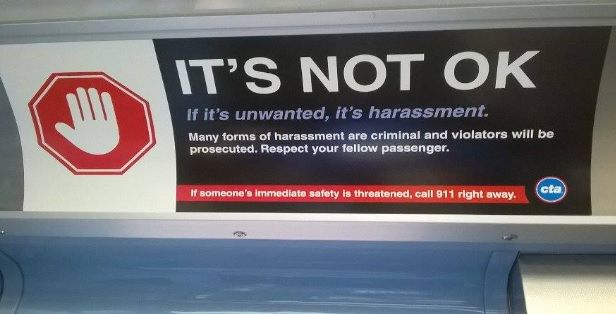
When asking my friends about their experiences on the “L”, they shared similar experiences: men coming up to them, sitting next to them, relentlessly pursuing them until they are forced to leave the car. My group of friends and I must not have been the only women who have experienced serious harassment while on public transportation, because recently the Chicago Transit Authority (CTA) began an ad campaign to bring awareness to the issue.

CTAjune2016

Ads on the trains and buses encourage passengers to not just sit by and watch fellow riders be harassed or threatened during their commute.  A CTA official told the Chicago Tribune in an interview that they are aware that the vast majority of harassment cases are not reported, “One of the main reasons for this campaign is that we want customers to report incidents they experience or witness.”

As the campaign is relatively new, many of the people with whom I spoke had not noticed the advertisements, but upon viewing images of them, they agreed that they would be helpful.  Many people agreed that bringing any sort of attention to the issue is good and could encourage bystanders to intervene and victims to report cases, but a few people whom I interviewed expressed concern that since they hadn’t noticed the ads, the efforts should be expanded and that the ads should be more eye catching. I carry the same sentiment as many of my peers, but this is definitely a step in the right direction.

Maybe one day I won’t have to practice my resting bitch face in the mirror before heading to work.

Hope is a full-time undergraduate student studying public health and Spanish in Chicago, IL. During her time in Chicago, Hope has participated in many protests and events trying to call awareness to women’s issues on campus and in the broader Chicago community. Follow her on Twitter @hope_lucille or check out her public health blog.

Share

Filed Under: correspondents, street harassment Tagged With: chicago, CTA, transit

« Previous Page
Next Page »

Share Your Story

Share your street harassment story for the blog. Donate Now

From the Blog

  • #MeToo 2024 Study Released Today
  • Join International Anti-Street Harassment Week 2022
  • Giving Tuesday – Fund the Hotline
  • Thank You – International Anti-Street Harassment Week 2021
  • Share Your Story – Safecity and Catcalls Collaboration

Buy the Book

  • Contact
  • Events
  • Join Us
  • Donate
  • Facebook
  • Instagram
  • Pinterest
  • Tumblr
  • Twitter
  • YouTube

Copyright © 2026 Stop Street Harassment · Website Design by Sarah Marie Lacy