Tharunya Balan, Bangalore, India, SSH Blog Correspondent
Trigger Warning
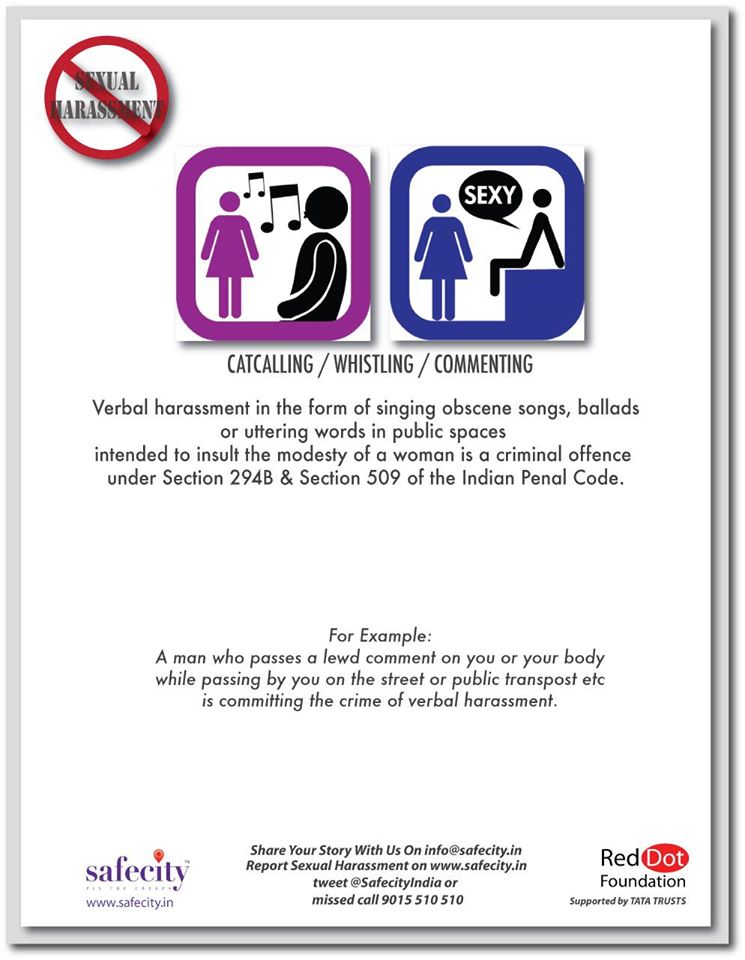 The 2012 case of the young woman who was fatally raped and assaulted on a bus in the Indian city of Delhi led to a number of decisions made at the State and Central levels to address violence against women, including several new laws against rape and sexual assault. The new laws include specific mentions of sexual harassment, voyeurism and stalking as punishable offences.
The publicity and international attention around the issue has led to more open conversation on the subject and encouraged more (mostly educated) women to report sexual assault and harassment. Unfortunately, passing laws to criminalize behaviour does little to change the prevalent rape culture and attitudes towards women held by much of the population. Even judges in other countries seem to assume that Indian culture means men simply do not understand boundaries and so cannot be held accountable for their actions.
In May of 2015, Amnesty International India approached the feminist magazine The Ladies Finger about their upcoming Ready to Report initiative, aimed at making it easier for victims of sexual harassment and assault to report incidents to the police. The online magazine then threw their doors open to people who had experienced sexual assault or harassment, and asked if they had tales to tell.
The stories published (a woman assaulted in a car, a woman molested by a friend she was visiting, a woman stalked by an old classmate, a woman molested on the street by a stranger, a team of journalists stalked and harassed by a stranger) include examples of the victims being interviewed in front of their attackers, of them being forced to recount the most intimate details of their assaults in front of a station full of curious policemen, of being browbeaten into recanting or rewriting their stories, and of their being treated as overreactions to minor annoyances, and the police taking it upon themselves to mete out justice as they saw fit.
The campaign also included a twitter hashtag that paints a depressing picture of the narratives that surround victims and stories of sexual assault in the country. Women are hesitant to speak up for a number of reasons, ranging from the fear of reprisals, the social stigma around sexual assault, the fear of being slut shamed for their choices, the stress of filing and following reports while fearing more harassment at the hands of the police force, the fear of negative media attention, and the fear of not being supported by friends and family, and the horror that surrounds medical examinations.
The founder of The Ladies Finger, Nisha Susan writes:
“The variables that affect whether an Indian woman’s claim is taken seriously by the police range considerably, from class, caste, the site of the assault, to the time of day. The more familiar the complainant was with the assaulter/ rapist/ stalker the less likely she was to successfully register a case. Our findings backed up results from the more rigorous studies undertaken by activists: in the legal system, you are likely to fare better if you have been violently assaulted by a working-class stranger in a public place.” (emphasis mine)
This only underscores the fact that marital rape is not a punishable offence, or indeed, a term recognized by the law at all, and it explains why so many reports of stalking are ignored or not taken seriously.
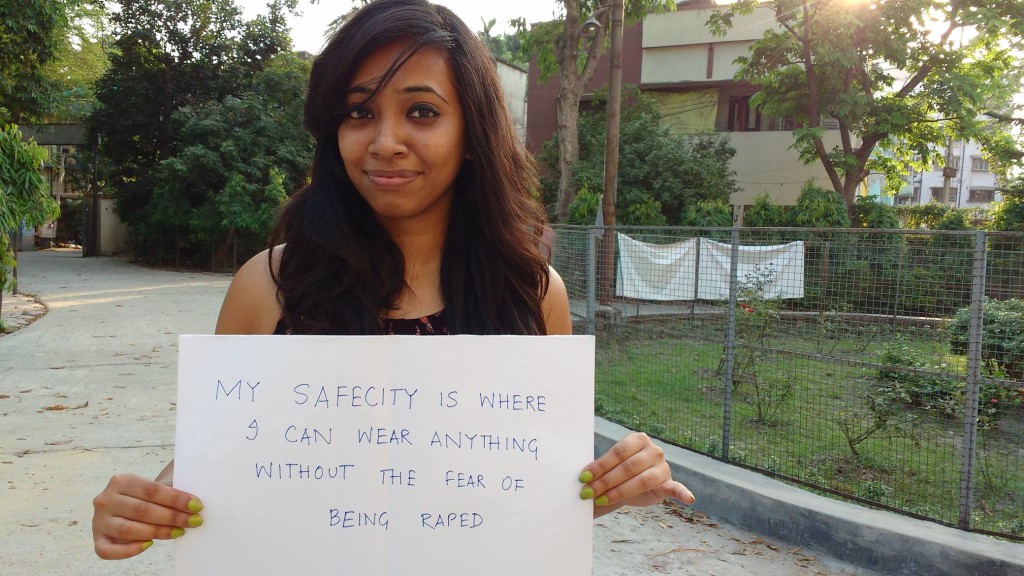
There is a lack of genuine discussion around the way women and women’s bodies are perceived in this country. The original text of the law (section 354 of the Indian Penal Code) defines as criminal the “assault or criminal force to woman with intent to outrage her modesty”, and it is this idea of “modesty” in the India context that is still such a sticking point. It is this idea that lies at the heart of the victim blaming, the slut shaming, and the dehumanizing treatment of rape and assault victims when they do come forward.
It is not just female victims who suffer under our archaic ideas of modesty and bodily autonomy. The sections of the Indian Penal Code that refer to rape are not gender neutral, and they do not acknowledge male victims of rape. There is something deeply embarrassing about a country whose leaders and whose laws are the equivalent of an ostrich sticking its head in the sand and pretending that what it sees does not exist. Treating sex as a taboo, refusing to understand the spectrums of gender and sexuality, ignoring the contradictions between what is portrayed in our media and what is taught to our children in schools and homes, and
What we are in dire need of in our country is real sex education: real conversations on consent and real understandings of the ways in which someone’s body and person can be violated by another’s actions.
Tharunya is an urban planner and architect with a passion for issues of social, environmental and spatial justice, including the gendered ways in which urban spaces are designed and function. She has a bachelor’s degree in architecture and a master’s degree in City and Regional Planning from the Georgia Institute of Technology, where she will be returning to obtain a degree in Geographic Infomations Systems Technology later this year.


 Shahida is a summa cum laude graduate of Columbia University graduate school and is the author of four books, including
  Tharunya is an urban planner and architect with a passion for issues of social, environmental and spatial justice, including the gendered ways in which urban spaces are designed and function. As a middle-class well-educated Indian woman in a large cosmopolitan city in the subcontinent, she constantly works to expand her understanding of gender, privilege, discrimination, and systemic oppression in her country and environment. She has a particular interest in including men in conversations around women’s issues and the ideas of safety, respect, and consent. She has a bachelor’s degree in architecture and a master’s degree in City and Regional Planning from the Georgia Institute of Technology, where she will be returning to obtain a degree in Geographic Infomations Systems Technology later this year.
 Mariel is a recent college graduate, feminist, and women’s rights activist. Although she received her degree in Nutritional Sciences, she plans to pursue graduate degrees in the fields of Public Policy and Women’s Studies to turn her volunteer activism into a career. She began her activism as a confidential crisis advocate for sexual and domestic violence survivors for Rutgers University’s Office of Violence Prevention and Victim Assistance. Since her training, she has become completely immersed into the field of women’s health and rights. Currently, she volunteers for a number of different organizations, including the Planned Parenthood Action Fund of New Jersey and the New Jersey Coalition Against Sexual Assault. She is passionate about ending sexual violence, and is determined to see the elimination of rape culture in her lifetime. You can follow her on Twitter at @
 Deborah is a recent MSW graduate who also received certification from American University’s Women and Politics Institute and Rutgers’ Center on Violence Against Women and Children. In addition to social work, Deborah is looking to pursue an MPP/MPA in order to help create policies that empower many different members of society, particularly those who are dealing with trauma. Deborah hopes to use her passion and skills to continue advocating and writing for human rights, gender and racial equity, trauma, HIV and AIDS, reproductive health and maternal care, LGBTQ issues, and economic inequality. In addition to social justice issues, Deborah is also extremely passionate about the arts (theater, writing, film, television, fine art, poetry, performance art), history, and Hamilton.
 Hope is a full-time undergraduate student studying public health and Spanish in Chicago, IL. After graduation in Spring 2017, Hope wants to return to her hometown of Cleveland, OH, and help work on outreach programs to improve the overall health of the community by focusing on minorities and high risk populations. Street harassment is intimately linked to the health of women, and as such is a serious public health issue. During her time in Chicago, Hope has participated in many protests and events trying to call awareness to women’s issues on campus and in the broader Chicago community. Her role model is Michelle Obama, a powerful woman who has devoted her life to many great causes like children’s health equity, the advancement of young women, and gender equality. If you want to keep up with Hope you can follow her on Twitter @
 Minying is a 19-year-old British-born Chinese student from Cambridge, England. She is studying for a BA in Spanish and Arabic at Oxford University and is currently on her Year Abroad in Amman, Jordan,
  Manish is a Professor of Criminal Justice at Stockton University where his research focuses on examining sexual harassment, gender empowerment, spousal abuse and policing issues. It is grounded in policy, international and comparative research. He teaches both undergraduate and graduate students. His research has appeared in International Criminal Justice Review, Policing: An International Journal of Police Strategies & Management, Asian Journal of Criminology, and Journal of Criminal Justice and Security, and in many prominent media outlets including NY Times, India Today and The Economic Times. He was recognized with President’s Outstanding New Scholar Award by the Western Social Science Association in 2015. He frequently consults organizations on sexual harassment and gender issues. Manish earned his doctorate at Michigan State University and has Masters in Statistics, from India (Delhi) and Canada (Newfoundland). You can follow him
  Ginger is a full-time reporter and long-time New Yorker with over 10 years of experience writing about health and wellness. Ginger is also a member of Brooklyn Movement Center’s No Disrespect anti-street harassment team, and is dedicated to deepening the conversations surrounding the causes of gender-based harassment and violence, and the intersections of race. She’s also a poet and essayist, currently working on a collection of poems on the impact of colorism on Black women and girls. She holds a BA from Howard University. Ginger enjoys drinking strong coffee, wearing shoes, listening to podcasts, and biking, and has an irrational fear of small talk and flying insects. Follow Ginger on Twitter at
  Turquoise is a 26-year-old freelance journalist, program manager at the Wichita Women’s Initiative Network, and a junior at Wichita State University. Upon graduating she plans to attend a joint Juris Doctor/Masters of Social Work Program. A California native, with a background in youth development and law enforcement, her current work focuses primarily on women, children and gender. In Fall 2015 she expanded her fieldwork and academic studies outward from California to the Midwest with the intention of expanding women’s services in underserved states such as Kansas. Turquoise is an avid public educator and presents regularly as the founder of SHERO Coalition (SHERO Co). Feel free to follow her on twitter @
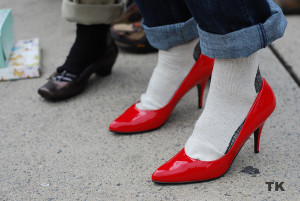 Every April, for Sexual Assault Awareness Month (SAAM), men all over the country stumble through public parks in high heels to raise awareness for the gender-based violence movement.