• About Us
    • What Is Street Harassment?
    • Why Stopping Street Harassment Matters
    • Meet the Team
      • Board of Directors
      • Past Board Members
    • In The Media
  • Our Work
    • National Street Harassment Hotline
    • International Anti-Street Harassment Week
    • Blog Correspondents
      • Past SSH Correspondents
    • Safe Public Spaces Mentoring Program
    • Publications
    • National Studies
    • Campaigns against Companies
    • Washington, D.C. Activism
  • Our Books
  • Donate
  • Store

Stop Street Harassment

Making Public Spaces Safe and Welcoming

  • Facebook
  • Instagram
  • Pinterest
  • Tumblr
  • Twitter
  • YouTube
  • Home
  • Blog
    • Harassment Stories
    • Blog Correspondents
    • Street Respect Stories
  • Help & Advice
    • National Street Harassment Hotline
    • Dealing With Harassers
      • Assertive Responses
      • Reporting Harassers
      • Bystander Responses
      • Creative Responses
    • What to Do Before or After Harassment
    • Street Harassment and the Law
  • Resources
    • Definitions
    • Statistics
    • Articles & Books
    • Anti-Harassment Groups & Campaigns
    • Male Allies
      • Educating Boys & Men
      • How to Talk to Women
      • Bystander Tips
    • Video Clips
    • Images & Flyers
  • Take Community Action
  • Contact

USA: Vigilant against Street Harassment

May 21, 2016 By Correspondent

Turquoise A. Thomas (Morales), Kansas, USA, SSH Blog Correspondent

Growing up I, like most girls and women, had wholeheartedly internalized the fear of “stranger danger.” So naturally, as I matured and my family allowed me to explore the cities we lived in unattended, I was extremely vigilant. However, like most girls and boys coming into young adulthood, I also felt it was exciting and flattering to occasionally catch the eye of someone who was ‘mutually attractive’. Strolling the mall on a Saturday afternoon with friends, hunting for friendship bracelets at Claire’s, might include a game of seeing how many cute boys we could spot, and in turn, how many would ask for our numbers. We invited these experiences verbally and physically. Some might even argue that we “reverse catcalled” boys of our age.

While my parents, and others always advised my friends I to be wary of strangers, usually older men, there was little to no mention of strangers our own age, whom we often perceived as peers, and thus less threatening.  At the time, most of us girls were still physically larger or around the same stature as the boys our age.

Casual conversations with “cute boys” at the mall, bus stops, or other places in the neighborhood led to my peers building their first “real” relationships.  I met my first “real” boyfriend, walking to a 7-11 in Inglewood, CA, when I was 17. He was 18. While my experience with him is what I’d call atypical, I had other experiences stemming from what I now understand to have been street harassment. I’d also heard haunting tales of street harassment from peers and continue to hear horrific stories now, ten years later.  Today with social media platforms like Snapchat, Instagram, YikYak etc it’s quite easy to share these experiences and the negative experiences easily can spread like wildfire and result in literal organized protests, which I personally welcome.

Street harassment is unavoidable, there is nothing a woman or any other harassment victim can do to ‘avoid’ a perpetrator. In adulthood, my response to inquisitive strangers regardless of their gender or apparent interest in me is much less inviting and quite frankly hostile.  Yet still, I occasionally get harassed. When I’m harassed in adulthood it is almost solely by people I regularly see but still am not acquainted with. Strangers rarely say anything to me.

In a recent survey I conducted of women and gender non-conforming, or non-heterosexual individuals, living in Chicago, IL; Wichita, KS; Miami-Dade, FL; and Sacramento, CA, more than 65% said they had been harassed in areas or on routes that they frequented and their harasser was someone they recognized from their daily routines but did not know.  This seemingly small finding in my survey led me to look into the research of others on the same topic regarding metropolitan populations. I found that in large cities such as Boston, MA, 87% of those harassed were women, 90% were disabled, 90% were LGBTQ+, and 94% were people of color.  Indicative of what I felt I already knew: people harass those that are already systemically disenfranchised. Arguably to remind them of their powerless status in society.

Being in public can result in wonderful and exciting interactions or scary ones. It’s a shame that street harassment has to put so many of us on high alert.

Turquoise is a 26-year-old freelance journalist, a program manager at the Wichita Women’s Initiative Network, and a junior at Wichita State University. She is the founder of SHERO Coalition (SHERO Co) and you can follow her on twitter @anthroisms.


Share

Filed Under: correspondents, street harassment

Jordan: Taking up Space in the City

May 18, 2016 By Correspondent

Minying Huang, Amman, Jordan, SSH Blog Correspondent

Photo of AmmanFor women in Amman, street harassment is a daily reality and, due to its prevalence, one to which many have grown de-sensitized. Though I still feel anger that it occurs, it’s frightening how easily I can brush off verbal and physical harassment and how little emotional impact it has on me now. Equally, I realize that life would be exhausting if I were to let every catcall, every grope, and every micro-aggression get to me.
My internal reactions to incidents of harassment were very different when I first moved here from the UK at the start of October of last year: after being felt up twice in one night in the streets of downtown Amman, I remember feeling acutely uncomfortable, ashamed, and angry at myself for having remained silent as wandering hands touched me, shielded from public view by shopping bags. Despite knowing that victims of harassment shouldn’t have to feel shame or guilt for what is done to them, I couldn’t shake my unwarranted feelings of dirtiness and humiliation – showing that, on some level, I, along with many others, have internalized the damaging, socially-entrenched myths surrounding sexual harassment.

As a foreigner living here, and especially as a young woman of East Asian descent, it’s easy to fall into the trap of thinking that you are targeted for your racial difference and on account of common misconceptions regarding non-Arab women. Whilst this is certainly a factor that comes into play (and one that I hope to explore in future posts), it’s also clear that sexual harassment in Jordan is by no means solely limited to foreign women and it happens regardless of what you wear.

In 2012, a group of students at the University of Jordan created a short film titled ‘This is my privacy’ in an attempt to combat on-campus sexual harassment and draw attention to the issue. The original video was taken down but you can watch a re-uploaded version. It speaks volumes that Professor Rola Qawas, who supervised the making of the film, was dismissed from her post as Dean of the Faculty of Modern Languages after senior management deemed it a distorted representation of university life and an attack on the overall reputation of the university.

I’d like to emphasize that sexual harassment is a global phenomenon not exclusive to Jordan and the Middle East. I have encountered sexual harassment in the UK where I grew up; however, without wishing to generalize, I don’t think that it would be too far-fetched to suggest that cultural ideas of space and notions of “honor” perpetuate and intensify the problem here, reinforcing the adaptive behaviors women engage in to avoid putting themselves in vulnerable situations. As a result, men are able to continue exerting control over public spaces, and progress toward redefining these established boundaries is slow.

More often than not, sexual harassment is about power. In Jordan, where high youth unemployment is a major socio-economic concern, young people are becoming increasingly disillusioned with politics and worried about their future prospects. Restless, sometimes without the means to achieve independence and further their aspirations, the shabab – literal translation: ‘the youth’; commonly used to refer to young men in the streets – may be inclined to resort to expressions of dominance in communal areas in order to offset the sense of powerlessness found in other aspects of their life.

The question is: how do we bring this conversation into the public sphere without compromising the safety of those wishing to effect change? How do we promote the idea that public spaces are not male spaces but shared spaces accessible to people of all genders? The social and legal framework here in Jordan fails to protect women from harassment. Instead, society attaches stigma and shame to the victims. The law does not explicitly condemn the act, with lawmakers neglecting to clearly define the crime. The law states that offenders can be punished for committing violations against “modesty” and “humanity”, but the use of such nebulous and subjective terminology makes it difficult for victims of harassment to actually achieve justice.

The repercussions of speaking out impose a culture of silence on Jordanian society. Few people openly discuss the realities of sexual harassment, and those that do are subject to public criticism. Yet, in private spaces, the consensus is that something needs to be done to tackle the underlying causes of this recent phenomenon in response to a rapidly increasing number of Jordanian women setting foot outside the confines of the home and entering the public space. When a woman dares to occupy the public space and asserts her right to an equal share in it, the ownership of her body should not then be up in the air and up for grabs.

Minying is a 19-year-old British-born Chinese student from Cambridge, England. She is studying for a BA in Spanish and Arabic at Oxford University and is currently on her Year Abroad in Amman, Jordan. You can follow her on Twitter @minyingh.

Share

Filed Under: correspondents, race, Stories Tagged With: jordan, traveling

USA: Welcome to Campus: Peer-to-peer sexual harassment

May 16, 2016 By Correspondent

Hope Herten, IL, USA, SSH Blog Correspondent

According to an informal study conducted by the organization Hollaback! in 2015, nearly 67% of female students experienced some sort of sexual harassment on campus.  This figure may seem shocking, but what I find the most disturbing is that despite research and meek attempts to curb catcalling and other forms of sexual harassment, this number has remained stagnant for years.  In 1996, a study was published that looked at two different colleges, reporting the 68% of the women in their study had experienced sexual harassment on campus, not only walking between classes, but many of them experiencing some sort of harassment by male peers while in class (Ivy & Hamlet).  Similarly, an extensive report published in 2005 by AAUW found that that two-thirds of their participants had experienced sexual harassment while at their university (Hill & Silva).  The 2005 study reported that the top three reasons student gave for harassing their peers were (1) “I thought it was funny”, (2) “I thought the person liked it”, and (3) “it is just a part of school life/ a lot of people do it/ it is no big deal”.

As a female college student in Chicago, I expected that I would experience harassment, but I never imagined that my peers would be the ones harassing me or my friends.  During her freshman year, a friend of mine experienced frequent harassment from a random guy in our university’s commons. To avoid that constant harassment, she had to go out of her way to avoid him in ways that made her own life much harder. Now that she’s in her third year, she is still occasionally approached by him on campus, whether he is following her to the bathroom or asking her out. To be faced with this issue not once, not twice, but multiple times from the same person is unacceptable. She says that she rarely feels threatened by him, but the frequent harassment is an additional unnecessary nuisance to her day.  She is not the only one of my friends who faces harassment on campus, whether it is the hallways, the quad, the student union, or even the classroom; many female students at my university face this frequent hurdle in their pursuit of academic success.

The deep-rooted integration of technology has been a blessing and a curse. Though more people have a voice on the internet and information is more readily available, it has opened a new door for sexual harassment on campus. Social media accounts meant for anonymous submissions of confessions and crushes at my university have allowed for a new avenue of harassment. Many women on campus have been publicly shamed and objectified using these platforms, with no repercussions for the men submitting them. One student complained about appearing on these Twitter accounts multiple times; one of the posts was even commenting on the clothes she wore to the gym and calling her a “sexy babe”.  Students should be able to go to public places on campus and feel comfortable walking around or working out without the fear of being talked about publicly, and anonymously, online.

Women have been experiencing harassment on campuses for decades across the country, both at public and private, big and small, and religiously-affiliated or secular institutions.  It seems that no matter how committed an institution is to providing the best education possible, this one issue is constantly put on the back burner.

All students, regardless of gender, sexuality, race, or ability, deserve their right to pursue their education in a place where they are valued and respected parts of the community. From personal experience, I know that it is difficult to focus on school when you are nervous about going to specific places at certain times, if you don’t want to go to class because of that one man who won’t leave you alone, or, now because of technology, fear being called out online for participating in a wide array of activities from going to the gym or drinking at a party.  College is a place to grow as a person intellectually, spiritually, and socially; everyone deserves to feel safe pursuing that education.

What can we do to draw attention to this issue and push administrators to action?  Once we have the critical mass to create change, what concrete strategies do we have to stop harassment?

Hope is a full-time undergraduate student studying public health and Spanish in Chicago, IL. During her time in Chicago, Hope has participated in many protests and events trying to call awareness to women’s issues on campus and in the broader Chicago community. Follow her on Twitter @hope_lucille or check out her public health blog.

Share

Filed Under: correspondents, public harassment Tagged With: campus harassment, chicago

India: The Challenges Reporting Sexual Harassment

May 14, 2016 By Correspondent

Tharunya Balan, Bangalore, India, SSH Blog Correspondent

Trigger Warning

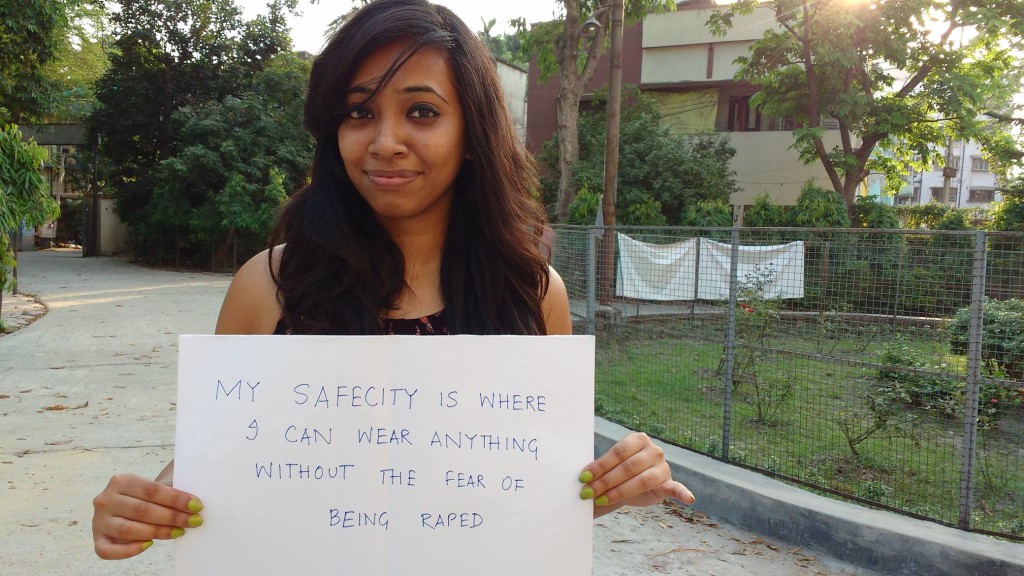
Verbal Harassment - IndiaThe 2012 case of the young woman who was fatally raped and assaulted on a bus in the Indian city of Delhi led to a number of decisions made at the State and Central levels to address violence against women, including several new laws against rape and sexual assault. The new laws include specific mentions of sexual harassment, voyeurism and stalking as punishable offences.

The publicity and international attention around the issue has led to more open conversation on the subject and encouraged more (mostly educated) women to report sexual assault and harassment. Unfortunately, passing laws to criminalize behaviour does little to change the prevalent rape culture and attitudes towards women held by much of the population. Even judges in other countries seem to assume that Indian culture means men simply do not understand boundaries and so cannot be held accountable for their actions.

In May of 2015, Amnesty International India approached the feminist magazine The Ladies Finger about their upcoming Ready to Report initiative, aimed at making it easier for victims of sexual harassment and assault to report incidents to the police. The online magazine then threw their doors open to people who had experienced sexual assault or harassment, and asked if they had tales to tell.

The stories published (a woman assaulted in a car, a woman molested by a friend she was visiting, a woman stalked by an old classmate, a woman molested on the street by a stranger, a team of journalists stalked and harassed by a stranger) include examples of the victims being interviewed in front of their attackers, of them being forced to recount the most intimate details of their assaults in front of a station full of curious policemen, of being browbeaten into recanting or rewriting their stories, and of their being treated as overreactions to minor annoyances, and the police taking it upon themselves to mete out justice as they saw fit.

The campaign also included a twitter hashtag that paints a depressing picture of the narratives that surround victims and stories of sexual assault in the country. Women are hesitant to speak up for a number of reasons, ranging from the fear of reprisals, the social stigma around sexual assault, the fear of being slut shamed for their choices, the stress of filing and following reports while fearing more harassment at the hands of the police force, the fear of negative media attention, and the fear of not being supported by friends and family, and the horror that surrounds medical examinations.

The founder of The Ladies Finger, Nisha Susan writes:

“The variables that affect whether an Indian woman’s claim is taken seriously by the police range considerably, from class, caste, the site of the assault, to the time of day. The more familiar the complainant was with the assaulter/ rapist/ stalker the less likely she was to successfully register a case. Our findings backed up results from the more rigorous studies undertaken by activists: in the legal system, you are likely to fare better if you have been violently assaulted by a working-class stranger in a public place.” (emphasis mine)

This only underscores the fact that marital rape is not a punishable offence, or indeed, a term recognized by the law at all, and it explains why so many reports of stalking are ignored or not taken seriously.

#SafeCity
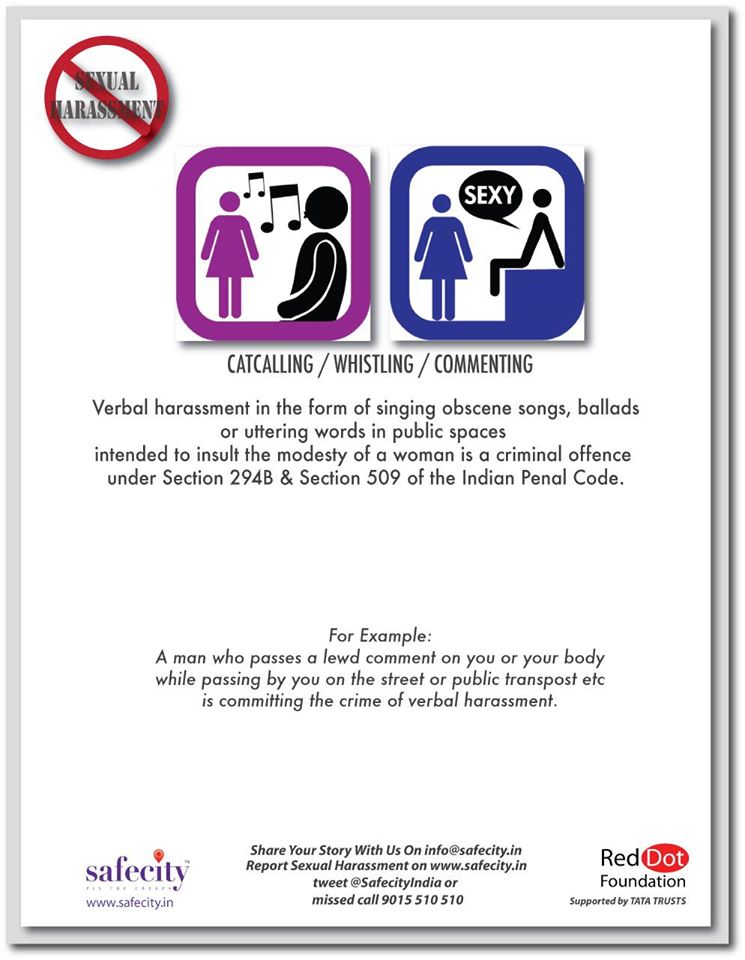
#SafeCity

There is a lack of genuine discussion around the way women and women’s bodies are perceived in this country. The original text of the law (section 354 of the Indian Penal Code) defines as criminal the “assault or criminal force to woman with intent to outrage her modesty”, and it is this idea of “modesty” in the India context that is still such a sticking point. It is this idea that lies at the heart of the victim blaming, the slut shaming, and the dehumanizing treatment of rape and assault victims when they do come forward.

It is not just female victims who suffer under our archaic ideas of modesty and bodily autonomy. The sections of the Indian Penal Code that refer to rape are not gender neutral, and they do not acknowledge male victims of rape. There is something deeply embarrassing about a country whose leaders and whose laws are the equivalent of an ostrich sticking its head in the sand and pretending that what it sees does not exist. Treating sex as a taboo, refusing to understand the spectrums of gender and sexuality, ignoring the contradictions between what is portrayed in our media and what is taught to our children in schools and homes, and

What we are in dire need of in our country is real sex education: real conversations on consent and real understandings of the ways in which someone’s body and person can be violated by another’s actions.

Tharunya is an urban planner and architect with a passion for issues of social, environmental and spatial justice, including the gendered ways in which urban spaces are designed and function. She has a bachelor’s degree in architecture and a master’s degree in City and Regional Planning from the Georgia Institute of Technology, where she will be returning to obtain a degree in Geographic Infomations Systems Technology later this year. 

Share

Filed Under: correspondents Tagged With: India, reporting

USA: Street Harassment is the “Global” Trigger That Re-Traumatizes Victims

May 11, 2016 By Correspondent

By Shahida Arabi, New York, USA, SSH Blog Correspondent

Image via Flickr
Image via Flickr

I grew up in neighborhoods where street harassment was an all-pervasive part of living, breathing and communicating. This is not to say any area is exempt from the threat of street harassment – this form of harassment takes place all over the world and across all cultures. In my own country of origin, Bangladesh, street harassment is incredibly common, along with sexual harassment, and this form of “eve teasing” has even led to the suicides of young girls. I found that my experiences with street harassment in the USA did not differ as drastically as one might think from my experiences in Bangladesh.

Starting from the age of fifteen, I was routinely objectified by older male strangers on the street as a part of my everyday commute in New York. I have been followed, stalked, harassed, asked whether I was “eighteen yet,” told that putting my earphones on were against the law, cursed at for not being responsive, bashed for being sassy and talking back in a way that was not to their liking, and at one point, almost assaulted on a train by a man who followed me from train car to train car until two other men intervened.

These experiences were triggering enough without any prior history of sexual assault, but after I also experienced my first sexual assault on the streets in Bangladesh and then a later, more severe sexual assault in the U.S., street harassment became something even more darker and foreboding – it became a constant trigger that reminded me that my body was not considered my own in this society. Women are constantly reminded – through lingering stares, covert and overt sexual remarks and even touches – that their bodies are the property of the men who desire them and that their consent does not matter.

It began occurring to me that although street harassment has and always will be incredibly traumatizing for all women navigating public spaces, it will also be incredibly re-traumatizing for women whose spirits, minds and bodies have also been violated by assault, rape or physical and/or emotional violence. Those with histories of chronic trauma, who may have PTSD or Complex PTSD, will be even further debilitated by this form of harassment every day as a barrier to a peaceful, safe commute because their brain is already on high alert, scanning the environment for potential threats. As a result, these victims will are likely to experience even more anxiety, rage and depression after an incident of harassment.

RAINN estimates that there is 1 sexual assault every 107 seconds in America and an average of 293,066 victims (age 12 and older) each year. With numbers like these, along the prevalence of childhood sexual abuse and domestic violence, I can only imagine that there are many survivors of abuse and trauma who are being subjected to a dual traumatization on their daily commutes that are leaving them feeling further revictimized. It doesn’t help that street harassment in itself is in fact a very real threat, and many have experienced sexual assault when encountering this form of harassment regardless of their trauma history.

Street harassment also has a strong verbal component which can be psychologically retriggering for survivors of verbal and emotional abuse who may have suffered childhood abuse or long-term abuse in an intimate relationship. Being name-called on the streets as a form of retaliation after rejection as well as in the private space of your home by a spouse, partner or family member can be incredibly jolting. It can reinforce and instill a pervasive sense of helplessness and worthlessness that already exists in other facets of a victim’s life and his or her trauma history.

That is why I call street harassment the “global” trigger – it not only has the capacity to affect every country, it also has the potential to trigger every other trauma experienced in one’s life. It’s an assault and a violation on a woman’s right to navigate public spaces without having her body being considered public space.

Those who trivialize street harassment as a “compliment” are not only ignorant about the deep-seated issues of this patriarchal entitlement to women’s bodies and rape culture, they are also ignorant about the effects of trauma. According to Dr. Bessel van der Kolk, author of The Body Keeps the Score (2014), trauma lives in our bodies and rewires our brains. Incidents of trauma add onto each other and make the brain more and more hypervigilant to threat. When we are traumatized, we can “regress” back to the original trauma through visual flashbacks or ones that have a high emotional component; these are what therapist Pete Walker calls emotional flashbacks.

The people who leer, touch, degrade, objectify women and later rationalize their heinous boundary-breaking behavior with a narcissistic sense of entitlement are essentially prioritizing their selfish desires over the very real needs, boundaries and desires of the victim. Like many other forms of abuse, street harassment is not about sexual desire or flirting – it is about power, control, coercion, devaluation, objectification and manipulation.

Unfortunately, every incident of street harassment builds upon pre-existing trauma and societal stereotypes about women. This cumulative effect traumatizes and continues to re-traumatize victims in an endless cycle of sexual violence against women, especially for those who reside in neighborhoods where street harassment is a pervasive problem.

It’s time that society heed the wake-up call. Street harassment is a serious issue that is part of the larger problems of gender violence and rape culture. It is this everyday microaggression, this global trigger, that has the potential to traumatize and even re-traumatize victims, all over the world.

Shahida is a summa cum laude graduate of Columbia University graduate school and is the author of four books, including The Smart Girl’s Guide to Self-Care and Becoming the Narcissist’s Nightmare, a #1 Amazon Best Seller. As a passionate advocate for survivors of abuse, sexual assault and trauma, her writing has been featured on many sites. You can follow Shahida on Twitter, her blog Self-Care Haven and join her Facebook community.

Share

Filed Under: correspondents, Stories Tagged With: bangladesh, NYC, ptsd, sexaul assault, trauma, usa

« Previous Page
Next Page »

Share Your Story

Share your street harassment story for the blog. Donate Now

From the Blog

  • #MeToo 2024 Study Released Today
  • Join International Anti-Street Harassment Week 2022
  • Giving Tuesday – Fund the Hotline
  • Thank You – International Anti-Street Harassment Week 2021
  • Share Your Story – Safecity and Catcalls Collaboration

Buy the Book

  • Contact
  • Events
  • Join Us
  • Donate
  • Facebook
  • Instagram
  • Pinterest
  • Tumblr
  • Twitter
  • YouTube

Copyright © 2026 Stop Street Harassment · Website Design by Sarah Marie Lacy