• About Us
    • What Is Street Harassment?
    • Why Stopping Street Harassment Matters
    • Meet the Team
      • Board of Directors
      • Past Board Members
    • In The Media
  • Our Work
    • National Street Harassment Hotline
    • International Anti-Street Harassment Week
    • Blog Correspondents
      • Past SSH Correspondents
    • Safe Public Spaces Mentoring Program
    • Publications
    • National Studies
    • Campaigns against Companies
    • Washington, D.C. Activism
  • Our Books
  • Donate
  • Store

Stop Street Harassment

Making Public Spaces Safe and Welcoming

  • Facebook
  • Instagram
  • Pinterest
  • Tumblr
  • Twitter
  • YouTube
  • Home
  • Blog
    • Harassment Stories
    • Blog Correspondents
    • Street Respect Stories
  • Help & Advice
    • National Street Harassment Hotline
    • Dealing With Harassers
      • Assertive Responses
      • Reporting Harassers
      • Bystander Responses
      • Creative Responses
    • What to Do Before or After Harassment
    • Street Harassment and the Law
  • Resources
    • Definitions
    • Statistics
    • Articles & Books
    • Anti-Harassment Groups & Campaigns
    • Male Allies
      • Educating Boys & Men
      • How to Talk to Women
      • Bystander Tips
    • Video Clips
    • Images & Flyers
  • Take Community Action
  • Contact

USA: Intimidation is a Currency of Power and Control

November 29, 2015 By Correspondent

Hannah Rose Johnson, Arizona, USA, SSH Blog Correspondent
power and control wheelMichel Foucault writes in Discipline and Punish (1975) that discipline is used to control entire populations through organizing space and the self-policing of individuals. For instance, he writes extensively about the panopticon—an architectural design of a prison, where a tower sits high in the middle of a circle of cells and while guards can see out of the tower, prisoners cannot see in. Without telling if a guard is or isn’t in the tower, prisoners are forced to police their own behavior and the behavior of others because, what if the guard is in the tower and watching? The architecture of communities plus the management of people is a way in which power is exercised. Power is a producer of reality that includes objects, rituals, examinations, individuals, “norms” and truths. He says, on the panopticon: “Is it surprising that prisons resemble factories, schools, barracks, hospitals which all resemble prisons?” (p. 228).

Is it surprising that sexual violence resembles white supremacy, compulsive heterosexuality, heteronormativity, neoliberal economics which all resemble sexual violence? (Please refer to my previous article Police Violence is a Form of Street Harassment). We live in a culture of discipline, watching ourselves and others, which is shaped by an architecture of domination. Sexual violence and oppressive systems are about power and control.

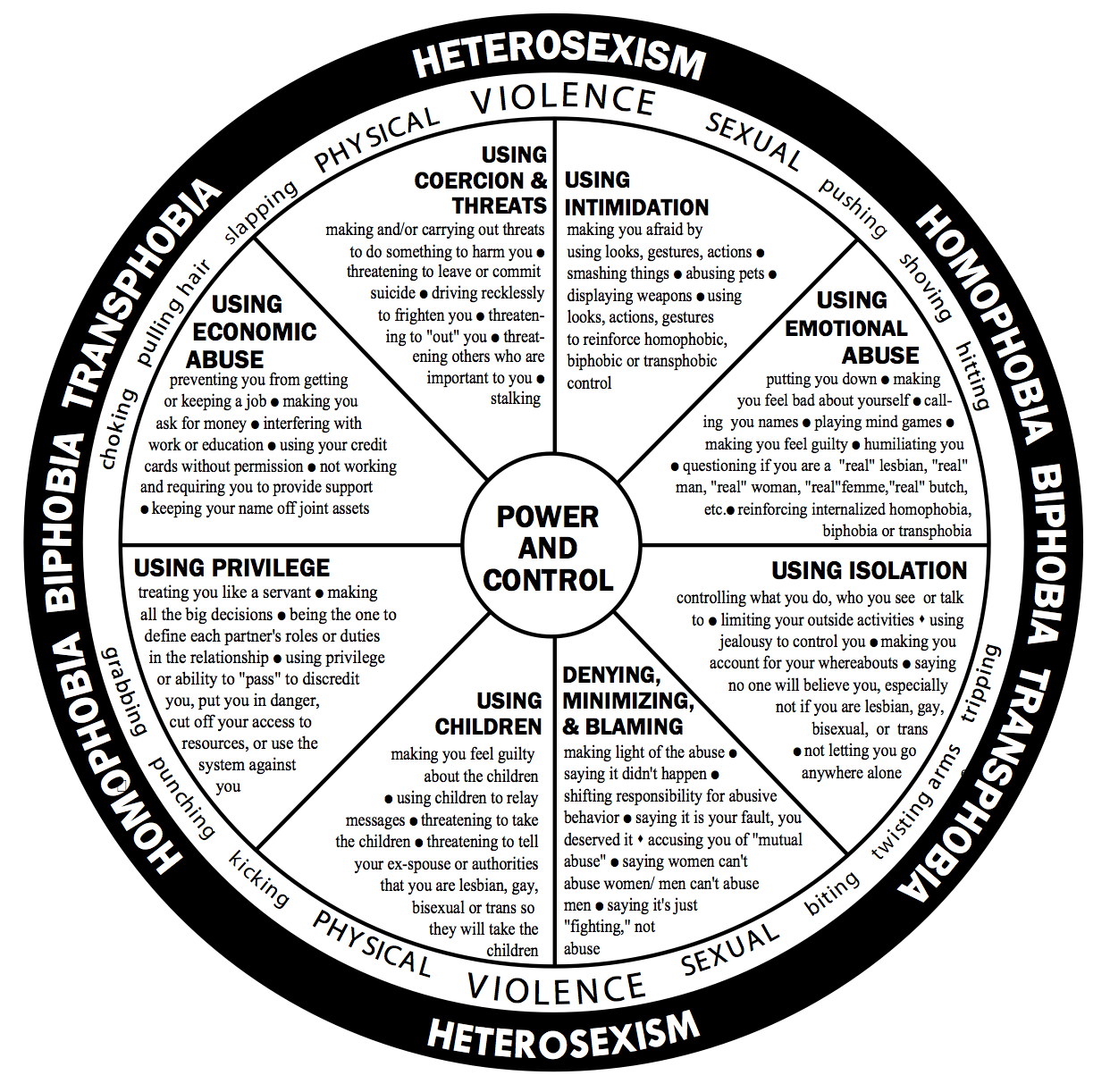
This month I have been thinking about intimidation in public spaces. On the Power and Control Wheel, which is used to identify patterns of physically and sexually violent behavior within intimate partner violence, there is a section for intimidation. Wheels differ from varying degrees, but generally intimidation highlights: placing partner in fear by looks, actions, and gestures; smashing things; destroying property; displaying weapons; sending frequent, unwanted messages and expecting the partner to respond immediately; and stalking. What I’m interested in exploring is the link between intimidation, control and power. That the use of intimidation, the behavior, is a performance of control and shaped by experiences of domination.

When I think of public spaces, I think of streets, I think of the commons, parks, I think of state and county buildings, I think of school systems and universities. I think of signs and lights and billboards and advertisements. I think about how power is exercised in ways that allow communities to organize themselves based on interlocking systems of oppression. When I think of public spaces, I think about the social contract that binds most of us together.

Social contract theory refers to the things we give up in order to come into public spaces; moral and political obligations, like agreeing not to take matters into one’s own hand and put faith in a legal system. Social contract theory explains how some people are locked away from public space and other people are not recognized even though they are here all the time, on the basis of race, gender identity, class status, sexual identity, HIV+ status, and unregulated labor.

I’d like to explore reproduction coercion within the context of intimate partner violence and expand the conceptual understanding. Reproductive coercion is forcing a partner into pregnancy when they do not wish to be pregnant, or forcing a partner to have an abortion when they wish not to. Reproductive coercion includes the murder of Native women during colonization so that an entire race of people would be wiped out. It includes the raping and forced pregnancies of Black women during slavery in the US to birth an entire disposable and exploited labor force (please read Incite! Dangerous Intersections).

And then there is reproduction in the performative sense- the reproduction of social roles and systems. In this instance, intimidation. If you play the intimated, you are the role that is the reason of power and control. Intimidation is white supremacy, compulsive heterosexuality, heteronormativity, and neoliberal economics. These systems of oppression feed an exercise of power, from anti-abortion billboard messaging to construction of the welfare queen—the image of the sexually immature Black mother who is both draining government assistance and creating poverty. Reproductive livelihoods are constantly threatened and queered.

In public we are surrounded by intimidation and it is a tactic of sexual violence. In the expanded understanding of imperfect victims (again, please refer to my article Police Brutality is a Form of Street Harassment), we see that not only is street harassment bound to sexual violence, it’s also dependent on reproducing instances and interactions of intimidation. So that when some people can control other people by a look or a gesture, or a certain kind of eye contact, power is running through the exchange. And actions, looks and gestures exist between partners, strangers, and the public/private. The look/gesture is the panopticon of intimidation.

It is the self-policing and submission for survival in violent relationships and interactions. Intimidation is a currency. It is intertwined with reproducing fear—in the context of street harassment it is the fear of harassers, from catcallers to police officers. Fear instills control, a conduit for power. And power, of a sexually violent nature, is sustained through systems of white supremacy, compulsive heterosexuality, heteronormativity and neoliberal economics.

Hannah Rose is writing from Tucson, Arizona and Lewiston, Maine (US) as she transitions from the Southwest to the Northeast for a career in sexual violence prevention and advocacy at the college level.  You can check her out on the collaborative artistic poetic sound project HotBox Utopia.

Share

Filed Under: correspondents, street harassment

Nepal: Fuel Shortages Lead to Carpooling… and then to Harassment (Part 2)

November 28, 2015 By Correspondent

Smriti RDN Neupane, Nepal, SSH Blog Correspondent

In Part 1, I discussed how a fuel shortage in Nepal has led to an increase in carpooling. However, carpooling has not been free from harassment for girls and women, and so a few young women created a closed Facebook group called “Carpool Nepal (Women).” Part 2 is my interview with one of the women (who wants to be anonymous).

Carpool Nepal (Women) 1edited finalWhat do you mean by carpool or carpooling?

Simply, carpooling is ride-sharing. To elaborate, carpooling is a way of sharing rides by several participants to save on fuel and the cost. However, in Nepal’s context, most of the time, the owners have shared a ride out of generosity.

Ok, so what is Carpool Nepal (Women) – closed group and how does it work?

Carpool Nepal (Women) is a closed women’s group on Facebook for carpooling. We are a small group of individuals. We have also created a Facebook profile with the username “Carpoolers” to keep people updated personally and by best to our collective abilities.

The women in the group mention hashtags such as #Ask to ask and #Offer to offer rides to each other.

How do you want to be addressed as – administrators, initiators, campaigners, others?

We saw some people already sharing rides and many groups already being created to help one another through ride-sharing because people were starting to have problems getting rides due to shortage of fuel. So, we do not identify ourselves as being initiators. However, we started and administered the group Carpool Nepal (Women) which was made specifically for women.

Are the administrators of Carpool Nepal open group and women only group page same?

No, we are different. After 5-6 days of Carpool open group page started, we formed a women-only closed group. We requested the admins of open group to help by posting about the women’s group page so that women would be more secure and comfortable because clearly most of them weren’t. We did not receive any reply from the administration. However, we received a message from a woman saying that there is no need for our group. But we only wanted to feel safe while carpooling by asking and offering rides for and by women.

Some people also harshly said that there was no need to divide the group. Their logic was that creating a different “women’s only” group is like segregating the country on the basis of religion, caste and ethnicity, and that the creator and members of this “women’s only” group are the narrowest of minds. It was ironic because toilets are divided based on gender; dormitories are divided based on gender, but all that they saw were us being as one of the culprits. Despite seeing so many women being bullied and harassed on Facebook, all they saw was us dividing and somehow failed to see that specific segment of women that we were targeting to help.

Were there many instances of harassment?

Women who asked for offers were bombarded with harsh comments, were teased and made fun of. One time, one of the women expressed that she felt uncomfortable while receiving a ride with strange men and that was met with so many derogatory comments from many men and few women as well. Some (or most) men made outrageous comments and that made women feel harassed and bullied. Then women who asked and offered rides to women only were ridiculed as being discriminatory towards men.

Many women were skeptic of the rides because there were some posts stating that some women were harassed. Also, some men asked for rides with needing one, just for the excuse of riding with a woman on her scooter.

There were women who needed rides and some were willing to offer rides but were too uncomfortable to post on the Facebook page because they knew they would be attacked by dreadful, awkward, perverted and crazy comments.

Also, the purpose of the initial group was to post to ask and offer with respective hashtags. However, people used to post irrelevant posts, spam posts and jokes and a lot of selfies. So, the important posts used to pile below thus very few people were getting rides. We also wanted to make it clean, so we stuck to no other things being posted except asks and offers.

What has been the overall reaction from members and non-members?

Our group is clean as there are no irrelevant posts. However, the posts have been decreasing in number. Although many women were getting rides, the stacks of posts for asking and offering that the women made would pile below and it is inconvenient to search for posts on Facebook group. Another reason is that, people would get a lot of posts in there news feed, which may have forced them to turn off notification. This has happened in both the groups and happens in Facebook groups often.

We believe that it is because of just having it as a Facebook Group. A mobile app would have helped a lot of women in need. The negative feedback which we received, we have mentioned it. The good ones, the ones who have personally sent us a message to ask us for help have thanked us a lot and we feel as much thankful to them as well for giving us an overwhelming share of delight.

Though there are only 6K+ members, women were active, very comfortable and happier than in the other group.

Do you intend to continue the campaign and your page even after easy availability of fuel?

We will help the group as long as we can from our Facebook profile. We have also helped a few by personally finding rides for them. We thought of creating a mobile app specifically for women, however the cost and time constraints kept us away from doing it. Despite that, we want to keep on helping our women by whichever way we can and we have been as well to the best of our abilities and resources.

Smriti coordinated Safe cities campaign in Nepal with a team of feminist activists of various organisations, networks and community groups from 2011 to 2014 and is still voluntarily engaged with it. She is currently engaged in an action research and advocacy on women’s leadership in climate change adaptation focusing on women’s time use.

Share

Filed Under: Activist Interviews, correspondents, street harassment Tagged With: carpooling, fuel shortage, Nepal

Nepal: Fuel Shortages Lead to Carpooling… and then to Harassment (Part 1)

November 27, 2015 By Correspondent

Smriti RDN Neupane, Nepal, SSH Blog Correspondent

In Nepal, due to “unofficial blockade” by India since September, 2015, no fuel could be imported via the border. The blockade of borders has been causing a crisis in lives of Nepali people since it is a landlocked country surrounded by India on three sides. They have been suffering from shortage of many basic amenities in life most importantly, fuel (petrol, diesel and gas) and medicinal supplies. Fuel shortage was the first thing that hit and caused impact on daily lives of people.

Public and private vehicles became scarce, creating difficulty in mobility for everyone. During the initial days, it worsened in a way that schools had to shut down and people started walking or working from home in Kathmandu. Although there were Safa Tempos (battery-run three wheelers), there were not enough to accommodate everyone.

After the first few days, young people from Kathmandu started initiating various campaigns from a cycle rally with slogan “No Petrol, No Problem” to peaceful protests in front of the Indian embassy and Nepali government offices. The campaigns were not limited to protests and strikes but were also focused on adaptation and how to be self-sustainable.

The people who had free seats on their two wheelers or four wheelers started offering rides to others who were traveling through the same route. Similar, a campaign on Facebook called “Carpool Nepal,” which is an open group where people who had access to Facebook could #offer and #ask for rides. This became an instant hit among the young students and office workers. This fostered a very communal feeling among people towards one another in Kathmandu valley and many people benefitted through it.

Unfortunately, a campaign initiated purely to help people became a site for discomfort for women, both on the page itself and also during rides in the public roads. Various instances of harassment against women started happening. Women and girls shared their stories on the Facebook page and they were mostly met by ridicule and derogatory comments, mostly by men.

The instances of harassment started increasing at such a rate that in almost a week, a few of the young women came up with a closed Facebook group named “Carpool Nepal (Women).” Some commented that the new group was useless because it served the same purpose as “Carpool Nepal” but many women are glad that it exists.

I had a conversation with one of the administrators of the closed group, who wished to remain anonymous. Part 2 contains my conversation with them.

Smriti coordinated Safe cities campaign in Nepal with a team of feminist activists of various organisations, networks and community groups from 2011 to 2014 and is still voluntarily engaged with it. She is currently engaged in an action research and advocacy on women’s leadership in climate change adaptation focusing on women’s time use.

Share

Filed Under: correspondents, News stories, street harassment Tagged With: carpooling, fuel shortage, harassment, Nepal

Croatia: It’s Never Too Soon to Talk to Children

November 19, 2015 By Correspondent

Marinella Matejcic, Croatia, SSH Blog Correspondent

As I was finishing my chores for the day, my daughter began sharing a story from her class with me. She goes to elementary school, is very calm, mature, and has a strong sense of justice. “So, do can you even imagine what did this boy did..”

“Which one?” I asked gently, trying to hide my ignorance. “This X kid or the Y kid?”

“Neither of them, it was the XY, he pushed a girl to the ground and tried to kiss her. We didn’t tell anyone, and he decided to let her go. But can you imagine?”

The unexpected sorrow got to me because the sad part is – I could imagine. That boy is the theoretical boy who later on continues to hassle other people. That boy represents the one who never hears no from his peers because they’re afraid of him. Boys like that get to be local mini-bully that grow up to a typical bully and possibly later on develop a file with the police. That kind of behaviour is the starter pack for harassment that includes catcalling and other forms of street harassment.

What bugs me is this – when and why and where did that boy decide it would be okay to harass someone? I don’t feel that kind of behaviour is congenital. Are the patriarchal patterns so deeply incorporated into our culture that we are successfully implementing them from that early age? I’m not thinking about general gender-roles expectations, but – is the violence that comes from hatred and the urge to dominate so easily being ignored, just for the sake of letting “boys be boys?”

I firmly believe that it’s never too soon to talk to our children about these serious topics — consent, personal boundaries, acceptance, freedom, and discrimination – even though they keep our throats dry and heart rates high. Those are the topics we should discuss at home since children carry their respect to others from home.

What is the exact moment when the let “boys be boys” changes into a hate crime, sex crime, whatever? In situations like that, when we’re talking about children and parenting, it’s important not to blame it on the kid – it’s never the kid’s fault. At the same time, we have to keep in mind that at some point, the child will start making informed or less informed choices and we are here to help them carry out the good ones by promoting healthy life choices and providing positive models to look up to.

Society changes step by step, and we are the society, so wouldn’t it be logical to teach our children the same values we desire? We can talk about how to combat street harassment with activities, rallies, and websites, but we will not make as big of a positive impact until we start teaching the next generation how to avoid becoming those harassers.

Marinella is a freelance journalist/writer, feminist activist, and soon-to-be administrative law student. She writes for Croatian portal on gender, sex and democracy called Libela.org and covers CEE stories for globalvoicesonline.org. Follow her on Twitter @mmatejci.

Share

Filed Under: correspondents, street harassment Tagged With: children, parents

The Netherlands: From Paris to Amsterdam: Connecting the Dots

November 16, 2015 By Correspondent

Eve Aronson, Amsterdam, the Netherlands, SSH Blog Correspondent

The events in Paris last week, just a few hours drive from Amsterdam, were tragic and appalling. They also represent an extreme form of a familiar foe.

The Paris shooters targeted people in public venues—sports stadiums, restaurants and concerts—dictating their movement and using violence to carry out their agenda.

What such a choice in venues and tactics makes clear is that the perpetrators targeted spaces designed for public use and leisure and used violence towards people they did not know within these spaces.

We can therefore look at the events in Paris as examples—albeit extreme ones—of the broader power structures that define how safe people feel in public spaces.

Not unlike a man groping or catcalling a woman on the street, the incidents in Paris show how important it is to understand seemingly mundane ‘everyday’ street harassment incidents as part of broader notions of freedom and safety in public spaces.

You might be thinking: Wait a second. That’s a bit of a stretch. Street harassment is, for one, typically gendered (e.g. a man catcalls/whistles at/gropes a woman), whereas the Paris events were not.

That is a valid point to raise and indeed, the Paris events were not explicitly gendered (although they do have implicit echoes of links between terrorism and masculinity that have been raised in relation to previous violent attacks in public spaces).

However, there are a few important connections to highlight that bring these issues closer together than you might expect.

But before I do, I want to note why I am taking the time to do so. By showing how different and seemingly unrelated forms of violence within public spaces connect, my hope is that better, more lasting and enduring solutions can be found to a larger number of problems that affect people in public spaces. In addition to finding better solutions, underlining the similarities among these issues can also lead to more resources and brains available to prevent them in the future. But I digress.

One main connection between the incidents in Paris and everyday street harassment are that the feelings of powerless, confusion and fear that were evoked last Friday were the same feelings that people in Amsterdam, for example, reported feeling while and after they were harassed.

And, at least for the short-term, the feelings of apprehension that many people in Paris are feeling when they step out into the public sphere is not so dissimilar to the feelings expressed by people as a result of their experiences with street harassment in Amsterdam.

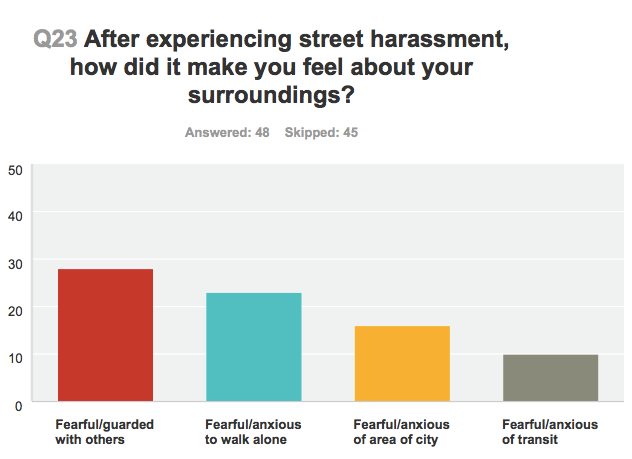
Below is a chart of some of the primary feelings about their surroundings that people in Amsterdam reported after experiencing various forms of street harassment:

amsterdam-fearful

A look on the conversations happening on Twitter about the Paris events reveals a similar spectrum of emotions. What this shows, is that in order to more fully understand and fight against issues like street harassment and violent attacks in public spaces, we have to start making connections between different manifestations of impeding or restricting movement within public spaces.

By doing this, we can start to see broader power structures emerge that reveal why these incidents occur and the factors that drive people to be physically or verbally violent towards others they do not know within different public spaces around the world.

The majority of reasons that people in Amsterdam, for example, think that their harasser(s) did what they did is that they believe their harasser(s) want to fit in with others in some way and to be accepted and applauded for their actions. The second most common reason people cited that was that they believed that their harasser(s) thought it was the ‘normal’ or ‘natural’ thing to do.

The fact that many perpetrators (street harassers or others) are motivated by group acceptance and by what they think is normal are just more of the many commonalities between issues like street harassment and other forms of violence in public spaces.

In a time where people are increasingly fearful, anxious or weary of moving through public spaces—whether because they do not want to be catcalled or groped, or whether because they do not want to be harmed or attacked in another way—it is absolutely essential that we make it our priority to examine the links between different forms of violence in public spaces more closely.

Looking at these links and using them to our advantage in the fight against street harassment and against violence in public spaces will lead to more informed policies, more helpful solutions and to more individuals feeling safer in public spaces. So what are we waiting for?

You can find the full analysis of the Amsterdam survey results here or by contacting Eve at evearonson@gmail.com. Follow Eve and Hollaback! Amsterdam on Twitter at @evearonson and @iHollaback_AMS and show your support by liking Hollaback! Amsterdam’s Facebook page here.

Share

Filed Under: correspondents, News stories Tagged With: paris, terrorism

« Previous Page
Next Page »

Share Your Story

Share your street harassment story for the blog. Donate Now

From the Blog

  • #MeToo 2024 Study Released Today
  • Join International Anti-Street Harassment Week 2022
  • Giving Tuesday – Fund the Hotline
  • Thank You – International Anti-Street Harassment Week 2021
  • Share Your Story – Safecity and Catcalls Collaboration

Buy the Book

  • Contact
  • Events
  • Join Us
  • Donate
  • Facebook
  • Instagram
  • Pinterest
  • Tumblr
  • Twitter
  • YouTube

Copyright © 2026 Stop Street Harassment · Website Design by Sarah Marie Lacy