• About Us
    • What Is Street Harassment?
    • Why Stopping Street Harassment Matters
    • Meet the Team
      • Board of Directors
      • Past Board Members
    • In The Media
  • Our Work
    • National Street Harassment Hotline
    • International Anti-Street Harassment Week
    • Blog Correspondents
      • Past SSH Correspondents
    • Safe Public Spaces Mentoring Program
    • Publications
    • National Studies
    • Campaigns against Companies
    • Washington, D.C. Activism
  • Our Books
  • Donate
  • Store

Stop Street Harassment

Making Public Spaces Safe and Welcoming

  • Facebook
  • Instagram
  • Pinterest
  • Tumblr
  • Twitter
  • YouTube
  • Home
  • Blog
    • Harassment Stories
    • Blog Correspondents
    • Street Respect Stories
  • Help & Advice
    • National Street Harassment Hotline
    • Dealing With Harassers
      • Assertive Responses
      • Reporting Harassers
      • Bystander Responses
      • Creative Responses
    • What to Do Before or After Harassment
    • Street Harassment and the Law
  • Resources
    • Definitions
    • Statistics
    • Articles & Books
    • Anti-Harassment Groups & Campaigns
    • Male Allies
      • Educating Boys & Men
      • How to Talk to Women
      • Bystander Tips
    • Video Clips
    • Images & Flyers
  • Take Community Action
  • Contact

USA: Street Harassment Doesn’t Stop in College

August 13, 2015 By Correspondent

Laura Voth, USA, SSH Blog Correspondent
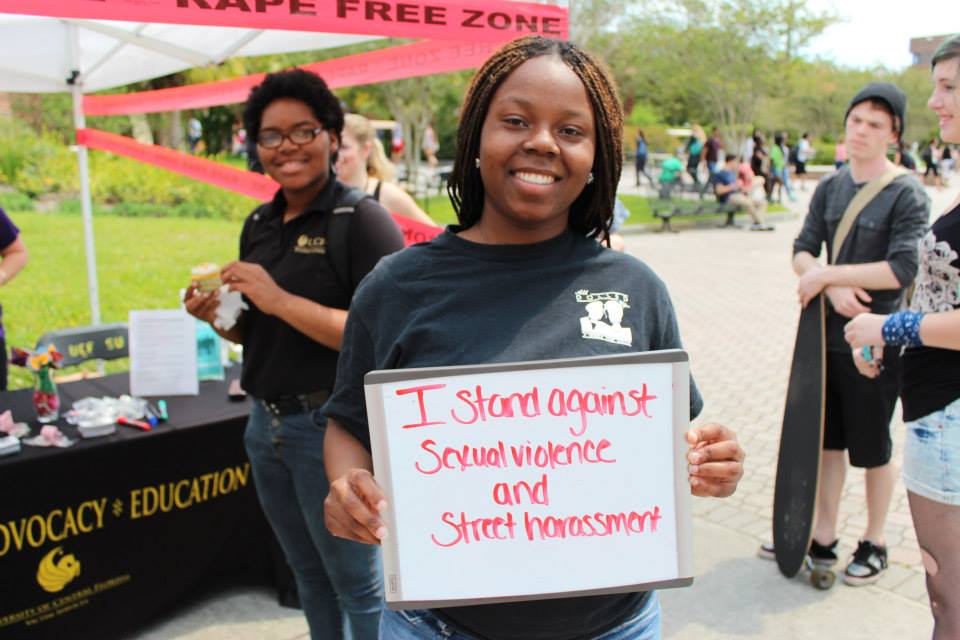
University of Central Florida, 2014

One of the most disheartening aspects of being a woman in this world today is the unpredictability of our environments. Even in spaces that we would expect to be more respectful or tolerant than others (for example, an art gallery compared to a city street), we still encounter threatening situations.

Street harassment on college campuses certainly exists, but it manifests itself in quite a different way than in other spaces. During the day at least it involves much more staring and leering than derogatory comments, and even then it isn’t so prevalent as it is on, say, a city street.

At night, and especially on weekends, the mood shifts. Groups of college boys, already slightly drunk from pregaming, hassle any lone women they spot. Like in any situation, it doesn’t matter what the woman is wearing or how she is acting: they harass indiscriminately. They call out whistles and commentary on their target’s appearance, sometimes even following the woman until she ducks into a well-lit building. The perpetrators will slap each other on the back, hooting and laughing, proud to have asserted their dominance in the presence of their peers.

Shockingly, some of the biggest harassers at my school are actually high school students (at least, that’s the word on the street, and they certainly don’t look any older than sixteen or seventeen). They drive around campus and whistle at the college women, only to floor it when their targets notice them.

This summer, a guy has been using a pseudonym on Facebook to send friend requests to women at my college. He sends messages claiming to be a research student in the psychology department (I’m not even sure what he thought he could possibly mean by “research student”) who is performing a study that would involve a free foot massage.

A close friend of mine alerted the psychology department as well as the Dean of Student Affairs, both of whom have reported back to her saying that there is no individual by that name at the school. They are looking into the situation, but I’m still concerned. Incoming first-year students frequently use Facebook to connect to others at my college, regardless of whether they have met the people they’re “friending” in person. They have questions about everything from life at our school to specific classes and have no reason to be suspicious—and they shouldn’t have to be.

Students frequently forget about the realities of the world while we’re in our little college bubble, especially if we are living in a small, remote town. We pay through the nose not only to get an education but also to fund our safety on campus in the form of better lighting and security, but too frequently we find that those have little impact on our experiences. For women, the facts of what the world is like never really disappear.

What street harassment have you experienced in college?

Laura is an emerging adult-slash-college student studying to enter a healthcare profession. In addition to studying and writing, Laura works at her university’s women’s center where she helps design and implement programs on all things lady. 

Share

Filed Under: correspondents, street harassment

UK: An interview with Bryony Beynon of Hollaback! London

August 10, 2015 By Correspondent

Ruth Mair, UK, SSH Blog Correspondent

When it comes to street harassment, the use of the word “street” is seen kind of as a catch-all. Anyone who has observed harassment, or experienced it knows that the street is just one of the many spheres of public space where it can occur, and since so many spaces are so very different, there must be different approaches to combating harassment that are tailored (as much as possible anyway) to the space they are hoping to make safe and fully public.

There are a variety of ongoing projects in different cities across the world to combat the harassment of women, LGBTQ people, and any vulnerable individuals who are likely to have encountered that kind of treatment. This week I spoke to Bryony Beynon of Hollaback! London, who has been independently advising Project Guardian, British Transport Police’s (BTP) and Transport for London’s (TFL) initiative to tackle unwanted sexual behaviour on public transport, on the progress that has been made, and the work that still needs to be done.

Project Guardian contact information

“It’s been a really interesting journey,” Beynon told me, “although it has been slightly disappointing to see how TFL – less so BTP – are so reticent to put out a message that this kind of violence is happening across their network.”

The “Report it, Stop it” video and Tumblr Beynon calls “quite brilliant” and I am inclined to agree. TFL and BTP have clearly learned a lot from the advice and support of people like Beynon through Hollaback! London, as well as consulting with the Everyday Sexism Project and End Violence against Women Coalition. However as Beynon and I spoke it became clear that there are certain barriers still preventing a more thorough and widespread campaign.

“The ‘Report it, Stop it’ video got over 1 million views, and TFL were really pleased with that. But given that 24 million journeys are made on their network every day, wouldn’t a poster reach more people?”

Beynon explained to me that, since the video was up on YouTube as targeted advertising, there was a limit to which audiences it could reach- targeting 18-30 year old women depending on what other videos they were watching obviously excludes a significant proportion of the population that might experience harassment on street harassment, and although Beynon is the first to acknowledge that she is an activist, not a communications person, this does appear to be an unintentionally blinkered response on the part of TFL, to the issue of sexual harassment on public transport. Bearing in mind also that on TFL’s own pages concerning “Safety tips for using public transport” and “Information on reporting a crime” there is no reference to sexual harassment, or to the BTP text number (61016) specifically created for the reporting of such crimes, although there are plenty of references to taking extra care not to trip down escalators when drunk.

“It’s a really simple message,” says Beynon, but there is a clear reluctance to put such information on posters in case they scare people. However this seems to be a reflection of the perpetuation of the view that a sexual harasser is still “a shadowy man in a mac.”

“The video was great because the guy who was harassing the woman in it was in a suit, and clearly looked like a commuter. That much more accurately matches the profile of harassers from stories that we (Hollaback London) collect.” But there seems to be a block on acknowledging that sexual assault on the TFL network is no different to attacks on members of staff (some of whom happen to also be women) that TFL have also run brilliant campaigns to help prevent.

“There seems to be this idea that posters about unwanted sexual behaviour won’t work because the only people doing it (the harassing) are people who are somehow pre-programmed to do it anyway. It’s stuck in that mode, rather than realising that it’s about power and wanting to control someone else.”

However, as Beynon points out, there are many other projects similar to this that have been highly successful, and reflect a much broader approach to communicating the extent of the issue, as well as the solutions to it. In New York City, the NYPD are working with the MTA, and have messages in subway stations and on trains stating that “A crowded train is no excuse for an improper touch” along with posters and a website with a reporting tool that has been live since October 2014. In Washington, DC, SSH and Collective Action for Safe Spaces have worked with the transit authority since 2012 and their second wave of posters was up this spring saying, “If it’s unwanted, it’s harassment.”

Similarly in Boston, MA, the MBTA launched an app called “See Say” in 2012, allowing passengers to report “suspicious” behaviours- including harassment. In the UK, Nottingham’s public transit is launching an initiative called Project Regard, based on the Project Guardian model of the BTP, but have already had posters on their buses concerning unwanted sexual behaviour for quite some time. Clearly such projects can be successful, in a variety of different contexts.

However, as Beynon and I agree, sometimes that “extra push” outside of all the other messages that women receive constantly telling them that such harassment is the norm, and that they are expected to get on with their day and ignore it, could be quite significant, even to those of us who are engaging frequently with activism relating to street harassment. For all of those who are less engaged, the extra information from posters, stating repeatedly that we do not have to just accept or ignore such harassment, could be absolutely integral to their feeling safe on public transport. But hopefully this will be the next step of TFL in their campaign. This is a long term project, and affecting behavioural change is the only way to really improve the situation. TFL have made progress, with significant support and input of groups like Hollaback, Everyday Sexism, and others, but there is still a long way to go before their campaign will be on the level of more extensive ones like New York’s MTA.

If you would like to support Hollaback! London, there is due to be a call out for volunteers at some point in the next few months. Sharing stories and testimony is really important for Hollaback’s campaigns, so if you have any stories relating to harassment on public transport, or if any of this information regarding reporting is new to you and you would have liked to have seen it on posters on the TFL network then you can share your stories here.

Ruth is a human rights MA student finishing her MA dissertation on the legal and normative rights of terror suspects in the UK (spoiler alert: rights are being violated). She also plays bass in a band called Kinshot, sews as often as she can, and spends time getting annoyed at the cat sleeping on top of her computer.

Share

Filed Under: Activist Interviews, correspondents, public harassment

Volunteer with us as a Blog Correspondent!

August 3, 2015 By HKearl

Do you feel passionately about ending street harassment and do you like to write? We need YOU!

Stop Street Harassment is one of the top street harassment websites in the world and we’re recruiting new members for our first Blog Correspondents Program cohort of 2015. This is an unpaid, volunteer opportunity. Build your resume and add your voice to the global conversation about this important topic!

Your words will be read: the SSH blog receives up to 30,000 unique readers per month.

Assignment:

From September to December 2015, correspondents in our third cohort must commit to writing one blog post per month about street harassment issues in their community, region or country, for four posts total. The topics could include incidents of street harassment covered in the news, activism to stop it, interviews with street harassment activists, and street harassment in popular culture, traditions or the news. You can also write pieces that tie street harassment to relevant related issues (such as racial profiling/racism, online harassment, and campus rape).

We aim to have geographic diversity among our cohort members. People of all genders, ages, regions are welcome to apply.

Applying:

If you would like to join our final Blog Correspondents cohort of the year, please complete this short application form by August 20. Applicants will be notified by August 22 and the selected cohort will be announced by the end of August.

Note: If you prefer to write in a language other than English, please also indicate what language is most comfortable for you and you can send your writing sample in that language.

Please apply and/or share with others who may be a good fit!


Share

Filed Under: correspondents, SSH programs

USA: “All it takes is one voice in a crowd of many”

July 31, 2015 By HKearl

Liz Merino, Massachusetts, USA, SSH Blog Correspondent

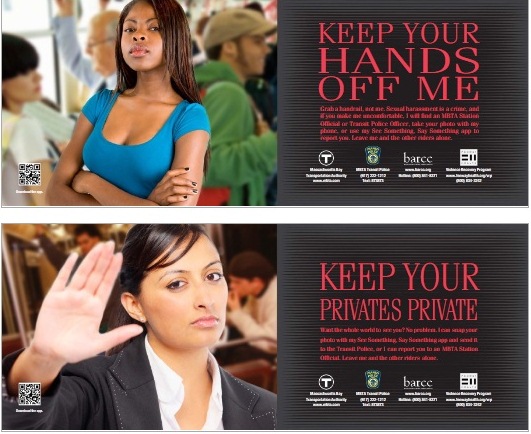
Boston anti-harassment transit ads, 2013
Boston transit ads, 2013

According to the Massachusetts Bay Transportation Authority’s 2014 Ridership and Service Statistics, more than one million riders use its urban services every week. This includes the Red and Orange Line, as well as the system’s many buses and trackless trolleys.

I am only one of those riders, and I am a woman. Taking public transit as a woman in the dog days of summer isn’t easy. Let me rephrase that, being a woman on public transit is never easy, but the summer makes it a hell of a lot worse.

“It makes me really uncomfortable how people feel so comfortable with just shouting degrading things to you or things like, ‘Hey, do you want a boyfriend?’ or ‘Where’s that smile?’ It really turns you off from riding public transportation, but with most people, that’s their only option getting to work or wherever they need to go,” said NYC resident Maddie Michalik

The bus stop that I wait at every day to take into the city is on a main stretch of road, busy with the typical morning rush hour found anywhere across the U.S.

I’m sure the harassment I face can be found there too.

Men slow down their cars and yell at me out their window as they pass by. Some I can’t understand, their words garbled by wind, others I find I’m able to tune it out, but then there are other things I hear but for now I won’t repeat.

Others just stare. I know what you’re thinking. What do I mean staring? How can someone staring be harassment, especially from across the street in a car, a bus, a truck a anything?

A stare may not seem like anything but for men that harass and see women as nothing but something to look at and f***, it is. Their eyes are lecherous, undressing me, a once over that lasts as long as a red light but feels like forever leaving me sweating but still wishing I was wearing a parka instead of a skirt and a top.

Fully dressed I seemingly feel completely exposed.

At the bus stop I have nowhere to go, and these men know it. As they continue to stare, I look away, put up my book, stare at the sun and wait for the sidewalk to swallow me whole. Or I did.

I’ve started to stare back. Sometimes I wave like I’m a woman in the circus, a one-lady show hard and fast until they look away. My personal favorite is giving the finger or looking away blatantly as if they are not even there. I told my friend this and she worried for my safety.

A man rebuffed for his advances, unwanted at that, is a scary thing. A man with a grudge and a sense of entitlement to a body that isn’t his, a woman’s worst fear. I stand in the same spot every day.

What if they come back for me?

“I want to be just like every other commuter, pedestrian and jogger in the park. Can women be anonymous, invisible sometimes? Is that too much to ask?” asked Boston resident Lisi when asked about her experience with harassment.

In some aspects, though, it is getting better. The street harassment dialogue, the stories, social media posts and personal accounts are getting louder. Now, they can’t be ignored.

The other day on the Orange Line a man sat in one of the seats reserved for those that are handicap, close to the door and easy accessible. It’s also a spot to see everyone who gets on and off the train.

Standing three seats over, I watched as he tried to talk to a woman with headphones in. She wasn’t interested and shook her head, so he reached out and tried to grab her. Before he made contact, she moved away and the jostle of her body alerted the other passengers, including myself, that something was amiss.

The doors opened and she got off, another woman taking her place. Again the man tried to talk to this new woman, and again she just wanted to ride to her destination and not be bothered, like everyone else. When she didn’t respond to him speaking, he reached out to touch her too, and before my mouth opened, the lips of another parted and what she said made the whole car turn.

“Hey, you don’t touch her, or me or anyone else. If you want something you use your mouth and if someone doesn’t want no part of it, you leave them be. But you respect their personal space, you hear?”

He sat and stared, and two stops later he was gone.

All it takes is one voice in a crowd of many to say what so few can sometimes manager to utter on their own. As a woman, it made me happy to see a fellow woman stick up for someone else, but it made me happier that the whole car was in agreement with what she had said.

It can be easy in situations like this to turn away, it’s uncomfortable and awkward, and sometimes to speak up, it can even be dangerous. But when nothing is said instead, the behavior seems to be accepted as normal. Street harassment, touching someone without consent, yelling and hollering, groping and staring, whistling and whispering isn’t normal.

Speaking up can be hard, but saying something makes a difference even if it’s small or seems insignificant. Saying something means it’s happening, and it’s wrong, but you see it and won’t let it continue. Using your voice, no matter how loud or soft, speaks volumes for those who at the moment cannot find their own.

Liz is a recent graduate of Hofstra University with a Bachelor of Arts Journalism degree. She is currently a staff writer for a marketing agency in Boston. Follow her on Twitter @slizmerino and Instagram @elizabethmerino93.

Share

Filed Under: correspondents, street harassment

Spain: Col·lectiu Punt 6: Shaping public spaces with a gender approach

July 29, 2015 By Correspondent

Rebecca Smyth, Spain, SSH Blog Correspondent

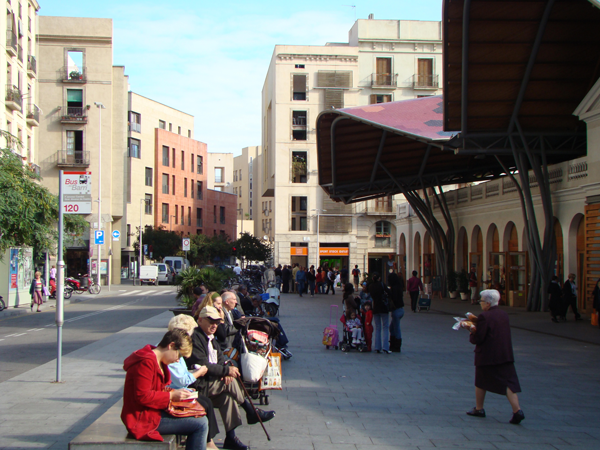
Espacio vital y equipado delante del Mercado de Santa Caterina_barrio de la Ribera_Barcelona

Tucked away down one of the many labyrinthine streets of Barcelona’s El Born district, Col·lectiu Punt 6 is an organisation formed by and intent on forming the space which it occupies. They very kindly invited me along for a chat on Tuesday to tell me about their origins, development and objectives.

The first seeds were planted in 2004, when the Catalan government of the time passed the so-called ‘Llei de barris’ (Llei 2/2004 de millora de barris, àrees urbanes i viles que requereixen una atenció especial to give it its full title; it roughly translates to ‘law for the improvement of neighbourhoods, urban areas and towns which require special attention’). An ambitious project, the law aimed to improve civic participation and social inclusion through a multi-pronged approach to urban planning and development.

In order to receive funding, any proposed project must include action on eight ‘points’, the sixth of which is the promotion of gender equality in the use of public space and facilities – hence the collective’s name. It began life as a project sponsored by l’Institut Catala de la Dona (Catalan Institute of Women) in collaboration with l’Universitat Politecnic de Catalunya (Polytechnic University of Catalonia) and hasn’t shown any sign of slowing down since.

From 2006 to 2011, the group gained momentum, members and influence. It facilitated workshops with diverse groups and provided formal and informal training. 2011 saw the formalisation of the collective, which operates on a cooperative-type basis.

And goodness are they a formidable bunch: architects, sociologists and activists, often all in one, Punt 6 is a group on a mission. They have an extensive list of publications to their names (available here and here) as well as a strong presence in the vibrant world of Barcelona activism. They organised a Jane’s Walk in May of this year and have collaborated with other feminist organisations in Barcelona in the innumerable marches, festivals and street parties that punctuate daily life in the city.

As if that wasn’t enough for a group of people trying to write their doctoral theses, they also have projects in Málaga, Argentina and Colombia. The link between Punt 6 and Latin America is a strong one, given that one of their founding members, feminist architect and activist Zaida Muxí Martínez, is originally from Argentina.

I had the privilege to meet Blanca Gutiérrez Valdivia, Sara Ortiz Escalante and Roser Casanovas on Tuesday morning, and bombarded them with questions about their experiences thus far.

If there’s one thing that struck me as I sat and chatted away with them, it was just how much can be achieved by a small group of people with a clear idea of what they want to do. I felt and still feel immensely buoyed up by having witnessed first-hand their impressive work.

Having talked about where they’d come from, the conversation moved to where they hope to go and how they want to get there. Ultimately, their goal is to reshape urban space so that it takes into account women’s needs and experiences. This in turn requires an intersectional approach to six key themes: public spaces, facilities, mobility, housing, public participation and safety. This boils down to whether or not women and other minorities not only feel safe passing through public spaces, but also feel welcome to participate in them. They want to make women’s experience of urban space more visible, and also facilitate women’s awareness of urbanism and how to influence it. Along with this grassroots approach, they’ve worked in conjunction with local government initiatives. Like I said, a formidable bunch.

When asked about the wider political and social context here in Barcelona, Catalonia and Spain, all three women were unanimous in their agreement that it has shaped their work. There’s a longstanding tradition of political engagement and activism in this corner of the world, and the impact of the recession has also increased the already-existing desire for a social and political system that protects everyone’s interests and wellbeing. When asked about the interminable independence debate, theirs was a collective shrug. “Whatever happens,” Sara said, “We’ll continue our work.”

** For more information on Col·lectiu Punt 6, visit http://punt6.org/. Sincere thanks to Blanca, Sara and Roser for their time and willingness to share their experiences. **

Rebecca is currently living, working and stumbling through ballet classes in Barcelona. Originally from Kilkenny, she has a degree in European Studies and a Master’s in Gender and Women’s Studies from Trinity College Dublin, and will be doing an LLM in Human Rights Law in Edinburgh this fall.

Share

Filed Under: Activist Interviews, correspondents, street harassment

« Previous Page
Next Page »

Share Your Story

Share your street harassment story for the blog. Donate Now

From the Blog

  • #MeToo 2024 Study Released Today
  • Join International Anti-Street Harassment Week 2022
  • Giving Tuesday – Fund the Hotline
  • Thank You – International Anti-Street Harassment Week 2021
  • Share Your Story – Safecity and Catcalls Collaboration

Buy the Book

  • Contact
  • Events
  • Join Us
  • Donate
  • Facebook
  • Instagram
  • Pinterest
  • Tumblr
  • Twitter
  • YouTube

Copyright © 2026 Stop Street Harassment · Website Design by Sarah Marie Lacy