• About Us
    • What Is Street Harassment?
    • Why Stopping Street Harassment Matters
    • Meet the Team
      • Board of Directors
      • Past Board Members
    • In The Media
  • Our Work
    • National Street Harassment Hotline
    • International Anti-Street Harassment Week
    • Blog Correspondents
      • Past SSH Correspondents
    • Safe Public Spaces Mentoring Program
    • Publications
    • National Studies
    • Campaigns against Companies
    • Washington, D.C. Activism
  • Our Books
  • Donate
  • Store

Stop Street Harassment

Making Public Spaces Safe and Welcoming

  • Facebook
  • Instagram
  • Pinterest
  • Tumblr
  • Twitter
  • YouTube
  • Home
  • Blog
    • Harassment Stories
    • Blog Correspondents
    • Street Respect Stories
  • Help & Advice
    • National Street Harassment Hotline
    • Dealing With Harassers
      • Assertive Responses
      • Reporting Harassers
      • Bystander Responses
      • Creative Responses
    • What to Do Before or After Harassment
    • Street Harassment and the Law
  • Resources
    • Definitions
    • Statistics
    • Articles & Books
    • Anti-Harassment Groups & Campaigns
    • Male Allies
      • Educating Boys & Men
      • How to Talk to Women
      • Bystander Tips
    • Video Clips
    • Images & Flyers
  • Take Community Action
  • Contact

Spain/Ireland: In praise of (feminist) festes majors

August 28, 2015 By Correspondent

Rebecca Smyth, Spain, SSH Blog Correspondent

Oh how time flies. This time last year I was wandering about what was then my new Barcelona neighbourhood. Today I’m back home in Ireland wondering where summer is.

And oh what I could be doing in Barcelona if I were still there. It’s festa major season you see, and what a season that is.

(Maria di Mario, tefl-iberia.com)  And yes, that is a bunch of people dancing under fireworks.
(Maria di Mario, tefl-iberia.com) And yes, that is a bunch of people dancing under fireworks.

From the 24th of June (Sant Joan, for those of you taking notes) until, as far as I can tell, the 24th of June of the following year, every other day sees the celebration of a festa in one corner of Catalonia or another.

Festes Majors de Mataró, 2015 (Dani Ros)

Festes are great. I want to import them here. For want of a better translation, they’re local, traditional festivals. They can be a one-day event or a two-week long blowout. What I like best about them is that there’s more to them than just the Degenerate Youth vomiting and brawling in the streets. You get kind of sick of seeing that if you grow up in Ireland. In point of fact, I witnessed no Degenerate Youth vomiting or brawling. Instead I saw people of all ages out until the wee hours of the morning taking part in processions and dances, watching open-air concerts, having water fights, having cook-outs in the street and generally just enjoying summer fun with family and friends. There may be some firework-related mayhem here and there, but what’s a lost finger or two among friends?

When I first arrived in Barcelona last year, the Festa Major de Sants was already in full swing. It’s not everyday that the new city you’ve just moved to throws a party for you, so I felt we were already off to a good start.

Festa de Sants street decorations 2014

As part of the Festa Major de Sants many streets participate in a competition to see which one can come up with the best themed street design. I’m not entirely sure how or by whom it’s judged or whether anything more substantial than the honour and the glory is won, but that is irrelevant to this blog post (what is relevant will be revealed shortly, honest.) I wandered around for a couple of hours marvelling at the creativity, humour and effort that went into the street decorations, and marvelling all the more at the fact that groups of people get together and pick a theme and gather old bottles and clothes and scraps and cut and glue and stick and transform it all into Under the Sea or Pokémon or Angry Birds or Important Event in Catalan History or Witty Commentary on International News Events every single year because this is their neighbourhood and they love it and are proud of it.   And then they turn around and plan a bunch of events suitable for all ages to take place in the now-decorated street.
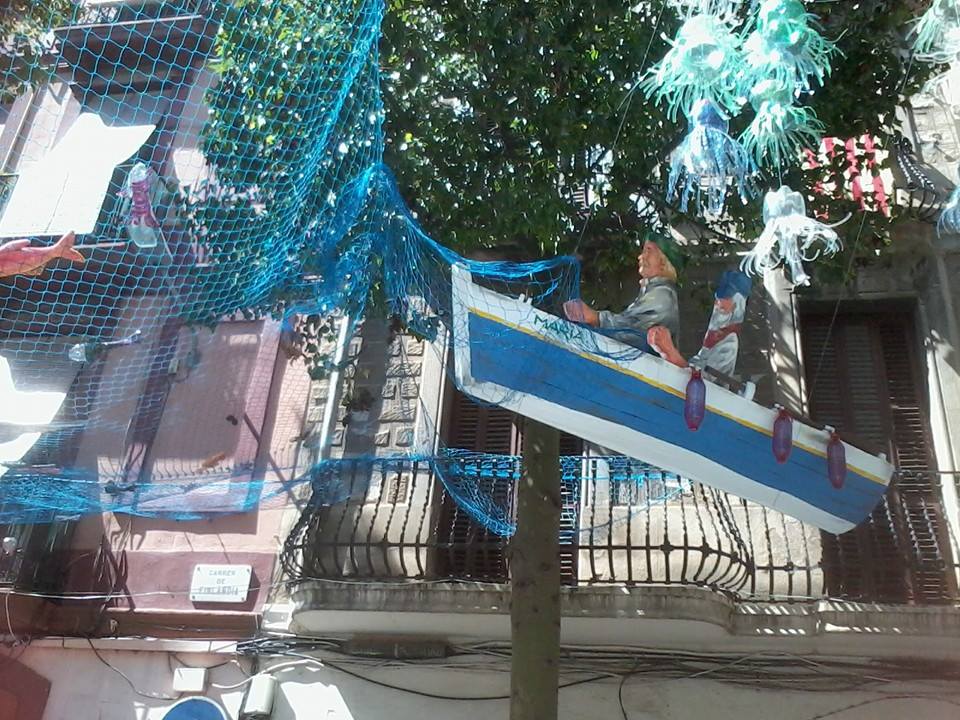
Festa de Sants Under The Sea, Boat in a Tree

And this is just one neighbourhood. It happens all over Barcelona, in El Raval and Poble Sec and, most famously, in Gràcia. Apparently the street decorations there are a whole other level, but Muggins here can’t say for sure because Muggins here couldn’t really afford to stay in Barcelona until the Festa de Gràcia kicked off on the 15th.

All sounds peachy, doesn’t it? But there’s a but. There’s always a darn but, isn’t there?

Fortunately I didn’t experience any nastiness first hand, but this is patriarchy and that’s why we can’t have nice things. Assaults, harassment and general perviness ruin something that should be fun for far too many women and other Others.

Asamblea de Dones Feministes de Gracia 2014 campaign poster (No means No; my body is not an object.  Use non-sexist language.  We don't want paternalism.  We can do it alone.  Don't justify your machista behaviour by blaming alcohol.  You are not alone, it is the responsibility of all to act against sexual harrasment)
Asamblea de Dones Feministes de Gracia 2014 campaign poster (No means No; my body is not an object. Use non-sexist language. We don’t want paternalism. We can do it alone. Don’t justify your machista behaviour by blaming alcohol. You are not alone, it is the responsibility of all to act against sexual harassment)

In response to this, numerous feminist collectives based in different Barcelona barrios and beyond have drawn up anti-harassment protocols in recent years. In 2012 the Asamblea de Dones Feministes de Gràcia (Assembly of Feminist Women of Gràcia) started the ball rolling with a poster campaign. The following year, they launched an awareness campaign featuring leaflets, posters and even radio advertisements. That summer also saw them draw up a proposed protocol against sexual harassment during festes majors. Primarily focused on their own ‘catchment area’, Plaça del Raspall, their activities and the protocol inspired other collectives involved in the Festa de Gràcia to take similar action. In both 2014 and 2015 the Asamblea and other collectives continued to campaign against sexual harassment and to provide support services to those who experienced it. It also inspired the barrio of Poble Sec’s les dones de La Base to draw up a campaign and protocol of their own this summer, to which many important groups involved in organising the Festes Majors de Poble Sec signed up.

La Asemblea de Dones Feministes de Gràcia’s 2015 protocol outlines how best to respond to different types of sexual harassment: non-physical harassment, physical harassment without force and physical harassment with force. In the case of the first two, the perpetrator is first warned that their behaviour will not be tolerated and, that if they continue, they will have to leave. If they continue, they are expelled from the festivities. In the case of violent physical harassment, they are immediately expelled.

Significantly, the Asamblea states in its protocol that it’s the person on the receiving end of any form of harassment to call the shots. If they feel like it’s harassment, then it’s frickin’ harassment. Organisers should only do what the person who has been harassed would like them to do. It also emphasises the importance of everyone being on the lookout for anti-social, sexist behaviour. Finally, and perhaps most importantly, the Asamblea also makes the point that those involved in organising the festivities should look to prevent harassment before it happens. This gives a whole new dimension to what ‘inclusivity’ can and should mean. For members of La Trama, a Sants-based feminist organisation, their anti-harassment campaigns in recent years aim “to show the rejection of sexist or homophobic violence by the organisers and the barrio.” Safe spaces can be fun spaces and fun spaces can be safe spaces, one hopes.

Writing this as my last blog was very much a deliberate thing: obviously it ties in nicely because the festes are currently ongoing, but most of all I wanted to write about something positive and something that reflected on the impressive grassroots activism that informs everyday life in Barcelona. Groups like La Trama, La Base, La Asamblea de Dones Feministes de Gràcia and many, many more have drawn upon and, to my mind, updated what can seem like fuddy-duddy concepts of community spirit and civic duty by giving them an intersectional feminist twist. It’s something I think we can all aspire to replicating in our own neighbourhoods, towns, university campuses and other communities. Failing that, we can all just move to Barcelona. Lovely weather you know.

The following article was a most helpful starting point and point of reference in writing this post.

For more information on the organisations mentioned, visit their websites:

* Asamblea de Dones Feministes de Gràcia

* La Base

* La Trama Feminista de Sants

Rebecca is currently living, working and stumbling through ballet classes in Barcelona. Originally from Kilkenny, she has a degree in European Studies and a Master’s in Gender and Women’s Studies from Trinity College Dublin, and will be doing an LLM in Human Rights Law in Edinburgh this fall.

Share

Filed Under: correspondents

USA: When Does Street Harassment Begin?

August 22, 2015 By Correspondent

Liz Merino, Massachusetts, USA, SSH Blog Correspondent

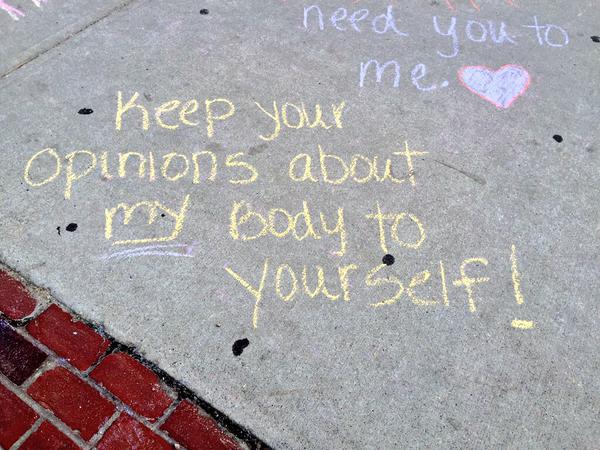
Boston chalking for International Anti-Street Harassment Week 2015

When does street harassment begin? I asked myself this the other day. When can I remember instances throughout my life that someone has sexualized my body without my consent?

There are really too many too count.

The news does capture some of it. Blips and glances, reels of one rape case or harassment of another, slowly turning, always changing, lighting up the television screen until something more repulsing replaces it.

Between sexist school dress codes, elite school rape cases and the systematic rape-based theology of Yazidi women carried out by of ISIS soldiers; I can’t help but feel helpless.

When does the sexualization of a woman begin? When does it really end?

Street harassment occurs every day. It happens on busy sidewalk streets during the morning hours when the sun is just slinking over the horizon. It happens on poorly lit streets after a night out with friends, causing some women to wonder if they will even make it home to see their loved ones again.

It happens on public transportation, city sidewalks and country back roads. Sexual harassment happens in the hallways of our schools and in the corners of our office spaces.

Sexual harassment doesn’t need an actual street to happen. It just needs a man with a sense of entitlement that reaches far beyond a normal scope of perception.

Don’t draw attention to yourself, but be sure people know you are there and carry your keys for protection, but don’t let them jingle or they will hear that too. Pull the top of your shirt up if you don’t want the attention, but stop, not every man is looking, not everyone is a predator. But cover your drink and watch your back just in case, because if they get you it’s always your fault. But you’re probably lying anyways, right?

Street harassment hurts. It creates a world in which men believe that a woman is their property simply for being in a public space.

If men can call you a slut on the street, take upskirt pictures of you in a grocery store or ask you to suck their dick from behind a car window, what will they really do to you when they get you all alone?

Priyanka, 23, a resident of New York City recounted her first experience of street harassment:

“The first place that I can truly remember it occurring was in the Middle East in one of the nicer malls. There would always be guys standing in a row near the theatre, just staring at you walking by and whistling or following you eventually. It was creepy and I didn’t appreciate the attention. I didn’t like feeling like a piece of meat.”

Having a vagina and a set of breasts is not a welcome mat upon which to lay your comments or your opinion or your crass approval of my body.

Street harassment is not a compliment. The oversexualization of women has never been “something nice” or “just something to do.” Funny how a woman can go from “sexy “and “honey” to stark raving mad, like a feral dog, when she rebuffs a man’s advances responds with how she really feels.

A woman is not a prude, stuck up cunt just because she doesn’t want you to grope her on the subway.

Jade, 21, a California resident echoed the same sentiment as Priyanka:

“I remember driving with an older guy friend, who was like my brother. He thought it was so funny to catcall women and he said, ‘If I see something I like I want to tell them.’ I tried to explain how uncomfortable it makes girls feel and he just didn’t understand that women are not here for his viewing pleasure. I don’t understand what men think they will get out of it. I am not going to hop in your car and I’m definitely not going to give you my number because you honked at me and said I have a nice ass. You are someone that I would make sure to stay far away from.”

Compared to a lot of other things I wrote in this article, the following incident isn’t that big of a deal. Or maybe in comparison, there are other bigger, more important things happening that people should care more about.

The one incident that has been popping into my mind happened during my freshman year of high school. I was wearing a tank top and a cardigan with a pair of sweatpants. I was 15.

As I was walking to class a teacher pulled me aside, a woman at that, and told me to pull up my shirt because it was “too low” and “I shouldn’t have worn it to school.”

I was embarrassed, mortified, I wanted to crawl into a hole and die. So I pulled up my shirt and hid my barely there boobs as a 15-year-old because I was “distracting,” “improper” “not appropriate.”

I hid my body because it was not deemed to be appropriate.

That line of thinking followed me into my sophomore year of college. During a sociology class discussion of street harassment, I finally realized that my body, my visible breasts and butt, thighs and flesh, the rough patches on my elbows and the bits of my baby toes were mine. Mine.

My body was not improper, but the way people view it and think about it is.

During this class I recounted a story of how my roommate and I were spending the day in NYC. It was hot, and my roommate had worn a beautiful sequin skirt, shiny and incandescent in the sunshine. We walked along laughing and smiling, taking in the city sights on our way to the Metropolitan Museum.

Street by street though, men called out to her. “Motherf***ing gorgeous,” “legs for days,” “hey sexy, come over here.” I watched as my roommate, a tall brunette with a wide smile and a contagious kindness folded into herself, hunching over and staring at the sidewalk, embarrassed by the attention she had drawn.

Before we got to the museum, she changed into a pair of pants she had in her bag. She covered herself to shield us both from the men old enough to be her father lusting after her.

She too felt her body was inappropriate, too much, asking for it. It killed me to watch it happen, and it kills me to see it now.

The only person a body belongs to is the one who can feel its heart beating from the inside. A woman is not a walking vagina, here for your pleasure only. She has two eyes, a nose and lungs, she breathes and loves and walks and thinks just like you.

And she feels.

Street harassment is not a compliment. Sexualizing women constantly is not acceptable. We know better. We can do better.

If you don’t believe street harassment, or the plight women suffer every day is actually an issue please educate yourself. If after reading and researching the topic you still don’t see the problem, rest assured we all do for you, because you are a part of it.

Liz is a recent graduate of Hofstra University with a Bachelor of Arts Journalism degree. She is currently a staff writer for a marketing agency in Boston. Follow her on Twitter @slizmerino and Instagram @elizabethmerino93.

Share

Filed Under: correspondents, Stories, street harassment

UK: Harassment and Technology – Legislation Is Not Growing Fast Enough

August 19, 2015 By Correspondent

Emma Rachel Deane, UK, SSH Blog Correspondent

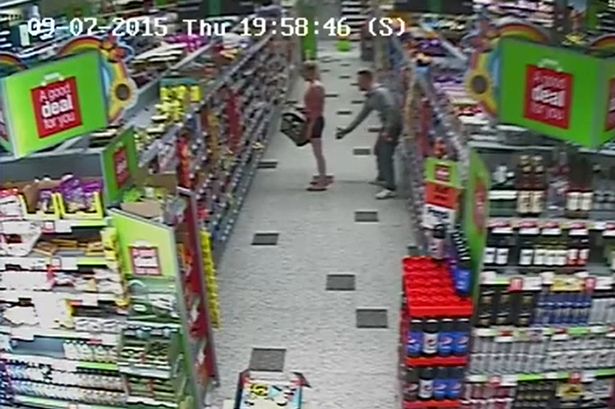
PAY-Gemma-NewittLast month 20-year-old Gemma Newitt was left enraged after no charges could be brought against a man who took inappropriate photos of her in a supermarket. CCTV footage from a Co-op store in St Austell, Cornwall shows Karl Leggatt holding his mobile phone inches away from Newitt’s bottom as she browsed the shelves of the store. After the incident was reported to the Store Manager the police were called and Newitt was told that no arrests could be made because Leggatt had not broken any laws.

After celebrities including Katy Perry, Paris Hilton and Lindsay Lohan fell victim to an invasive lens, the “upskirt photo” became an all too familiar phrase. Although generally used to refer to an unauthorised photograph under a woman’s skirt, the term is also used in relation to more general voyeuristic photography depicting, almost exclusively, women. Despite the relatively recent phrasing, the interest in creating such images is not a recent occurrence and references in art can be found as early as the 1700s as well as a plethora of pictures created during the pin-up era. The difference between then and now, of course, is the development of technology. Smartphones now make it possible for non-consensual images to be uploaded to the internet and viewed by millions within minutes. There are entire websites dedicated to photographs of women sitting on benches, relaxing in parks and stepping out of cars completely unaware that they are being intimately photographed and posted on an erotica site.

Screenshot 2015-08-16 at 22Last year, despite complaints, crowdfunding site Indiegogo continued raising funds for a smartphone accessory, pitching itself on the ability to take stealthy photos of a woman’s body without her knowledge. The text on the webpage advertised the accessory’s ability to “take pictures round corners” while images used in the marketing focused on discreetly photographed breasts and legs.

Australia, New Zealand and India are countries that have specific legislation in place to tackle the issue based on a reasonable expectation of privacy but the UK is yet to follow suit. The Sexual Offences Act of 2003 criminalises ‘voyeurism’ in the UK and defines it as recording someone engaging in a private act or installing surveillance equipment in private areas without the knowledge or consent of the victim. This means that because Newitt was shopping in a public place, her body was considered available for public recording. Few countries have tackled the issue head on and created specific legislation for the protection of a woman’s privacy in this modern world of ever developing technology.

The attitude that women’s bodies are publicly owned is ingrained deeply in our society. We see this exhibited in a myriad of ways which each boil down to denying women agency over their own bodies. Restriction to abortion access, slut-shaming, sexual assault and the endless barrage of judgmental appearance based media representation are all displays of entitlement to the female form which promulgate a culture in which Leggatt could think of his actions as reasonable behaviour and stand vindicated by the law.

Emma Rachel Deane is a London-based retail manager for a fast growing women’s lifestyle brand and an outspoken advocate for women’s social justice issues. She can be found blogging on Raging Hag or tweeting @emmaracheldeane.

Share

Filed Under: correspondents, News stories, public harassment

USA: Street Harassment Doesn’t Stop in College

August 13, 2015 By Correspondent

Laura Voth, USA, SSH Blog Correspondent

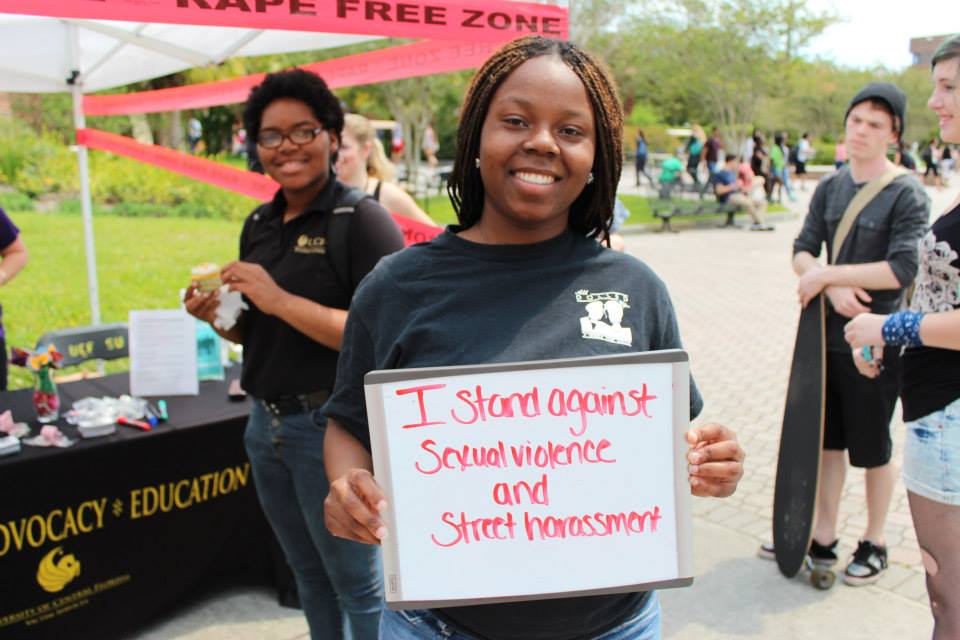
University of Central Florida, 2014

One of the most disheartening aspects of being a woman in this world today is the unpredictability of our environments. Even in spaces that we would expect to be more respectful or tolerant than others (for example, an art gallery compared to a city street), we still encounter threatening situations.

Street harassment on college campuses certainly exists, but it manifests itself in quite a different way than in other spaces. During the day at least it involves much more staring and leering than derogatory comments, and even then it isn’t so prevalent as it is on, say, a city street.

At night, and especially on weekends, the mood shifts. Groups of college boys, already slightly drunk from pregaming, hassle any lone women they spot. Like in any situation, it doesn’t matter what the woman is wearing or how she is acting: they harass indiscriminately. They call out whistles and commentary on their target’s appearance, sometimes even following the woman until she ducks into a well-lit building. The perpetrators will slap each other on the back, hooting and laughing, proud to have asserted their dominance in the presence of their peers.

Shockingly, some of the biggest harassers at my school are actually high school students (at least, that’s the word on the street, and they certainly don’t look any older than sixteen or seventeen). They drive around campus and whistle at the college women, only to floor it when their targets notice them.

This summer, a guy has been using a pseudonym on Facebook to send friend requests to women at my college. He sends messages claiming to be a research student in the psychology department (I’m not even sure what he thought he could possibly mean by “research student”) who is performing a study that would involve a free foot massage.

A close friend of mine alerted the psychology department as well as the Dean of Student Affairs, both of whom have reported back to her saying that there is no individual by that name at the school. They are looking into the situation, but I’m still concerned. Incoming first-year students frequently use Facebook to connect to others at my college, regardless of whether they have met the people they’re “friending” in person. They have questions about everything from life at our school to specific classes and have no reason to be suspicious—and they shouldn’t have to be.

Students frequently forget about the realities of the world while we’re in our little college bubble, especially if we are living in a small, remote town. We pay through the nose not only to get an education but also to fund our safety on campus in the form of better lighting and security, but too frequently we find that those have little impact on our experiences. For women, the facts of what the world is like never really disappear.

What street harassment have you experienced in college?

Laura is an emerging adult-slash-college student studying to enter a healthcare profession. In addition to studying and writing, Laura works at her university’s women’s center where she helps design and implement programs on all things lady. 

Share

Filed Under: correspondents, street harassment

UK: An interview with Bryony Beynon of Hollaback! London

August 10, 2015 By Correspondent

Ruth Mair, UK, SSH Blog Correspondent

When it comes to street harassment, the use of the word “street” is seen kind of as a catch-all. Anyone who has observed harassment, or experienced it knows that the street is just one of the many spheres of public space where it can occur, and since so many spaces are so very different, there must be different approaches to combating harassment that are tailored (as much as possible anyway) to the space they are hoping to make safe and fully public.

There are a variety of ongoing projects in different cities across the world to combat the harassment of women, LGBTQ people, and any vulnerable individuals who are likely to have encountered that kind of treatment. This week I spoke to Bryony Beynon of Hollaback! London, who has been independently advising Project Guardian, British Transport Police’s (BTP) and Transport for London’s (TFL) initiative to tackle unwanted sexual behaviour on public transport, on the progress that has been made, and the work that still needs to be done.

Project Guardian contact information

“It’s been a really interesting journey,” Beynon told me, “although it has been slightly disappointing to see how TFL – less so BTP – are so reticent to put out a message that this kind of violence is happening across their network.”

The “Report it, Stop it” video and Tumblr Beynon calls “quite brilliant” and I am inclined to agree. TFL and BTP have clearly learned a lot from the advice and support of people like Beynon through Hollaback! London, as well as consulting with the Everyday Sexism Project and End Violence against Women Coalition. However as Beynon and I spoke it became clear that there are certain barriers still preventing a more thorough and widespread campaign.

“The ‘Report it, Stop it’ video got over 1 million views, and TFL were really pleased with that. But given that 24 million journeys are made on their network every day, wouldn’t a poster reach more people?”

Beynon explained to me that, since the video was up on YouTube as targeted advertising, there was a limit to which audiences it could reach- targeting 18-30 year old women depending on what other videos they were watching obviously excludes a significant proportion of the population that might experience harassment on street harassment, and although Beynon is the first to acknowledge that she is an activist, not a communications person, this does appear to be an unintentionally blinkered response on the part of TFL, to the issue of sexual harassment on public transport. Bearing in mind also that on TFL’s own pages concerning “Safety tips for using public transport” and “Information on reporting a crime” there is no reference to sexual harassment, or to the BTP text number (61016) specifically created for the reporting of such crimes, although there are plenty of references to taking extra care not to trip down escalators when drunk.

“It’s a really simple message,” says Beynon, but there is a clear reluctance to put such information on posters in case they scare people. However this seems to be a reflection of the perpetuation of the view that a sexual harasser is still “a shadowy man in a mac.”

“The video was great because the guy who was harassing the woman in it was in a suit, and clearly looked like a commuter. That much more accurately matches the profile of harassers from stories that we (Hollaback London) collect.” But there seems to be a block on acknowledging that sexual assault on the TFL network is no different to attacks on members of staff (some of whom happen to also be women) that TFL have also run brilliant campaigns to help prevent.

“There seems to be this idea that posters about unwanted sexual behaviour won’t work because the only people doing it (the harassing) are people who are somehow pre-programmed to do it anyway. It’s stuck in that mode, rather than realising that it’s about power and wanting to control someone else.”

However, as Beynon points out, there are many other projects similar to this that have been highly successful, and reflect a much broader approach to communicating the extent of the issue, as well as the solutions to it. In New York City, the NYPD are working with the MTA, and have messages in subway stations and on trains stating that “A crowded train is no excuse for an improper touch” along with posters and a website with a reporting tool that has been live since October 2014. In Washington, DC, SSH and Collective Action for Safe Spaces have worked with the transit authority since 2012 and their second wave of posters was up this spring saying, “If it’s unwanted, it’s harassment.”

Similarly in Boston, MA, the MBTA launched an app called “See Say” in 2012, allowing passengers to report “suspicious” behaviours- including harassment. In the UK, Nottingham’s public transit is launching an initiative called Project Regard, based on the Project Guardian model of the BTP, but have already had posters on their buses concerning unwanted sexual behaviour for quite some time. Clearly such projects can be successful, in a variety of different contexts.

However, as Beynon and I agree, sometimes that “extra push” outside of all the other messages that women receive constantly telling them that such harassment is the norm, and that they are expected to get on with their day and ignore it, could be quite significant, even to those of us who are engaging frequently with activism relating to street harassment. For all of those who are less engaged, the extra information from posters, stating repeatedly that we do not have to just accept or ignore such harassment, could be absolutely integral to their feeling safe on public transport. But hopefully this will be the next step of TFL in their campaign. This is a long term project, and affecting behavioural change is the only way to really improve the situation. TFL have made progress, with significant support and input of groups like Hollaback, Everyday Sexism, and others, but there is still a long way to go before their campaign will be on the level of more extensive ones like New York’s MTA.

If you would like to support Hollaback! London, there is due to be a call out for volunteers at some point in the next few months. Sharing stories and testimony is really important for Hollaback’s campaigns, so if you have any stories relating to harassment on public transport, or if any of this information regarding reporting is new to you and you would have liked to have seen it on posters on the TFL network then you can share your stories here.

Ruth is a human rights MA student finishing her MA dissertation on the legal and normative rights of terror suspects in the UK (spoiler alert: rights are being violated). She also plays bass in a band called Kinshot, sews as often as she can, and spends time getting annoyed at the cat sleeping on top of her computer.

Share

Filed Under: Activist Interviews, correspondents, public harassment

« Previous Page
Next Page »

Share Your Story

Share your street harassment story for the blog. Donate Now

From the Blog

  • #MeToo 2024 Study Released Today
  • Join International Anti-Street Harassment Week 2022
  • Giving Tuesday – Fund the Hotline
  • Thank You – International Anti-Street Harassment Week 2021
  • Share Your Story – Safecity and Catcalls Collaboration

Buy the Book

  • Contact
  • Events
  • Join Us
  • Donate
  • Facebook
  • Instagram
  • Pinterest
  • Tumblr
  • Twitter
  • YouTube

Copyright © 2026 Stop Street Harassment · Website Design by Sarah Marie Lacy