• About Us
    • What Is Street Harassment?
    • Why Stopping Street Harassment Matters
    • Meet the Team
      • Board of Directors
      • Past Board Members
    • In The Media
  • Our Work
    • National Street Harassment Hotline
    • International Anti-Street Harassment Week
    • Blog Correspondents
      • Past SSH Correspondents
    • Safe Public Spaces Mentoring Program
    • Publications
    • National Studies
    • Campaigns against Companies
    • Washington, D.C. Activism
  • Our Books
  • Donate
  • Store

Stop Street Harassment

Making Public Spaces Safe and Welcoming

  • Facebook
  • Instagram
  • Pinterest
  • Tumblr
  • Twitter
  • YouTube
  • Home
  • Blog
    • Harassment Stories
    • Blog Correspondents
    • Street Respect Stories
  • Help & Advice
    • National Street Harassment Hotline
    • Dealing With Harassers
      • Assertive Responses
      • Reporting Harassers
      • Bystander Responses
      • Creative Responses
    • What to Do Before or After Harassment
    • Street Harassment and the Law
  • Resources
    • Definitions
    • Statistics
    • Articles & Books
    • Anti-Harassment Groups & Campaigns
    • Male Allies
      • Educating Boys & Men
      • How to Talk to Women
      • Bystander Tips
    • Video Clips
    • Images & Flyers
  • Take Community Action
  • Contact

USA: School is a (un)safe place

May 20, 2015 By Correspondent

Laura Voth, USA, SSH Blog Correspondent
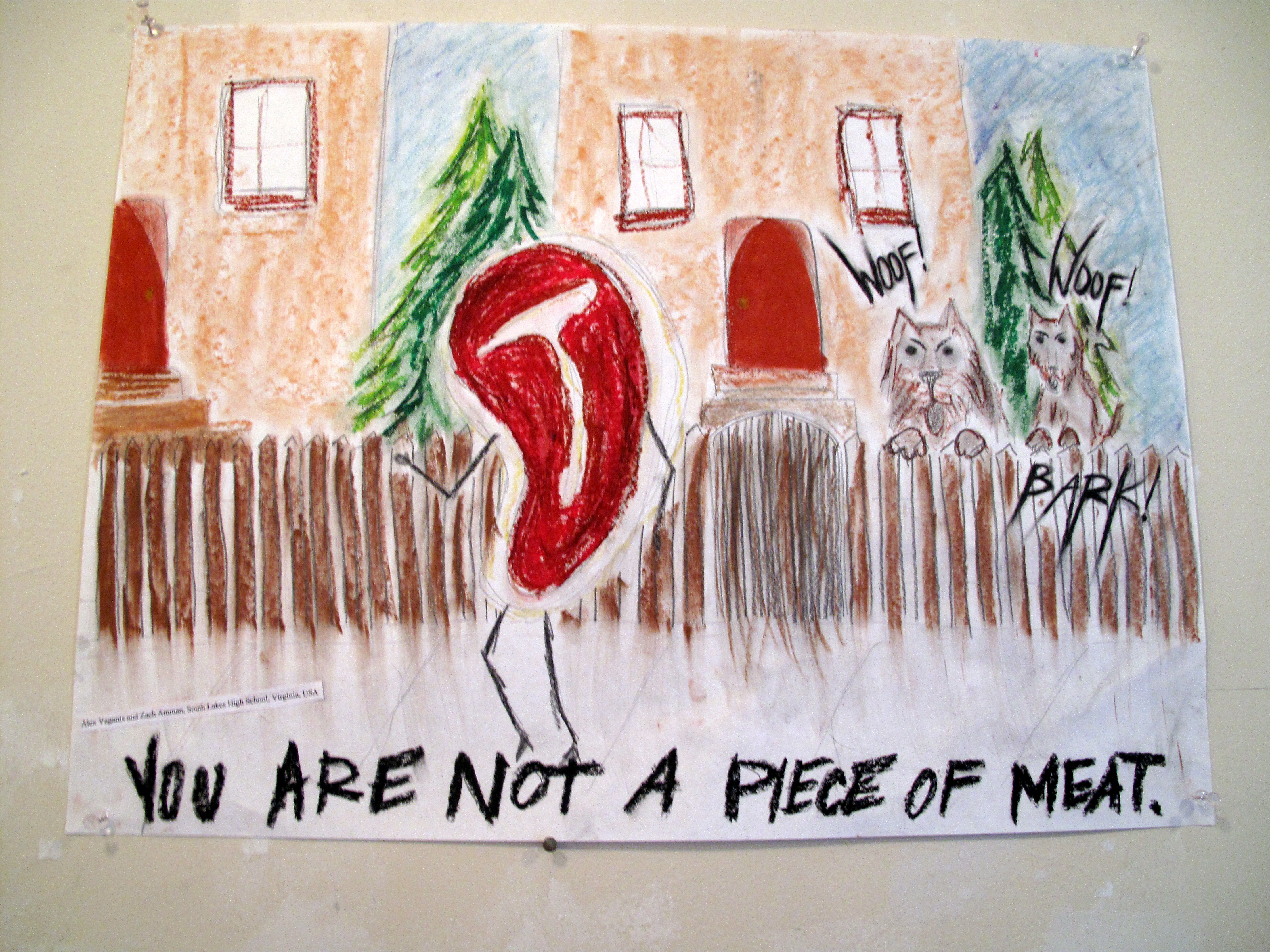
Artwork by a high school student in Virginia.

I am twelve years old, walking down the locker-lined hallway of my middle school on the way to the bathroom. The corridor is empty but for two or three eighth-graders loitering outside of a classroom. As I walk by, one of the boys, a red-head, calls out “where you going, pretty girl?” He bares his teeth and narrows his eyes at me, giving a poor imitation of a smile.

I give the boy my fiercest glare and continue on to the bathroom, looking back once to make sure he isn’t following me. As I wash my hands and return to class—taking care to go a different route to avoid running in to the redhead—I think about what has just happened. Surely I shouldn’t feel so upset; a boy called me pretty. Isn’t that a compliment?

At the time, I couldn’t describe why I felt dirty and disgusted by what had happened, and for years afterwards I was still confused. Why did such a seemingly-innocent phrase make my stomach turn? Why did I feel nervous every time I saw that boy in the hallway or at an assembly? I didn’t even know his name—and to this day I still don’t—but that boy made me feel unsafe in an environment that ought to have been something of a haven. More than that, his words made me feel as though I didn’t deserve to be comfortable at school.

I still wonder today what that boy was thinking—why he would choose to make that comment and why it would even occur to him to say it. It’s true that fourteen-year-olds aren’t great at making wise decisions, but this wasn’t an impersonal, largely harmless action. I still remember the look in his eyes and the timbre of his voice—I believe that he knew the impact of what he was saying.

I wonder where that boy learned to call upon women in passing as though he had a right to comment on them. I wonder whether he saw his father or brothers doing it. Maybe he saw it in a music video or a TV show. Maybe he legitimately thought that his comment was a good way to get some positive attention from a girl.

When I tell this story of the first time I experienced street harassment, the listener sometimes indicates that I’ve made a mountain out of a molehill, that the boy’s comment was harmless, and that I ought to let it go (although perhaps I should). But how can someone forget the first time they felt that their personal safety was in immediate danger? I remember that moment as the point when I realized that those around me considered my body fair game for public scrutiny; that my body was not truly my own.

For many women, street harassment starts around puberty, with 90% of women experiencing it before the age of nineteen. Harassment sends a message that the victim doesn’t deserve to feel safe in her environment and that she is not worthy of simply moving through her world without a crude comment tossed her way.

It’s no wonder that girls’ confidence seems to drain away as they emerge into adolescence. With men and boys harassing them at school and in their very own neighborhoods, how can girls be expected to assert themselves in other situations? After all, if they can’t feel safe even moving through their world, venturing outside of their comfort zone—socially, academically, emotionally—becomes an even greater risk. If a thirteen-year-old isn’t able to walk down the street without being catcalled, she won’t explore avenues unfamiliar to her.

Those of us who began experiencing harassment at young ages—and I know there are many who were first harassed younger than I was—need to nurture the girl who still believes she is undeserving of safety and respect. Explain what happened like you would to a niece or a daughter: remind yourself that you are worthy of feeling comfortable in your environment and that nobody has the right to take away your peace of mind.

If I could go back to that day in the middle school hallway as an adult, I’d ask the red-headed boy what he thought gave him the right to accost a girl who was doing nothing more than existing in a public space. I would tell him the impact that his comments can have on a woman—that the women he harasses will likely remember his words for years to come (and may even write articles describing their negative experiences with him).

I would tell that red-headed boy that his actions are neither respectful nor attractive and that no woman has ever thought “damn, I’d love to go out with that guy who catcalled me today.” I’d tell him that the words he says to women in the street are not indicative of his power, but rather of his inability to see women as human beings.

I’d tell him that, while the girl he just catcalled has no idea what to say to him and only knows that she feels confused and violated, he is the one that should be ashamed.

I’d ask him whether his comment was worth the momentary swagger; whether he truly deserved the brief ego-boost more than I deserved to feel safe at school—safe to walk through the halls, safe to make my voice heard, safe to explore my world.

Laura is an emerging adult-slash-college student studying to enter a healthcare profession. In addition to studying and writing, Laura works at her university’s women’s center where she helps design and implement programs on all things lady. 

Share

Filed Under: correspondents

USA: Poetry and Street Harassment

May 19, 2015 By Correspondent

Michelle Marie Ryder, USA, SSH Blog Correspondent

Slyvia Plath, via BrainPickings

Despite her themes of feminism, there is no Sylvia Plath poem about street harassment. If you type “street harassment” into the search bar at two of the largest poetry databases (The Poetry Foundation and poets.org) you’ll get zero results. Type in “trees” or “love” and you’ll find hundreds or thousands of matching results.

It appears as if street harassment is not the subject of poetry. Which isn’t surprising, considering how historically male-dominated the literary world has been. Just like public space, cultural circles and high centers of learning are long-established male domains. Only within recent memory have women experienced some success in forcing the doors open, demanding a ‘room of their own’ in the literary world.

Still, I don’t think I ever expected to find a poem about street harassment by Sylvia Plath, despite the regularity in which her name surfaced when I talked to people about the subject. As both a literary giant and a feminist icon, I understood why Plath came to mind. But the dots, easy to connect, were still too few.

In truth, only very recently are enough dots beginning to appear and fuse intelligibly to bring the bigger picture into view. Thanks to our ability to disseminate our stories through modern technology, women from all ranks of society are speaking up and being heard, exposing the bigger picture of street harassment for what it really is: “a pattern of violence that constitutes a genuine social crisis,” writes Rebecca Solnit.

Despite the lack of search results at some popular websites, the poetic imagination is alive and flourishing. Survivors of street harassment are fighting back and sharing their experiences through the poetic medium. They are using poetry as a powerful tool to develop a vocabulary of dissent against gendered oppression in the public sphere. Surging with raw poetic insight and justified rage, these poets are transforming the streets by changing minds.

Being the digital age, this conversation is happening mostly online, on personal websites and social media platforms, among career artists and activists and ordinary folks alike. And because of its grassroots nature, it is expanding beyond the limited reaches of the white, cis, middle class female experience in order to embrace the experiences of the LGBTQIA community, lower-income people, people of color, and people with disabilities. Anyone who is not a wealthy, straight, white man is likely to endure public harassment at some point in their life.

Perhaps what’s most fascinating about this burgeoning genre of poetry is that it is dominated by spoken word: “performance-based poetry that focuses on the aesthetics of word-play and storytelling” (Wikipedia). This is in part because the literary establishment has yet to take street harassment as a subject of poetry seriously, but also – and more importantly – because spoken word is a natural fit.

Rooted in the oral tradition, spoken word has long served as a powerful vehicle for voicing dissent and agitating for social change. Poetry about street harassment is about moving beyond the individualistic poetic pursuit. It is about translating painful, self-aware moments into something larger, pushing poetic self-expression to answer to larger political realities in order to create a wider community consciousness – i.e. a movement.

It is about practicing freedom, even if we don’t have it yet. Change can and does start with a poem, even if your voice trembles. And now is the time to speak up. Visibility of the issue is at an all time high. The term “street harassment” has finally entered the popular lexicon thanks to the hard work of countless organizations and individuals.

Sylvia Plath may never have written a poem about street harassment, but it would be disingenuous of me to leave you with the impression that she was silent on the issue. She wasn’t. She suffered too, as much from the problem itself as from her own radical understanding of it, writing in her journal:

“My consuming desire is to mingle with road crews, sailors and soldiers, barroom regulars — to be a part of a scene… all this is spoiled by the fact that I am a girl, a female always supposedly in danger of assault and battery. My consuming interest in men and their lives is often misconstrued as a desire to seduce them, or as an invitation to intimacy. Yes, God, I want to talk to everybody as deeply as I can. I want to be able to sleep in an open field, to travel west, to walk freely at night…”

The limitations patriarchy placed on Plath’s life were obvious and unwelcome; catcalls, sexual solicitations and the underlying threat of assault policed her existence.

If street harassment is the shrinking of one’s world, poetry is its opposite.

Michelle is a freelance writer and community activist. She has written for Infita7.com, Bluestockings Magazine, and The New Verse News on a range of social justice issues, and shares her poetry regularly at poetrywho.blogspot.com.

Share

Filed Under: correspondents, street harassment

UK: This is why street harassment violates human rights

May 11, 2015 By Correspondent

Ruth Mair, UK, SSH Blog Correspondent

When I first browsed around the SSH site for some ideas on what had and had-not been written about by others so far, one of the things that struck me was that in the information about the origins of the Stop Street Harassment project, street harassment was referred to as a human rights issue.

As a human rights student, my first inclination was to agree: of course street harassment is a human rights issue. But I am also the first to admit that although I vehemently oppose street harassment, I had not thought of it in terms of human rights violations before. And when I tried to unpack this, to myself, in my head I had trouble thinking about how I would explain it to someone else, particularly if that someone had never experienced street harassment, or had perhaps never seen it taking place.

So I thought that for my first blog as one of the SSH Summer Correspondents, I would put together a check-list of sorts, in case you are ever faced with trying to explain to someone why street harassment is a human rights issue. Then you can shout it at anyone (should you wish to) who suggests that street harassment is just a women’s issue, or worse, just banter.

First, the human rights aspects of street harassment can be broken in to two realms of violation. The first is that street harassment literally infringes on the human dignity of the person being harassed, and seriously affects their ability to live their life as they wish to. Preservation of human dignity is one of the key aims of instruments such as the Universal Declaration of Human Rights, and street harassment in all its forms violates one’s ability to live in the world with equal dignity to that of other people who are not generally harassed (e.g. women who are harassed when men are not, or transgender people who are harassed when cis people are not, or people of colour who are harassed in ways that white people are not etc). This would be the case regardless of which groups are most vulnerable to being harassed. In the language of rights violations, human dignity is incredibly important, and street harassment can be extremely detrimental to an individual’s sense of personal dignity.

Secondly, there is very little authoritative or legal framework from which governments are able to prevent harassment, or hold those who harass others accountable for their actions. This is also illustrative of a rights violation, because it reflects an institutionalised vulnerability of those who are most often the victims of street harassment. There are laws against bullying in the workplace generally, and laws specifically against harassment of women in the workplace, for example, but not to address the problem of harassment in the streets. As a wise woman one said (or perhaps typed), just because we move through a public space, does not mean that our bodies are public spaces. The lack of framework to address violations in public spaces also reflects a gap in rights protection, regardless of the reasons behind this specific gap (funding, difficulties of enforcement etc) which represent a whole other sphere of problems in rights protection generally.

In terms of the specific articles of rights that are relevant to the problem of street harassment, much of the time this will depend on the context and circumstances of the harassment taking place, however some rights will often apply in a general sense, to any form of street harassment. The first is the right to a private life. This is embodied in article 12 of the Universal Declaration of Human Rights, and states that no one shall be subjected to arbitrary interference with their privacy. Although this is intended to apply to instances of the government interfering with private life, it can also be used to refer to examples of harassment where the government are unable or unwilling to uphold and actively protect that right.

Similarly, the right to freedom of peaceful assembly is significant; attending public events is peaceful assembly, and harassment violates that both by removing the safety to attend, and by removing the “peaceful” part of things, which can thus be seen as a violation of that right. The rights embodied in CEDAW, the Convention on the Elimination of Discrimination against Women, are also helpful here, as they refer to the specifically gendered side of interaction with the public sphere, and the inherent dangers that face those who are not cis males when interacting with the public generally. CEDAW sets out to create legislation for the purpose of guaranteeing women the exercise and enjoyment of human rights and fundamental freedoms on a basis of equality with men, and in ignoring the problem of street harassment for women, states party to CEDAW are inherently violating this, if only by an act of ignorance rather than malice.

In my opinion, these rights easily make street harassment an issue worthy of much more attention at a government level, but for now they should at least give you an edge when anyone attempts to suggest that street harassment is a problem that does not need talking about.

Ruth is a human rights MA student finishing her MA dissertation on the legal and normative rights of terror suspects in the UK (spoiler alert: rights are being violated). She also plays bass in a band called Kinshot, sews as often as she can, and spends time getting annoyed at the cat sleeping on top of her computer.

Share

Filed Under: correspondents, street harassment Tagged With: human rights

UK: Page 3 – a shameless contributor to street harassment

May 6, 2015 By Correspondent

Emma Rachel Deane, UK, SSH Blog Correspondent

Britain is an odd place. We have an international reputation for stiff upper lips and conservatism, when in fact, much of our politics and our stance on many human rights issues are really rather liberal compared to the US and other western countries. And yet, there are still examples within our culture of mainstream British institutions hell bent on dragging us back to the dark ages. Like the third page of tabloid newspapers (including The Sun – Britain’s biggest selling newspaper) that show a girl in her late teens or early twenties posing in underwear or with her breasts exposed. This serves no purpose except for sexual entertainment. To be clear, this isn’t a “lad’s mag” or one of the top shelf publications your Dad might have had a secret stash of when he was a teenager. This is Britain’s biggest. selling. newspaper. What does that say about women today and how we should see them?

When a young woman’s maturing body is presented to us as news, particularly in such a powerful way as this, is it any wonder that street harassment, and the social acceptance of it, is so widespread? By putting a semi-naked woman on such a prominent page within a publication among news of foreign conflicts, natural disasters and welfare cuts, The Sun and other newspapers like it, are sending the very clear message that women’s bodies are just as attention-worthy and deserve to receive just as much public discussion as any other news story.

Sarah Faulkner is one of the women at the forefront of “No More Page 3”, a grassroots activist campaign calling for the voluntary removal of Page 3 by the tabloids. She had this to say about her earliest memories of Page 3. “My first experience of Page 3 was at school, when one of the boys would bring a copy of The Sun onto the bus. He and his friends would use the images in it to tease female classmates whose bodies had developed a little earlier than others. For the girls that were picked on it affected their confidence as they grew up. We are taught to enjoy male attention, if it makes us popular it must be a good thing, but if a woman’s sense of self-worth comes solely from men enjoying how she looks, then then that confidence is meaningless.”

It’s worth noting that prior to the Sexual Offences Act of 2003 (which outlawed the practice) many Page 3 models were just 16 years old when they posed topless for The Sun, wearing school ties and hats. The sexualisation of schoolgirls is a widespread problem, for which The Sun is not solely responsible, but as Faulkner went on to say, “The influence that a feature like Page 3 has on our society can’t ever be measured to reach a firm conclusion, but what we must accept is that it provides validation for people who already have negative ideas about the role of women and girls within our culture and certainly allows space for casual public discussion of women as objects.”

I agree with her. The attitudes that cause instances of street harassment are held together and even perpetuated by countless forms of embedded cultural validations. The tabloids are not accountable for the misdeeds of the advertising industry, or the tired gender stereotypes we see in film or TV, but when we’re discussing the content of newspapers we must do so while remembering Allen Ginsberg’s famous quote, “Whoever controls the media, the images, controls the culture.” These tabloids have a social responsibility to us all and they must be held accountable.

The debates surrounding Page 3 have received more press than usual recently when, in January, The Sun appeared to remove the feature without explanation. Its sister paper, The Times, broke the news that Page 3 had been ditched for good. This turned out to be no more than a school-boy prank and sure enough, Page 3 returned a few days later under the headline “We’ve had a mammary lapse.” How witty. I have to say, the timing was impeccable.

The Sun managed to draw attention to the “No More Page 3” campaign and the debates surrounding it in the wake of the Charlie Hebdo attacks at a time when discussions around freedom of press are very much at the forefront of our cultural zeitgeist. Faulkner’s views on press freedoms are very clear and are reflected in the No More Page 3 campaign strategy. “I would not support a government imposed ban on Page 3.” She said. “I’m not a fan of slippery slope arguments by a long shot, but that way danger lies. If the images are removed by force its far less meaningful than if the tabloids accepted that they have been at fault, which would propel a real shift in societal attitudes.”

The debates surrounding Page 3 are about as complex as it gets in relation to modern feminism. Many would suggest that these images are a result of second wave sexual liberation and so it falls to us as individuals to decide what female sexuality truthfully looks like and how to represent it in our media. I for one think that if Page 3 was, as its supporters claim, a beacon of female empowerment and a shrine to the female form, we would see much more of a variety of women “enshrined”.

The oldest model ever featured on Page 3 was 29. Considering the fact that the average life expectancy of women in the UK is 83, that’s already 65% of the adult female population ousted. We must then take into account that only four black women have ever been represented in Page 3 and only women with a size 6-10 dress size have ever been featured.

If we’re going to talk about Page 3 in terms of female empowerment, let’s bear the Page 3 criteria in mind and remember how few women we are actually representing in that empowerment. Comparisons have also been drawn from No More Page 3 and the Free The Nipple movement, a campaign that seeks to address sexist nudity censorship. Faulkner was quick to point out that No More Page 3 is not about nudity. “This was never about the exposure of breasts to the public. We have no problem with female nudity at all, this is about media representation.”

She went on to describe the complex relationship between the two campaigns. “I can see where they’re coming from, and I agree with what they’re saying. Female nudity is over-sexualised and therefore over-censored. When women sunbathe topless on the beach or breastfeed their babies, people see sex where there isn’t any, it’s just a body part. It would be great if women could do those things without the usual controversy or fear of harassment that accompanies them. Normalising female nudity is very important, but in order to do that we first have to desexualise it.”

That, in essence is what No More Page 3 is about. It’s about reclaiming our bodies and reclaiming our sexuality which does not exist purely for male entertainment. If we can stop turning women’s bodies into news, we can stop people responding to them as if they were newsworthy.

Sign the No More Page 3 petition here and stay up to date with the campaign at nomorepage3.org. You can also tweet your support @NoMorePage3

Emma Rachel Deane is a London-based retail manager for a fast growing women’s lifestyle brand and an outspoken advocate for women’s social justice issues. She can be found blogging on Raging Hag or tweeting @emmaracheldeane.

Share

Filed Under: Activist Interviews, correspondents, street harassment Tagged With: page 3, sexualization

Blog Correspondents: Cohorts 1 and 2 of 2015

May 4, 2015 By HKearl

Thank you so much to our first Blog Correspondents cohort of 2015!! From Australia to Brazil, from Romania to the USA, they brought forward important stories, observations, and campaigns happening in their countries and communities.

Meet the next Blog Correspondents cohort. They will write monthly articles from May to August.

Share

Filed Under: correspondents, SSH programs

« Previous Page
Next Page »

Share Your Story

Share your street harassment story for the blog. Donate Now

From the Blog

  • #MeToo 2024 Study Released Today
  • Join International Anti-Street Harassment Week 2022
  • Giving Tuesday – Fund the Hotline
  • Thank You – International Anti-Street Harassment Week 2021
  • Share Your Story – Safecity and Catcalls Collaboration

Buy the Book

  • Contact
  • Events
  • Join Us
  • Donate
  • Facebook
  • Instagram
  • Pinterest
  • Tumblr
  • Twitter
  • YouTube

Copyright © 2026 Stop Street Harassment · Website Design by Sarah Marie Lacy