• About Us
    • What Is Street Harassment?
    • Why Stopping Street Harassment Matters
    • Meet the Team
      • Board of Directors
      • Past Board Members
    • In The Media
  • Our Work
    • National Street Harassment Hotline
    • International Anti-Street Harassment Week
    • Blog Correspondents
      • Past SSH Correspondents
    • Safe Public Spaces Mentoring Program
    • Publications
    • National Studies
    • Campaigns against Companies
    • Washington, D.C. Activism
  • Our Books
  • Donate
  • Store

Stop Street Harassment

Making Public Spaces Safe and Welcoming

  • Facebook
  • Instagram
  • Pinterest
  • Tumblr
  • Twitter
  • YouTube
  • Home
  • Blog
    • Harassment Stories
    • Blog Correspondents
    • Street Respect Stories
  • Help & Advice
    • National Street Harassment Hotline
    • Dealing With Harassers
      • Assertive Responses
      • Reporting Harassers
      • Bystander Responses
      • Creative Responses
    • What to Do Before or After Harassment
    • Street Harassment and the Law
  • Resources
    • Definitions
    • Statistics
    • Articles & Books
    • Anti-Harassment Groups & Campaigns
    • Male Allies
      • Educating Boys & Men
      • How to Talk to Women
      • Bystander Tips
    • Video Clips
    • Images & Flyers
  • Take Community Action
  • Contact

UK: Empowering Women through Street Art

October 23, 2014 By Correspondent

Siel Devos, London, England, SSH Blog Correspondent
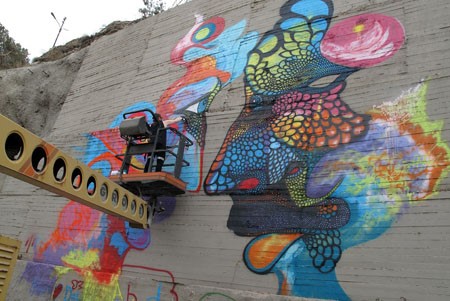
Via the Jordan Times

Last month I wrote about how I experienced harassment in Amman, and I ended my post by wondering how we can address this issue and bring a change to the mentality of Arab men and boys towards women. You can imagine my excitement when I came across a project called Women on Walls that focuses on women’s empowerment through graffiti and gives artists a chance to express themselves through street art.

Women on Walls (WOW) was founded by Angie Balata and Mia Grondahl, who recorded the contributions made by graffiti artists to the 25 January Revolution in Egypt in her book “The Revolution’s Graffiti”. After noticing that of the 17.000 street art photographed in the book only 253 featured women, they decided to take action and came up with the Women on Walls project to draw attention to women’s rights issues through street art. Thanks to their graffiti project in the Bourse area in Cairo, WOW gained more exposure, which eventually led them to collaborate with women’s and anti-harassment organisations like HarassMap and Uprising of Women in the Arab World in 2014. WOW is currently expanding through the region, starting with a street arts festival in Jordan, where 25 women artists from Palestine, Jordan and Lebanon contribute works to the wall to spark the conversation on women’s issues.

Laila Ajjawi, one of the artists participating in the WOW festival in Amman, says she wants to bring a message to men who still look at girls as objects instead of full-fledged human beings with intellectual depth. Research has shown that 80 percent of Jordanian women have experienced street harassment, and 99.3 percent of Egyptian women have reported being sexually harassed, so it’s clear that street harassment is still a problematic issue in the region. This is the reason why Ajjawi choose to focus on street harassment in line with the Women on Walls festival theme “Stories from Fear to Freedom”. She finds that street art is the perfect way to address the issue of street harassment because it reaches a much wider audience. “It challenges harassers in their domain: the streets. This kind of art doesn’t just decorate cement walls; it forces a conversation. “It catches the eye,” says Ajjawi. “But it’s not confrontational.”

Women are often fearful of speaking out against harassment, but Ajjawi hopes that her art may stand in for those who have been silenced into submission.

“If a women is silent, it’s because society compels her to be silent,” says Ajjawi.

The Amman festival combined the Women on Walls project with Baladak, launched by Al Balad Theatre in 2013, who aim to enhance the sense of citizenship through street art. In addition to revealing the street art gallery, the festival also included discussions, lectures and meetings initiated by local organisations to “raise awareness on women’s issues in Jordan and the Arab world, and create an inspirational space for artists to express their opinions,” says Al Balad Theatre Programme manager Lubna Al-Juqqa. The aim is to change the stereotypical image of women that is presented by the media as “just a pretty face”.

A great initiative if you ask me – I hope Women on Walls will expand throughout the region and most importantly, continue to raise awareness of street harassment and women’s issues in the Middle East.

Siel is a master’s student in Middle Eastern studies with a major in contemporary Islam at SOAS University in London. Find her on twitter and instagram under @mademoisielle.

Share

Filed Under: correspondents, street harassment

USA: Does Socialized Aggression Fuel Street Harassment?

October 22, 2014 By Correspondent

Khiara Ortiz, NY, USA, SSH Blog Correspondent

As a woman living in New York City, it’s a given that I have to put up with street harassment on an almost daily basis. I leave my apartment in the mornings on my way to work and the men at the produce market on the corner of my street will toss out sexually fueled comments like biscuits to a dog, hoping I’ll bite. I don’t, but it’s not always easy to ignore them. Sometimes, I change the route I take to the train just to avoid them, only to be greeted by another slew of catcalls on the other side of the street.

And it doesn’t stop there. I work in the midtown neighborhood of Manhattan where there’s always an endless amount of construction work being done and an endless amount of street harassment from construction workers polluting the streets like the dirt and dust clouds from a drilling site.

All of these instances have made me think about why street harassment happens. Most women in America are aware that street harassment either happens to other women, happens to them, that they will probably experience it at least once a week, and that they’ll just have to put up with it. But I’ve begun to wonder how many of the victims of street harassment think about the why; why is this man calling me out for being female?; why does he think he can talk to me like that?; why can’t he see me as his equal, as another human being going about her day, NOT wanting to draw any type of attention towards herself, much less any sexual attention?

In New York, anonymity is easy. You see hundreds, maybe thousands, of people every day. The chances of remembering a face you saw the day before or even that morning are slim. People go unnoticed all the time. This has led me to consider the reasons men feel comfortable practicing street harassment and entitled in doing so. Perhaps the man feels he will not be punished because the woman he is calling out to won’t remember him. Or maybe the complete opposite is true and the man wants to be remembered by a woman, wants to feel more masculine, and therefore calls out to the woman at her expense and for his own psychological benefit. He has now brought himself to the surface of the woman’s psyche and may not even realize he’s done so in a negative way.

In either situation, I think there’s an underlying factor: the release of aggression. An article published in The New York Times in 1983 cited that while “psychologists and psychiatrists often disagree sharply when they discuss whether behavioral differences between the sexes exist, many agree on one difference – that boys and men are still the more aggressive and violent [sex].”

An article published last month in Psychology Today addressing the same issue, the differences in aggression between men and women, theorized about the reasons behind this seemingly factual statement. The article cites a theory by Leonard Berkowitz, a leading American psychologist, who says that “men and women are educated, traditionally, to carry out different social roles.”

The type of aggression that occurs among women is “verbal aggression in intrasexual competition”, not the more obvious, testosterone-fueled aggression that’s valued in men by societal standards. Men’s aggressive tendencies are rooted in the way they are brought up by their parents, in the positive reinforcements they experience when they play rough or practice aggression, to an extent, in sports. When they grow up to become men and no longer have the outlets they did as little boys – sports, games between friends, etc. – they lose a clear target towards which to direct their aggression, which by this time can manifest itself in sexual forms. I believe that sexual harassment, street harassment, and catcalling are all outlets for men who don’t know how to deal with their cultivated aggression. And the streets are places outside their homes, away from their wives and children, where they don’t have anyone to tell them any better because they know the women they target will most likely walk by, leaving them anonymous and free of punishment.

I think that an effective way to break this cycle is to start calling men out on the wrongness of street harassment. Make them uncomfortable, make them realize that their targets aren’t just objects of sex walking by like sponges ready to absorb insults. In the way that the parents of a kidnapped daughter might use photos of the daughter or stories about her to humanize her to the kidnapper, women must humanize themselves before these men to make them realize they cannot and will not be used as targets for male aggression.

Khiara is a recent graduate of New York University with a BAS in Journalism and Psychology who works as an assistant in the contracts department for Hachette Book Group. She is also the co-social media manager for Stop Street Harassment.

Share

Filed Under: correspondents, street harassment

Peru: The Macho is a Coward

October 22, 2014 By Correspondent

Laura Bustamante, Lima, Peru, SSH Blog Correspondent

Ser macho es Ser “marica”

Via Peru.com

El otro día, la calle estaba desolada, tuve miedo de cruzar a la acera de al frente al ver a un hombre que lucía poco confiable, pensé en no cruzar, pero mi espíritu reivindicativo y feminista brotó, por qué como mujer tenía que restringir mi libre tránsito, elecciones y sentirme insegura en mi barrio por un hombre, entonces crucé. Y lo veía venir, mientras caminaba él se acercaba mirándome, no iba a correr, odio huir ante una agresión masculina… soy una mujer no una rata. Se acercó cortando mi camino y rozando mi brazo, inclinándose para decirme no sé qué, yo escuchaba música con mis audífonos, mientras me alejaba le grité: ¡Respeta a las mujeres! El se volteó y parado desafiante me dijo: sólo te estoy “saludando”.

Para mi es sencillo: Es inadmisible que muchos hombres crean que se nos pueden acercar en las calles sin consenso, por qué se creen con derecho a “saludarnos”, invadir nuestro espacio, rozarnos, decirnos cosas sexuales o tocarnos. Es que la violencia sexual, simbólica y psicológica a la que se somete a la mujer se justifica por los roles de género que debemos asumir, ser hombre, ser mujer. Mientras la mujer es pasiva, no activa sexualmente, linda y sumisa; se espera que el hombre -aquí la palabra que me da náusea- sea macho, un macho latino, el macho peruano, por ello se sienten orgullosos, ellos son machos pues, son lo máximo, los que están en la cima de la jerarquía, tienen más libertades, activos con híper-sexualidad, fuertes que no lloran. Bajo este sistema machista-patriarcal el hombre es dueño del espacio público y privado, poseen territorio y hembras, es el protector y proveedor que tiene el control, y el medio para ejercer su dominio es la violencia.

Sí, bienvenidos a “Macholandia”, el reino no muy lejano del macho latino y su ideología, que sobrevalora la sexualidad masculina, educa hombres conquistadores que siempre deben desear una mujer para demostrar su hombría, incluso ejerciendo una sexualidad violenta, porque el macho acumula mujeres no hombres, es heterosexual no “maricón”, por eso rechaza y desvaloriza lo femenino, débil e inferior, donde las mujeres existen para darle placer y afirmar su masculinidad, convirtiéndolas en objeto, y como debe ser “fuerte”, es dominante y el cuerpo femenino les pertenece, así acosan a las mujeres en la calle, el hombre se convierte en juez y puede juzgar sexualmente el cuerpo de una mujer.

Así, la mujer como objeto queda sujeta a la voluntad del hombre protector o del que decide dañarnos, dando paso a la cultura de la violación, porque el macho al demostrar su heterosexualidad fuerte-dominante puede intentar aprovecharse y nosotras nos debemos cuidar: “el hombre propone, la mujer dispone”, porque “un hombre no puede controlarse, es su instinto” y todo será nuestra culpa, tu culpa por tomar o vestirte así, porque tu ropa justifica que te acosen, te toquen o hasta te violen. ¡Hay pobrecitos estos machos inocentes! Dueños de todo y todas pero no de sus actos y responsabilidades, machos racionales llevados por sus emociones agresivas, fuertes pero débiles a su sexualidad, dominantes pero sometidos al machismo, la culpa la tienen ellas, las Evas, la tentación. El agresor se convierte en víctima de provocación y la agredida en culpable, en puta, en la vergüenza que en casos más terribles se le exige continuar con un embarazo por violación, como lo exige el Estado peruano, la mujer objeto sexual también es objeto reproductivo.

El acoso sexual callejero afecta el día a día de las mujeres, evitas una construcción por los obreros, te cubres más de lo que quieres, evitas ciertas zonas o salir sola de noche; tratas de salir acompañada por un hombre reforzando tu dependencia. Afecta la seguridad, independencia, libertad sexual y de tránsito, tu derecho a vivir sin miedo ni violencia, pero todo esto no es suficiente y estos machos defenderán su masculinidad incorrecta, negarán que el acoso sexual callejero es una forma de violencia sexual sutil, naturalizado y tomado en broma, parte de la cultura de la violación porque no interesa tu permiso, consenso, si no te gusta, el macho se siente con derecho de juzgar sexualmente tu cuerpo o tocarte, tu cuerpo es de ellos de manera simbólica. Dirán de las mujeres que se defienden que son exageradas, histéricas, incluso se burlan o se vuelven más agresivos, porque no conciben que el cuerpo femenino no les pertenezca, no pueden vivir en un mundo donde no sometan, abusen y ejerzan poder sobre sus compañeras femeninas.
¬¬
Deberían entenderlo ¡ya!, ser macho es peyorativo, no es motivo de orgullo es una vergüenza, el macho desvaloriza y rechaza lo considerado femenino, como a los gays, los llama maricas, que significa: cobardes, afeminados. Es que los machos creen que es un orgullo ser abusivo, agresivo, homofóbico, violento, ser el que somete y reprime sus sentimientos, sin empatía, que trata a otros seres humanos (mujeres) como objetos. Al final, ser macho es ser un pusilánime sin valor rendido ante los mandatos del machismo, un inseguro que prueba constantemente su masculinidad, es un cobarde que se mete con las mujeres apoyado en la intimidación porque tienen más fuerza física. Estos machos se dan cuenta que a las mujeres no les gusta su acoso, que molestan, que lo hacen contra su voluntad y da miedo, pero generar miedo los hace sentir más machos y con más poder.

Ser macho no es una masculinidad es un tipo de dominación, una masculinidad debe ser una expresión de tu humanidad, debe convertirte en mejor persona sin dominar a otras u otros para definirte, hay que repensar “el orgullo de ser macho” porque ser macho es ser un “verdadero maricón”.

Laura ha estudiado Administración en Turismo en Universidades de Perú y Barcelona, y Estudios de Género en la ONG Flora Tristán. La puedes seguir en Twitter en @laeureka.

IN ENGLISH

The other day I was afraid to cross the street when I saw a man and no one else around. But my feminist spirit arose; why as a woman should I have to restrict my movement and feel unsafe in my neighborhood because of a man?

Then I crossed. And I saw it coming; while I was walking he was approaching, staring at me. I wasn’t going to run away from a potential male aggression … I am a woman not a rat. He came near to me almost cutting me off and rubbed my arm, leaning in to me to tell me – I do not know what – I was listening to music with my headphones on. As I walked away I said, “Respect Women!” He turned and stood defiantly replying, “I’m just ‘greeting you’.”

For me it is simple: It is unacceptable that many men believe that they can approach us on the streets without our consent that they feel entitled to “greet us”, invade our space, tell us sexual things, or even touch us.

The sexual, psychological and symbolic violence to which women are subjected are often justified by the gender roles we assume. While the woman is supposed to be passive, not sexually active, beautiful and submissive, a man is expected to be –and here is a word that makes me nauseated- a “macho”, a Latino macho, the Peruvian macho. That word makes many Latin-American men proud: they are machos, they are at the top of the hierarchy, they have more freedom, they are actively hyper-sexual, they are strong and don´t cry.

Welcome to “Macholand”, in the not too far away kingdom of the macho Latino, and its ideology, which overestimates male sexuality, educates men to be a womanizer who always has to desire a woman to prove his manhood. He even may use sexual violence but that is seen as women’s fault. “The man proposes and the woman disposes” because “a man cannot control himself, it is his instinct” is how it goes, so everything will be a woman’s fault, It´s her fault for drinking too much or for dressing like that, because her clothes justifies harassment, touching, and even rape. The attacker becomes the victim of provocation and the victim becomes guilty, become a slut in terrible shame that in the most horrible cases are forced to continue with a pregnancy by rape, as the Peruvian State requires, because women are sexual and reproductive objects.

A macho is supposed to be heterosexual, not a “fagot,” so he rejects and devalues the feminine. He considers the feminine weak and inferior and believes that women are objects that exist to please and reaffirm his masculinity. As a macho he believes he should be “strong”, dominant, and that the female body belongs to him. The man becomes a sexual judge and feels he can judge a woman’s body by harassing her on the street.

The result is that street harassment is common and affects women´s daily life. We avoid walking by construction workers, we cover our body more than we want, we avoid certain areas or go out alone at night; we try to be accompanied by a man, strengthening our dependency on men. Street harassment affects our safety, independence, sexual freedom and transit, and our right to live without fear and violence.

Even still, machos will defend their wrong masculinity, denying that sexual harassment is a form of sexual violence, but say it is normal or a joke. They say women who defend themselves are exaggerating, hysterical, or they become more aggressive against them because they do not want to conceive that the female body does not belong to them.

This is the truth: Being macho is pejorative, it´s not something to be proud of but is actually shameful. Being macho means being a pushover with no courage and being subjected to the mandates of sexism. These machos realize that women do not like to be harassed, but still they do it to make women afraid, because creating fear makes them feel more macho and powerful.

Being macho is not a good masculinity. Masculinity should be an expression of one’s humanity and desire to become a better person without dominating others. It must be rethought.

Laura has studied Tourism Management in Universities of Peru and Barcelona, and Gender Studies at the NGO Flora Tristan. You can follow her on Twitter at @laeureka.

Share

Filed Under: correspondents, street harassment

USA: Our Oppressions are Intertwined

October 20, 2014 By Correspondent

Sarah Colomé , IL, USA, SSH Blog Correspondent

Via Gradient Liar

Throughout the past several years of working to combat rape culture, I have noticed a disturbing trend. I often find that in our work, we make strong calls for solidarity that may not be equally, if at all, reciprocated.  We often forget that violence against our children is a reproductive justice issue. We forget that our oppressions are intertwined. Sometimes we don’t show up as often as we should.

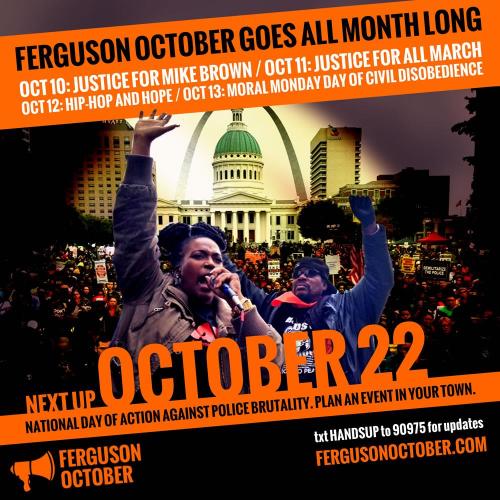
The wake of the tragic death of Michael Brown, fueled by the recent finding that every 28 hours a black person is killed by a security officer, highlights the lived reality of fear and dehumanization experienced by many people of color. Have we, as a community, engaged with this historic issue of police misconduct and brutality? Are we examining our own prejudices and acknowledging when we ourselves, racially profile others? Are we collaborating with other community organizations focused on racial justice and police violence to transform our society into a safer place for all to exist? Have we actively framed this as a reproductive justice issue?

Dani McClain outlines this disconnect between movements in The Nation explaining, “the killing of Michael Brown, like the killing of many young black people before him, is rarely framed as a feminist issue or as an issue of pressing importance to those who advocate for choice, self-determination and dignity as they relate to family life.”

To create change in the manner in which female identified persons can walk through the world with more ease and less threat of violence, we must recognize that others face similar fears about violence because of their identity. After all, the same structures and systems that functionally condone, and perpetuate the degradation of female identified and queer presenting or identified persons, also actively propagate the dehumanization of people of color, and yes, all oppressed people.

Doing “the work” can manifest itself in a multitude of ways:

* Explore with your staff why some individuals feel they should not, or could not, go to police officers to safely report street harassment.Consider screening a film like this one from Found Voices, and asking a partner organization to come debrief and collaborate.

* Offer community-wide trainings on how to report abusing policing in your area. For example, report here for New York, here for Chicago, or here for Los Angeles.

* Organize a staff outing where you attend a local rally or teach-in, or write letters to legislators, in support of racial justice.Support movements for Marissa Alexander, university teach-ins on Ferguson, or local measures for police accountability.

* Consider offering your employees and volunteers “cop watch” trainings. Organizations including Cop Watch NYC, CAAAW,Berkeley Copwatch,We Cop Watch, and We Charge Genocide all offer these trainings.

Challenge your organization, and the community as a whole, to refrain from segregating ourselves and our work, claiming “that’s not what we do.”

* Continually doing our work, without recognizing how oppression interacts among us both uniquely and interconnectedly, destabilizes the very foundation that is essential to create tangible, sustainable change. Addressing gender-based harassment and violence without acknowledging that others are equally harassed and violated based on their visible identities, whether actual or assumed, does nothing to create relationships for future bystander interventions.

This is not to suggest that there are not phenomenal groups doing intersectional work and capacity building across movements. This does not negate that there are a multitude of struggles and experiences of oppression that are lived out daily, needing our support, intervention, and attention. Nor does my assertion forgo the difficult realities of the nonprofit industrial complex, and the structures that often make our desire to collaborate difficult.

But I ask you all this: Are we showing up for those who are targeted for harassment based upon their perceived race? If not, we must ask ourselves why and how we may in some instances, be perpetuating the very experiences of violation that we are aiming to prevent.

It should never be acceptable to ask for support from our community when we do not show up for those same people as they engage with their own struggle. Recognize the privileges we hold in various spaces.  We know that male presenting individuals hold privilege in this world that female presenting people do not. This status as a target group however, does not negate other instance of privilege that we may hold. We must hold ourselves accountable to recognize our complicated, multifaceted identities, and how in some situations, the power of our privilege may outweigh the disadvantages of our target group status.

Ask yourself:

* Are we showing up at rallies, marches, or protests addressing police brutality, misconduct, or profiling?

* If not physically, or otherwise able to attend, are we engaging these topics on social media, or relating them intersectionally in our own work?

* Are we incorporating the voices of other marginalized groups in our work against rape culture and street harassment?

* Do we make sure to recognize that for many, police are not a safe option for reporting or “protection?”

* Are we engaging in self-assessment and reflection on how our own actions may perpetuate, or result in, others’ experiences of street harassment?

Bystander intervention does not exist solely in acting when someone is being cat called, followed or bombarded with sexualized comments. Bystander intervention exists in acknowledging and challenging ANY instance of oppression, no matter the movement that the target group may align with.

This note is a call to action, out of love, to the community I fight alongside with passion and commitment. We are at a crucial time for a multitude of resilient movements, both nationally and internationally. We must stand alongside one another.  I challenge us all to interrogate our own perceptions of others, as we call one another to accountability for our actions.

Sarah is a progress-focused educator and advocate dedicated to building strategic coalitions centered on creating social change who serves as an adjunct professor in DePaul University’s Peace, Justice and Conflict Studies department. You can follow her updates on Linkedin or hear her perspectives on Twitter.

Share

Filed Under: correspondents, public harassment

USA: Building a New Culture of Consent at NYCC

October 17, 2014 By Correspondent

Katie Bowers, NY, USA, SSH Blog Correspondent

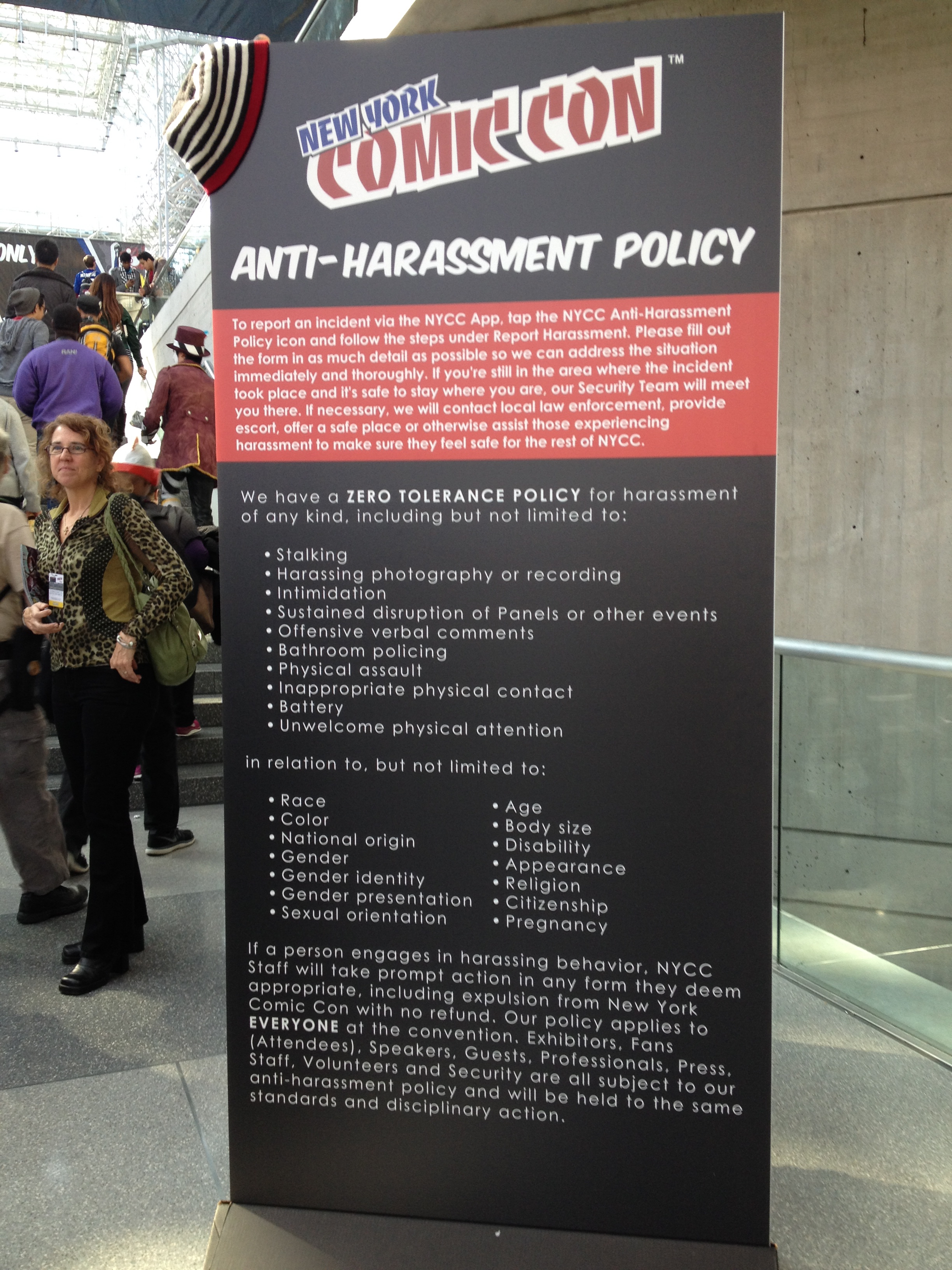
Last week we discussed New York Comic Con’s shiny, new anti-harassment policy.  Over Saturday and Sunday at the convention, I got to see the policy in action.

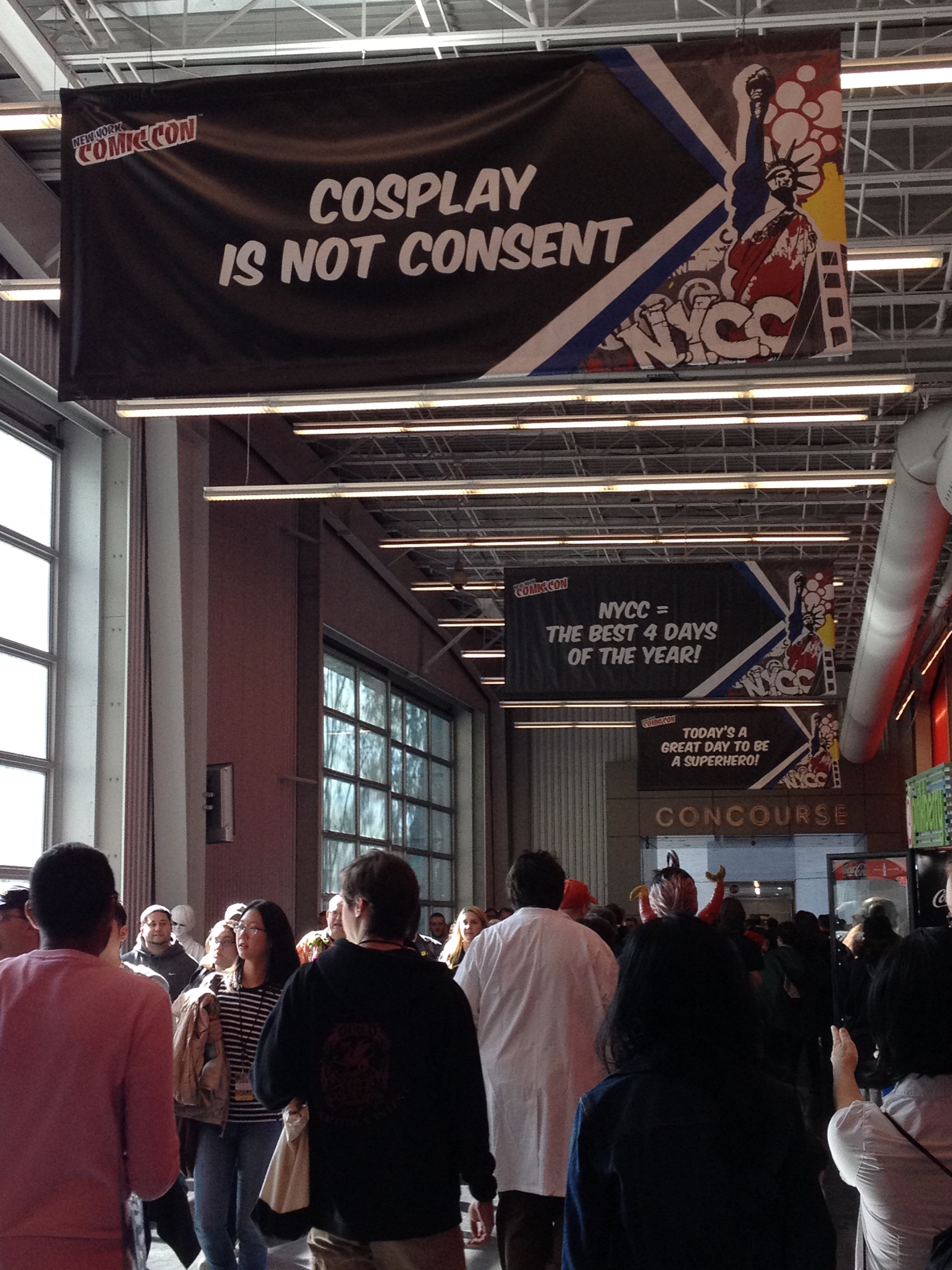
Thanks to the efforts of Geeks for CONsent, The Mary Sue, and others, New York Comic Con 2014 featured a plethora of reminders that “Cosplay is not Consent”.  Prominent black and red standees stood throughout the Javits Center’s main lobby – a major site for amateur and professional photographers looking to grab a shot of attendee’s incredible costumes.  The policy, which also covered a full page of the program booklet, forbids a wide range of harassment including unwanted physical touching and gestures, verbal comments, stalking and intimidation, and photos taken without consent.  Offenders, the standees and program booklets proclaimed, run the risk of being kicked out of the convention.

I spent the weekend dressed up as one of sci fi’s favorite red heads: Special Agent Dana Scully.  To my knowledge, everyone who took my picture asked for my permission – and everyone asked with enthusiasm.  This isn’t a new phenomenon.  In general, anyone excited enough about your costume to want a picture also wants to share their excitement – but one interaction in particular stuck out to me.

A man approached me on the show floor and asked to take my photo.  “Sure,” I said and went to set down my stuff.  My badge and bag got tangled and it took a minute to unhook the two.  “Sorry, hold on,” I told him.

“No, no, I’m sorry,” he said quickly.  “I don’t want to make you uncomfortable.  You don’t need to be sorry.”

In a place where people walk around on stilts and stilettos, strap proton packs to their back, and squeeze through overcrowded aisle ways, comfort is generally not the first thing on anyone’s mind.  His response was totally surprising and wonderfully welcome.

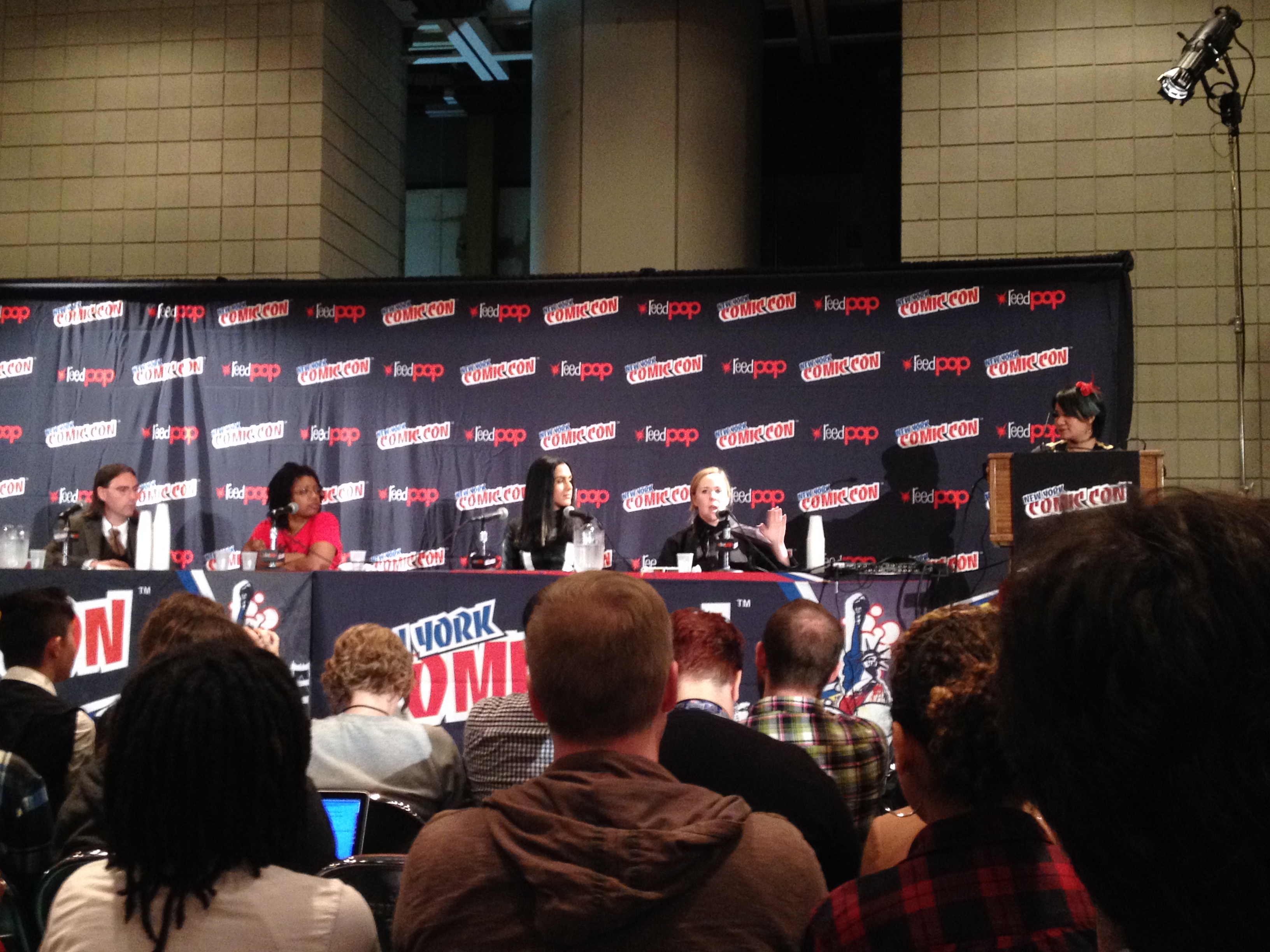
In addition to visual reminders, NYCC also hosted “#YesAllGeeks”, a panel about harassment in convention spaces with Diana Pho of Beyond Victoriana, , Marlene Bonnelly of comics.tumblr.com, writer and prolific tweeter Mikki Kendall; Emily Asher Perrin of Tor, writer and #YesAllWomen creator Kaye M, and Robert Anders, a nurse practioner speaking about the psychological effects of harassment. The panelists did a great job of breaking down why having anti-harassment policies are so important:

* Obviously, a strong policy helps victims to recognize harassment when it happens to them and provides them with an immediate course of action.  It can also help women, people of color and members of other frequently harassed groups feel more welcome – an important consideration as conventions grow larger and more diverse.

* With a well-publicized policy, harassers can be held accountable.  It’s hard to convincingly claim ignorance when standing next to an 8-foot tall standee and holding the full text of the anti-harassment policy in your swag bag.

* Policies can also open up opportunities for bystanders.  Often, bystanders witness harassing behavior but don’t step in.  They’re not sure what to do, and they don’t want to be harassed themselves.  With a policy in place, bystanders have more options.  They can ask the victim if they are okay, if they’d like help, if they’d like to report, and even if they have heard about the “Report Harassment” feature of the NYCC app.  Or, if it feels safe, they can remind the harasser about the “Cosplay is not consent” policy.

So there are lots of good reasons to create and publicize strong anti-harassment policies – but Mikki Kendall pointed out that the most important reason of all isn’t action and reaction.  It’s prevention.  When asked how we can make fan communities safe spaces, Kendall advised that we need to be communities that respond appropriately and immediately to unacceptable behavior. When we speak out against harassment and oppression – at conventions, online, or even in the media that we geek out about – we make our communities better and safer.  We hold ourselves and other members of the community to a higher level.  Or, since we’re at Comic Con, you could say we “level up”.

This weekend, NYCC became the most highly attended convention of the year with 150,000 fans walking through the front door.  Those 150,000 fans saw costumes, sneak previews, art, comics, panels – and a new message: it’s time to level up.

Want to see the panel in its entirety?  Visit Beyond Victoriana!  Or read more at The Mary Sue.

Katie is a social worker and community educator interested in ending gender-based violence, working with youth to make the world a better place, and using pop culture as a tool for social change. Check out her writing at the Imagine Better Blog and geek out with her on Twitter, @CornishPixie9.

Share

Filed Under: correspondents, public harassment Tagged With: comic con, NYCC

« Previous Page
Next Page »

Share Your Story

Share your street harassment story for the blog. Donate Now

From the Blog

  • #MeToo 2024 Study Released Today
  • Join International Anti-Street Harassment Week 2022
  • Giving Tuesday – Fund the Hotline
  • Thank You – International Anti-Street Harassment Week 2021
  • Share Your Story – Safecity and Catcalls Collaboration

Buy the Book

  • Contact
  • Events
  • Join Us
  • Donate
  • Facebook
  • Instagram
  • Pinterest
  • Tumblr
  • Twitter
  • YouTube

Copyright © 2026 Stop Street Harassment · Website Design by Sarah Marie Lacy