• About Us
    • What Is Street Harassment?
    • Why Stopping Street Harassment Matters
    • Meet the Team
      • Board of Directors
      • Past Board Members
    • In The Media
  • Our Work
    • National Street Harassment Hotline
    • International Anti-Street Harassment Week
    • Blog Correspondents
      • Past SSH Correspondents
    • Safe Public Spaces Mentoring Program
    • Publications
    • National Studies
    • Campaigns against Companies
    • Washington, D.C. Activism
  • Our Books
  • Donate
  • Store

Stop Street Harassment

Making Public Spaces Safe and Welcoming

  • Facebook
  • Instagram
  • Pinterest
  • Tumblr
  • Twitter
  • YouTube
  • Home
  • Blog
    • Harassment Stories
    • Blog Correspondents
    • Street Respect Stories
  • Help & Advice
    • National Street Harassment Hotline
    • Dealing With Harassers
      • Assertive Responses
      • Reporting Harassers
      • Bystander Responses
      • Creative Responses
    • What to Do Before or After Harassment
    • Street Harassment and the Law
  • Resources
    • Definitions
    • Statistics
    • Articles & Books
    • Anti-Harassment Groups & Campaigns
    • Male Allies
      • Educating Boys & Men
      • How to Talk to Women
      • Bystander Tips
    • Video Clips
    • Images & Flyers
  • Take Community Action
  • Contact

Ireland: Have a Good Night Out!

October 10, 2014 By Correspondent

Yvonne Ní Mhurchú, Limerick, Ireland, SSH Blog Correspondent
Credit: Colin Doherty

Harassment isn’t something that just happens on the street.  It isn’t just confined to ‘outside’, it is something that happens everywhere; outside, inside, work, school, university, bars, concerts, sporting events and nightclubs.  It is happening everywhere in every city and every country around the world.  For proof of this, look no further than the Stop Street Harassment blog, it has stories and reports of harassment by various people from across the globe.

Last month I wrote about how I walked home for the first time ever without any fear of street harassment.  This month I want to write about socialising without being subjected to harassment.  I currently run a feminist group in my town, we frequently liaise with other likeminded groups.  It is through this communication I heard about the Good Night Out Campaign.

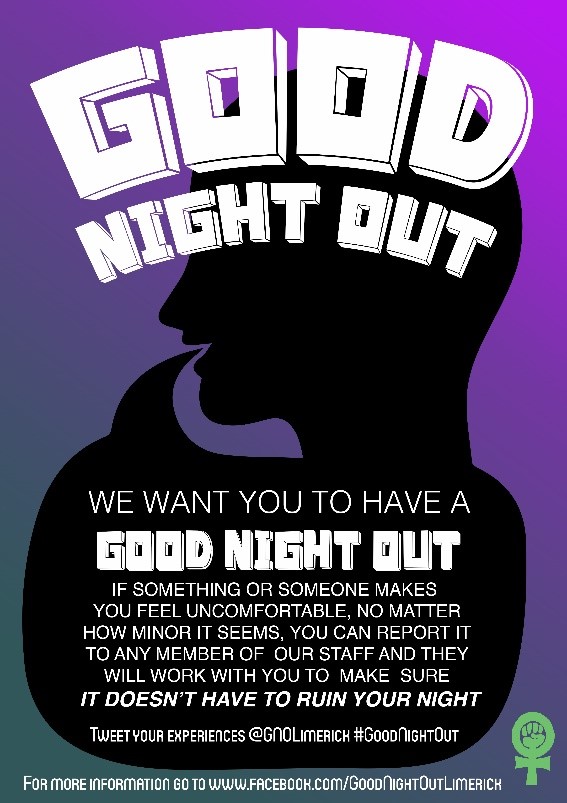
Originally the brain child of Hollaback London, the premise of the Good Night Out Campaign is simple: we want nightlife venues to adopt and promote a zero tolerance policy when it comes to the harassment of their patrons – particularly female and those from the LGBTQ community.  Venues show their commitment by displaying official GNO posters around their establishment and training staff to deal with any complaints that might arise.

The reason I feel so strongly about this campaign is because I am all too aware of how problematic nightlife harassment can be.  My feminist group had a meeting to discuss the campaign.  I shared some of my own experiences as did the group, and the stories just kept on coming.  Comments, groping, sexually aggressive behaviour, being followed, yelled at and assaulted.  It is difficult not to get angry after hearing what all of these people had to put up with.  So, we decided to channel our anger positively and bring Good Night Out to Limerick.

The support we have received so far has been amazing.  Local newspapers have written about it and a local radio station did a short piece on it too.  Two weeks ago we asked the public to share their stories with us to help highlight just how serious a problem harassment in nightlife venues is.  Here is an example of two incidents that people were kind enough to share with us (TW):

“I was on a night out with some friends, a few of them were dancing while I was minding the drinks. I saw a guy on the dance floor start to follow one of my friends around, he was trying to grind up against her and touch her. She was not interested in the slightest but he wouldn’t leave her alone, eventually she got fed up and left the floor, as she did he pulled up her skirt. My ass was grabbed 3 times that same night.”

“I was in _____ during my freshers week. I didn’t know many people, but I was there with a solid group of people. I was upstairs dancing and some guy started grinding on me. I tried to back away and he and a friend pinned me up against a wall. They were laughing, I was shouting at them to let me go. A friend of mine was also pulling at them to get them off me, to no avail. I ended up biting one of them so he’d take his arm off me and running outside, closely followed by my friend who hugged me while I hyperventilated. To this day I regret not going up to security or something, because I doubt those guys even realised how much they terrified me.”

Stories like these are regular occurrences for a majority of people when they go out.  Not only can harassment completely ruin a person’s night out, it can also leave a lasting negative effect on them.  We want venues and patrons of these venues to send a message that this sort of negative behaviour won’t go unchallenged and will not be tolerated.  The more people that get involved the louder that message becomes.  If you would like to bring Good Night Out or a version of it to your town/city please feel free to contact me via twitter and I will do what I can to help get you started.

Yvonne volunteers as a SATU (psychological support) worker for her local Rape Crisis Centre and is an advocate for women’s issues and equality. You can follow her, her feminist group or her anti-harassment campaign on twitter: @YvonneNiMhurchu, @lmkfeminist and @GNOLimerick.

Share

Filed Under: correspondents, public harassment

USA: I’m Going to NYCC! Let’s Geek Out About Ending Harassment

October 9, 2014 By Correspondent

Katie Bowers, NY, USA, SSH Blog Correspondent

This weekend marks my now-annual tradition: cosplaying at New York Comic Con (NYCC).  I’ve attended NYCC as Ramona Flowers (from Scott Pilgrim) and Amy Pond and Donna Noble (both from Doctor Who). Needless to say, as a geek girl, cosplayer, and advocate for ending street harassment, I’ve been pretty interested in the work of Geeks for CONsent.

Geeks for CONsent is a group of female cosplayers and allies working to make sure that comic cons and the surrounding streets and events are harassment-free zones.  They have produced comic books, info sheets, and online resources for attendees, and they also advocate for and help convention staff to create high quality, well-publicized sexual harassment policies.

On the street or in the convention center, cosplay grabs attention and can inspire a lot of picture-taking.  If you ask for a photo and behave politely, most cosplayers are happy to oblige – we worked hard, after all, to look this awesome.  Unfortunately, some con-goers don’t apply that basic level of respect to cosplayers.  Harassment at cons often involves a camera: harassers may grab a cosplayer’s body parts during a photo, snap shots of cosplayers bending over, click quick up-skirt pics while sitting on the floor, and other clearly unconsented behaviors.  Other times, it won’t be on film.  It will be a passing comment in the hall about how a woman “fills out” a costume or the sudden, frightening sensation of a stranger’s hand feeling your costume or your hair.

This is a problem at every con, including that largest and most well known of the nerd conventions: San Diego Comic Con.  Back in July, we reported that despite Geeks for CONsent’s 2,500 signature petition, SDCC would not be updating their harassment policies or changing the ways they publicize those policies.

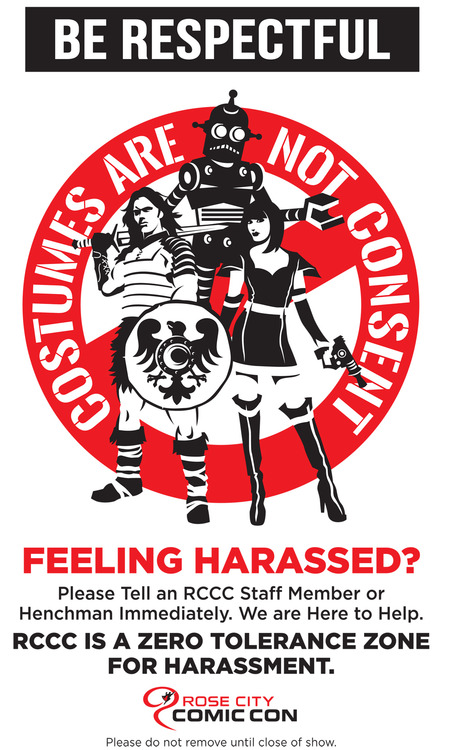
Fortunately, Geeks for CONsent and other anti-harassment advocates know that San Diego isn’t the only con around.  The work of the anti-harassment movement led both Emerald City Comic Con in Seattle and Rose City Comic Con in Portland to post some clear and beautiful signage throughout the convention center reminding attendees that “Costumes are not consent”.  Awesome Con, which hosts shows in Indianapolis, Milwaukee, and Washington, D.C., brought in Geeks for CONsent as their in-house anti-harassment team and used their anti-harassment training manual to train all of their volunteers in 2014.

Geeks for CONsent at Awesome Con DC, 2014

This weekend, NYCC will open their doors with a new anti-harassment policy, created by geek girl blog The Mary Sue and a panel of geeky advocates.  The policy includes a pretty comprehensive definition of harassment and protocols for reporting and dealing with harassers.  The policy also introduces the new Report Harassment feature of the NYCC app.  This cool piece of technology allows users to file an immediate, detailed report (provided, of course, that they have cell service in the concrete depths of the Javits Center).  Geeks for CONsent and Fan Girls’ Night Out will also be on hand to “spread the anti-harassment message, collect your stories, and provide a safe space to talk about your experiences”.

As geek culture becomes mainstream, making cons a place where all people feel welcome is more pressing than ever before.  At its core, geeking out is about enthusiasm.  It’s the type of unbridled exhilaration that gets you reading every installment, watching every episode, dressing up in character, traveling to cons.  Geeks are thrilled by seeing our favorite fictional heroes battle the forces of evil.  But what’s exciting now isn’t in the stories: it’s in us.

Major conventions are adopting new policies, geek celebs are speaking out against harassment, high traffic blogs and just-for-fun tumblrs are heralding the call that cosplay does not equal consent. Outside the geek-o-sphere, street harassment is being talked about by everyone from The Daily Show to Fox News (with, let’s say, “varying levels of support”).  After years of work, and even longer years of stifled silence, the heroic efforts of anti-harassment advocates are starting to turn the tide.

This weekend, I’ll be at NYCC and I’m excited to see how things are different.  Will the new policies eliminate harassment at the con?  Of course not – but this is the beginning.  It feels good to step into the Javits Center – wig, costume, and all – and know that the convention has my back.  And that?  That’s something to geek out about.

Katie is a social worker and community educator interested in ending gender-based violence, working with youth to make the world a better place, and using pop culture as a tool for social change. Check out her writing at the Imagine Better Blog and geek out with her on Twitter, @CornishPixie9.

Share

Filed Under: correspondents, Events, public harassment Tagged With: comic con, cosplay, NYCC

USA: Traveling While Female: Five Things India is Doing Better

September 30, 2014 By Correspondent

Angie Evans, Washington, DC, SSH Blog Correspondent

Photo provided by Angie

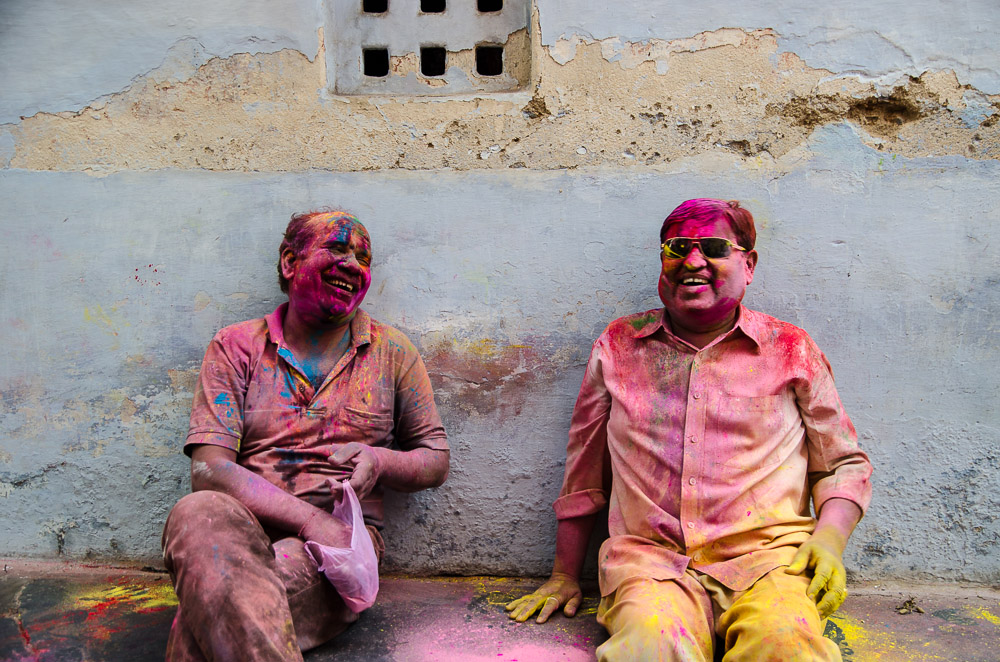
You can’t emotionally prepare yourself for sexual harassment or assault. It’s 11:15 a.m. and I am sitting on the rooftop of a guesthouse in Udaipur, India. My teeth are covered in purple chalk. From my fingertips to my elbow there is a splash of bright pink dye, later I will have to accept that my arm is going to be fuchsia for weeks. In the street I can hear kids laughing as they toss colors into the air. Two Grandfathers sit on a stoop below, chuckling with each other. I slump into a chair and breath for the first time in hours. Two other women sit with me. One had her shirt nearly ripped off by a group of teenagers and the other had to slap someone in the street for trying to run his hand across her chest. I’d had chalk smeared into my eyes by a man while his friend came up from behind me and grabbed by breasts.

Although Holi, the Hindu festival of colors, tops the bucket list for tourists all over the world, it isn’t the same experience for for all genders. The playful celebration that was traditionally held with family and friends relaxes many social norms between men and women, allowing some to use it as an excuse for groping, fondling, and grabbing women in the streets. In a culture so deeply rooted in spiritual practice and values, what is bubbling beneath the surface?

Reports of sexual assault in India have increased over the years, resulting in a continuous decline in the foreign tourism sector. In 2013, female travelers decreased by over a third in just 3 months. Hotel operators, travel agents, and others in the industry were undone by such a steep decline.  The international community was enraged by story after story of sexual assault. The first female chief justice was assigned to the the Delhi high court, immediately taking notice of some negative gender dynamics. An urgency prompted governmental investigations in national, state, and local Indian agencies.

Change is hard in a country with 1.2 billion people, but it’s an inevitable part of growth. A number of new policy measures have made female residents and travelers more safe in India. So what lessons can we learn from the policy changes and movement building in India around sexual harassment and assault?

1. Female Participation

When the Indian state of Gugarat decided to make a strong statement on sexual harassment, they set up a council to educate, mediate, and set policy framework within the high court. They made sure to prescribe exactly what kind of position in the system each member should have, and set a minimum quota for female participants. This isn’t the only governing body that set up a review board or fixed the number on the board, but it set a strong precedence for local communities.

2. Police Consent and Government Engagement

It is hard to know the true impact of sexual harassment in communities because it continues to be underreported for many reasons. In Delhi, they recognized that many victims felt uncomfortable calling the police so they set up a separate hotline just for sexual harassment and assault victims. They also started an on-going series of free self defense courses to female residents. In Ahmedabad, the police posted billboards in high traffic areas, offering a free ride home to any women who feel unsafe. The court systems are undeniably slow, and until this is changed, law enforcement officials need to play a strong role.

3. Education

India is slowly working on implementing one of their new laws, which protects women from workplace sexual harassment. A key part of that has become educating staff. This is important because the onus cannot be on women to stop the harassment, it must be on how men treat their female counterparts. Like all sexual harassment interventions in India, it must be about the perpetrator and not the victim in order to see fundamental change.

4. Make Streets Safe

Delhi is known worldwide for it’s confusing streets, lack of addresses, and chaotic traffic. Following the UN Safe Cities Global Initiative, the municipal government set up an audit for urban planning, identifying key ways that they could improve the safety of their city. Things as simple as street lights and better designed public restrooms can vastly improve safety records in a city. There are a number of Indian cities reviewing this checklist to find areas of improvement.

5. Support Survivors

Setting up sexual harassment and assault hotlines is the first step in a community response. Some organizations in India are making this the focus of their intervention because for many victims, it is a silent daily battle. In equipping these women with an emotional outlet, as well as the tools to respond to future experiences, you build an intervention that empowers each woman.

Organizations all over India are continuing to bring up problems with sexual harassment and assault, and will continue to fight for systemic and societal changes, because they haven’t reached a point where the laws represent the real values of the country. For a nation to truly grow and thrive, the equality of women must be central. And with women and children representing 70% of the population, this isn’t just the right thing to do in India, it’s good economic sense.

Angie is a community organizer and social worker. Last year she quit her job to travel around the world with her husband. They have just returned and are continuing to write about travel and adventure at http://whereisseangie.com

Share

Filed Under: correspondents, street harassment

USA: Music, Urban Space, and Me

September 30, 2014 By Correspondent

Pamela Segura, NY, USA, SSH Blog Correspondent

Via Unique New York Tours

When I was younger, I delighted in music videos. I enjoyed how fantastical and formulaic they seemed. Pop music videos featured a series of dancers, many of whom were female and often displayed a great deal of coordination and agility. Hip-hop videos were equally as methodical: men delivered rhymes with fervent hand motions while women pranced about.

Many of these videos sent a complicated, deeply fraught message to me: girls were spectacles to be admired and assessed in a particular setting.

The hip-hop videos, however, engaged me because they frequently contained women in a decidedly urban space.

Of course, I didn’t understand the notion of “urban space” when I was eight. To me, every child knew the same images and sensations I did while growing up on East 198th Street and Grand Concourse in the Bronx: stairs leading to the B and D trains, fading streetlights, blaring music and shouts from passersby, greens trees sporadically playing with the grayness of concrete. I felt comfortable in this environment, in this home that would only later become an “urban space.”

I gravitated to hip-hop music and videos because they felt like an extension of that home. I heard rap tracks swimming through my building’s hallways, or down by the corner of the street during mixing with the ice cream truck’s refrain. And I saw those buildings in the same videos. My younger self was engaging in an affirmation of her identity: there’s me, there’s my home, and there’s my music.

This changed when I was eleven. My sister and I were making our way home from our school, a quaint parochial school that sat on the left side of Grand Concourse right before Bedford Park Blvd. We were in uniform: skirts, knee-high socks, heavy black shoes. I noticed a group of teenage boys walking towards us, one of whom carried a radio playing Nelly’s “Hot in Herre.” One boy said something quite loudly to his friends: “I love Catholic school girls. They give the best head.”

Even now, at the age of 22, the vulgarity of that statement shocks and shames me. It strikes within me a strange mixture of anger and frustration, sadness and confusion. These teenagers perhaps didn’t possibly understand what they were indirectly doing: fetishizing girls and their Catholic school uniforms. These teenagers perhaps didn’t realize that they limited my ability to feel safe, to feel empowered and healthy in my own space. These teenagers perhaps didn’t realize how young my sister and I were.

As a young girl, however, I just knew that it was…not right. I obsessed about the comment—and the uniform and music that contextualized the comment—for several days. I wrote about it in my diary and slowly began to interpret Nelly’s lyrics and video. There isn’t much of an urban space in this video. Much of the video’s narrative consists of men and women packed tightly into a nightclub; the women eventually take off their clothing because it’s “hot in herre.” The lyrics dictate the visuals: Nelly eyes women in the club and clothes slide off bodies.

But I heard the song in my urban space.  And the specific attention to women’s clothing in Nelly’s song altered something in me. The connections were too vivid, too coincidental to ignore. My sister and I were walking, enjoying our time on Grand Concourse, chatting away the day and passing the train station. A comment from some other place, a far different and darkly mature place, penetrated that naïveté.

As I got older, the streets that shaped my childhood perspective became an “urban space,” a locale to be probed, theorized, considered, and written about. I developed a fear of the train when I was entering my teenage years. The train system in New York City seemed the ultimate irony. It gets you everywhere, opens up your world to the most famed and most hidden corners of the city, grants you that liberty with limited economic commitment. Yet, it’s all about cramped spaces; it removes the idea of privacy. Certain stops, moreover, had—and still, unfortunately, have—no lighting.

While my awareness of the “urban space” grew, my experiences with street harassment increased. And so did those of my other female friends.

Now that I’ve graduated from college, the Bronx still seems like a geographical puzzle, one that is shaped and reshaped by so many different factors. Hip-hop is a culture that sprang from there, and its nuances—musical sampling, lyrical realism and sensationalism, awareness of social ills—highlight just how beautiful and complex the Bronx will always be. But this music also reveals the strangeness “urban space” and, most important, how that space makes the body seem open, public, ready to be expressed.

Pam recently graduated from Manhattan College and she writes for SciArt in America. You can follow her on Instagram or Twitter @pamlivinlovin.

Share

Filed Under: correspondents, Stories, street harassment

USA: “Men harassing women represents a loss for everyone “

September 30, 2014 By Correspondent

Daniel Burdick, CA, USA, SSH Blog Correspondent

I’m truly honored to be a correspondent for the Stop Street Harassment blog.  As you have probably noted by my photo, I could actually be one of the perpetrators of sordid public-performance graffiti.  The intention of Stop Street Harassment is to include men in this discussion; and this has to be duly appreciated; as it seems to happen far too often that men’s paltry contributions to various gender issues tend to be defensive, apologist, arrogant, offering irrelevant advice, neurotic, hostile, or otherwise opportunistic efforts at presenting themselves as feminists; when in fact, they are actually more analogous to wolves trying to conceal themselves in sheep-suits.  I’m fastening the shoulder harness for this hot seat.  It’s going to be a bumpy ride…

I hope you are truly interested in solving this issue and are reading this because you understand that street harassment is a serious problem for men as well as women…   and not that, heaven forbid, men might get harassed as well; but that men harassing women is not only embarrassing for the men who aren’t into it, but represents a considerable loss for everyone in our society.  I’m also really hopeful that males of all ages and stages are reading this, because this is the group for whom I’m pitching.  You may have seen the title of the recent effort expressed by the executive branch of the U.S. government to end sexual assault on college campuses: “It’s On Us.”  Yes, it truly is.

Avoid blaming – This is not really anyone’s “fault,” per se – for harassment is only one of the more visible tips of a larger iceberg representing a fatal flaw institutionalized into our society.   Even though many of us may have unsubscribed to the western religions that brought us this and other sublime forms of enslavement and control of masses, this philosophical heritage of systematically demeaning females may prove a rather difficult cancer to eliminate.  Therefore, I propose a top-down approach.  I will elaborate more about the strategy later. For now, it remains up to us men to fix this problem, even if the “nice guys” are uncomfortable with accepting responsibility for actions of “those other jerks.” I urge you to visit the website HeForShe.org and accept the challenge of addressing the human rights issue of preventing violence and discrimination against women and girls worldwide.

An exceptionally thorny obstacle in the way of addressing this subject is while gender-based street harassment is mainly a little tour-de-force favoring continued entrenchment of male power, it also contains the component of human sexuality; a realm where every adult has a diverse opinion; usually based on their personal experiences, tendencies, preferences, hang-ups, and self-valuation.   A funny thing I’ve noticed about this hot button (pardon the pun) issue is that our differences of opinion regarding sex tend to mimic our political polarizations… there exist sexual conservatives, sexual liberals, libertarians, radicals, and so on.  There are sometimes alternative labels for these divisions; for example, self-described “sex-positive” women represent a libertarian faction of feminism.

Street harassment has no positive side.  It cannot be considered a form of release for its perpetrators; in fact, it would appear to instead promote the opposite effect – exciting and inspiring the perpetrator or perpetrators to continue.  By definition, it can never be accepted as complimentary by the recipients.  Why?  In cases when the recipient truly doesn’t mind being shouted at, then the incident is simply no longer considered as “harassment.”

This question of acceptability is where the dark gray area of public relations is haunted by the specter of ambiguity.  Admittedly, there are circumstances under which it is entirely possible to communicate unsolicited via a shout to another stranger in a manner that is not a problem.  On the other hand, it is also possible that an identical exchange, yet under slightly different and unforeseen circumstances, can be rightfully perceived by the recipient as annoying, undesired, and thus as harassment.  It’s not always possible to recognize all the contributing circumstances in advance.  Therefore, it is a more prudent course of action to avoid initiating an unsolicited exchange; unless it is quite obvious the potential recipient or recipients are open to public communication and will be agreeable with its message.

Even though the true intent of the message may be purely harmless or even complementary by the perpetrator; intent cannot be considered a factor in determining whether an exchange is harassment or not.  It is often said that “The road to hell is paved with good intentions.”  It’s the recipient’s call.

This outlines the basic theories I must try to communicate to my fellow men to actualize.  Now my bro’s tend to be a bunch that do not ask for, nor read, directions; they are also being bombarded with fantasy-sex advertising, when too often they feel like they get the short end of the stick with their real relationships. I don’t expect this quest to be easy…   so please keep your seat belts fastened, and your emotional shields up.

Daniel is a longtime activist for peace, the environment, and social equality. He currently works as a design engineer and is an avid bicyclist.

Share

Filed Under: correspondents, male perspective, street harassment

« Previous Page
Next Page »

Share Your Story

Share your street harassment story for the blog. Donate Now

From the Blog

  • #MeToo 2024 Study Released Today
  • Join International Anti-Street Harassment Week 2022
  • Giving Tuesday – Fund the Hotline
  • Thank You – International Anti-Street Harassment Week 2021
  • Share Your Story – Safecity and Catcalls Collaboration

Buy the Book

  • Contact
  • Events
  • Join Us
  • Donate
  • Facebook
  • Instagram
  • Pinterest
  • Tumblr
  • Twitter
  • YouTube

Copyright © 2026 Stop Street Harassment · Website Design by Sarah Marie Lacy