• About Us
    • What Is Street Harassment?
    • Why Stopping Street Harassment Matters
    • Meet the Team
      • Board of Directors
      • Past Board Members
    • In The Media
  • Our Work
    • National Street Harassment Hotline
    • International Anti-Street Harassment Week
    • Blog Correspondents
      • Past SSH Correspondents
    • Safe Public Spaces Mentoring Program
    • Publications
    • National Studies
    • Campaigns against Companies
    • Washington, D.C. Activism
  • Our Books
  • Donate
  • Store

Stop Street Harassment

Making Public Spaces Safe and Welcoming

  • Facebook
  • Instagram
  • Pinterest
  • Tumblr
  • Twitter
  • YouTube
  • Home
  • Blog
    • Harassment Stories
    • Blog Correspondents
    • Street Respect Stories
  • Help & Advice
    • National Street Harassment Hotline
    • Dealing With Harassers
      • Assertive Responses
      • Reporting Harassers
      • Bystander Responses
      • Creative Responses
    • What to Do Before or After Harassment
    • Street Harassment and the Law
  • Resources
    • Definitions
    • Statistics
    • Articles & Books
    • Anti-Harassment Groups & Campaigns
    • Male Allies
      • Educating Boys & Men
      • How to Talk to Women
      • Bystander Tips
    • Video Clips
    • Images & Flyers
  • Take Community Action
  • Contact

Peru: The Macho is a Coward

October 22, 2014 By Correspondent

Laura Bustamante, Lima, Peru, SSH Blog Correspondent

Ser macho es Ser “marica”

Via Peru.com

El otro día, la calle estaba desolada, tuve miedo de cruzar a la acera de al frente al ver a un hombre que lucía poco confiable, pensé en no cruzar, pero mi espíritu reivindicativo y feminista brotó, por qué como mujer tenía que restringir mi libre tránsito, elecciones y sentirme insegura en mi barrio por un hombre, entonces crucé. Y lo veía venir, mientras caminaba él se acercaba mirándome, no iba a correr, odio huir ante una agresión masculina… soy una mujer no una rata. Se acercó cortando mi camino y rozando mi brazo, inclinándose para decirme no sé qué, yo escuchaba música con mis audífonos, mientras me alejaba le grité: ¡Respeta a las mujeres! El se volteó y parado desafiante me dijo: sólo te estoy “saludando”.

Para mi es sencillo: Es inadmisible que muchos hombres crean que se nos pueden acercar en las calles sin consenso, por qué se creen con derecho a “saludarnos”, invadir nuestro espacio, rozarnos, decirnos cosas sexuales o tocarnos. Es que la violencia sexual, simbólica y psicológica a la que se somete a la mujer se justifica por los roles de género que debemos asumir, ser hombre, ser mujer. Mientras la mujer es pasiva, no activa sexualmente, linda y sumisa; se espera que el hombre -aquí la palabra que me da náusea- sea macho, un macho latino, el macho peruano, por ello se sienten orgullosos, ellos son machos pues, son lo máximo, los que están en la cima de la jerarquía, tienen más libertades, activos con híper-sexualidad, fuertes que no lloran. Bajo este sistema machista-patriarcal el hombre es dueño del espacio público y privado, poseen territorio y hembras, es el protector y proveedor que tiene el control, y el medio para ejercer su dominio es la violencia.

Sí, bienvenidos a “Macholandia”, el reino no muy lejano del macho latino y su ideología, que sobrevalora la sexualidad masculina, educa hombres conquistadores que siempre deben desear una mujer para demostrar su hombría, incluso ejerciendo una sexualidad violenta, porque el macho acumula mujeres no hombres, es heterosexual no “maricón”, por eso rechaza y desvaloriza lo femenino, débil e inferior, donde las mujeres existen para darle placer y afirmar su masculinidad, convirtiéndolas en objeto, y como debe ser “fuerte”, es dominante y el cuerpo femenino les pertenece, así acosan a las mujeres en la calle, el hombre se convierte en juez y puede juzgar sexualmente el cuerpo de una mujer.

Así, la mujer como objeto queda sujeta a la voluntad del hombre protector o del que decide dañarnos, dando paso a la cultura de la violación, porque el macho al demostrar su heterosexualidad fuerte-dominante puede intentar aprovecharse y nosotras nos debemos cuidar: “el hombre propone, la mujer dispone”, porque “un hombre no puede controlarse, es su instinto” y todo será nuestra culpa, tu culpa por tomar o vestirte así, porque tu ropa justifica que te acosen, te toquen o hasta te violen. ¡Hay pobrecitos estos machos inocentes! Dueños de todo y todas pero no de sus actos y responsabilidades, machos racionales llevados por sus emociones agresivas, fuertes pero débiles a su sexualidad, dominantes pero sometidos al machismo, la culpa la tienen ellas, las Evas, la tentación. El agresor se convierte en víctima de provocación y la agredida en culpable, en puta, en la vergüenza que en casos más terribles se le exige continuar con un embarazo por violación, como lo exige el Estado peruano, la mujer objeto sexual también es objeto reproductivo.

El acoso sexual callejero afecta el día a día de las mujeres, evitas una construcción por los obreros, te cubres más de lo que quieres, evitas ciertas zonas o salir sola de noche; tratas de salir acompañada por un hombre reforzando tu dependencia. Afecta la seguridad, independencia, libertad sexual y de tránsito, tu derecho a vivir sin miedo ni violencia, pero todo esto no es suficiente y estos machos defenderán su masculinidad incorrecta, negarán que el acoso sexual callejero es una forma de violencia sexual sutil, naturalizado y tomado en broma, parte de la cultura de la violación porque no interesa tu permiso, consenso, si no te gusta, el macho se siente con derecho de juzgar sexualmente tu cuerpo o tocarte, tu cuerpo es de ellos de manera simbólica. Dirán de las mujeres que se defienden que son exageradas, histéricas, incluso se burlan o se vuelven más agresivos, porque no conciben que el cuerpo femenino no les pertenezca, no pueden vivir en un mundo donde no sometan, abusen y ejerzan poder sobre sus compañeras femeninas.
¬¬
Deberían entenderlo ¡ya!, ser macho es peyorativo, no es motivo de orgullo es una vergüenza, el macho desvaloriza y rechaza lo considerado femenino, como a los gays, los llama maricas, que significa: cobardes, afeminados. Es que los machos creen que es un orgullo ser abusivo, agresivo, homofóbico, violento, ser el que somete y reprime sus sentimientos, sin empatía, que trata a otros seres humanos (mujeres) como objetos. Al final, ser macho es ser un pusilánime sin valor rendido ante los mandatos del machismo, un inseguro que prueba constantemente su masculinidad, es un cobarde que se mete con las mujeres apoyado en la intimidación porque tienen más fuerza física. Estos machos se dan cuenta que a las mujeres no les gusta su acoso, que molestan, que lo hacen contra su voluntad y da miedo, pero generar miedo los hace sentir más machos y con más poder.

Ser macho no es una masculinidad es un tipo de dominación, una masculinidad debe ser una expresión de tu humanidad, debe convertirte en mejor persona sin dominar a otras u otros para definirte, hay que repensar “el orgullo de ser macho” porque ser macho es ser un “verdadero maricón”.

Laura ha estudiado Administración en Turismo en Universidades de Perú y Barcelona, y Estudios de Género en la ONG Flora Tristán. La puedes seguir en Twitter en @laeureka.

IN ENGLISH

The other day I was afraid to cross the street when I saw a man and no one else around. But my feminist spirit arose; why as a woman should I have to restrict my movement and feel unsafe in my neighborhood because of a man?

Then I crossed. And I saw it coming; while I was walking he was approaching, staring at me. I wasn’t going to run away from a potential male aggression … I am a woman not a rat. He came near to me almost cutting me off and rubbed my arm, leaning in to me to tell me – I do not know what – I was listening to music with my headphones on. As I walked away I said, “Respect Women!” He turned and stood defiantly replying, “I’m just ‘greeting you’.”

For me it is simple: It is unacceptable that many men believe that they can approach us on the streets without our consent that they feel entitled to “greet us”, invade our space, tell us sexual things, or even touch us.

The sexual, psychological and symbolic violence to which women are subjected are often justified by the gender roles we assume. While the woman is supposed to be passive, not sexually active, beautiful and submissive, a man is expected to be –and here is a word that makes me nauseated- a “macho”, a Latino macho, the Peruvian macho. That word makes many Latin-American men proud: they are machos, they are at the top of the hierarchy, they have more freedom, they are actively hyper-sexual, they are strong and don´t cry.

Welcome to “Macholand”, in the not too far away kingdom of the macho Latino, and its ideology, which overestimates male sexuality, educates men to be a womanizer who always has to desire a woman to prove his manhood. He even may use sexual violence but that is seen as women’s fault. “The man proposes and the woman disposes” because “a man cannot control himself, it is his instinct” is how it goes, so everything will be a woman’s fault, It´s her fault for drinking too much or for dressing like that, because her clothes justifies harassment, touching, and even rape. The attacker becomes the victim of provocation and the victim becomes guilty, become a slut in terrible shame that in the most horrible cases are forced to continue with a pregnancy by rape, as the Peruvian State requires, because women are sexual and reproductive objects.

A macho is supposed to be heterosexual, not a “fagot,” so he rejects and devalues the feminine. He considers the feminine weak and inferior and believes that women are objects that exist to please and reaffirm his masculinity. As a macho he believes he should be “strong”, dominant, and that the female body belongs to him. The man becomes a sexual judge and feels he can judge a woman’s body by harassing her on the street.

The result is that street harassment is common and affects women´s daily life. We avoid walking by construction workers, we cover our body more than we want, we avoid certain areas or go out alone at night; we try to be accompanied by a man, strengthening our dependency on men. Street harassment affects our safety, independence, sexual freedom and transit, and our right to live without fear and violence.

Even still, machos will defend their wrong masculinity, denying that sexual harassment is a form of sexual violence, but say it is normal or a joke. They say women who defend themselves are exaggerating, hysterical, or they become more aggressive against them because they do not want to conceive that the female body does not belong to them.

This is the truth: Being macho is pejorative, it´s not something to be proud of but is actually shameful. Being macho means being a pushover with no courage and being subjected to the mandates of sexism. These machos realize that women do not like to be harassed, but still they do it to make women afraid, because creating fear makes them feel more macho and powerful.

Being macho is not a good masculinity. Masculinity should be an expression of one’s humanity and desire to become a better person without dominating others. It must be rethought.

Laura has studied Tourism Management in Universities of Peru and Barcelona, and Gender Studies at the NGO Flora Tristan. You can follow her on Twitter at @laeureka.

Share

Filed Under: correspondents, street harassment

USA: Our Oppressions are Intertwined

October 20, 2014 By Correspondent

Sarah Colomé , IL, USA, SSH Blog Correspondent

Via Gradient Liar

Throughout the past several years of working to combat rape culture, I have noticed a disturbing trend. I often find that in our work, we make strong calls for solidarity that may not be equally, if at all, reciprocated.  We often forget that violence against our children is a reproductive justice issue. We forget that our oppressions are intertwined. Sometimes we don’t show up as often as we should.

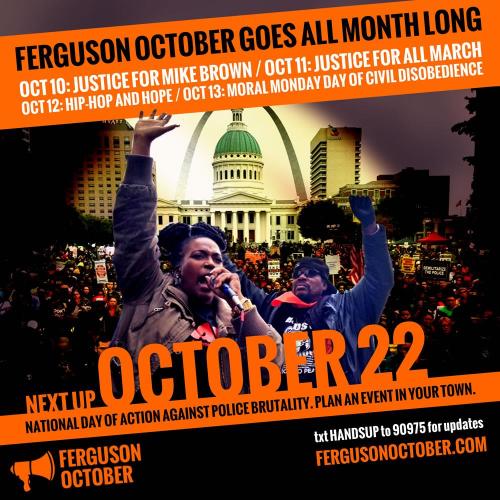
The wake of the tragic death of Michael Brown, fueled by the recent finding that every 28 hours a black person is killed by a security officer, highlights the lived reality of fear and dehumanization experienced by many people of color. Have we, as a community, engaged with this historic issue of police misconduct and brutality? Are we examining our own prejudices and acknowledging when we ourselves, racially profile others? Are we collaborating with other community organizations focused on racial justice and police violence to transform our society into a safer place for all to exist? Have we actively framed this as a reproductive justice issue?

Dani McClain outlines this disconnect between movements in The Nation explaining, “the killing of Michael Brown, like the killing of many young black people before him, is rarely framed as a feminist issue or as an issue of pressing importance to those who advocate for choice, self-determination and dignity as they relate to family life.”

To create change in the manner in which female identified persons can walk through the world with more ease and less threat of violence, we must recognize that others face similar fears about violence because of their identity. After all, the same structures and systems that functionally condone, and perpetuate the degradation of female identified and queer presenting or identified persons, also actively propagate the dehumanization of people of color, and yes, all oppressed people.

Doing “the work” can manifest itself in a multitude of ways:

* Explore with your staff why some individuals feel they should not, or could not, go to police officers to safely report street harassment.Consider screening a film like this one from Found Voices, and asking a partner organization to come debrief and collaborate.

* Offer community-wide trainings on how to report abusing policing in your area. For example, report here for New York, here for Chicago, or here for Los Angeles.

* Organize a staff outing where you attend a local rally or teach-in, or write letters to legislators, in support of racial justice.Support movements for Marissa Alexander, university teach-ins on Ferguson, or local measures for police accountability.

* Consider offering your employees and volunteers “cop watch” trainings. Organizations including Cop Watch NYC, CAAAW,Berkeley Copwatch,We Cop Watch, and We Charge Genocide all offer these trainings.

Challenge your organization, and the community as a whole, to refrain from segregating ourselves and our work, claiming “that’s not what we do.”

* Continually doing our work, without recognizing how oppression interacts among us both uniquely and interconnectedly, destabilizes the very foundation that is essential to create tangible, sustainable change. Addressing gender-based harassment and violence without acknowledging that others are equally harassed and violated based on their visible identities, whether actual or assumed, does nothing to create relationships for future bystander interventions.

This is not to suggest that there are not phenomenal groups doing intersectional work and capacity building across movements. This does not negate that there are a multitude of struggles and experiences of oppression that are lived out daily, needing our support, intervention, and attention. Nor does my assertion forgo the difficult realities of the nonprofit industrial complex, and the structures that often make our desire to collaborate difficult.

But I ask you all this: Are we showing up for those who are targeted for harassment based upon their perceived race? If not, we must ask ourselves why and how we may in some instances, be perpetuating the very experiences of violation that we are aiming to prevent.

It should never be acceptable to ask for support from our community when we do not show up for those same people as they engage with their own struggle. Recognize the privileges we hold in various spaces.  We know that male presenting individuals hold privilege in this world that female presenting people do not. This status as a target group however, does not negate other instance of privilege that we may hold. We must hold ourselves accountable to recognize our complicated, multifaceted identities, and how in some situations, the power of our privilege may outweigh the disadvantages of our target group status.

Ask yourself:

* Are we showing up at rallies, marches, or protests addressing police brutality, misconduct, or profiling?

* If not physically, or otherwise able to attend, are we engaging these topics on social media, or relating them intersectionally in our own work?

* Are we incorporating the voices of other marginalized groups in our work against rape culture and street harassment?

* Do we make sure to recognize that for many, police are not a safe option for reporting or “protection?”

* Are we engaging in self-assessment and reflection on how our own actions may perpetuate, or result in, others’ experiences of street harassment?

Bystander intervention does not exist solely in acting when someone is being cat called, followed or bombarded with sexualized comments. Bystander intervention exists in acknowledging and challenging ANY instance of oppression, no matter the movement that the target group may align with.

This note is a call to action, out of love, to the community I fight alongside with passion and commitment. We are at a crucial time for a multitude of resilient movements, both nationally and internationally. We must stand alongside one another.  I challenge us all to interrogate our own perceptions of others, as we call one another to accountability for our actions.

Sarah is a progress-focused educator and advocate dedicated to building strategic coalitions centered on creating social change who serves as an adjunct professor in DePaul University’s Peace, Justice and Conflict Studies department. You can follow her updates on Linkedin or hear her perspectives on Twitter.

Share

Filed Under: correspondents, public harassment

USA: Building a New Culture of Consent at NYCC

October 17, 2014 By Correspondent

Katie Bowers, NY, USA, SSH Blog Correspondent

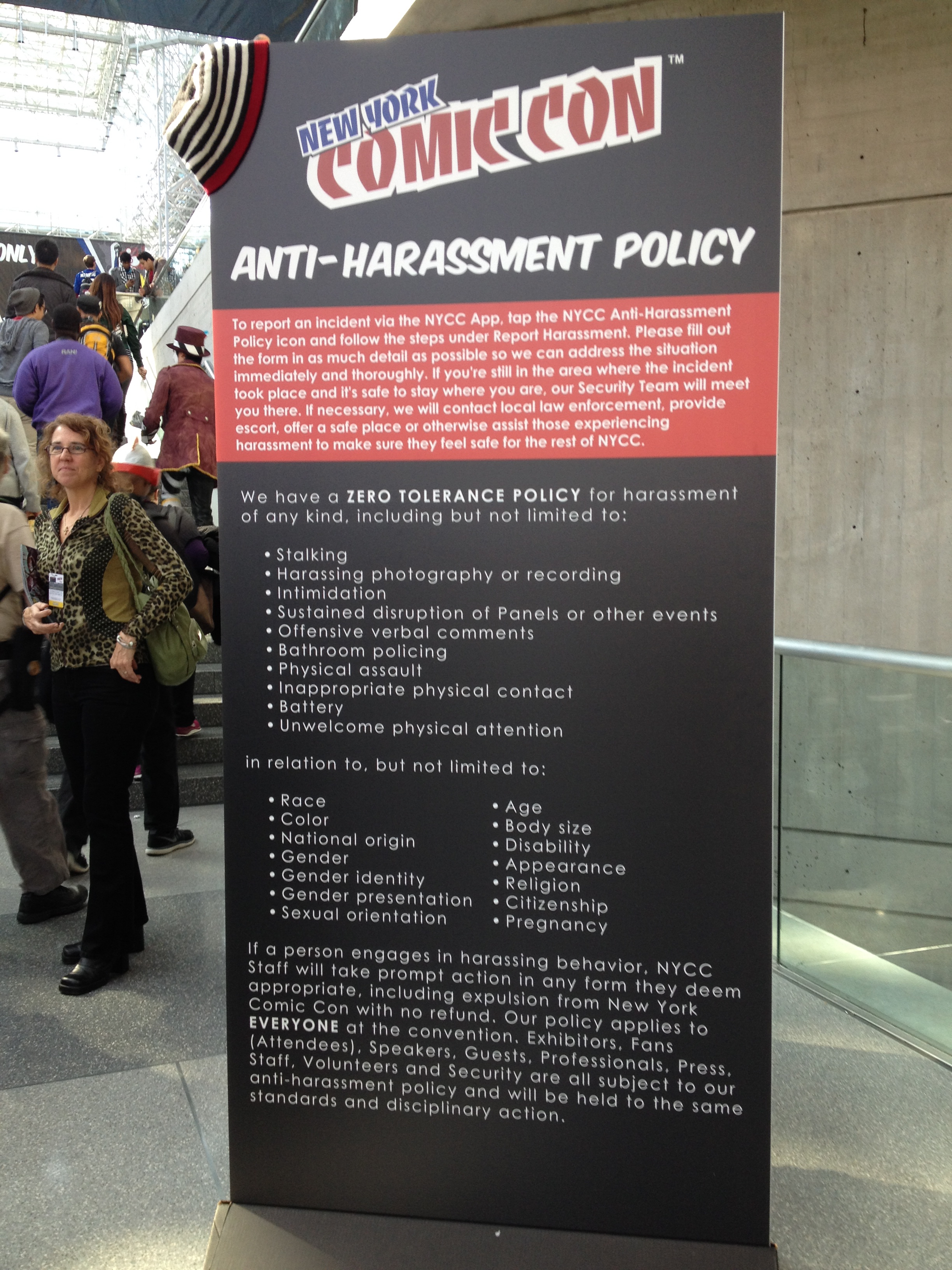
Last week we discussed New York Comic Con’s shiny, new anti-harassment policy.  Over Saturday and Sunday at the convention, I got to see the policy in action.

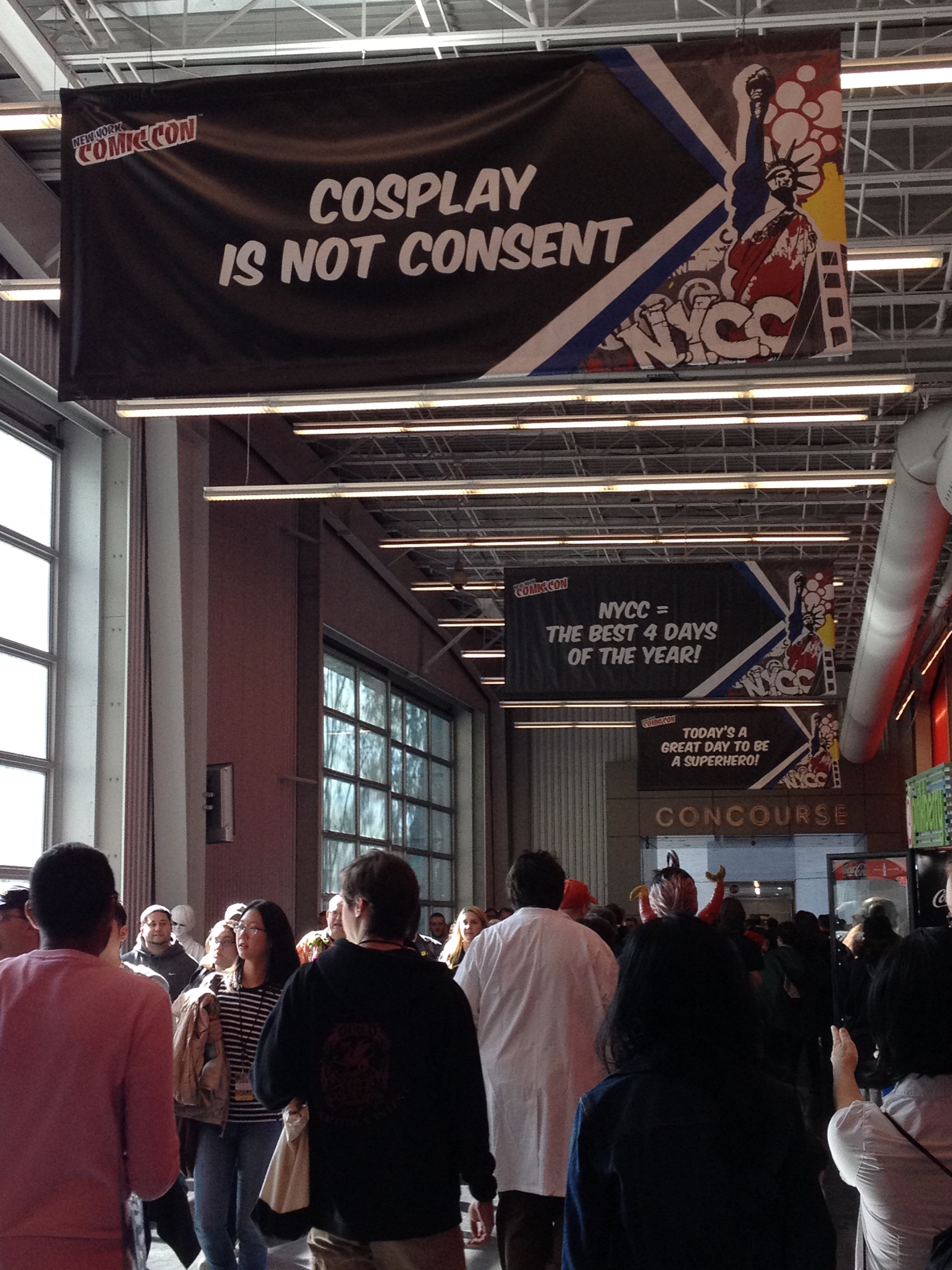
Thanks to the efforts of Geeks for CONsent, The Mary Sue, and others, New York Comic Con 2014 featured a plethora of reminders that “Cosplay is not Consent”.  Prominent black and red standees stood throughout the Javits Center’s main lobby – a major site for amateur and professional photographers looking to grab a shot of attendee’s incredible costumes.  The policy, which also covered a full page of the program booklet, forbids a wide range of harassment including unwanted physical touching and gestures, verbal comments, stalking and intimidation, and photos taken without consent.  Offenders, the standees and program booklets proclaimed, run the risk of being kicked out of the convention.

I spent the weekend dressed up as one of sci fi’s favorite red heads: Special Agent Dana Scully.  To my knowledge, everyone who took my picture asked for my permission – and everyone asked with enthusiasm.  This isn’t a new phenomenon.  In general, anyone excited enough about your costume to want a picture also wants to share their excitement – but one interaction in particular stuck out to me.

A man approached me on the show floor and asked to take my photo.  “Sure,” I said and went to set down my stuff.  My badge and bag got tangled and it took a minute to unhook the two.  “Sorry, hold on,” I told him.

“No, no, I’m sorry,” he said quickly.  “I don’t want to make you uncomfortable.  You don’t need to be sorry.”

In a place where people walk around on stilts and stilettos, strap proton packs to their back, and squeeze through overcrowded aisle ways, comfort is generally not the first thing on anyone’s mind.  His response was totally surprising and wonderfully welcome.

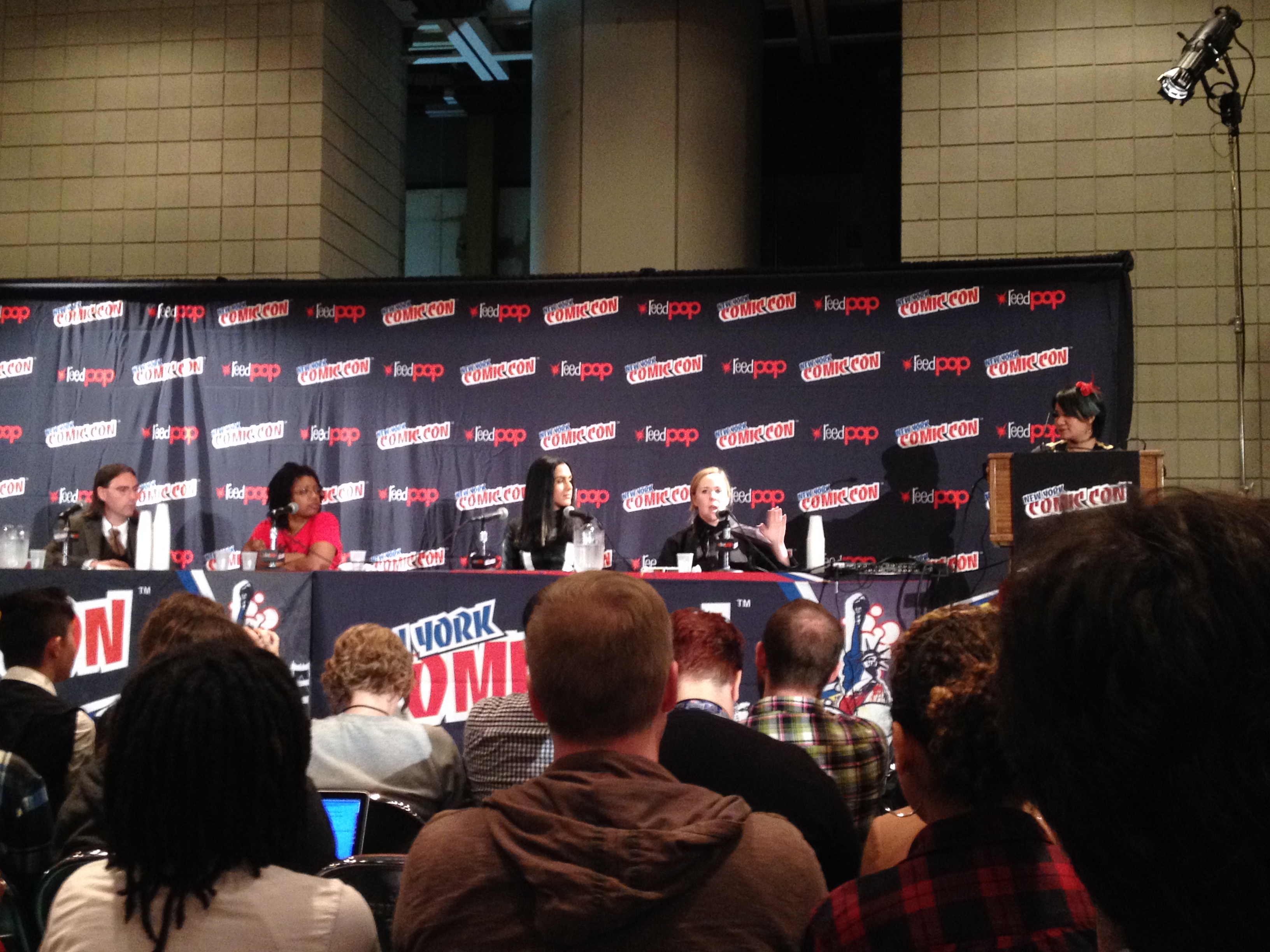
In addition to visual reminders, NYCC also hosted “#YesAllGeeks”, a panel about harassment in convention spaces with Diana Pho of Beyond Victoriana, , Marlene Bonnelly of comics.tumblr.com, writer and prolific tweeter Mikki Kendall; Emily Asher Perrin of Tor, writer and #YesAllWomen creator Kaye M, and Robert Anders, a nurse practioner speaking about the psychological effects of harassment. The panelists did a great job of breaking down why having anti-harassment policies are so important:

* Obviously, a strong policy helps victims to recognize harassment when it happens to them and provides them with an immediate course of action.  It can also help women, people of color and members of other frequently harassed groups feel more welcome – an important consideration as conventions grow larger and more diverse.

* With a well-publicized policy, harassers can be held accountable.  It’s hard to convincingly claim ignorance when standing next to an 8-foot tall standee and holding the full text of the anti-harassment policy in your swag bag.

* Policies can also open up opportunities for bystanders.  Often, bystanders witness harassing behavior but don’t step in.  They’re not sure what to do, and they don’t want to be harassed themselves.  With a policy in place, bystanders have more options.  They can ask the victim if they are okay, if they’d like help, if they’d like to report, and even if they have heard about the “Report Harassment” feature of the NYCC app.  Or, if it feels safe, they can remind the harasser about the “Cosplay is not consent” policy.

So there are lots of good reasons to create and publicize strong anti-harassment policies – but Mikki Kendall pointed out that the most important reason of all isn’t action and reaction.  It’s prevention.  When asked how we can make fan communities safe spaces, Kendall advised that we need to be communities that respond appropriately and immediately to unacceptable behavior. When we speak out against harassment and oppression – at conventions, online, or even in the media that we geek out about – we make our communities better and safer.  We hold ourselves and other members of the community to a higher level.  Or, since we’re at Comic Con, you could say we “level up”.

This weekend, NYCC became the most highly attended convention of the year with 150,000 fans walking through the front door.  Those 150,000 fans saw costumes, sneak previews, art, comics, panels – and a new message: it’s time to level up.

Want to see the panel in its entirety?  Visit Beyond Victoriana!  Or read more at The Mary Sue.

Katie is a social worker and community educator interested in ending gender-based violence, working with youth to make the world a better place, and using pop culture as a tool for social change. Check out her writing at the Imagine Better Blog and geek out with her on Twitter, @CornishPixie9.

Share

Filed Under: correspondents, public harassment Tagged With: comic con, NYCC

Bulgaria: Harassment-free schools: Whose responsibility is it anyway?

October 16, 2014 By Correspondent

Diana Hinova, Sofia, Bulgaria, SSH Blog Correspondent

Public schools are public spaces. Schools are also one of the places where we learn, ‘by doing’, about what public space is and what behaviors are acceptable in it. It is no secret that there can be serious problems with bullying and harassment in schools. In Bulgaria, though, teachers and school officials –underpaid and often burned out – tend to ignore anything that is happening between students and does not lead to serious bodily injury. They try to just focus on their job, insisting that they are responsible for educating, not protecting or disciplining the students.

So, a lot goes on in Bulgarian schools to ‘teach’ girls that they cannot count on their bodies being respected or their rights protected. Being groped and verbally harassed by classmates on a regular basis just seems to be part of the public school experience. When Bulgarian women who had experienced physical or sexual violence since age 15 by someone other than their partner were asked details about the most serious such incident, 22% cited someone from a school context as the perpetrator (European Study on Violence Against Women, 2012).

The message that girls cannot count on their bodies being respected or their rights protected is reinforced by street harassment. Bystander passivity compounds it. When they experience and witness street harassment, in their daily commutes to school and other activities, girls come to understand that this behaviour is seens as tolerable not only for their rowdy peers, but for any man. Boys similarly see that there is no incentive to stop harassing women.

As long as sexual harassment goes on between classmates, school officials will turn the other way and focus on their ‘educating’ work. This realization was certainly part of my stints in Bulgarian public school, and one of the most memorable at that. Is it any wonder then that some of these boys carry the same attitudes and behaviors out into the street? Or that we continue not to talk about gender-based violence as adults? A huge opportunity to break the cycle of tolerated harassment is missed.

A small proportion of cases though, in public school settings, are such where the perpetrator is not another student. An alleged case of this variety captured Bulgaria’s attention this week: the parents of a 13-year-old girl became aware that there was misconduct by staff against their daughter, probably of a sexual nature, at a special-needs school in Sofia. The immediate response by school officials was, in essence, ‘[shrug], I don’t know, I wasn’t there, and, nobody would believe an autistic kid, anyway’. The parents filed complaints with the relevant child rights agencies and the Ministry of Education, public protests and press statements ensued.

What bitter irony that this year the State Agency for Child Protection, along with similar national authorities elsewhere, marks “2014: Year of Child Rights”! It is on the occasion of the 25-year anniversary of the Convention of the Rights of the Child, ratified by Bulgaria in 1991. The Convention guarantees children, among other things, protection from physical and sexual violence and exploitation. In addition, while many school officials may not be aware of this fact, a coordination mechanism between the SACP, Ministry of Education, and law enforcement institutions, stipulates that anyone aware of potential violations of these rights bears responsibility for reporting these concerns to the relevant authorities.

As it turns out, there are (on paper) fairly adequate systems for dealing with sexual harassment and more serious offenses in Bulgarian public schools. It’s just that no one wants to take on the added responsibility for using these means.

There is a movement among young parents in Sofia to consider various forms of alternative education. How to educate your children is a huge decision – these people take it quite seriously. And they find themselves pushed away from the public school system not only because of what they perceive as poor quality education, but to a large extent also because it does not provide a safe environment.

They do not want their children to become either victims or aggressors by default, or to internalize the norms tolerant to violence. But Bulgarian public schools at present pretty much guarantee that they would.

Diana has a Master’s in Public Policy from Georgetown University and works as a consultant to INGOs. Follow her on Twitter @dialeidoscope or letnimletni.blogspot.com.


България: Училище без тормоз: Чия е отговорността?

Държавните училища са публични пространства. Училищата са и места, където научаваме, ‘от опит’, що е то публично пространство и какво поведение се приема в него. За никого не е тайна, че в училищата може да има сериозни проблеми, конфликти и насилие между връстници. В България, учителите и персоналът – обикновено с недодстатъчно заплащане и претръпнали – не обръщат внимание на отношенията между учениците, стига да не се стига до сериозни физически наранявания. Стараят се да се концентрират в работата, като настояват, че те трябва да обучават, а не да защитават или възпитават учениците.

Така много неща в училище “обучават” момичетата, че не могат да разчитат телата им да бъдат неприкосновени или правата им да бъдят защитени. Това съучениците ти да те опипват, задавят нежелано и обиждат, редовно, е просто част минаването през държавното училище. От българките изпитали физическо или сексуално насилие извършено от друг, а не техен партньор, 22% са посочили извършител от учебната си среда (Европейско Изследване на Насилието над Жени, 2012).

Идеята, че момичетата не могат да разчитат на уважение, заради телата си, или на правата си, се подсилва от уличния тормоз. Апатичните наблюдатели я потвърждават. Когато биват тормозени на улицата или наблюдават такива случки в ежедневното си придвижване, момичетата осъзнават, че такова поведение се толерира не само сред бурните им връстници, но от страна на всеки непознат. Момчетата също не виждат пример и причина да противостоят на такова поведение.

Стига сексуалният тормоз да се случва между учениците, персоналът на училищата извръщат поглед и се концентрират да ‘образоват’. Това прозрение със сигурност го изпитах лично в държавните училища и то остава най-яркият ми спомен от времето прекарано там. Да се учудваме ли, че момчетата после излизат на улицата и в обществото със същите нагласи и поведение? Или че продължаваме да не говорим за половото насилие и като възрастни? Пропускаме огромна възможност да спрем цикъла на толериран тормоз.

В малък процент от случаите на сексуален тормоз в училищна среда, все пак, извършителят не е друг ученик. Такъв е случаят на 13-годишната Ана-Мария, чиито родители повдигат въпроса за сексуален тормоз извършен от служител пред настоятелите на училището. Сблъскват се първоначално с отговора “Не зная какво е станало, не сме били там, а и никой няма да и повярва, защото е аутист”.

Каква горчива ирония – Държавна Агенция за Закрила на Детето (ДАЗД) в момента отбелязва “2014-та: Година на правата на детето!” по случай 25-годишнината от Конвенцията за правата на детето, която България ратифицира през 1991-ва. Конвенцията гарантира на децата, наред с други права, закрила от физическо и сексуално насилие и експлоатация. Освен това, въпреки нехаенето на болшинството служители в училищата, координационният механизъм на ДАЗД, Министерство на Образованието и Науката и органите на съдебната власт, задава задължение на всеки информиран за потенциално нарушение на тези права да сигнализира компетентните институции.

Излиза, че (на хартия) има сравнително адекватна система за сексуален тормоз и други сериозни нарушения в Българските училища. просто никой не желае да поеме отговорността да я използва.

Има една тенденция сред младите родители в София да търсят алтернативни методи за образование за децата си. Изборът на образование е много значимо решение, което тези хора приемат съвсем на сериозно. И се усещат отблъснати от държавната образователна система не само защото оценяват образователната програма като некачествена, но и до голяма степен защото не смятат, че осигурява безопасна среда.

Те не искат децата им да се превърнат в жертви или агресори по предопределеност, или да възприемат толерантността към насилието, на която българските държавни училища почти гарантирано ще ги научат.

(Развития по случая на Ана-Мария offnews и резултати от проверката на ДАЗД)

Следвайте автора в Twitter @dialeidoscope или на блога letnimletni.blogspot.com.


Share

Filed Under: correspondents, public harassment, street harassment

Cameroon: Street Harassment is an Attack on Women

October 13, 2014 By Correspondent

Ngwentah Berlyne Ngwalem, Buea, Cameroon, SSH Blog Correspondent

My younger sister recently told me that she never really understood what harassment meant. Not that she doesn’t have to deal with it on a daily basis, but that she had not found a name before to describe the repulsive rude behavior committed by men towards her. She found it hard articulating her feelings as she sadly said to me:

“I mean sometimes you just want to be left alone but these men don’t get it. Is it harassment when you get in a taxi and a guy starts narrating the story of his life, even though you show no interest? They immediately jump into chatting you up, and you don’t respond, but they keep talking and try to teach you how you should act back? I feel really irritated by what these guys do.”

I listened and felt how difficult it was for her to explain what happens to her and a lot of other women on a daily basis. I told her that it was harassment.

As these things are now being talked about, a lot of girls are realizing that what happens to them — what hurts them so much, but they couldn’t find words to explain it — is actually called “harassment.”

To many men, toying with women’s lives is like a game, or like a remote controller in their hands and they can press any button and expect women to dance according to their tune. The acceptance of harassment in the culture encourages men to see women as play things.

One of the biggest causes of harassment I’ve seen is the permission society gives to men to be the primary and sole initiators of “chatting”. Playing the main role in chatting gives men the power to be in control. When street harassers want you to act nice you have to be subservient whether you approve of what they do or not. Many men have been groomed to focus on what they want and not what women want.

Recently, in response to one of my Facebook posts teaching people about the difference between a compliment and harassment, one of my friends whom I viewed as someone who is very accepting and open to compliments complained to me after reading my posts that she felt insulted about the way guys on the streets treat her.

This made me think differently. I started asking myself if sometimes these women I deem as being open to compliments smile at these aggressive random men out of fear or due to the fact that they are tired of being harassed and have no other choice than to act like they love what these guys say to them?

She had talked about how groups of guys jumped into insulting her after being in her face, demanding that she accept their harassment as complimentary words about her beauty. I could feel in her writing how insecure and insulted she felt.

Talking about harassment is a way for the Cameroonian population to know what harassment is and its impact on women’s peace and security in our society. Talking about street harassment unceasingly acts as a motivator for other women to speak out, to share their stories and frustration at the fact that nothing, or very little, is being done by the Cameroonian society and law enforcement to stop this demeaning disturbing madness.

I have heard cries from young women saying street harassment needs to be addressed. One of my former classmates Melvis Loh, an English Language master’s student at the University of Buea, explains what happens to certain women when they do not act according to the demands of men in her community in Sandpit, Buea;

“Some guys even go as far as trashing up girls who turn down their advances to chat up or date them”

Melvis recounted painfully how her younger sister was continuously molested psychologically and severely beaten by a young guy who could not stand the fact that this young lady turned down his continuous approach to be his lover. He had made it clear to her that he would not take no for an answer. If not for the help of passersby, this girl would have probably have lost her life. She had to be pulled out of the grips of this young man who felt insulted being turned down by this young lady.

It has to take persistence, severe brutality or even death for law enforcement to respond to acts of harassment with will and desire to protect the women involved. If you come from a family where there is not much status, education or wealth, that family might find themselves negotiating with harassers to no avail to make sure the harassed is safe.

Young boys are being taught how to chat up a woman, but how many of them are taught to chat up a woman or compliment them the right way? I strongly think if our society creates a balance in the milieu of who gets to ask who out, propose to whom, how and when, there might be a reduction in female street and sexual harassment.

Berlyne is a Cameroonian-based women’s human rights activist, passionate and determined to put an end to social injustice of any kind. You can find her on twitter @Luvequalityrule and Facebook.

Share

Filed Under: correspondents, street harassment

« Previous Page
Next Page »

Share Your Story

Share your street harassment story for the blog. Donate Now

From the Blog

  • #MeToo 2024 Study Released Today
  • Join International Anti-Street Harassment Week 2022
  • Giving Tuesday – Fund the Hotline
  • Thank You – International Anti-Street Harassment Week 2021
  • Share Your Story – Safecity and Catcalls Collaboration

Buy the Book

  • Contact
  • Events
  • Join Us
  • Donate
  • Facebook
  • Instagram
  • Pinterest
  • Tumblr
  • Twitter
  • YouTube

Copyright © 2026 Stop Street Harassment · Website Design by Sarah Marie Lacy