• About Us
    • What Is Street Harassment?
    • Why Stopping Street Harassment Matters
    • Meet the Team
      • Board of Directors
      • Past Board Members
    • In The Media
  • Our Work
    • National Street Harassment Hotline
    • International Anti-Street Harassment Week
    • Blog Correspondents
      • Past SSH Correspondents
    • Safe Public Spaces Mentoring Program
    • Publications
    • National Studies
    • Campaigns against Companies
    • Washington, D.C. Activism
  • Our Books
  • Donate
  • Store

Stop Street Harassment

Making Public Spaces Safe and Welcoming

  • Facebook
  • Instagram
  • Pinterest
  • Tumblr
  • Twitter
  • YouTube
  • Home
  • Blog
    • Harassment Stories
    • Blog Correspondents
    • Street Respect Stories
  • Help & Advice
    • National Street Harassment Hotline
    • Dealing With Harassers
      • Assertive Responses
      • Reporting Harassers
      • Bystander Responses
      • Creative Responses
    • What to Do Before or After Harassment
    • Street Harassment and the Law
  • Resources
    • Definitions
    • Statistics
    • Articles & Books
    • Anti-Harassment Groups & Campaigns
    • Male Allies
      • Educating Boys & Men
      • How to Talk to Women
      • Bystander Tips
    • Video Clips
    • Images & Flyers
  • Take Community Action
  • Contact

Bolivia: “Si no te silba un albañil, quiere decir que eres fea”

September 26, 2014 By Correspondent

Andrea Flores Hernández, Santa Cruz, Bolivia, SSH Blog Correspondent
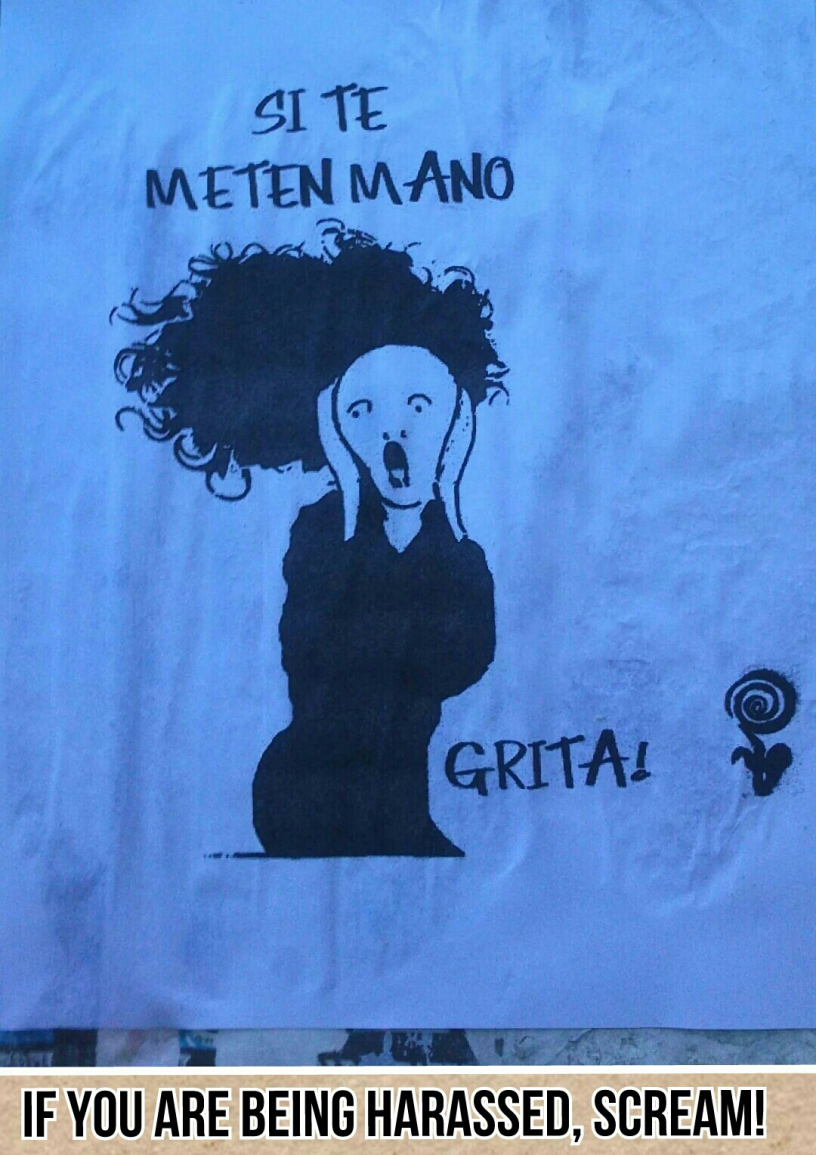
“Agitadoras Sociales” on Facebook. By: “More Nada”

Escuché ese dicho meses atrás, de parte de una compañera de universidad. Quisiera decir que le discutí esa afirmación, que le demostré argumentos que mostraran el craso error en el que ella se encontraba, pero no lo hice. La frase me dejó sorprendida. Esa frase me mostró cómo el acoso callejero está tan inmerso en nuestra vida cotidiana que ya lo encontramos usual. Algo “inevitable” de todos los días. Y quizá por encontrarlo tan común, es que en Bolivia poco se habla de este problema.

¿Desde cuándo el acoso callejero comenzó a formar parte de aquello que las personas consideran “común”? o peor aún, ¿desde cuándo las mujeres se han acostumbrado a esto?

Sé que no son todas las que consideran normal caminar por la calle y recibir silbidos o miradas lascivas. He presenciado con gran admiración a mujeres que no se quedaron calladas ante tal acoso. Aquellas mujeres son las que han dicho “basta” a esta situación y dejaron de sentirse culpables por algo que ellas no provocaban.

Escribir acerca de esto es fácil, pero vivirlo no lo es. Para decir “basta”, una mujer ha tenido que pasar por un largo proceso para entender que no es su culpa. Que no es culpa de la falda corta que usa, que no es culpa de su cuerpo, que no es culpa de su manera de caminar. Ha tenido que soportar durante años silbidos, frases sexuales, comentarios denigrantes e incluso manoseos de parte de hombres que no entendían que el cuerpo de esa mujer no era de su propiedad. Ha tenido que dejarse de ver como la causante del problema, para entender al fin que ella es la única víctima.

Todo esto no significa que una vez que la mujer se da cuenta de aquello, los hombres comenzarán a respetarla en la calle. Nunca sucede así. Es más, a veces, recién comienza  a llegar lo peor. Porque cuando una mujer responde a un silbido, a un comentario, o hace algo al respecto; el hombre lo toma como un chiste, o se siente amenazado en su “derecho” de dirigirse de esa manera a una mujer, e intensifica su agresión.

Y lo admirable de todo esto, es que estas mujeres no se rinden. Ellas saben muy bien que no son las culpables. Ellas reclaman el derecho de circular libremente por las calles sin ningún tipo de comentario acerca de su cuerpo.  Estas mujeres tienen fuego en los ojos y no permiten que nadie las denigre. Ellas entienden que aún falta mucho camino por recorrer para que hombres y mujeres comprendan el porqué de su lucha. Una lucha con una premisa tan simple pero demoledora: “El cuerpo que tengo, es mío”. Y yo, como mujer que ha sufrido este tipo de acoso durante bastante tiempo, me uno a la lucha. Porque, aunque parezca increíble, muchos hombres todavía no se dan cuenta de que cuando una mujer sale a las calles, no es para entretenerlo. No se dan cuenta de que ellos no tienen ningún derecho sobre nuestro cuerpo, no pueden denigrarlo, insultarlo, comentarlo ni tocarlo sin nuestro permiso. Nosotras tenemos el derecho de vestirnos como queramos, de sentirnos atractivas sin que eso sea motivo de acoso.

Y, con respecto a la frase “Si no te silba un albañil, quiere decir que eres fea”; en caso de que no me silbe, no me sentiré “fea”. Me sentiré libre; libre de circular por las calles sin miedo a nada. Porque en esa situación, podré ver que nuestra lucha, está dando resultado.

Andrea is in her second year of university, studying Social Communication. You can follow her on Twitter: @AndreaFlores116


Bolivia: “If a construction worker does not cat-call you, you are ugly”

I heard that expression months ago from a college classmate. I would like to say that I discussed her affirmation, I showed her some arguments that could let her know that she was mistaken, but I did not do anything. That phrase really surprised me. That expression demonstrates to me how greatly street harassment is immersed in our daily life. It was so “usual”, something almost “inevitable”. And maybe because of that thought, in Bolivia people do not talk too much of this issue.

Since when did street harassment form part of what we consider “normal”? Or worse, since when did women consider “normal” to be street harassment?

I know that not all women find it “usual” to walk down the street being cat-called. I have seen women that were not silent by street harassment. Those women are who have said “enough” to that situation and they stopped feeling guilty about something they did not provoke.

Writing about this issue is easy, but living it is not. To say “enough”, a woman has had to go through a long process to understand that is not her fault. That it is not the fault of the short skirt that she is wearing, that it is not the fault of her body, and that it is not the fault of the way she walks. A woman who has had to endure years of cat-calls, sexual phrases, and even degrading comments from men who did not understand that the body of the woman was not his property. She has had to leave, watching herself as the cause of the problem, to understand that she was only the victim.

This does not mean that once a woman realizes this that the man begins to respect her on the street. It never happens like that. Moreover, sometimes, it just gets worse. Because when a woman responds to cat-calls, comments, or does something about it; the man takes it as a joke, or he feels threatened in his “right” to treat a woman that way, and he intensifies his harassment.

And what is admirable in all of this, is that these women do not surrender. They know very well that they are not guilty of this situation. They claim the right to move freely in the streets without any comment about their body. These women have fire in their eyes and they do not let anybody denigrate them. They know that there is still a long way to go before men and women understand why they fight. A fight with a premise so simple but devastating: “The body that I have is mine”.

And I, as a woman who has suffered such harassment for quite some time, I join the fight. Because, incredibly, many men still do not realize that when a woman goes out to the streets, it is not to entertain them. They do not realize that they have no right on our bodies, and they cannot denigrate, cat-call, nor touch us without our permission. We have the right to dress like we want, to feel attractive without that causing street harassment.

And with regard to the phrase “If a construction worker does not cat-call you, you are ugly”, I say that if he does not cat-call me, I will not feel “ugly”. I will feel free. Free to walk on the streets without the fear of being harassed. And I will see, in that moment, that our fight, is working.

Andrea is in her second year of university, studying Social Communication. You can follow her on Twitter: @AndreaFlores116

Share

Filed Under: correspondents, Stories, street harassment

USA: An inside look at the forthcoming documentary “The People’s Girls”

September 24, 2014 By Correspondent

Sarah Colomé , IL, USA, SSH Blog Correspondent

The Student Nonviolent (National) Coordinating Committee’s vital work during the American Civil Rights Movement of the 1960’s, Chicago’s “We Charge Genocide” Delegation bringing issues of police violence before the United Nations in the 1950s, and the recent developments in attention to sexual assault on college campuses: Youth-led activism, advocacy, and community-building is deeply engrained in the success of several of the globe’s most well-recognized social movements, in addition to many of the less visible ones.

Globally, youth are taking active steps to challenge inequality, to create the preferred world that they will someday leave behind. In Cairo, Egypt, 26-year-old Tinne Van Loon and 22-year-old Colette Guhnim are doing just that, taking strides to bring sexual harassment to the forefront, not just as an issue among Arabs or within the boundaries of Egypt, but among all nations and communities. I was lucky enough to speak with Van Loon last week about the focus, standing, and long-term goals for the team, and their forthcoming project.

Titled The People’s Girls, Van Loon and Guhnim’s upcoming documentary focuses on the realities of street harassment, and society’s apprehensive in combatting it: “Two women battle the newest epidemic in Egypt, sexual harassment. Society stands in their way. Will they succeed?”

The recently released teaser for the film gives a glimpse of what these two filmmakers hope will be soon screened across film festivals after the documentary’s anticipated release in January 2015. Guhnim outlined the focus of the documentary, explaining how the film will document three different people with varying views of, and interactions with, street harassment: Esraa, a 25-year-old Egyptian woman and activist “who challenges social norms by performing in storytelling theater pieces about sexual harassment,” Abdullah, a 28-year-old tuk tuk driver from a working class neighborhood, and a to-be-determined third participant, who the filmmakers hope will be an Egyptian lawyer working at a women’s rights organization focusing on sexual harassment. “We really need to let the women speak for themselves,” Van Loon told me.

Highlighting the power of personal narratives, Van Loon explained, “Storytelling is important to bring issues to light, and makes people care and change their mind… statistics aren’t human.” The bravery of women who walk daily through threat of harassment and assault, is only mirrored by that of the filmmakers, shining light on such a devastatingly common global struggle.

According to the recent Study on Ways and Methods to Eliminate Sexual Harassment in Egypt, sponsored by the UN Entity for Gender Equality and the Empowerment of Women, 99.3% of Egyptian women report having experienced sexual harassment, with 49.2% reporting they experience harassment on a daily basis. The People’s Girls, puts human faces on these statistics, capitalizing on Van Loon’s observation that since the 2011 revolution, “less people are denying [the frequency] of sexual harassment… activism around street harassment in Cairo is huge.”

Esraa, one of the film’s main characters, highlights her own experiences in one of her interviews, as recounted on The People’s Girls’ Facebook page:

“I got harassed since I was 6 years old. One of my relatives who was older than me by 10 years did it. He told me “let’s play a game”. I was shivering, and I refused to play. At this age I wasn’t aware of what the hell that was, but I discovered when I met him 10 years later, that while I thought that I had forgotten the story, time said no.”

While openly recognizing the problematic frequency in which women experience harassment in Egypt, the filmmakers firmly assert that the film is not meant to perpetuate a negative, or stereotypical framework of the country, or its people. “Everywhere we’ve been in the world, the United States, Latin America, Europe, South Asia, we’ve experienced various levels of sexual harassment,” said Guhnim. “This is a problem of a patriarchal society, which is unfortunately worldwide. We’ve gotten a lot of hateful comments towards Arabs and Egypt and we really want to point out that not all men are like this.”

Furthering this point, while speaking last week Vin Loon passionately stated, there is “no other place in the world I’d rather live even though Street Harassment is such an epidemic.”

Speaking specifically on what she views as the root cause of harassment, Vin Loon explained the need to shift the prevention narrative, taking issue with an approach focusing on “don’t harass this woman because there’s a man attached to her, rather than don’t harass this woman because she’s a human being.”

Breaking down concepts of patriarchy and possession, the film encapsulates the dangers of gender norms and gender roles. One interviewee in particular encroaches on this topic in the teaser stating, “I wish every father and every mother would stop saying ’you are a boy, you are a girl, you are a boy, you are a girl’ because the main problem in my opinion starts from these two sentences. “

The filmmakers hope to use the film as an advocacy tool, focusing on collaboration and highlighting the work already happening on the ground. Recognizing the global effectiveness of youth-led activism, I asked Van Loon if she noticed a similar leadership pattern in Egypt. “The activism around sexual harassment is huge in Cairo, especially since the revolution… It’s really more mainstream,” she explained, citing that while being “youth-led,” in Egypt, the term youth regularly includes people up to the age of 30 years old. “And it’s really something that we also want to show in our film, and that’s kind of the reason we wanted a global audience for the film.  To show these active groups in other countries, the creative ways that Egyptians are dealing with this issue because I really think they are, very innovative…There’s over a dozen organizations working on this issue. We want to them a larger reach as well.”

The People’s Girls is anticipated to release in January 2015. If you would like to support the work of Vin Loone and Guhnim, please consider making a contribution to their Kickstarter campaign before October 4th. Solidarity starts with showing up, no matter what form that may take.

Sarah is a progress-focused educator and advocate dedicated to building strategic coalitions centered on creating social change who serves as an adjunct professor in DePaul University’s Peace, Justice and Conflict Studies department. You can follow her updates on Linkedin or hear her perspectives on Twitter.

Share

Filed Under: Activist Interviews, correspondents, street harassment

UK: The daily reality of street harassment in Jordan

September 24, 2014 By Correspondent

Siel Devos, London, England, SSH Blog Correspondent

Via The Global Post

I spent last year studying Arabic in Amman, Jordan. Overall it was an amazing and unforgettable experience, although there is always one thing I bring up when asked what living in the Middle East is like.

In Amman I was living only two blocks away from an all-boys secondary school. Just like all 12-14 year-old boys, these kids’ favourite after-school activity was spending their pocket money on candy and soda, holding a ‘who is the most macho of all’ contest and hanging around the local park. Unlike all 12-14 year-old boys, harassing girls and women was also part of their daily routine. When boys who have barely outgrown the cartoon-watching phase ask you if you would like some “good sex” and grope you in the middle of the day, you realise something is very wrong.

You could say there is a general lack of respect towards women in the Arab world, and not only foreign women: I’ve talked to Jordanian women who experience harassment on a daily basis. The argument that is still put forward by men to justify harassment in a way – “most women bring it on themselves by the way they are dressed” – doesn’t really apply here. Almost all Jordanian women wear a variety on the headscarf, ranging from a hijab in fashionable colours to the black niqaab that only leaves the eyes uncovered. If this way of dressing is still considered as asking for harassment, what isn’t? Should women just never leave their houses anymore out of fear of getting shouted at or catcalled?

I caught myself postponing errands because I wanted to avoid leaving my apartment around the time school finished. I took a different route to the supermarket because I glimpsed boys hanging around the street I usually go down. I realized I had changed my behaviour because of men – no, boys – and that there was pretty much nothing I could do about it.

Getting harassed on the street always puts you in such a vulnerable position – react and you might get an even worse response, ignore and they just go on to harass the next person to come along. Now imagine getting shouted at in a language that you don’t completely master (although the tone doesn’t leave too much to the imagination) and trying to defend yourself. Because you don’t want to be the white girl who yelled out insults in Arabic (if I knew any) or any other language on the street, the only other option is to let it pass and make them think this is acceptable behaviour?

A recent survey conducted by 4Youth Magazine in Jordan of 3000 youth ages 18-25 found that 53% felt a lack of education about harassment was the main cause of it, while 20% believed Jordanian customs and traditions cause it.

For these teenagers who harassed me, harassment might only be a way to act cool around their friends, but what if they never outgrow this phase? We need to teach children about basic respect towards women in school. With one step at the time, we can try to create a gender-equal society. Inshallah…

Siel is a master’s student in Middle Eastern studies with a major in contemporary Islam at SOAS University in London. Find her on twitter and instagram under @mademoisielle.

Share

Filed Under: correspondents, Stories, street harassment

USA: Harassment Up in the Air

September 22, 2014 By Correspondent

Khiara Ortiz, NY, USA, SSH Blog Correspondent

Sexual harassment isn’t something that only happens on the streets of our dear planet Earth. In a recent article on Mashable, Heather Poole, a flight attendant “for a major U.S. carrier” wrote about her experience with an “unruly passenger” when, eighteen years ago, he pinched her “you-know-what” not once, but twice, while she was working.

“I didn’t know what to do,” she writes, “so I nervously laughed and ran to the galley where I would’ve cursed him out – if he hadn’t followed me there. That’s when he did it again. Right in front of my crew.”

Having just started her career as a flight attendant, she didn’t report the incident because she didn’t know who to complain to. This is one of the major issues with sexual harassment, even when it’s happening at an altitude of 35,000 miles. Women don’t know who to turn to, who will listen to them, or who will care.

“I figured it was the sort of thing that came with the job of being a flight attendant,” Poole continues. “I knew the airline wouldn’t want to be inconvenienced by a call to law enforcement over a nonviolent, though unruly, passenger. Especially since the only person offended was me, an employee.”

Poole also cites that though companies in the U.S. have laws that protect their employees against this type of treatment, sexual harassment is just one of those practices that seem to slide by, not unnoticed, but simply uncared for.

“These young girls [the ones most frequently hired by airlines] are just too afraid to say anything for fear of losing their job,” Poole says, quoting a flight attendant who reached out to her after Poole became vocal about her sexual harassment experience.

Perhaps that is the exact reason why sexual harassment in the workplace still happens. The men who exhibit inappropriate behavior are aware of the vulnerable position that women are in because they are only supposed to be doing their jobs and nothing else. If they are harassed, they cannot act out or fight back against the harasser because it would violate the guidelines of their jobs. The men see those women not as humans, but just as employees and therefore below them, the men, in the hierarchy of humanity (though something like that shouldn’t even exist in the first place).

Flight attendants, like other female-dominated service industries like retail and waitressing experience a lot of harassment from “customers.” Earlier this year in February, the Hong Kong-based Equal Opportunities Commission (EOC) announced that in a survey of 392 flight attendants between November 2013 and January 2014, 27% reported being sexually harassed while on-duty in-flight in the last twelve months. Of the survey participants, 86% were female and 14% were male.

So what would it take to end this type of sexual harassment? Poole cites that some airlines, mostly foreign carriers, uphold practices that make it more difficult for women to receive equal treatment from their male customers while on the job. “There are Middle Eastern airlines that make flight attendants resign after they become pregnant or get married, an Asian carrier with only one size of uniform, and an Indian carrier who only hires females between the ages of 18 to 22. Males, on the other hand, can be older.”

Of course, harassment and groping on airplanes doesn’t just happen to flight attendants, it can also happen to passengers by flight attendants, other passengers, and even air marshalls. No matter the perpetrator or victim, each case of harassment should be taken seriously as an assault on a human’s right over his or her body.

Khiara is a recent graduate of New York University with a BAS in Journalism and Psychology who works as an assistant in the contracts department for Hachette Book Group. She is also the co-social media manager for Stop Street Harassment. 

Share

Filed Under: correspondents, News stories, public harassment

USA: On the Road to End Street Harassment

September 19, 2014 By Correspondent

Katie Bowers, NY, USA, SSH Blog Correspondent

Veronica, from Mexico City. “Who gave you the right to bother me?”

Tatyana Fazlalizadeh, creator of the “Stop Telling Women to Smile” public art project, has taken her show on the road.  The campaign features piercing portraits and a quote from women who have shared their stories of street harassment with Fazlalizadeh.  Originally Fazlalizadeh pasted the posters on walls around her Brooklyn neighborhood, but after a successful Kickstarter, she has been traveling across the United States (and some of Mexico) to hear stories about how harassment changes with geography.

It was in New York City that I first thought about how transportation and geographic differences influence street harassment.  I was listening to a coworker describe an unexpected bit of culture shock she encountered when she left Los Angeles for New York.

“When I first got here I was like, ‘What is wrong with men in New York?  These men get in my face and harass me everyday.  That just doesn’t happen to me in California,” my coworker said.  “But then I realized I have to walk a lot more here.  In L.A., we drive everywhere.”

As we talked about what street harassment looks like in a city steeped in car culture versus one built around public transit, lightbulbs lit up as I thought about how harassment has changed with each city, suburb, and rural county that I have lived in.

In L.A., my coworker explained, someone might yell at you from their car, but often the person being harassed is also in a car. I’ve driven down multilane parkways and seen men make obscene gestures or shout degrading comments through closed car windows.  While still rude and uncomfortable, being in my car provides a sense of security and escape that isn’t there when I’ve been harassed on foot.

Growing up, in a small Upstate NY city, I knew in addition to harassing fellow motorists, drivers will also accost pedestrians.  When I am walking I hear a yelped “I’d hit that!” from a car passing by at 30 miles per hour, I roll my eyes.  When I hear about friends being slowly followed home by cars with tinted windows, I get worried.  When a taxi driver suggestively asks, “So, pretty lady, are you married?” I clutch the door handle and grip my phone.  Looking at these scenarios, it is easy to recognize how transportation can deepen the power divide between harasser and harassed.

Perhaps nowhere is this difference more impactful than on public transportation.  Some of the worst harassment that I have experienced has happened on the subway.  Unlike pedestrians, drivers, or cyclists, public transportation riders have no real control of how quickly they can escape an uncomfortable situation.  If you hop on the express train from 59th St, it doesn’t matter if your harasser is leering, commenting, groping or even masturbating – you’re stuck with them for the entire length of Central Park.

As more research is created around sexual harassment, programs and laws are slowly being created to address unique needs in different parts of the country.  Collective Action for Space Spaces launched a strong public awareness campaign in the Washington, D.C. subway system, L.A. has adopted an anti-harassment law for cyclists, and activists in Lancaster, PA have erected anti-harassment billboards near roadways.  This, Fazlalizadeh says, is exactly how it should be.

“It’s important for me,” she says on her Kickstarter page, “to learn about these differences and create work that will resonate better within a particular community.”  Step by step, mile by mile, Fazlalizadeh is shining new light on the age old problem of street harassment – and in some communities, it looks like things are finally starting to change.

Katie is a social worker and community educator interested in ending gender-based violence, working with youth to make the world a better place, and using pop culture as a tool for social change. Check out her writing at the Imagine Better Blog and geek out with her on Twitter, @CornishPixie9.

Share

Filed Under: correspondents, street harassment

« Previous Page
Next Page »

Share Your Story

Share your street harassment story for the blog. Donate Now

From the Blog

  • #MeToo 2024 Study Released Today
  • Join International Anti-Street Harassment Week 2022
  • Giving Tuesday – Fund the Hotline
  • Thank You – International Anti-Street Harassment Week 2021
  • Share Your Story – Safecity and Catcalls Collaboration

Buy the Book

  • Contact
  • Events
  • Join Us
  • Donate
  • Facebook
  • Instagram
  • Pinterest
  • Tumblr
  • Twitter
  • YouTube

Copyright © 2026 Stop Street Harassment · Website Design by Sarah Marie Lacy