• About Us
    • What Is Street Harassment?
    • Why Stopping Street Harassment Matters
    • Meet the Team
      • Board of Directors
      • Past Board Members
    • In The Media
  • Our Work
    • National Street Harassment Hotline
    • International Anti-Street Harassment Week
    • Blog Correspondents
      • Past SSH Correspondents
    • Safe Public Spaces Mentoring Program
    • Publications
    • National Studies
    • Campaigns against Companies
    • Washington, D.C. Activism
  • Our Books
  • Donate
  • Store

Stop Street Harassment

Making Public Spaces Safe and Welcoming

  • Facebook
  • Instagram
  • Pinterest
  • Tumblr
  • Twitter
  • YouTube
  • Home
  • Blog
    • Harassment Stories
    • Blog Correspondents
    • Street Respect Stories
  • Help & Advice
    • National Street Harassment Hotline
    • Dealing With Harassers
      • Assertive Responses
      • Reporting Harassers
      • Bystander Responses
      • Creative Responses
    • What to Do Before or After Harassment
    • Street Harassment and the Law
  • Resources
    • Definitions
    • Statistics
    • Articles & Books
    • Anti-Harassment Groups & Campaigns
    • Male Allies
      • Educating Boys & Men
      • How to Talk to Women
      • Bystander Tips
    • Video Clips
    • Images & Flyers
  • Take Community Action
  • Contact

Canada: Street Harassment in Ontario A Century Ago

October 18, 2013 By Correspondent

By: Lisane Thirsk, Ottawa, Canada, SSH Correspondent
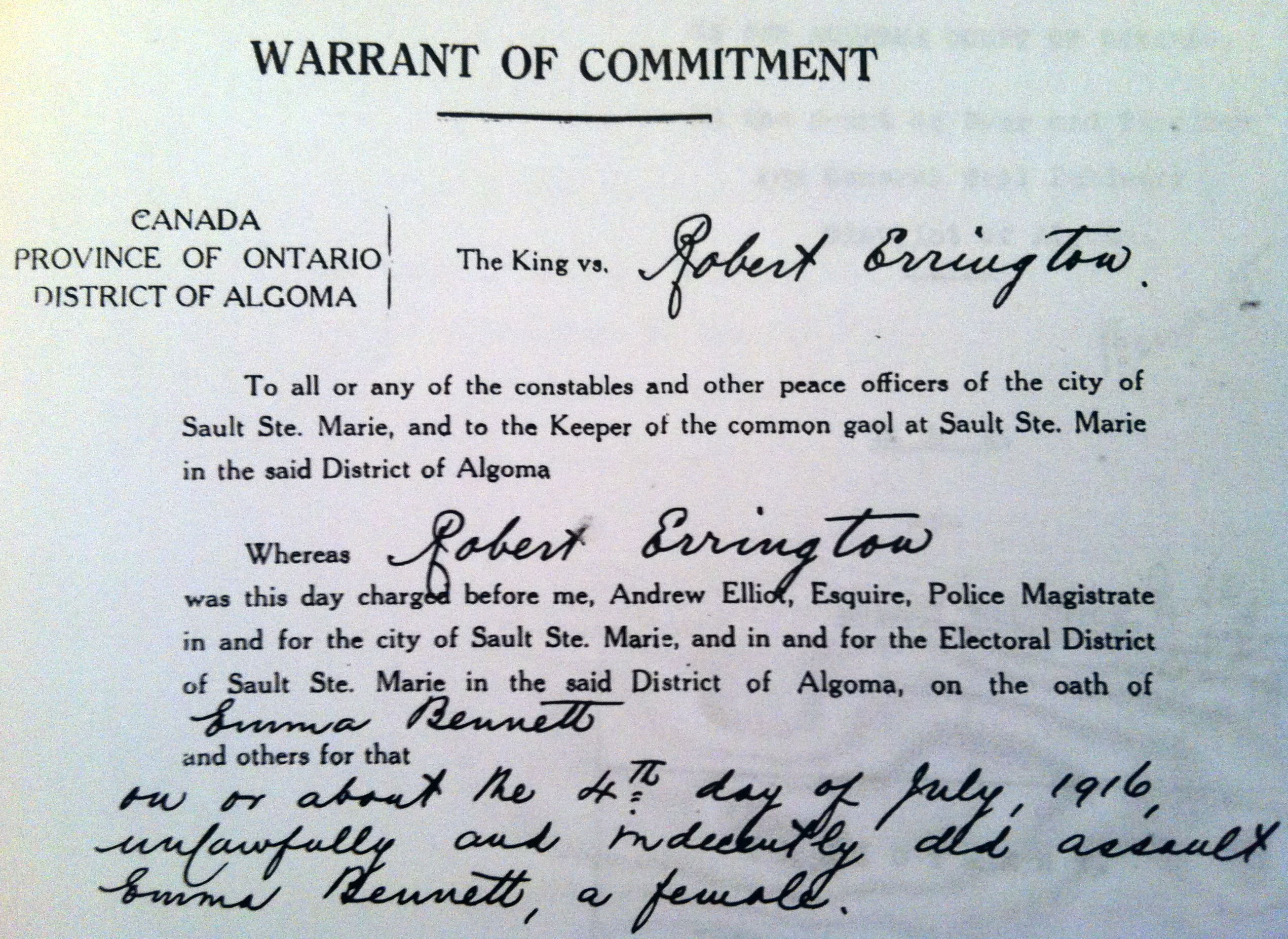
Criminal Assize Indictment, Algoma District, 1916. Available at the Archives of Ontario.

After reading SSH blog posts earlier this month about the history of street harassment in the U.S. (book review, author interview, and 100 years of activism), I was inspired to dig up some research I did a couple years ago for my master’s degree. For one assignment I went to the Archives of Ontario and uncovered criminal case files about street harassment around the turn of the 20th century.

According to historians, this period was characterized by “moral panic” in Canada. Social anxiety surrounded immigration, urban growth, and women’s shifting roles in public life.

My search at the Archives was guided by Karen Dubinsky’s Improper Advances: Rape and Heterosexual Conflict in Ontario, 1880-1929. I recommend this book to anyone interested in the history of street harassment – particularly Chapter Two on “The Social and Spatial Settings of Sexual Violence” in rural and northern areas of the province.

The legal records cited in Dubinsky’s book, as well as those I examined on microfilm reels at the Archives, provide vast documentation of sexual violence committed by strangers outdoors.

In rural communities, rape and sexual assault were often reported by women who had been attacked while walking through isolated farm fields. On small-town roads, women more often reported offences such as being chased, insulted or grabbed.

Just like in the U.S., street harassment was known as “mashing” at that time, and it was viewed as undesirable behaviour. The records show that these assaults didn’t just occur at night or when women were walking alone.

Panic emerged in numerous communities in Ontario. Mashers were stereotypically imagined as strangers in berry patches, tramps from Montreal, taxi drivers, and Indigenous men.

One of the most infamous predatory figures was known as Jack the Hugger, the nickname of a serial sexual assaulter (or more likely, several assaulters) appearing in the records from 1894 to 1916.

When confronted by a street masher, women were quite often assertive and resourceful. They defended their right to the street with defiant words, an umbrella, or by slapping the perpetrator.

Meanwhile, the prevalence of street harassment led commentators, including judges, to call for harsher punishment in the name of women’s freedom of mobility. And it was not uncommon for women – at least those who show up in the archives as “respectable” – to successfully pursue justice through legal avenues.

In her book Dubinsky reveals that the willingness of authorities to hold mashers accountable was due in part to the growth of the labour movement in Ontario.

As it became more acceptable for single women to migrate to towns and cities for jobs, scrutiny shifted to young lower-class men harassing female factory workers. Men’s public idleness and aggression were seen as threats to the values of self-control, restraint and productivity.

Below are the basic facts from one of the case files from Sault Ste. Marie that I examined at the Archives. It included statements from the complainants, the accused, and witnesses; and it illustrates some of Dubinsky’s conclusions about mashing in early 20th century Ontario.

* Around 7:30 a.m. in July 1916, Robert E. began following Emma B., a young woman who lived at a boarding house and was on her way to work at a tailor’s shop. Emma had been alerted to the Jack-the-Hugger stories circulating in her community, so she turned onto a busier street. Robert caught up to her, grabbed her hip, and said, “You would make good fucking.” He ran away, but Emma caught up to him and told him to keep his hands off her and to mind his own business.

* A few days later, Robert assaulted Louise P. around 5:15 in the evening. In her deposition Louise reported, “a young man caught hold of me by the bre[a]st … He turned around and put his hands down the front of his pants … I asked him what the devil he meant, and I started to follow him up, and then he ran.”

* In September 1916, Robert was charged with two counts of Indecent Assault on a Female. His defence focused on him having been steadily employed at the Steel Plant.

When we look back on the history of sexual violence, we tend to assume one of two things.

We either believe that in “the good old days” women were more respected in public and harassment wasn’t as explicit. Emma and Louise’s stories, along with many others I encountered at the Archives of Ontario, would suggest otherwise.

Or else we believe that as a society we’ve come a long way from the prejudiced thinking of the past. By reading between the lines in documents like Robert E.’s indictment, Dubinsky shows that it wasn’t always women’s wellbeing or principles of social equality that guided the prosecution of street harassers.

If we look carefully at today’s responses to street harassment – legal or otherwise – we might find many of these same patterns playing out.

Lisane works in the non-profit communications sector and supports local anti-street harassment advocacy through Hollaback! Ottawa. In 2012, she completed a Master’s in Socio-Legal Studies at York University in Toronto, where she wrote her Major Research Paper on gender-based street harassment. She holds a B.A. in Latin American Studies and Spanish from the University of British Columbia.

Share

Filed Under: correspondents, SH History, Stories, street harassment

USA: Street Harassment is Everywhere, but so are the People Fighting It

October 16, 2013 By Correspondent

By Britnae Purdy, SSH Correspondent

Germany: International Anti-Street Harassment Week 2013

Last summer I had the opportunity to study-abroad through a month-long tour of five European capital cities. It was amazing experience, it changed my life, but blah blah blah – that’s not the point of this story. The point is that I can’t think about street harassment now without remembering one distinct night in Berlin.

Our group was on the rail system coming back from a concert. At the next stop, a few young men got on. They had clearly been drinking already that night, and were shouting, pushing each other around, roughhousing –taking up as much space in the car as they could with their overt shows of “masculinity” and being a general nuisance to the rest of the riders. They proceeded to quite obviously make remarks about the women in my school group. It was one of the few times in my life I’ve actually been grateful not to speak the local language, because judging from the uncomfortable looks of other passengers, they were being quite crude. I pulled an old trick – I “borrowed” one of my guy friends, hanging close on his arm to give the illusion that we were together to try and avoid being a target of the harassment. A couple of stops later the guys disembarked and we all breathed a sigh of relief that the uncomfortable situation was over.

Back at the hotel, a few of the girls in our group made plans to go out on the town and enjoy the Berlin nightlife. I opted to stay at the hotel with some friends instead to catch up on the required readings (nerd alert). As they left, one of the remaining boys made the remark, “I can’t believe they still want to go out, after witnessing that display of what men are like here.”

I was angry before I fully knew why, and replied sharply without thinking, “That’s ridiculous. There are guys like that everywhere.”

Thinking back, I’m not sure what made me more angry – the idea that that particular male could have been so oblivious to the fact that women are harassed on every metro system in the world, or the fact that he thought that the girls should change their plans based on that one encounter.

Women walk a fine line between staying safe and not letting fear dictate their actions. When I want to walk downtown on a weekend night in the summer, I find myself weighing how much I want to wear my cute new skirt against how much I don’t want to get harassed on the street – and then immediately hate myself and the world around me for that even being a matter I have to consider. What’s most worrisome is that, in my personal experience, I find that I sometimes internalize society’s horrid habit of victim-blaming – well, I chastise myself, as the perpetrator roars off in his car, obscenities still dripping from his tongue, blissfully free from repercussion – it is a Friday night. I am wearing heels. It is a dimly lit street. What did I expect?

When I repeat those things to myself, I realize that it’s a weak coping mechanism – if I can identify some “mistake” that I made, I can vow not to let it happen again. It lets me forget for a moment that I’m terrifyingly lacking in power to control how my own body is treated in public.

Of course, those self-chastisements do nothing to explain why I’ve also been harassed on a Wednesday, wearing flip-flops, in broad daylight.

Translating this across the sexes, perhaps a male – such as the one in my group who muttered that off-hand remark – feels that if he can blame street harassment on the actions of some drunken fellows and women who “should have known better,” he can excuse his own complacency in the harassment. He can remain comfortable identifying as a “good guy,” who only has “good guy” friends – he doesn’t street harass, and so in his mind, he need not play a role in stopping street harassment.

Perhaps some of my anger came from the truth in my own anger – yes, there are guys like that everywhere, just like there are men (and women) who deny that street harassment is a problem everywhere.

However, I refuse to believe that they outnumber the decent men and self-respecting women who are also, in fact, everywhere.

Britnae is a graduate student at George Mason University, in Virginia, where she is pursuing a Master of Arts in Global Affairs with a specialization in Security and Conflict Studies. She also writes for First Peoples Worldwide and you can read more of her writing on their blog and follow her on Twitter.

Share

Filed Under: correspondents, Stories, street harassment

USA: Anti-Flirt Club and Hassle-Free Zones, 100 Years of Activism

October 1, 2013 By Correspondent

By Lauren McEwen, Washington, D.C., USA, SSH Correspondent

A while back, I read an interesting post by a male ally about street harassment in which he attempted to explain to other cis men why gendered harassment in public spaces is not OK. It basically amounted to him saying, “Hey, I know it’s hard to understand that some of the social norms we were spoon-fed as kids isn’t OK, but it’s the 21st century, and we now officially know that street harassment is unacceptable.”

While I appreciate all positive support for something I believe in, here’s the thing: the anti-street harassment movement is not a new phenomenon. It can be argued that street harassment has been a problem since women began moving through public spaces on their own. There have been studies conducted, books written and protests waved to fight against street harassment for generations.

Today’s anti-street harassment movement has something that all of the other efforts did not – the power of the Internet. Each day, I come across about three to five stories about street harassment. I see tweets from people affected by it venting and comforting each other, in turn. The saturation of news and opinions and anecdotes about street harassment all over the web can make it seem like street harassment has been tolerable up until this new generation of overly sensitive, politically correct kids came of age, but it’s not.

This post is about times in the past 100 years when street harassment was both documented and fought.

Early 1900s: Mashing

Street harassment was called “mashing” in the early 1900s, and some women decided to take matters in their own hands, stabbing mashers with their hatpins, and punching or hitting harassers across the face with their handbags. They also reported harassment to the police and in some cases, were successful in getting the masher arrested.

While it’s not advisable to get into physical altercations with street harassers, these accounts prove that there was not a time when street harassment was universally viewed as a “compliment.” It was threatening enough in the 1930s for these women to attack their harassers, and one can only assume that the actual words and actions that present-day street harassers employ are can be even more vulgar than those used by their predecessors.

[Editor’s Note: Stanford professor Estelle Freedman’s new book Redefining Rape includes a chapter about mashers/street harassers from the 1880s to 1920s.]

1920s: The Anti-Flirt Club

In the 1920s, a group of D.C. women formed the Anti-Flirt Club and held the first and only Anti-Flirt Week. During World War I, it became common practice for men to offer female pedestrians rides when they saw them walking down the street as part of their civic duty. But soon, those offered rides became tainted by aggressive flirting on the part of the driver. Although the group’s secretary acknowledged that here were other “flirts” about, the drivers were the most worrisome.

The Atlantic reprinted excerpts from a 1920s Washington Post article that detailed the rules of the Anti-Flirt Club, and although some of the advice seems sound enough, (“Don’t accept rides from flirting motorists—they don’t all invite you in to save you a walk.” “Don’t let elderly men with an eye to a flirtation pat you on the shoulder and take a fatherly interest in you. Those are usually the kind who want to forget they are fathers.”) some of the rules were tinged with slut-shaming (“Don’t flirt; those who flirt in haste oft repent in leisure.” “Don’t use your eyes for ogling—they were made for worthier purposes.”)

The trouble with the Anti-Flirt Club was that, once again, the onus for preventing “flirting” (or rather, street harassment) was once again placed on women. Don’t make eye contact. Don’t smile. But be sure to keep your options open, because you never know where your future husband may be hiding.

The Manhattan-based version of the Anti-Flirt Club was run by men, and placed the burden of ending street harassment on women in another, slightly less oppressive, way. They wanted “to educate public opinion to the point where a woman will consider it her duty to prosecute the masher who attempts to force his attentions upon her. The association intends to have its own counsel, who will aid in prosecuting all masher cases.” (More on “mashers” in a bit.)

According to The Atlantic, it isn’t clear what charges could have been drawn against these early 20th century street harassers, but interestingly, two politicians tried (and failed) to get anti-street harassment bills passed in 1897, and in 1931, the Chicago Tribune quoted the Acting Police Commissioner John Alock saying, “This street flirting has got to stop in Chicago. No longer may young men in automobiles edge over to the curb and honk their horns at pretty girls on the sidewalk. They must quit ogling women from loafing places in front of drug stores, cigar stores and other public hangouts.”

Eventually, the efforts seemed to fizzle – fewer articles were written about the anti-flirt movement – but police and politicians from generations ago at least appeared to take sexual harassment seriously. Seems like we have regressed quite a bit over the years.

1940s: “Hands Off! Self Defense for Women”

In 1942, a book by Major W.E. Fairbairn was published that sought to teach women “basic methods of attack and defense” in order to help them defend themselves should they be attacked. It served as a sort of wartime manual to teach readers some of the self-defense tactics Fairbairn picked up while serving with the Shanghai Municipal Police.

In the foreword, Fairbairn explained what motivated him to write the book. As more American women began to work outside of the home, taking the places of men who were away at war, they would be in new and unfamiliar situations, and should be able to defend themselves in case their safety was threatened.

1980s: The Hassle-Free Zone Campaign

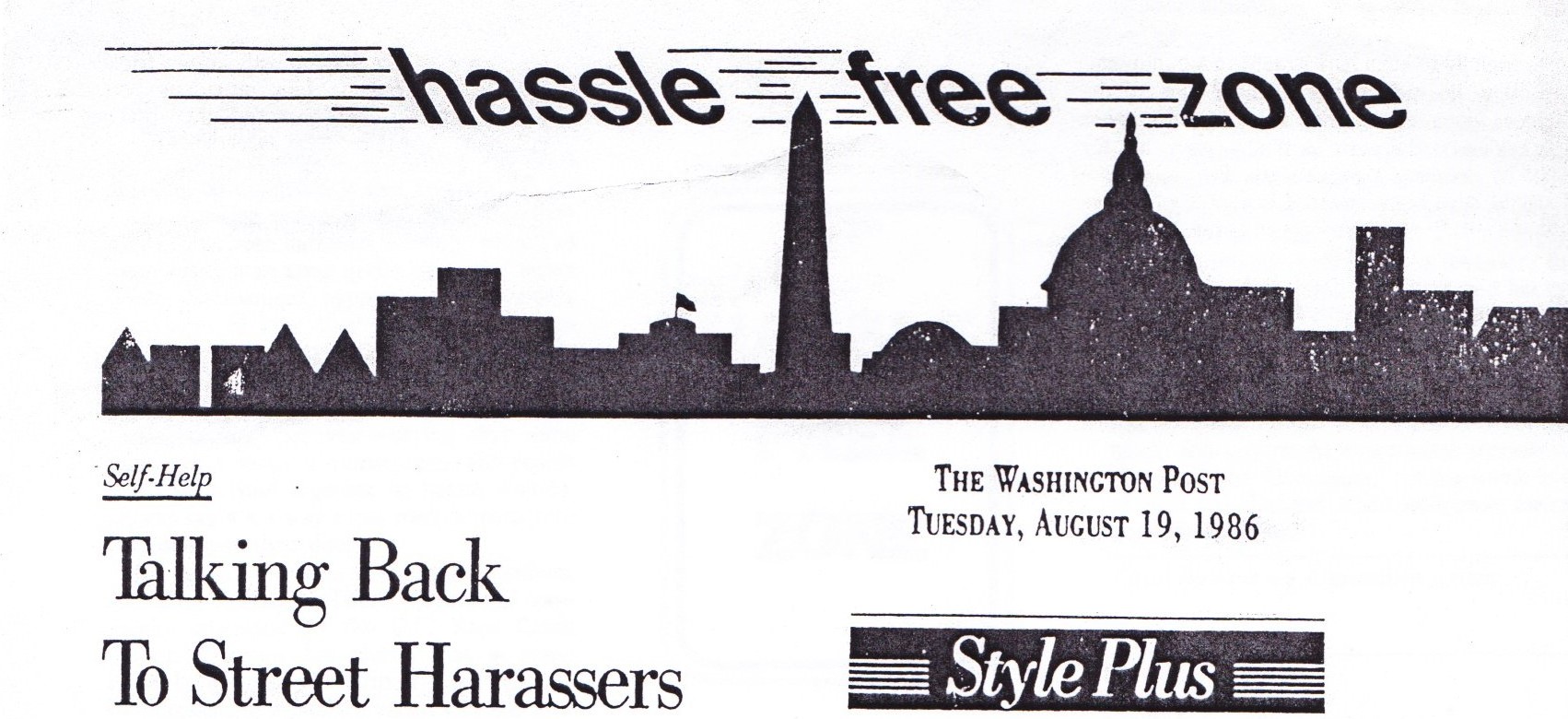
In 1985, several community organizations, including the D.C. Rape Crisis Center (the first rape crisis center in the U.S.), the D.C. Women’s Law Center and D.C. Men Against Sexual Violence teamed up to organize an effort to convert the District into a “hassle-free zone.”

Marty Langelan, the former president of the D.C. Rape Crisis Center and the author of Back Off: How to Confront and Stop Sexual Harassment and Harassers, detailed the 1985 campaign in her book and talked to me about it in an interview.

Posters and flyers were created by Linda Leaks and the African American Women’s Committee for Community Education, local law students researched ways to potentially prosecute harassers and self defense instructors from the D.C. Rape Crises Center taught women confrontation classes.

In September 1985, they focused on street harassment during the Take Back the Night March and the annual Anti-Rape Week program, and got then-Mayor Marion Barry to issue a proclamation asking that all Washingtonians strive to make the District a Hassle-Free Zone. A resolution supporting the campaign was passed by the City Council.

The following spring, the campaign hosted speakouts in street harassment hotspots, like parks and Metro Stations, after work and during lunchtime, when there would be more people on the street. There were skits, speeches and “open mike sessions to give women a chance to sound off about their harassment experiences.” They held their final public speakout during October 1986.

It’s hard to say if it is inspiring or disheartening to realize that groups have been fighting to end street harassment for generations. It does, however, serve as a reminder that we are not battling a non-issue, but something that has hindered the happiness and safety of people for longer than we would like to imagine.

Lauren is a recent graduate of Howard University where she majored in print journalism with a minor in photography. You can check out more of her work at laurenmcewen.weebly.com and follow her on Twitter at @angrywritergirl.
Share

Filed Under: correspondents, SH History, street harassment

South Africa: Harassment of Women within Political and Activist Movements

October 1, 2013 By Correspondent

By: Gcobani Qambela, South Africa, SSH Correspondent

**Trigger Warning**

A few days ago, I was shocked when I woke up to a tweet from a colleague who works in youth activist circles with me. In the tweet he said: “Activism without facts is like winking at a girl in the dark. No one knows you’re doing it #Factivism”. I was shocked that he would tweet this because he is a man working in youth activist circles that seek to especially advance women and especially young girls from the harmful ravages of patriarchy in Africa.

I was thus surprised that someone working in these spaces that promote not only gender parity in Africa, but also seeks to create an open African society where young women do not have to contend with harassment from men winking at them whether in the dark or public sphere without express permission to do so.

A few days after, I would encounter the same misogynistic type of tweet being retweeted into my timeline by someone who is a member of the new controversial political party, Economic Freedom Fighters (EFF) in South Africa. The young man who was retweeted, Khaya Caluza, maintains close links to the African National Congress (ANC), the governing political party in South Africa. In the tweet Caluza, using violently patriarchal languages, relegates women back to being alive only to look after and please men sexually.

These might appear to be isolated incidents, but misogyny and harassment of women (and sometimes LGBTIQ people) in heteronormative activist and political circles in South Africa, and Africa more broadly is a serious problem. The tweets and retweets by these young activist young men reminded me that even in activists’ and political movements, where women are supposed to be united with men for a common purpose, women also often have to contend with the extra-burden of not only doing activist and political work, but also combating patriarchal, sexual and misogynist attitudes and harassment from some of their fellow men. These attitudes carried by these men that a woman’s place is in the kitchen doing the dishes, or that winking at women is cool, especially when it is seen by others, is worrying because it means these attitudes also infiltrate into the gender dynamics of the work that must be done.

In The Guardian’s “Top 10 sexist moments in politics” is included the case of South Africa’s Lindiwe Mazibuko who constantly receives sexist comments in the course of her political work. Earlier in the year for instance she was criticized at a budget debate by two ANC MP’s for her dress sense. Writing for the Mail and Guardian, Nomalanga Mkhize, Mathe Maema, Babalwa Magoqwana and Siphokazi Magadla note that while Lindiwe is famous because of her political position in (South Africa’s main opposition party) the Democratic Alliance, they note that “Mazibuko’s case is only the latest in a number of public incidents where women are dismissed on the basis of body, age and dress – that age old language of reminding women that even when we [as women] have our right to leadership, we are not truly to be taken seriously in the public sphere.”

The tweets by these young men remind me that while we must tackle the harassment that women experience in public and in the streets, we also need to devote attention to the harassment women activists and politicians are subjected to.

Political and activist spaces are supposed to be spaces where all of us in our different genders and sexualities are supposed to come together, be free and united in common purpose of carving a positive change in society. However, because of harmful heteropatriarchy in South Africa, many women find themselves fighting what South African researcher and gender activist, Rethabile Mashale, calls a “dual war” for women.

She tells me “the dual war is unrelenting, and what is further troubling is the extent to which not only men, but also women nowadays in South Africa have become complicit in perpetuating deep misogyny against women like Mazibuko and not recognising the interconnectedness of our struggles as women. It’s not only sad, but deeply worrying.” I couldn’t agree with Mashale more. I hope that as all men (and women) in the activist and political movements especially, that we will start examining and correcting the ways in which our internalised (patriarchal) attitudes and words are harmful against many of our fellow men, women and LGBTIQ family in the anti-patriarchy and anti-street harassment movement.

Gcobani is completing his Masters in Medical Anthropology through Rhodes University, Grahamstown, South Africa. His research centres around issues of risk, responsibility and vulnerability amongst Xhosa men (and women) in a rural town in South Africa living in the context of HIV/AIDS. Follow him on Twitter, @GcobaniQambela.

Share

Filed Under: correspondents, street harassment

USA:The Many Ugly Heads of Street Harassment

October 1, 2013 By Correspondent

By Nikoletta Gjoni, Maryland, USA, SSH Correspondent

My mom always says that the more choices someone is offered, the harder it is to decide—whatever that decision may be about. In a strange way, that could very well apply to street harassment as well. Just follow me for a minute here. The term street harassment sounds very straightforward and is obvious as to what it refers to. It doesn’t leave much room for interpretation as to what would be considered street harassment vs. what wouldn’t be. However in today’s day and age, it’s becoming grayer, trickier, and harder to confine the definition of street harassment and where and how it can be encountered.

In my first article, I wrote about the reasons for and ramifications of using technology in public in an effort to thwart harassment. I focused on the use of ear buds, cell phones, and laptops as a means to deter men from communicating with women, but a recent article featured in the New York Times made me consider how technology itself encourages harassment on the Internet that can or cannot manifest into harassment encountered on the street.

In “Victims Push Laws to End Online Revenge Posts,” new light is shed on the ever growing problem with “revenge porn”—sites that cater to vindictive exes, overwhelmingly male exes, who post nude photos of ex-girlfriends/ex-wives/ex-lovers, sometimes with phone numbers, home addresses, and employment addresses attached to them.

Aside from the very obvious fact that this is intrusive and formulaically vengeful, it can spark, and in fact already has sparked, a slew of problems for the women whose pictures are posted—loss of jobs, alienation from friends and/or family, and not least of all, exposure to stalkers.

Ms. Taschinger, the twenty-three-year-old profiled in the article whose ex-boyfriend shared a dozen or so nude photos of hers on the Internet, states that on many occasions upon coming home from work, she would spot a man sitting in a car outside of her house. She eventually quit her job at a restaurant. Others have also experienced getting approached and hassled in public spaces.

“Sometimes I want to get into a fetal position and cry,” says Taschinger.

The Women’s Center states that 1 in 20 women will be stalked in their lifetime; 79% of women know their stalkers, 50% of women have been in a relationship with the stalker, and 80% of those relationships were abusive.

While it’s important to note that yes, these women did willingly give their then boyfriends/husbands/lovers their photographs, it is immeasurably more important to recognize that they did not agree to having them shared with the Internet world, a fact that seems to fall through the cracks of empathy and land right into the gutter of blame.

While street harassment is recognized as an unwelcome sexual advance, either verbal or physical, that occurs in real life while out on the street, I start to wonder whether or not that could and should include the Internet. Through the use of cell phones, laptops, and tablets we are exposed to Facebook, Twitter, Tumblr, Instagram—blog sites, porn sites, private sites, and public sites—free sites and sites that charge.

For a lot of us, ‘real life’ weaves on and off the Internet and everything we post becomes a reflection of our every day lives. In a world so highly charged and high speed where the sense of privacy diminishes a little more with each new piece of technology that is unveiled and every new app that is downloaded, I wonder if street harassment can be stretched out to encompass and define the pixelated paths of every WWW site we may encounter, particularly when they in turn create the kind of street harassment we typically classify as such.

Someone who isn’t brave enough to holler on the street may take the route of anonymity the Internet oftentimes provides. Someone who feels jilted can take to the Internet to post private photos without the photographed knowing.

Choices. And though they always existed in the simple form of you can either be the person who harasses or you can be the person who doesn’t, it has now become more complicated than that. You can holler; you can click and share; you can click and forward; you can click and view. Who is guilty of harassing? Who is guilty of perpetuating, and is perpetuating on the Internet the same as perpetuating on the street?

And if not—well, why not?

Nikoletta Gjoni graduated from UMBC in 2009 with a B.A. in English Literature. After graduation, she did almost four years of freelance work in a D.C. broadcast station, in addition to having worked as a literacy and linguistics assessor for pre-k classrooms in D.C.’s charter schools.  To get to know her better, she can be tracked on both her creative blog and Twitter, @nikigjoni.

Share

Filed Under: correspondents, street harassment

« Previous Page
Next Page »

Share Your Story

Share your street harassment story for the blog. Donate Now

From the Blog

  • #MeToo 2024 Study Released Today
  • Join International Anti-Street Harassment Week 2022
  • Giving Tuesday – Fund the Hotline
  • Thank You – International Anti-Street Harassment Week 2021
  • Share Your Story – Safecity and Catcalls Collaboration

Buy the Book

  • Contact
  • Events
  • Join Us
  • Donate
  • Facebook
  • Instagram
  • Pinterest
  • Tumblr
  • Twitter
  • YouTube

Copyright © 2026 Stop Street Harassment · Website Design by Sarah Marie Lacy