• About Us
    • What Is Street Harassment?
    • Why Stopping Street Harassment Matters
    • Meet the Team
      • Board of Directors
      • Past Board Members
    • In The Media
  • Our Work
    • National Street Harassment Hotline
    • International Anti-Street Harassment Week
    • Blog Correspondents
      • Past SSH Correspondents
    • Safe Public Spaces Mentoring Program
    • Publications
    • National Studies
    • Campaigns against Companies
    • Washington, D.C. Activism
  • Our Books
  • Donate
  • Store

Stop Street Harassment

Making Public Spaces Safe and Welcoming

  • Facebook
  • Instagram
  • Pinterest
  • Tumblr
  • Twitter
  • YouTube
  • Home
  • Blog
    • Harassment Stories
    • Blog Correspondents
    • Street Respect Stories
  • Help & Advice
    • National Street Harassment Hotline
    • Dealing With Harassers
      • Assertive Responses
      • Reporting Harassers
      • Bystander Responses
      • Creative Responses
    • What to Do Before or After Harassment
    • Street Harassment and the Law
  • Resources
    • Definitions
    • Statistics
    • Articles & Books
    • Anti-Harassment Groups & Campaigns
    • Male Allies
      • Educating Boys & Men
      • How to Talk to Women
      • Bystander Tips
    • Video Clips
    • Images & Flyers
  • Take Community Action
  • Contact

USA: “Expectations of gender performance need to stop”

July 21, 2013 By Correspondent

“This is not an excuse for harassment”
Via http://fashionsco0p.blogspot.com

By: Molly Redding, San Francisco, CA, USA, SSH Correspondent

An experience I had the other day got me thinking about how much street harassment has to do with heteronormativity and the presentation of gender in public spaces.

It was Pride weekend and the streets around my apartment in San Francisco were filled with revelers coming to soak in the atmosphere of pure elation after the Defense of Marriage Act was killed and Proposition 8 – a California ballot initiative restricting marriage to one woman and one man – was overturned.

My roommate and I ventured out to get dinner, and as we were walking down the street a gentleman looked at both of us and called, “Hey, lesbi-ans!” Now, given that the Dyke parade had passed not 20 minutes earlier, his assumption wasn’t crazy, but it made me stop for a second, because it was the first time someone had assumed for me a sexuality that I didn’t claim.

For me, this happened once. For many people, this is a daily experience.

Heteronormativity (one of my favorite words, btw), is exactly what it sounds like – the assumption that everyone is heterosexual unless proven otherwise. Much of street harassment rests on this notion, since many (but certainly not all) street harassment incidences are men sexualizing women’s bodies or body parts. They assume the woman is heterosexual, and thus, available to interact with them under the guise of “courting.” That any of the harassers ever think their actions are going to actually win them a date is a whole other blog topic.

On the flip side, non-compliance with heteronormativity also begets street harassment, when the person walking down the street does not fit within the heteronormative framework. This is why there is a high incidence of street harassment aimed at the LGBQT community. Being in a public space and outside of what the harasser might consider “normal” allows them power to point out and ridicule those differences (this, of course, seems insane to many of us who at one point in our lives learned that differences are opportunities for learning, not ridiculing).

And finally, there’s the issue of performativity – the “performance” of one’s gender. A large focus of street harassment has to do with clothing – how much or how little a woman was wearing when she was harassed. Wearing too little clothing is considered a sexualization and “overperformance” of the female gender – and leaves the situation open to blaming the victim.

But “underperformance” of one’s gender can also leave a person vulnerable to harassment. Judith Butler outlines this in a video where she discusses a young boy who was killed by his classmates because of a certain “swish” in his walk (start around minute 4:30 until 6:45):

“So then we have to ask why would someone be killed for the way they walk? Why would that walk be so upsetting to those other boys that they feel they must negate this person, must expunge the trace of this person, they must stop that walk, no matter what . . . it seems to me that we are talking about an extremely deep panic or fear, an anxiety that pertains to gender norms.  If someone says you have to comply with the norms of masculinity otherwise you will die, or I kill you now because you do not comply, then we have to start to question what the relation is between complying with gender and coercion.”

Expectations of gender performance need to stop. Heternormative assumptions need to stop. Their outcome, street harassment, needs to stop.

Molly received a graduate degree in International Development and Gender from the London School of Economics in 2011, where her dissertation focused on websites allowing victims of harassment to post about their experiences. She has worked in the non-profit sector for over 10 years. You can follow her on Twitter, @perfeminist.

Share

Filed Under: correspondents, LGBTQ, street harassment

USA: Street Harassment by Older Men

July 19, 2013 By Correspondent

By Lauren McEwen, Washington, D.C., USA, SSH Correspondent

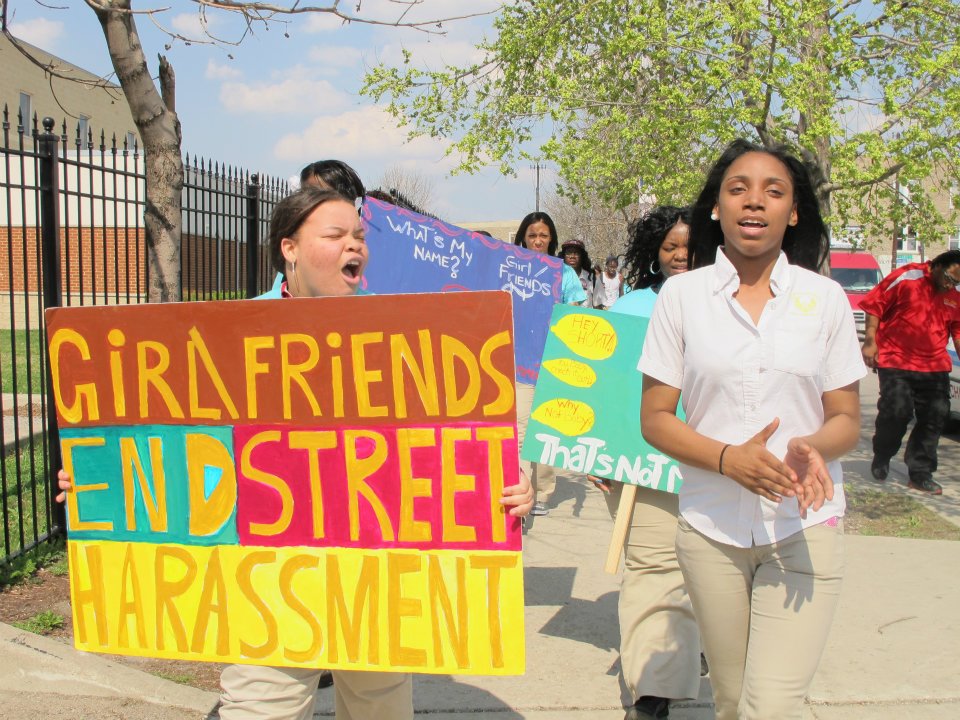
A Long Walk Home Girl\Friends in Chicago

If I always responded to street harassment with the same amount of energy I’d never arrive anywhere on time. So I have a go-to response for each “level” of street harassment: a grimace for a leer and a mild proposition (i.e. “Damn, baby. Can I walk with you?”), a raised middle finger for a honking horn, and so on.  Every once in a while, when I’m too tired to respond, I’ll just pointedly ignore the harasser. It’s not the most revolutionary tactic, but sometimes I just don’t have the energy. Or worse, it happens so quickly that I don’t have time to process what was just said or done to me, and spend hours afterward wishing I was physically capable of kicking myself.

But I can never ignore street harassment from elderly men. There’s something especially predatory and disconcerting about having a man old enough to be your grandfather ogle at your body or make sexual comments about it. Denying any street harasser’s advances could potentially lead to a verbal confrontation or put me in physical danger but when an elderly man harasses me, the playing field has morphed. I struggle to balance the need to defend myself with the engrained belief that I should always respect my elders. And I truly believe the grey-haired men who hang outside of the barbershop near my house know that I’ve been taught to respect them, and manipulate their assumed power every chance they get.

Or maybe they’ve spent so many years sexually harassing strange women without being called on it that they don’t realize that it’s wrong. Maybe they’re unaware that now that they’ve grown older, they’re behavior is no longer just “creepy,” but breeches unspoken agreements between the young and the old.

But is someone who is willing to sexually harass a stranger on the street still worthy of respect? I don’t think so. So I’ve taken to shouting back at a 70-something harasser just like I would one of my peers.

I’ve seen elderly men who make suggestive comments to women significantly younger than them get one of two reactions: either the woman will respond with an awkward smile and rush away in her discomfort, or she will act disgusted by his advances. I assume that the harassers tell themselves that the awkward smile meant she “appreciated” the “compliment.” The disgusted act means she’s ill-mannered and rude.

So I changed my approach. When I’m harassed by an elderly man, I tell them exactly how I feel. I look disappointed or angry and say, “How am I supposed to respect my elders when they don’t respect me?” It’s usually direct and pointed enough for my harasser to realize exactly what line was crossed. That I trusted him to behave a certain way because he was older than me, and that he ruined it. I don’t care if I’m an adult – I expect men my grandfather’s age to see me as a child. It may sound irrational, but if society teaches me that I should respect my elders, then shouldn’t they behave in a manner worth respecting?

Lauren is a recent graduate of Howard University where she majored in print journalism with a minor in photography. You can check out more of her work at laurenmcewen.weebly.com and follow her on Twitter at @angrywritergirl.

Share

Filed Under: correspondents, street harassment

USA: Unwanted and Unnoticed

July 18, 2013 By Correspondent

By Sara Schwartzkopf, Colorado, USA, SSH Correspondent

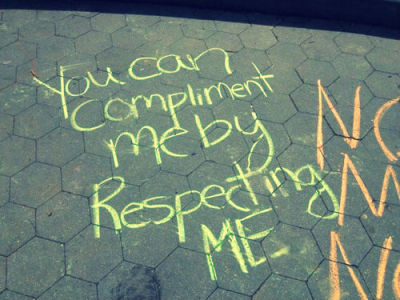
From “We Chalk Walk”

Like most women my age, I’ve experienced my fair share of street harassment. I remember the first time being when I was 14, as I was walking back to my school after lunch break. While I was waiting to cross the street, a man pulled up in a truck, rolled down the window and proceeded to make it perfectly clear that he was leering at my chest. He didn’t say a word, just gave me a suggestive eyebrow raise and a creepy smile before driving off. I remember shuddering, walking back into school and mentioning it to friends who seemed to think it a positive that an older man had “complimented” me.

I remember that instance, not so much because it was extraordinary, but because it was the first time I had a perfect stranger make clear to me that he felt entitled to make his opinion about my body known. It was also the first time that I wondered if this really was a compliment, or if my initial reaction was right that there was something deeply wrong about that encounter.

Since then I’ve had plenty of different interactions with strangers in public places. I’ve heard and witnessed people’s unsolicited opinions on my body when I was overweight, when I was a teenager, when I was out running, when I was with my mother, traveling, hiking, kayaking, walking, shopping, riding public transit, driving in my car, or simply out with friends in public. It’s a very rare occasion indeed when I count these interactions as a positive. It’s also very rare that these comments happen when I’m with a man, and I’ve noticed many of the men in my life are unfamiliar with what street harassment is.

Now both of those things are worth unpacking. As women, we’re frequently told that we are our bodies. Our self-worth becomes inherently tied to how attractive our bodies are. So when a stranger voices their opinion on our looks, it’s implied that we should take that as a compliment (or in some cases as valid criticism). The thing is we are a lot more than our bodies. We don’t need, or particularly want, random people’s opinions on how we look when we’re trying to get any myriad of things done.

The other part of not finding these interactions to be positive is that they frequently don’t come across as compliments so much as demands for attention. Ignoring a harasser on the street at night is often followed by the fear and sometimes reality of being followed. Telling someone to leave you alone sometimes escalates to insults and outright threats. I’ve heard thoughts that men who harass are just at a loss of how else to approach without getting rejected. I don’t think I buy this. I can’t believe how inept a man would have to be to think that yelling, “Nice ass!” at a passerby would net him a better response than, well, almost anything else.

The other thing is why I don’t get harassed if I’m around a man. I can only guess this: men don’t fear what I will do when they shout things at me in public. I am a woman, which means ideally I will smile when they tell me to and say thank you when a comment is offered. Regardless of whether I need or want this validation, I’m expected to take it and move on. Yet if I’m with a man it’s considered disrespectful to him, to address me. There’s a fear and a boundary line there that other men don’t cross. I think this goes a long way to explaining why most of the men I know say they’ve never seen street harassment, or even understand what it is. To them it’s an invisible problem.

Sara is a recent graduate of the University of Denver where she majored in Sociology, International Studies, and minored in Japanese. She has previously written on issues relevant to the Native American community at Le Prestige Du Monde, pulling heavily on her experiences as a mixed-race Kiowa and Chickasaw.

Share

Filed Under: correspondents, Stories, street harassment

India: Acid-Attacks: A Social Crime

July 15, 2013 By HKearl

By Pallavi Kamat, SSH Correspondent

Trigger Warning

When we talk of street harassment, we usually visualize women being subjected to a few catcalls and obscene comments in public places. Over the last few years, in India, however, women are being confronted with a completely gruesome form of street harassment.

Women in different parts of India have faced acid attacks from men for several reasons, most common among them being refusal of a proposal. Men track down these women, accost them and attack them with acid leaving them severely scarred. Though the physical injuries may heal (after laborious and multiple operations), the mental injuries remain for life.

Instances include Preeti Rathi, a nurse who had left Delhi to come to Mumbai for work. She was attacked by an unidentified man at Bandra Terminus in May-2013 and eventually succumbed to her injuries a month later. In 2006, Bollywood actress Kangana Ranaut’s sister had acid thrown on her by a young man in Dehradun, Uttarakhand. In 2003, Sonali Mukherjee’s face was permanently disfigured by an acid attack in Dhanbad, Jharkhand, by three men who wanted to teach her a lesson. A property owner attacked Y N Mahalakshmi in 2001 in Mysore, Karnataka, because she had filed a complaint against him.

The widespread nature of such attacks can be attributed to the lack of specific laws against such attacks; men attack women blatantly in open streets because they know they can get away with it. Even if the woman does manage to raise a hue and cry and complain, it might be months, even years, before the men are punished. That is, if they are. Often men get away with a much lighter punishment. The easy availability of over-the-counter acid is another reason for such attacks.

Though there are no official statistics on acid attacks in India, a study conducted by Cornell University in 2011 stated that 153 attacks had been reported in the media from January 2002 to October 2010. Many of these were acts of revenge because a woman spurned sexual advances or rejected a marriage proposal.

Since the media and all of us in general have short-term memory, we speak about the incident for some days and then forget about it. The media moves on to more recent stories and we move on with our lives.

However, there seems to be light at the end of the tunnel. In April-2013, the Criminal Law Amendment Act, which got passed, defined an acid attack as a separate offence under the Indian Penal Code and proposed punishment of not less than 10 years to a maximum of life imprisonment for perpetrators and fines up to one million rupees. On 9th July, 2013, in response to a PIL filed in 2006 by a Delhi-based acid attack victim Laxmi, the Supreme Court of India came down heavily on the Central Government for not implementing the court’s order on regulating the sale of acid. It said that if the Centre did not come out with a scheme by 16th July, 2013, the Court would completely ban the sale of acid. In February-2013, the Supreme Court had asked the Centre to enact a law which would regulate the sale of acid and also incorporate a policy for treatment, compensation and rehabilitation of acid attack victims.

I hope such legislations prevent further acid attacks. The courts also need to speed up the process in the earlier cases so that the victims get justice, albeit delayed. Women should feel free to step out of the house without a nagging thought at the back of their heads that any spurned suitor may return to take his revenge.

Pallavi is a qualified Chartered Accountant and a Commerce Graduate from the University of Mumbai, India, with around 12 years of experience working in the corporate sector. Follow her on Twitter, @pallavisms.

Share

Filed Under: correspondents, street harassment Tagged With: acid attacks, India

USA: The Customer is Always Right (Even When He’s Harassing Me)

July 14, 2013 By Correspondent

By Angela Della Porta, SSH Correspondent

I live in a small town. It goes without saying that I see many of the same people over and over again. I also work at a convenience store for the summer, which certainly has its downsides. (I could write a book about the drags of working customer service, but now isn’t the time.)

I experience street harassment every time I’m walking down the street. Despite the bigoted assumptions people often make about where and by whom street harassment is perpetrated, I am often greeted with harassing comments by “family men” in the rural, racially homogenous area in which I live. Being in a small town, there are very few places to shop, and I’m constantly faced with the situation of forcing myself to be friendly, helpful, and polite to men who harassed me hours before. More often than not, their harassment doesn’t stop there – I get lewd comments on a regular basis, ones I have to accept jovially with a smile for fear of being scolded by my boss. While it’s never fun to paint on a smile for customers when you don’t really feel like it, it’s somewhat different to be forced to smile and accept sexually harassing comments from people you know you’ll see every day. If I had a dollar for every time a man made a comment about my appearance, told me he’d “show me a good time” when buying alcohol, or told me he’d like to buy me (people have actually said that) when asked how he can be helped, I’d double my wages. I’ve actually been told that I should be friendlier to these men and laugh because they’re just joking.

Now, as a community of people against street harassment, we’ve decided that saying something to your harassers is an excellent tactic to put them in their place. However, that’s not always easy – or even possible. When I’m harassed among my friends, I often feel hesitant about shouting back because I don’t want to embarrass or upset them. When I’m with my family, I know saying something to a harasser will seem like an overreaction and potentially cause a scene. If I feel as if I might be putting myself in danger by saying something, I won’t speak up. There are many reasons why the decision whether to speak up against street harassment may be ambiguous or difficult to make. However, until now, I had never had that decision taken away from me: I cannot respond to my harassers or I will lose my job.

While speaking up personally against harassment can be a huge tool for anyone who is constantly bombarded with comments and gestures, it’s not enough. We’ll have to continue to fight against misogyny and patriarchy to really change hearts and minds. That’s why the work that Stop Street Harassment does is so important, and why getting involved can really make a difference. Share your stories. Write, tweet, Facebook, submit your stories here! Until we’ve created a culture in which it is inappropriate to harass women, men will continue to do it whenever and wherever they can. So, make your voice heard whenever you can.

Because at the moment, I can’t.

Angela Della Porta is a recent graduate of Clark University in Worcester, MA. She will join with Teach for America in Detroit in the fall. Until then, she’s spending her time in rural Maine. Follow her on Twitter: @angelassoapbox

Share

Filed Under: correspondents, Stories, street harassment

« Previous Page
Next Page »

Share Your Story

Share your street harassment story for the blog. Donate Now

From the Blog

  • #MeToo 2024 Study Released Today
  • Join International Anti-Street Harassment Week 2022
  • Giving Tuesday – Fund the Hotline
  • Thank You – International Anti-Street Harassment Week 2021
  • Share Your Story – Safecity and Catcalls Collaboration

Buy the Book

  • Contact
  • Events
  • Join Us
  • Donate
  • Facebook
  • Instagram
  • Pinterest
  • Tumblr
  • Twitter
  • YouTube

Copyright © 2026 Stop Street Harassment · Website Design by Sarah Marie Lacy