• About Us
    • What Is Street Harassment?
    • Why Stopping Street Harassment Matters
    • Meet the Team
      • Board of Directors
      • Past Board Members
    • In The Media
  • Our Work
    • National Street Harassment Hotline
    • International Anti-Street Harassment Week
    • Blog Correspondents
      • Past SSH Correspondents
    • Safe Public Spaces Mentoring Program
    • Publications
    • National Studies
    • Campaigns against Companies
    • Washington, D.C. Activism
  • Our Books
  • Donate
  • Store

Stop Street Harassment

Making Public Spaces Safe and Welcoming

  • Facebook
  • Instagram
  • Pinterest
  • Tumblr
  • Twitter
  • YouTube
  • Home
  • Blog
    • Harassment Stories
    • Blog Correspondents
    • Street Respect Stories
  • Help & Advice
    • National Street Harassment Hotline
    • Dealing With Harassers
      • Assertive Responses
      • Reporting Harassers
      • Bystander Responses
      • Creative Responses
    • What to Do Before or After Harassment
    • Street Harassment and the Law
  • Resources
    • Definitions
    • Statistics
    • Articles & Books
    • Anti-Harassment Groups & Campaigns
    • Male Allies
      • Educating Boys & Men
      • How to Talk to Women
      • Bystander Tips
    • Video Clips
    • Images & Flyers
  • Take Community Action
  • Contact

USA: Street Harassment and Street Art

June 7, 2013 By Correspondent

By: Erin McKelle, SSH Correspondent

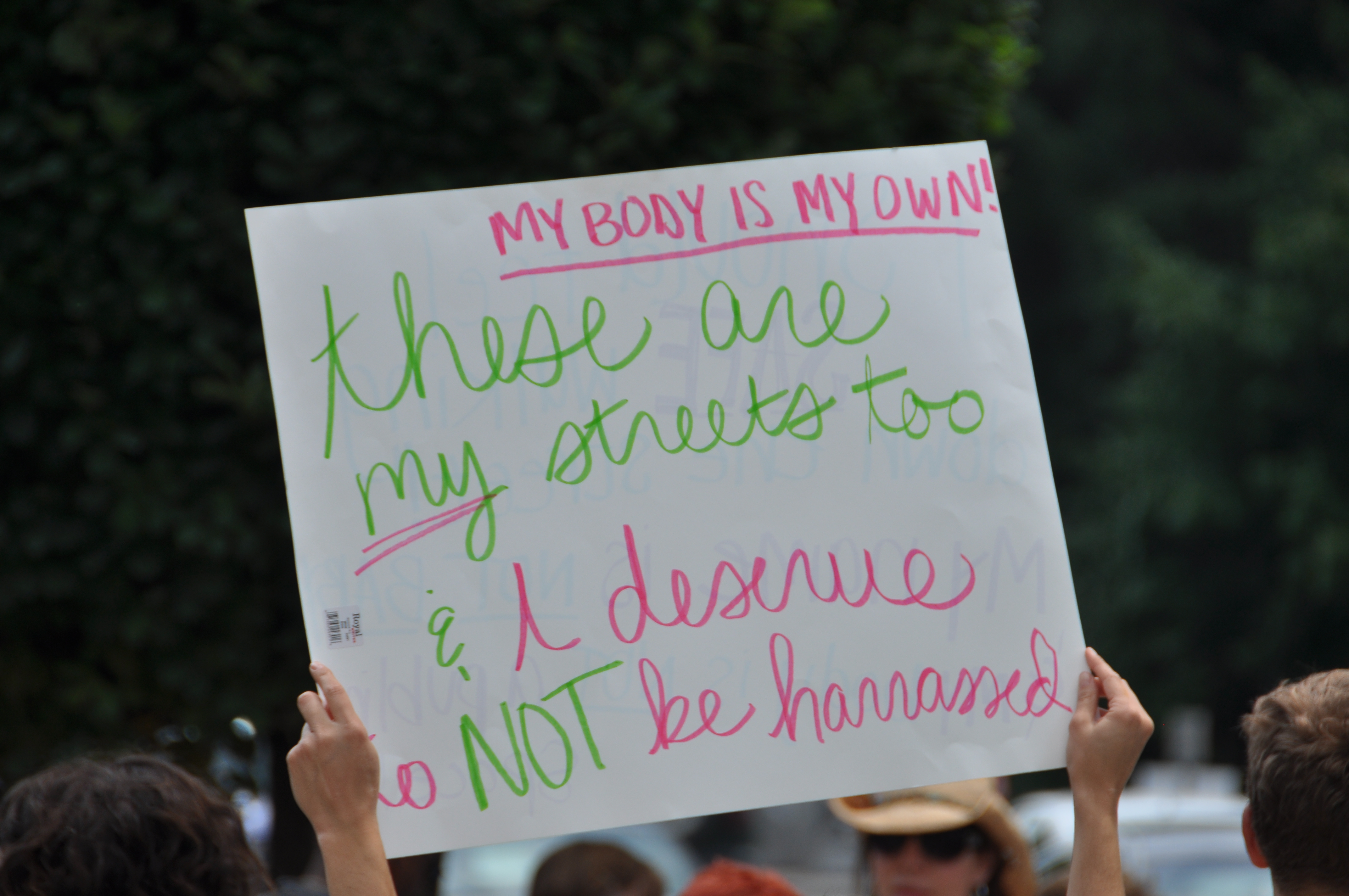
I’ve seen a lot of beautiful, powerful street art that has been created to combat or raise awareness about street harassment. These pieces always really inspire me, because art is one of the most powerful tools we can use to reach and touch others. It’s something that connects each and one of us, because no matter where you come from, how old you are or what your circumstances are in life, everyone can appreciate and find delight in art. They say a picture is worth 1000 words and considering that art can touch you in a lot of ways words sometimes cannot, this couldn’t be truer!

Street art was a tactic utilized by many during this year’s Anti-Street Harassment Week! Hollaback! Melbourne took to the streets to do a chalk walk and fill the streets with messages and images against street harassment. Women in Cities International worked with young men and women to create t-shirts with slogans and art that spoke out against oppression. Hollaback! Sheffield held a “craftivism” session, where they created crafts, such as t-shirts and quilts that had messages or symbols revolving around stopping street harassment. The Southern Arizona Center Against Sexual Assault hosted Art Against Sexual Violence workshops to have citizens create art that centers around anti-violence activism.

In addition to street art that was facilitated during Anti-Street Harassment Week, there are many other street artists and events that take place throughout the year whose message is one against street harassment. One such artist is Tatyana Fazlalizadeh who created posters with messages such as ,“My Name is Not Baby” and “Stop Telling Women to Smile” that she has posted around Washington D.C., Philadelphia, Pennsylvania  and Brooklyn, New York. She’s been strategic in using her art to combat street harassment by hanging her posters in places where she herself has experienced street harassment.

““I’ve put them in places where I’ve personally been harassed, and where I know street harassment is prevalent–which, honestly is everywhere,” she adds. “So, I’ve placed them on mailboxes in downtown business areas, on abandoned buildings in residential areas, on spare walls in tourist areas. Anywhere I can.”

Design Action Collective, an activist group based in Oakland, California, was inspired by Tatyana’s art and on this year’s International Women’s Day created a poster campaign also speaking out against street harassment. “We felt that creating stickers and flyers people could post would help shift the power on our streets. Messages like “I didn’t ask for your opinion on my body” will not necessarily change a harasser’s attitude, but it would show those who experience harassment that we are not alone.”

The anti-street harassment activists in Hollaback! Philly have created a comic book entitled  Hollaback: Red, Yellow, Blue that feature characters who face street harassment. The comic book even highlights male allies, when one of the male characters sees the negative effects of street harassment on women and then tries to decipher how to be an active bystander when he is witness to harassment.

Clearly, art is powerful and reaches people in a way that sometimes words can’t. Street art is reaching victims and harassers in the space where street harassment is happening. This is important and this can be significant in reaching people and helping those who may not understand street harassment understand it. Clearly, the art is simple and easy to understand and makes street harassment education very accessible. Street art is a part of anti-street harassment activism that is making a difference and it’s time that the artists’ voices are heard.

Erin is an e-activist and blogger based in Ohio. You can find more of her work here and here.

Share

Filed Under: correspondents, Resources, street harassment

USA: Shorts Are Not a Welcome Mat for Harassment

June 3, 2013 By Correspondent

By Natasha Vianna, SSH Correspondent

I was just 12 years old when I first experienced street harassment. While on a 2-month trip to Rio de Janeiro, Brasil, I was walking down the street in shorts, a tank top, and flip-flops when I passed by an outdoor bar. The group of men, drinking in the hot sun, all put their beers down and started making comments about my cousins and me.

As a young girl, I knew this was wrong and it made me feel so unsafe and scared. It was as if we were walking by purely for their viewing pleasure. We were simply players on their field and the sport was walking. Like commentators, they began narrating our walk and highlighting every detail. “Look at how sexy she walks.” “Oh my God, what a nice ass.”

And as my heart raced in nervousness, my cousins seemed unbothered. When we turned the corner and could no longer hear the men, I asked her what the hell that was about. My oldest cousin (only 14) looked over and I repeated what those men said to us. She giggled and asked me if that was the first time I heard men catcall. I blushed thinking that I now made myself look immature and said yes. “Oh hunny. That’s normal! Men will say things to you and you just have to stare straight forward and pretend you don’t hear anything. Men like that anyway.”

They all laughed at me and I never talked brought it up again.

When I came back to America, I brought an album of pictures into school from my trip to Rio. As the girls and boys in my class flipped through the album, they began to ask me about the trip. I told them it was great, it was hot, and that the guys were creeps. I remember telling them about the constant comments the older guys would shout at girls and one of the girls looked at me and said, “Well what do you expect? If you’re gonna wear shorts that short, expect to be treated like a slut.”

And so it began.

I got so angry. I tried to explain that people in Brasil dress differently than people in America because it’s extremely hot all year round and having a tan is a universal want. The less clothes you wear, the cooler you feel and the better the tan you will have. Yet, here I was defending the way we dressed instead of talking about the real issue – street harassment. I was being driven into a rant about why I wear what I wear instead of getting closer to feeling sympathy from my peers.

Some girls rolled their eyes and told me that I wore short shorts in Rio for attention and that if I was upset because of the attention, than I should wear pants. It was a frustrating and a very nonsensical conversation that ended sourly.

It didn’t occur to me until a few years ago that the people really don’t understand street harassment and the effect it has on women and on young girls, as I was a very young girl in no way looking for attention from men.

Today, I know that whenever I am harassed, it can quickly escalate into something much worse than just “hey baby”. If I don’t respond in a way that my harasser respects, my face could be the next one to have to defend the stigma of rape and harassment. Why were you dressed that way? Why were you out at that time? Why were you alone?

And as I spend my time defending my choice of clothes, another young girl becomes a victim because she was too hot to wear pants.

Natasha Vianna, a fearless activist and young feminist, is a freelance writer and blogger based out of Boston, MA. Follow her on twitter!

Share

Filed Under: correspondents, street harassment

USA: You’re Becoming a Woman

May 26, 2013 By HKearl

By Sean Crosbie, SSH Correspondent

Feminist men sometimes face an uphill battle to legitimize themselves in the face of their male counterparts. I was reminded of an experience during International Anti-Street Harassment week. One of the most exciting online activities during the week was a series of Tweet Chats, which created a place for concerned activists and organizations to discuss issues pertinent to street harassment. During the chat about male allies, I shared an experience in which a “friend” chastised me for becoming “more of a woman” because of my interest in women’s rights. I received supportive feedback and was heartened to see Men Can Stop Rape’s  response: “Sad b/c gender equality, gender-based violence are still seen as ‘women’s issues.’ Well u just helped change that perception.”

I agree that the comment was sad, but it also shows a skewed perception that perpetuates the culture of street harassment. Since women’s issues are constantly maligned in this fashion by the hyper-masculine power structure, issues such as street harassment are seen as trivial. The media and popular culture instill images of catcalling as romantic and playful, which sheds a positive light on these degrading acts.

There is an element of fear contained in the comment that is very common in the dismissal of women’s issues. Whenever you chip away at a structure that has defined a society for millennia, those in power are going to fight back with fear and intimidation. Conventional wisdom holds that as women gain a higher role in society, there will be fewer chances for men to get ahead and hold their traditional positions in society. If some men decide to break rank and support the “other side,” they will face emasculation or worse.

This group-think mentality among some men creates a huge barrier to the acceptance of male allies. It is time to end the notion that men cannot play a role in feminism, as there have been male allies of feminist movements since the time of suffrage. One of the ways to alleviate these archaic notions is by educating men and boys about feminism and offering positive reinforcement for respecting women. Men and boys need to break with the hyper-masculine collective mentality that creates attitudes that normalize street harassment and diminish the efforts of those who fight against it.

Sean has written for Stop Street Harassment since April 2011.  He is a library/research assistant at a labor union in Washington, D.C. and holds a Bachelor’s degree in economics from American University.

Share

Filed Under: correspondents, male perspective

Colombia: Confronting Harassers

May 17, 2013 By Contributor

By: Adriana Pérez-Rodríguez, SSH Correspondent

When I talk to female friends about street harassment I can tell most of them feel something is wrong with it, they realise that we should not put up with such behaviour. Yet, when it comes to reacting and confronting harassers, many of them don’t know where to start from. That’s why I want to tell my personal experiences to hopefully help clarify any doubts. I believe that, although, conscientiously acknowledging the problem is highly important, it isn’t sufficient as we do also need to take action on the matter.

However, one thing I want to clarify first is that I do understand we all feel scared when confronting harassers. For that reason I do not advice that we should always confront them directly, sometimes collective action or other sorts of actions are much better. I advise we measure the risks and dangers we can get into, always considering our safety first, especially if we’re on our own.

One reason that’s always listed when rejecting the idea of confronting street harassers is the fear factor: we, in the end, don’t know how they will react, especially if we’re on our own. Nevertheless, it’s also important to realise that in some cases we’re not necessarily concerned about our safety per se, but more about the sole fact of speaking up. If we’re systematically brought up to believe women should not speak up, open resistance becomes quite a challenge, as we first have to overcome strong cultural barriers imposed upon us since our first stages of socialisation. If we’re brought up to believe we should cope with how we are treated, especially if those who are harming us are men, then it’s normal we sense fear at the thought of openly reacting. Speaking up, in the end, can be seen as an act of political resistance, but as we’re told we should always cope, this act can also be quite overwhelming at first thought. My personal experience has been marked by that, as it took me quite a while to overcome fear for both, my safety, and more importantly, for overcoming cultural barriers.

So, the first time I confronted my harasser, I was walking down a very lovely but quiet road. In fact, it was just me on that road when I heard something along the lines of “hey beautiful”. I tried not to pay attention and kept walking when I heard again something like “you’re so beautiful, what are you doing walking on your own?” In that moment something snapped in my head, I had enough. I was so angry at the fact I knew this guy was blatantly talking advantage that it was just him and I on that road that I couldn’t cope any longer, so I stood in front of him and with a sharp tone I said “what did you just say?!”. He didn’t know what to say, he looked so puzzled, almost embarrassed and that’s when I left.

I think that’s important, as many of us may think that in order to confront we need to give speeches on how they’re reproducing patriarchal ideas of women in public spaces. However, a sharp and affirmative answer will do most of the times. In fact, sometimes they will be willing to engage in conversations where you’ll be able to fully explain what’s wrong with it. That happened once when I was walking with a friend and an older man started verbally harassing us, I couldn’t take it so after I answered back and he looked puzzled (how typical!) my friend replied “you know? We don’t like it”. He then explained why he did it and after we explained what’s so wrong with it he apologised.

Finally, in some cases collective action can be a better answer because it has a bigger impact and it does keep us safe. My experience with collective action was this: there’s a construction site in front of my place, I was tired of putting up with the builders harassing me and every woman every time we walked passed it, but I knew that I could get into a lot of risk if I confronted them on my own. So I collected signatures from everyone in the building and sent a petition letter with all the signatures to the project engineer explaining him how uncomfortable people from this building were at the behaviour of the builders. Seems to be it has worked since harassment has pretty much disappeared. However, that will be an experience I’ll write properly about the next time.

One thing you’ll realise once you start confronting them is how good it feels after, not only you confronted a wrongdoer but also you’re overcoming, resisting and reacting against cultural barriers that dictate that we, for the sole fact of being women, should keep quiet. We’re putting a message across for everyone to see that we’re not conforming to patriarchal ideas of women as submissive. We’re saying “we’re here, we’ll stay here and we don’t need your approval.”

Adriana is a Colombian national who’s passionate about all topics concerning social justice, especially gender-based justice.

____________________________________________

Enfrentando a un acosador:

Cuando hablo con amigas sobre el acoso sexual callejero puedo darme cuenta que la mayoría de ellas sienten que sí hay algo malo con eso y se han dado cuenta que no deben aguantar ese comportamiento. Aun así, cuando se trata de reaccionar y afrontar los acosadores, muchas no saben por dónde empezar, por eso me gustaría comentar mis experiencias personales para lograr aclarar dudas con respecto a este tema. Yo creo que, aunque tomar conciencia del problema es de gran importancia, no es suficiente puesto que también debemos actuar.

Una cosa que primero me gustaría aclarar es entiendo que todas sintamos temor al enfrentar a acosadores, por lo que enfrentarlos directamente no sea necesariamente la mejor solución, a veces acciones colectivas tienen un mejor efecto. Por lo tanto, yo aconsejo ponderar los riesgos y peligros, considerando nuestra seguridad primero, en especial si estamos caminando solas.

Una razón que siempre es nombrada cuando se rechaza enfrentar a nuestro acosador es el miedo: al fin y al cabo no sabemos cómo va a reaccionar nuestro agresor, especialmente si estanos solas. Sin embargo, también es importante darse cuenta que en algunos casos no estamos preocupadas por nuestra seguridad como tal, sino por el hecho de hablar. Si somos criadas sistemáticamente para creer que las mujeres no debemos manifestar nuestra oposición, la resistencia se vuelve todo un desafío ya que primero debemos vencer barreras culturales que fueron impuestas sobre nosotras desde las primeras etapas de socialización. Si fuimos criadas con la creencia de que debemos aguantar la manera en que somos tratadas, más aún si los que nos hacen daño son los hombres, se vuelve normal sentir miedo a la idea de hacer pública nuestra resistencia; manifestar abiertamente nuestra oposición puede considerarse como un acto de resistencia política pero, como siempre nos enseñaron a aguantar, esta idea puede ser inicialmente arrolladora. Así, mi experiencia personal ha estado marcada por estos hechos ya que me ha tomado tiempo superar estos miedos, tanto por mi seguridad personal, como por vencer estas barreras culturales.

La primera vez que enfrenté a un acosador fue mientras estaba caminando por una vía muy linda pero sola, en realidad era solo yo cuando oí algo como “oye hermosa”. Traté de no prestarle atención y seguir caminando hasta que oí algo como “qué hermosa eres, ¿por qué estás caminando sola?”, en ese momento sentí que ya no pude aguantar, estaba tan molesta del hecho que sabía que él se estaba aprovechando de que estaba caminando en una vía sola que le dije tajantemente “¡¿Qué me acabó de decir?!”. Él no supo qué decirme, me estaba viendo con una cara de confundido, así que me fui.

Creo que entender eso es importante ya que muchas creemos que a la hora de enfrentar a nuestro acosador debemos dar todo un discurso de cómo están reproduciendo lógicas patriarcales de la mujer en el espacio público, pero muchas veces una respuesta tajante es la mejor solución. Es más, en ciertos casos se podrá entablar una conversación con el agresor en donde se le expliqué por qué está mal, como me pasó una vez que fuimos acosadas por un hombre más mayor mi amiga y yo. Después de responderle a su agresión y de que el agresor me viera con cara de confuso (¡qué típico!), mi amiga le dijo “¿Sabe? Eso no nos gusta”, él nos explicó por qué lo hizo y nosotras lo que está mal con ese comportamiento, por lo que él se disculpó.

Finalmente, en varios casos acciones colectivas pueden ser la mejor respuesta debido al mayor impacto que tiene y a que protege nuestra seguridad. Mi experiencia con acciones colectivas fue la siguiente: hay un edificio en construcción enfrente de mi casa y cada vez que yo u otras mujeres pasaban en frente, teníamos que aguantar el acoso verbal de los obreros, empero yo sabía que corría riesgos altos si me enfrentaba directamente con ellos. Por lo que recogí firmas de todas las personas que viven en mi edificio y firmamos una carta de petición que fue enviada al ingeniero residente de la obra explicándole lo incómodos e incómodas que nos sentíamos los y las habitantes de este edificio con el comportamiento de los obreros, y al parecer ha funcionado ya que el acoso de los obreros ha prácticamente desaparecido desde entonces. Sin embargo, esa será una experiencia que relataré con más profundidad en mi próximo artículo.

Una cosa que uno se da cuenta cuando empieza a enfrentar estos actos es lo bien que se siente después, no sólo confrontamos algo que está mal hecho sino que también empezamos a luchar y derrumbar barreras culturales que nos dictan que por el hecho de ser mujeres debemos mantenernos en silencio. Estamos transmitiendo el mensaje, para que todos y todas lo vean, de que no vamos a aguantar ideas patriarcales que nos definen como sumisas, estamos diciendo “aquí estamos y aquí nos quedamos, y no necesitamos su aprobación”.

Soy una colombiana apasionada por todos asuntos relacionados con la justicia social, especialmente justicia de género.

Share

Filed Under: correspondents, street harassment

USA: How we can take back the streets?

May 14, 2013 By Correspondent

By: Erin McKelle, SSH Correspondent

We all know that street harassment is a huge problem and that we must work hard to end it. Street harassment happens to (by conservative estimates) 80% of women and because of how prevalent it is in our society and around the world, it means that the issue is that much more important and that ending it is that much more critical.

So the question is, how can we take back the streets? Not just for ourselves, but for every woman who has ever been harassed? How can we make the streets safe for everyone and create safe public spaces? It’s obviously a daunting task, so how can we go about it?

The answer lies in activism and taking an active role as bystanders. We have to be willing to not let things slide that make us uncomfortable or that are clearly sexist. It’s about going against the grain and letting harassers know that what they are doing isn’t okay.

To give a better and more thorough understanding of this, here is a list of 5 ways that you can take back the streets, whether you are the target of harassment, seeing harassment happen to someone else or are just simply wanting to make a difference.

1)    Stand Up to Harasser’s…if you feel safe, of course. The best way to do this is to use strong and assertive body language and speech. Tell the harasser directly exactly what they did that that was offensive and to stop. Keep your composure and remain cool, calm and confident. If you don’t feel safe enough to directly stand up to your harasser, report your story to Stop Street Harassment and/or Hollaback! to raise awareness and indirectly stick up for yourself. You could also report the incident to the police (although you may or may not have success with this) and take a picture or video of the harasser with your cell phone.

2)    Be an Active Bystander and help others who are experiencing harassment. If you see someone being harassed, step in and try to diffuse the harasser and also look out for the victim. Depending on the circumstance, you could use a distraction to get the harasser’s attention away from harassing (for example, asking them for directions), pull the victim aside and ask if they are okay and need help or even directly call out the harasser in front of a crowd, which will probably shock them and cause them to stop. Just be mindful of safety, the situation and use your judgment to form the best plan of action.

3)    Actively Resist and take action to create social change. Hold a march or rally to protest street harassment, create a short film or vlog on the issue or even leave information about Stop Street Harassment in public restrooms, subway cars or sidewalks. Volunteer or write an op-ed for organizations that work to end street harassment. Do something to get other people’s attention and raise awareness about the issue. Be creative and use your imagination

4)    Be an Advocate and talk to people young and old about street harassment and start conversations with friends and family. By talking about the issue openly, you are creating a safe space for others who have probably experienced the same thing and are simultaneously educating and erasing the stigma around street harassment. You could also act as a mentor to young boys and girls and talk to them about why harassment is not okay and empower young women to stand up for themselves and know that they never deserve or are inviting harassment.  Also, think about starting a town hall at your school or work to get your colleague’s talking about the issue.

5)     Use Social Media: Tweet information, facts and statistics about street harassment on your Twitter or Facebook page. It’s a very easy way to get a lot of people to engage with this issue and to make others aware of what street harassment is and how to end it. If you want to tweet your harassment story, include the hashtag #streetharassment or #hollaback and it will be added to the @Catcalled @ihollaback and/or the @StopStHarassment Twitter thread.

Remember, no action is too big or too small and any and everything you do to take back the streets brings us one step closer to ending street harassment for good.

Erin is an e-activist and blogger based in Ohio. You can find more of her work here and here.

Share

Filed Under: correspondents, Resources, Stories

« Previous Page
Next Page »

Share Your Story

Share your street harassment story for the blog. Donate Now

From the Blog

  • #MeToo 2024 Study Released Today
  • Join International Anti-Street Harassment Week 2022
  • Giving Tuesday – Fund the Hotline
  • Thank You – International Anti-Street Harassment Week 2021
  • Share Your Story – Safecity and Catcalls Collaboration

Buy the Book

  • Contact
  • Events
  • Join Us
  • Donate
  • Facebook
  • Instagram
  • Pinterest
  • Tumblr
  • Twitter
  • YouTube

Copyright © 2026 Stop Street Harassment · Website Design by Sarah Marie Lacy