• About Us
    • What Is Street Harassment?
    • Why Stopping Street Harassment Matters
    • Meet the Team
      • Board of Directors
      • Past Board Members
    • In The Media
  • Our Work
    • National Street Harassment Hotline
    • International Anti-Street Harassment Week
    • Blog Correspondents
      • Past SSH Correspondents
    • Safe Public Spaces Mentoring Program
    • Publications
    • National Studies
    • Campaigns against Companies
    • Washington, D.C. Activism
  • Our Books
  • Donate
  • Store

Stop Street Harassment

Making Public Spaces Safe and Welcoming

  • Facebook
  • Instagram
  • Pinterest
  • Tumblr
  • Twitter
  • YouTube
  • Home
  • Blog
    • Harassment Stories
    • Blog Correspondents
    • Street Respect Stories
  • Help & Advice
    • National Street Harassment Hotline
    • Dealing With Harassers
      • Assertive Responses
      • Reporting Harassers
      • Bystander Responses
      • Creative Responses
    • What to Do Before or After Harassment
    • Street Harassment and the Law
  • Resources
    • Definitions
    • Statistics
    • Articles & Books
    • Anti-Harassment Groups & Campaigns
    • Male Allies
      • Educating Boys & Men
      • How to Talk to Women
      • Bystander Tips
    • Video Clips
    • Images & Flyers
  • Take Community Action
  • Contact

USA: Government Policy and Street Harassment

April 30, 2013 By Correspondent

By Sean Crosbie, SSH Correspondent

Street harassment is a pervasive problem that has both public and private effects. Street harassment has psychological impact, including feelings of humiliation and worthlessness. This has negative consequences on how people interact with one another in public spaces that are supposed to be inclusive and safe for all. There is a debate on what measures local and national governments should take to combat street harassment and create the safe spaces that everyone deserves.

In a previous blog post, I wrote about how the culture of hypermasculinity creates the mentality that causes street harassment. The two women I interviewed for the post also had strong opinions on the role that local and national governments can play in alleviating street harassment. Both women agree that one of the most important initiatives any government can implement is a program of educating men and boys about the dangers of street harassment. Interviewee 1 noted the importance of local governments to fund anti-street harassment initiatives for public transportation. Here, she talks about the great first step WMATA (Washington Metropolitan Area Transit Authority) has made in preventing street harassment, but also what Metro can do to better enforce their policies:

I would like to see Metro put some teeth behind their campaign to stop harassment on the metro. …There are still numerous women who feel nothing was done in response to their complaints. I know I, personally, would probably not take the time to find a Metro employee and report “minor” harassment just because it seems like a waste of time. Until Metro employees (and police officers) truly understand what a threat this kind of harassment is, and treat it with as much respect as a mugging or assault, we won’t feel safe, and we won’t bother reporting the incidents.

Women need to feel that the government will back up anti-street harassment initiatives with effective action. The attitude that street harassment is “no big deal” or “a compliment” prevents local law enforcement from taking strong action. These attitudes cannot be reversed unless governments work to educate men and boys about the severity of street harassment. Interviewee 1 advocates for mandatory harassment training at all levels of schooling:

We also need mandatory harassment training in high schools, as well as in college. Awareness is key, so the more men are aware of how this behavior makes women feel, the greater the chance that we will see real change.

Interviewee 2 believes that this education should start as early as 6th grade:

The school district that I come from starts health education at sixth grade. Perhaps street harassment can be a conversation that starts then, too.

There is a tremendous amount that governments can do to combat street harassment. Both of my interviewees focused on reversing the dismissive attitude that some men and boys have with regard to catcalling. Since these ways of thinking begin early in men’s socialization, it’s necessary to start teaching men early on in their education against committing or tolerating degrading acts towards women. A shift in the way society views behavior like catcalling is needed for street harassment to be taken more seriously. This can also inspire government programs that are responsive and make women feel both safe and that their voices are being heard. But we need the societal shift to happen in conjunction with public policies – both are necessary for change.

Sean has written for Stop Street Harassment since April 2011.  He is a library/research assistant at a labor union in Washington, D.C. and holds a Bachelor’s degree in economics from American University.

Share

Filed Under: correspondents, male perspective, street harassment

USA: Why Sexism Causes Street Harassment

April 17, 2013 By Correspondent

By: Erin McKelle, SSH Correspondent

Street Harassment happens largely because of sexism. Street Harassment itself is gender-based, meaning that the context it occurs in is filled with dynamics that are shaped by gender. The power differences between men and women ultimately create the circumstances that make street harassment a reality. Both men and women have been told time and time again that women’s bodies are men’s to enjoy and to take pleasure in, no matter if they like it or not. After all, if you have a ‘sexy’ body or wear ‘slutty’ clothing, then men are going to ogle and according to our culture that is perfectly acceptable. We don’t see it as a problem because we largely don’t see patriarchy and gender power disparities as problems. As a society, we don’t seem to understand that how we teach and allow men to act towards women (in both public and private spaces) is wrong and the opposite of equality.

The sexism that comes into play with street harassment is based in our perception of sexuality (both male and female). Women are told that they must dress in non-provoking ways that they must always be on alert to avoid danger and be prepared to face violence. They must not go out by themselves late at night, that they must carry pepper spray in their purses that they must keep their guard. Men are told that women are sex objects, that commenting (especially in rude or crude ways) on women’s appearances and bodies is perfectly fine and even a way to assert their masculinity. Men are not taught to be afraid of public spaces.

This paradigm of fear that is then instilled in women but not in men is behind street harassment. These differing messages create the complex social atmosphere that allows for street harassment to exist. The sexism comes from how our society tells men and women how they are ‘allowed’ to behave, this schism being a significant one.

Arguably, we won’t end street harassment until we end sexism. That is why the feminist movement is so important and integral to creating a better world for people of every gender. Until we address the power dynamics that exist between men and women in public spaces, we will never really fully understand or get to the root of why street harassment happens. Embracing feminism and thinking and acting critically and addressing gender roles and norms is at the heart of ending street harassment.

In recent news, Marvel has released t-shirts to promote the Avenger’s comic book series that are relaying this societal message that women should be passive and men aggressive. As you can see here, the t-shirt made for boys says ‘Be a Hero’ and the girls’ version says ‘I Need A Hero’. Obviously, this is sending both boys and girls the wrong message about heroism and gender identity. After all, girl’s can be heroes too!

These shirts are also implying that girls need to be rescued and saved by men (and ironically, from men). It’s time that we stop victimizing girls and empowering only boys and that we allow girls to explore the roles of being active, heroic, and courageous and brave that society seems to designate for boys only.

In response to this, I created a petition through Change.org asking Marvel to stop making these sexist t-shirts. I want to see a world where boys and girls are empowered to be heroes equally and not one where girls are told that they need to be saved by a hero…and that they cannot be heroes themselves. If you want to also make this a reality, I would encourage you to sign the petition and share it with your friends on Facebook and Twitter.  Through actions like this, we can work to end the sexism that causes, among other things , street harassment.

Update: Thanks to lots of online activism in response to the sexist t-shirts, the “I Need a Hero” shirt is no longer available on the Disney Store website.

Erin is an e-activist and blogger based in Ohio. You can find more of her work here and here.

Share

Filed Under: correspondents, street harassment

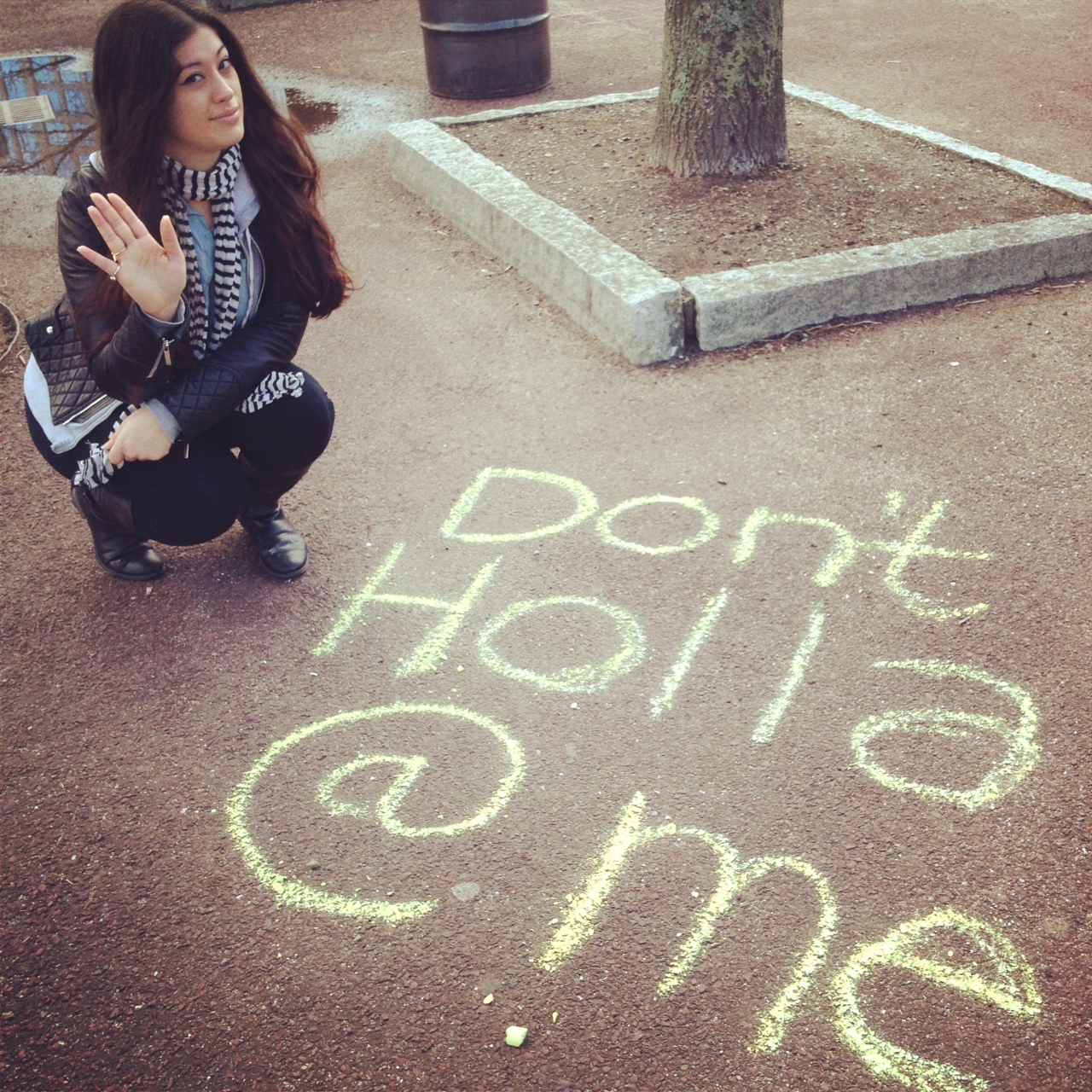
USA: Boston’s Anti-Street Harassment Chalk Walk

April 15, 2013 By Correspondent

Boston

By Natasha Vianna, SSH Correspondent

On Saturday, I joined Hollaback! Boston for an International Anti-Street Harassment Week chalk walk at the Christopher Columbus Park. As we all happily chalked messages to passersby, a couple stopped in front of our chalk designs and began a conversation:

Woman: reading the chalk “Hey baby is no way to say hello.”

Man: Haha. What is this?

Woman: An anti-street harassment campaign, I guess.

Man: What for?

Woman: To stop street harassment.

Man: I’ve never been harassed on the street.

Woman: I think that’s the point. Women are harassed on the street and most men don’t realize that they’re either the harasser or that they just never have to deal with harassment.

Natasha

As I knelt on the ground with chalk in my hand, writing phrases and sharing experiences with the sidewalk, these very moments made me smile from ear-to-ear. Our goal was to spark conversation and stimulate dialogue while sharing tidbits of information in a positive and non-traditional way. Needless to say, it worked amazingly well.

A few people stopped to ask questions, some tourists picked up a piece of chalk and joined us, while others read silently, smiled, and kept walking. It was an amazing feeling when young girls and women of all ages stopped to read and felt compelled to smile and take pictures.

The message was sent and received.

Natasha Vianna, a fearless activist and young feminist, is a freelance writer and blogger based out of Boston, MA. Follow her on twitter!

Share

Filed Under: anti-street harassment week, correspondents, Stories, street harassment

Canada: Please, for the love of God, Don’t Go Talk to Her

April 11, 2013 By HKearl

Photo via adamlodolce.coms

By Terris Schneider, SSH Correspondent

Hey ladies, did you know that FACT: everyone woman likes to be complimented, especially in public against their will? Sure, this may not be the actual case, but this is one of the ideologies behind Adam LoDolce’s dangerous “Go Talk To Her” campaign. According to Adam LoDolce: “Who dislikes a compliment? No woman I’ve ever met.” Well then, it must be true of all women!

LoDolce’s campaign encourages men to hit on women by approaching them in a public space. He believes that this method is much more effective than relying on women to make the first move or sticking with online dating sites. I didn’t realize either of these two strategies were such a bad thing, but I digress…  LoDolce’s approach sounds rather familiar – I think it might go under another name: Street Harassment. Even though LoDolce claims that shy men are usually the ones his coaching appeals to, and that he tells them to look for “indicators of disinterest,” this campaign still has the effect of propagating rape culture and doesn’t account for the fact that some men do not take no for an answer when women express they aren’t interested. Some men take it too far, and can cause women to feel threatened. Plus, most women I know just want to be left alone and aren’t property for men to disturb while they’re out walking or running errands.

And just who are this “Dating Confidence Coach™ (name trademarked!) that men are taking advice from? Sure, he has coached men for years on how to approach women, but where is he getting his information from? From what I can tell, he has no credible education making him an expert in this field. He is a glorified Pick Up Artist trying to claim himself as legitimate, and if people buy into this, then this can only set back the SSH movement.

In Vancouver, street harassment has been especially worse lately and my friends and I have attributed it to this campaign. Since my friends and I wrote some comments on LoDolce’s Facebook page that got deleted, and we no longer have access to write on his page (a social media faux pas, Mr. LoDolce!), I figured I’d write some of his greatest hits on here. His Facebook page is an especially great showcase of all the harm he is doing to the SSH movement, by making assumptions about women with no clear facts or evidence to back up his claims.

I have a vagina, therefore, I must like 50 Shades of Grey. Even though the leading female character is a total misrepresentation of women, and that the book encourages the idea that women want to be objectified and dominated.

She just probably didn’t feel like being harassed by you on her flight. Looks like your talking to women in public technique is working…

I’m hoping people will start to realize the flaw in this supposed dating technique, and it will be a passing trend, much like Pogs or gluten free diets.

Terris is a professional wordsmith (freelance writer) based in Vancouver, BC, Canada. You can read more of her work on her blog, or follow her on Twitter and Facebook.

Share

Filed Under: correspondents, street harassment

“No” is a complete sentence

April 10, 2013 By Contributor

By: Claire Biggs, SSH Correspondent

“No” is a complete sentence.

Sounds simple, right?

Already five hours in to our full force, full contact self-defense class, my classmates and I were feeling somewhat better about our personal safety skills.

I mean, that 6’3”, 250lb guy already wrapped his arm around my throat in a surprise chokehold and brought me to the ground, and I still managed to fight my way out of the situation.  As far as I – and many of my classmates were concerned – whatever came next would be cake.

Our instructor repeated it again: “No” is a complete sentence.

When you think of street harassment, what comes to mind? For me, I remember that time I was out jogging and someone threw a beer bottle at me from his truck.

But what do you do when you’re faced with more than just a passing interaction? What do you say to the person who won’t get out of your face – or out of your way?

“No” isn’t the start of a negotiation; it’s the end of a discussion. It’s a pretty revolutionary thought, if you let yourself think about it.

My fellow self-defense classmates and I quickly realized that saying “No” and meaning it were two very different things.

I remember thinking it would be a relief to get a break from slamming my elbow repeatedly into my (heavily padded) assailant’s face and solar plexus. Thank goodness I won’t have to watch my new friends get grabbed from behind and pulled to the ground, kicking and screaming.

Turns out, it’s just as uncomfortable, if not more so, watching those friends try to choke out a forceful “No” while blinking back tears.

Our class ranged in age from mid-teens to mid-50s. Some of us were victims of sexual, physical, and verbal assaults, while some just wanted to get some practical self-defense training in case they were ever put in a similar situation. We were all strong, brave women ready to come to blows if it meant getting out of a situation safely.

But there are some situations where you have to resist the urge to deliver a well-placed knee to the groin. Sure, you’re uncomfortable as hell, maybe embarrassed or furious or scared, but you’re not going to escalate the situation first.

Your one objective is to deescalate the verbal assault before it becomes a physical assault. In those cases, when you’re shaking because the man approaching you is saying things that would make Olivia Benson shiver, you have to deliver a “No.”

It’s not a “No, sorry” or a “No, thanks.”

It’s a “No.” End of discussion.

It took us more than few tries each, but after a while, we all delivered powerful, secure “No’s” that let our male counterparts know that we weren’t interested. We stayed calm, maintained strong body language, and talked our way out of scary situations.

If they discounted our “No’s,” we found other ways to end the conversation. If you’re looking for some examples, you can find assertive responses here.

Practice in front of a mirror. Have your friends role-play scenarios with you. Deliver your “No” with confidence.

Believe that it’s the end of the discussion and don’t let anyone discount it.

“No is a complete sentence.”

Remember that.

Claire Biggs spends her days writing for MTV. Her (very late) nights are spent tweeting about women’s rights and, among other things, her love of Twitter. You can find her there @ClaireMBiggs. 

Share

Filed Under: correspondents, street harassment

« Previous Page
Next Page »

Share Your Story

Share your street harassment story for the blog. Donate Now

From the Blog

  • #MeToo 2024 Study Released Today
  • Join International Anti-Street Harassment Week 2022
  • Giving Tuesday – Fund the Hotline
  • Thank You – International Anti-Street Harassment Week 2021
  • Share Your Story – Safecity and Catcalls Collaboration

Buy the Book

  • Contact
  • Events
  • Join Us
  • Donate
  • Facebook
  • Instagram
  • Pinterest
  • Tumblr
  • Twitter
  • YouTube

Copyright © 2026 Stop Street Harassment · Website Design by Sarah Marie Lacy