• About Us
    • What Is Street Harassment?
    • Why Stopping Street Harassment Matters
    • Meet the Team
      • Board of Directors
      • Past Board Members
    • In The Media
  • Our Work
    • National Street Harassment Hotline
    • International Anti-Street Harassment Week
    • Blog Correspondents
      • Past SSH Correspondents
    • Safe Public Spaces Mentoring Program
    • Publications
    • National Studies
    • Campaigns against Companies
    • Washington, D.C. Activism
  • Our Books
  • Donate
  • Store

Stop Street Harassment

Making Public Spaces Safe and Welcoming

  • Facebook
  • Instagram
  • Pinterest
  • Tumblr
  • Twitter
  • YouTube
  • Home
  • Blog
    • Harassment Stories
    • Blog Correspondents
    • Street Respect Stories
  • Help & Advice
    • National Street Harassment Hotline
    • Dealing With Harassers
      • Assertive Responses
      • Reporting Harassers
      • Bystander Responses
      • Creative Responses
    • What to Do Before or After Harassment
    • Street Harassment and the Law
  • Resources
    • Definitions
    • Statistics
    • Articles & Books
    • Anti-Harassment Groups & Campaigns
    • Male Allies
      • Educating Boys & Men
      • How to Talk to Women
      • Bystander Tips
    • Video Clips
    • Images & Flyers
  • Take Community Action
  • Contact

USA: Fighting the Mashers

May 8, 2013 By Correspondent

By: Talia Weisberg, SSH Correspondent

Street harassment is a daily phenomenon in every pocket of the United States during the present day. Interestingly, this social trend can be dated back to the late 1800s in America.

Back then, street harassment was called mashing. There are actually records of women who physically exacted revenge on their harassers. In 1904, a Manhattan woman arranged to meet privately with a masher so she could beat him up. Two years later, when a woman boxer in Massachusetts was grabbed by a man, she knocked him out and then revived him with smelling salts out of pity. Other women slapped mashers in the face with their handbags and umbrellas, gave them swollen eyes, and even lacerated their faces.

The police of the early 1900s were very active in combating street harassment. Female officers were often put in charge of catching mashers, and were usually extremely successful. In New York City, a group of jiu jitsu-trained policewomen called the Subway Squad patrolled the trains as plainclothes officers, looking out for mashing. In both the subway and aboveground, mashers were often caught through stings, where they had female officers or harassed women serve as bait to entice the would-be masher.

Interestingly, many victims of street harassment pursued legal justice against mashers. By the 1920s, women were likely to sue because of the availability of private hearings and public encouragement. This era was also the Jazz Age, when women began exploring their sexuality. Since they had gotten the right to vote in 1920, women felt more liberated. A possible result of this increased sense of self is that women were more likely to value their bodies, and were apt to prosecute a man for violating their space.

Men had mixed responses to mashing. Male officers were often apathetic towards victims of street harassment, part of the reason women police became so vital to the cause. However, many men in the force championed the anti-mashing cause. For example, after learning about a “masher’s corner” on 125th Street in Manhattan, the police chief stationed additional officers there. In general, men did take an active stand against street harassment. The Anti-Mashing Society was established in 1903 by a group of men frustrated by the mashing epidemic, and numerous men physically protected women who were being mashed.

What lessons can we, as anti-street harassment activists, learn from the history of mashing?

As effective as it may have been in the early 1900s, it may not be wise for us to support women beating harassers with their handbags. However, self-protection is vital, and women must be able to learn how to effectively protect themselves from street harassment. We cannot, however, pin the responsibility on women to not be harassed. We must educate men not to harass, and work with like-minded men to encourage their brethren to respect women’s space on the street. Our mission is to shift the social paradigm and change people’s attitudes. Hopefully, the term street harassment will sound just as foreign to our children as the term mashing does to our generation.

Talia Weisberg is a Harvard-bound feminist hoping to concentrate in Studies of Women, Gender, and Sexuality. Her work has appeared in over 40 publications and she runs the blog Star of Davida blog (starofdavida.blogspot.com).

Share

Filed Under: correspondents, SH History, street harassment

USA: Sky’s Out, Thighs Out

May 2, 2013 By Correspondent

By Lauren Duhon, SSH Correspondent

Unless you’ve been living under a rock for the past couple of weeks, spring is here, summer is right around the corner and the warmer weather is here to stay. With higher temperatures and sunnier days, it’s time to break out the short shorts, sundresses and swimsuits. Fewer clothes shouldn’t be a reason to justify sexual harassment, but all too frequently I hear men making comments, usually not in a discrete manner, as young women emerge from winter’s cold embrace.

Walking through campus on any given day, I’ve heard countless guys comment on the anatomy of female students; stripping them down with their minds bit by bit like they’re some type of prey for the taking. “Oh, man, did you see that ass?” Charming, isn’t it? A different situation happened to me the other day at a festival. I was wearing a dress when a guy walked up to me, looked right down my dress, made a comment about my breasts and then tried to strike up a conversation about my camera (I was taking photos for my university’s newspaper). The “best” (for lack of a better word) one I’ve heard is “sky’s out, thighs out,” which several of my friends use in reference to the female students and their shorter shorts during this time of year.

All too often I find myself looking into the mirror before I leave my apartment and wanting to put on more clothes in an attempt to avoid unnecessary commentary that I may come across during the day.  And, most of the time, I have grown to dislike the warmer months simply based on the fact that you are less covered and feel more vulnerable. As if I feel like I have to be more modest. Not everyone may feel this way, but I shouldn’t feel ashamed for my clothing decisions. What I choose to wear shouldn’t affect my day-to-day life, nor should some random man influence that decision.

I blame society for perpetuating the wrong idea. The way a woman dresses shouldn’t define or insinuate any sort of action from the opposite sex. Don’t say it’s okay or everyone does it, because it’s not and no one should. Everyone is naturally attracted to others, that’s the normal part. But, that doesn’t grant anyone a free pass to harass others as they please.

So, next time you see an attractive girl, please think about what you’re doing. Street harassment is not a compliment. No one wants to be catcalled or whistled at. Keep your thoughts to yourself and avoid making any vulgar comments. I’d like to walk down the street with confidence knowing I won’t feel attacked for my outfit of choice.

Lauren Duhon is a student journalist from LSU in Baton Rouge, La.

Share

Filed Under: correspondents, Stories, street harassment

USA: Government Policy and Street Harassment

April 30, 2013 By Correspondent

By Sean Crosbie, SSH Correspondent

Street harassment is a pervasive problem that has both public and private effects. Street harassment has psychological impact, including feelings of humiliation and worthlessness. This has negative consequences on how people interact with one another in public spaces that are supposed to be inclusive and safe for all. There is a debate on what measures local and national governments should take to combat street harassment and create the safe spaces that everyone deserves.

In a previous blog post, I wrote about how the culture of hypermasculinity creates the mentality that causes street harassment. The two women I interviewed for the post also had strong opinions on the role that local and national governments can play in alleviating street harassment. Both women agree that one of the most important initiatives any government can implement is a program of educating men and boys about the dangers of street harassment. Interviewee 1 noted the importance of local governments to fund anti-street harassment initiatives for public transportation. Here, she talks about the great first step WMATA (Washington Metropolitan Area Transit Authority) has made in preventing street harassment, but also what Metro can do to better enforce their policies:

I would like to see Metro put some teeth behind their campaign to stop harassment on the metro. …There are still numerous women who feel nothing was done in response to their complaints. I know I, personally, would probably not take the time to find a Metro employee and report “minor” harassment just because it seems like a waste of time. Until Metro employees (and police officers) truly understand what a threat this kind of harassment is, and treat it with as much respect as a mugging or assault, we won’t feel safe, and we won’t bother reporting the incidents.

Women need to feel that the government will back up anti-street harassment initiatives with effective action. The attitude that street harassment is “no big deal” or “a compliment” prevents local law enforcement from taking strong action. These attitudes cannot be reversed unless governments work to educate men and boys about the severity of street harassment. Interviewee 1 advocates for mandatory harassment training at all levels of schooling:

We also need mandatory harassment training in high schools, as well as in college. Awareness is key, so the more men are aware of how this behavior makes women feel, the greater the chance that we will see real change.

Interviewee 2 believes that this education should start as early as 6th grade:

The school district that I come from starts health education at sixth grade. Perhaps street harassment can be a conversation that starts then, too.

There is a tremendous amount that governments can do to combat street harassment. Both of my interviewees focused on reversing the dismissive attitude that some men and boys have with regard to catcalling. Since these ways of thinking begin early in men’s socialization, it’s necessary to start teaching men early on in their education against committing or tolerating degrading acts towards women. A shift in the way society views behavior like catcalling is needed for street harassment to be taken more seriously. This can also inspire government programs that are responsive and make women feel both safe and that their voices are being heard. But we need the societal shift to happen in conjunction with public policies – both are necessary for change.

Sean has written for Stop Street Harassment since April 2011.  He is a library/research assistant at a labor union in Washington, D.C. and holds a Bachelor’s degree in economics from American University.

Share

Filed Under: correspondents, male perspective, street harassment

USA: Why Sexism Causes Street Harassment

April 17, 2013 By Correspondent

By: Erin McKelle, SSH Correspondent

Street Harassment happens largely because of sexism. Street Harassment itself is gender-based, meaning that the context it occurs in is filled with dynamics that are shaped by gender. The power differences between men and women ultimately create the circumstances that make street harassment a reality. Both men and women have been told time and time again that women’s bodies are men’s to enjoy and to take pleasure in, no matter if they like it or not. After all, if you have a ‘sexy’ body or wear ‘slutty’ clothing, then men are going to ogle and according to our culture that is perfectly acceptable. We don’t see it as a problem because we largely don’t see patriarchy and gender power disparities as problems. As a society, we don’t seem to understand that how we teach and allow men to act towards women (in both public and private spaces) is wrong and the opposite of equality.

The sexism that comes into play with street harassment is based in our perception of sexuality (both male and female). Women are told that they must dress in non-provoking ways that they must always be on alert to avoid danger and be prepared to face violence. They must not go out by themselves late at night, that they must carry pepper spray in their purses that they must keep their guard. Men are told that women are sex objects, that commenting (especially in rude or crude ways) on women’s appearances and bodies is perfectly fine and even a way to assert their masculinity. Men are not taught to be afraid of public spaces.

This paradigm of fear that is then instilled in women but not in men is behind street harassment. These differing messages create the complex social atmosphere that allows for street harassment to exist. The sexism comes from how our society tells men and women how they are ‘allowed’ to behave, this schism being a significant one.

Arguably, we won’t end street harassment until we end sexism. That is why the feminist movement is so important and integral to creating a better world for people of every gender. Until we address the power dynamics that exist between men and women in public spaces, we will never really fully understand or get to the root of why street harassment happens. Embracing feminism and thinking and acting critically and addressing gender roles and norms is at the heart of ending street harassment.

In recent news, Marvel has released t-shirts to promote the Avenger’s comic book series that are relaying this societal message that women should be passive and men aggressive. As you can see here, the t-shirt made for boys says ‘Be a Hero’ and the girls’ version says ‘I Need A Hero’. Obviously, this is sending both boys and girls the wrong message about heroism and gender identity. After all, girl’s can be heroes too!

These shirts are also implying that girls need to be rescued and saved by men (and ironically, from men). It’s time that we stop victimizing girls and empowering only boys and that we allow girls to explore the roles of being active, heroic, and courageous and brave that society seems to designate for boys only.

In response to this, I created a petition through Change.org asking Marvel to stop making these sexist t-shirts. I want to see a world where boys and girls are empowered to be heroes equally and not one where girls are told that they need to be saved by a hero…and that they cannot be heroes themselves. If you want to also make this a reality, I would encourage you to sign the petition and share it with your friends on Facebook and Twitter.  Through actions like this, we can work to end the sexism that causes, among other things , street harassment.

Update: Thanks to lots of online activism in response to the sexist t-shirts, the “I Need a Hero” shirt is no longer available on the Disney Store website.

Erin is an e-activist and blogger based in Ohio. You can find more of her work here and here.

Share

Filed Under: correspondents, street harassment

USA: Boston’s Anti-Street Harassment Chalk Walk

April 15, 2013 By Correspondent

Boston

By Natasha Vianna, SSH Correspondent

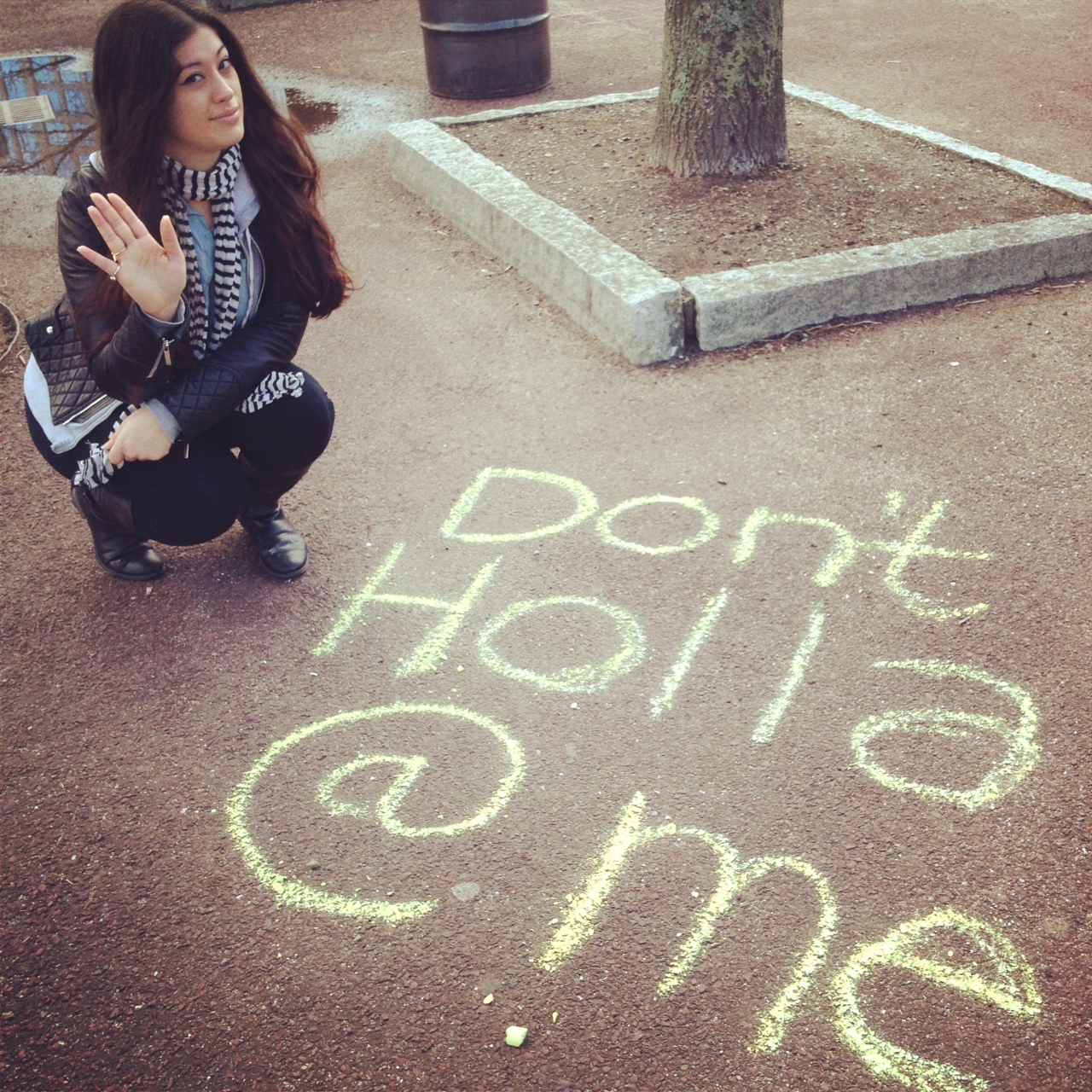
On Saturday, I joined Hollaback! Boston for an International Anti-Street Harassment Week chalk walk at the Christopher Columbus Park. As we all happily chalked messages to passersby, a couple stopped in front of our chalk designs and began a conversation:

Woman: reading the chalk “Hey baby is no way to say hello.”

Man: Haha. What is this?

Woman: An anti-street harassment campaign, I guess.

Man: What for?

Woman: To stop street harassment.

Man: I’ve never been harassed on the street.

Woman: I think that’s the point. Women are harassed on the street and most men don’t realize that they’re either the harasser or that they just never have to deal with harassment.

Natasha

As I knelt on the ground with chalk in my hand, writing phrases and sharing experiences with the sidewalk, these very moments made me smile from ear-to-ear. Our goal was to spark conversation and stimulate dialogue while sharing tidbits of information in a positive and non-traditional way. Needless to say, it worked amazingly well.

A few people stopped to ask questions, some tourists picked up a piece of chalk and joined us, while others read silently, smiled, and kept walking. It was an amazing feeling when young girls and women of all ages stopped to read and felt compelled to smile and take pictures.

The message was sent and received.

Natasha Vianna, a fearless activist and young feminist, is a freelance writer and blogger based out of Boston, MA. Follow her on twitter!

Share

Filed Under: anti-street harassment week, correspondents, Stories, street harassment

« Previous Page
Next Page »

Share Your Story

Share your street harassment story for the blog. Donate Now

From the Blog

  • #MeToo 2024 Study Released Today
  • Join International Anti-Street Harassment Week 2022
  • Giving Tuesday – Fund the Hotline
  • Thank You – International Anti-Street Harassment Week 2021
  • Share Your Story – Safecity and Catcalls Collaboration

Buy the Book

  • Contact
  • Events
  • Join Us
  • Donate
  • Facebook
  • Instagram
  • Pinterest
  • Tumblr
  • Twitter
  • YouTube

Copyright © 2026 Stop Street Harassment · Website Design by Sarah Marie Lacy