• About Us
    • What Is Street Harassment?
    • Why Stopping Street Harassment Matters
    • Meet the Team
      • Board of Directors
      • Past Board Members
    • In The Media
  • Our Work
    • National Street Harassment Hotline
    • International Anti-Street Harassment Week
    • Blog Correspondents
      • Past SSH Correspondents
    • Safe Public Spaces Mentoring Program
    • Publications
    • National Studies
    • Campaigns against Companies
    • Washington, D.C. Activism
  • Our Books
  • Donate
  • Store

Stop Street Harassment

Making Public Spaces Safe and Welcoming

  • Facebook
  • Instagram
  • Pinterest
  • Tumblr
  • Twitter
  • YouTube
  • Home
  • Blog
    • Harassment Stories
    • Blog Correspondents
    • Street Respect Stories
  • Help & Advice
    • National Street Harassment Hotline
    • Dealing With Harassers
      • Assertive Responses
      • Reporting Harassers
      • Bystander Responses
      • Creative Responses
    • What to Do Before or After Harassment
    • Street Harassment and the Law
  • Resources
    • Definitions
    • Statistics
    • Articles & Books
    • Anti-Harassment Groups & Campaigns
    • Male Allies
      • Educating Boys & Men
      • How to Talk to Women
      • Bystander Tips
    • Video Clips
    • Images & Flyers
  • Take Community Action
  • Contact

Canada: Please, for the love of God, Don’t Go Talk to Her

April 11, 2013 By HKearl

Photo via adamlodolce.coms

By Terris Schneider, SSH Correspondent

Hey ladies, did you know that FACT: everyone woman likes to be complimented, especially in public against their will? Sure, this may not be the actual case, but this is one of the ideologies behind Adam LoDolce’s dangerous “Go Talk To Her” campaign. According to Adam LoDolce: “Who dislikes a compliment? No woman I’ve ever met.” Well then, it must be true of all women!

LoDolce’s campaign encourages men to hit on women by approaching them in a public space. He believes that this method is much more effective than relying on women to make the first move or sticking with online dating sites. I didn’t realize either of these two strategies were such a bad thing, but I digress…  LoDolce’s approach sounds rather familiar – I think it might go under another name: Street Harassment. Even though LoDolce claims that shy men are usually the ones his coaching appeals to, and that he tells them to look for “indicators of disinterest,” this campaign still has the effect of propagating rape culture and doesn’t account for the fact that some men do not take no for an answer when women express they aren’t interested. Some men take it too far, and can cause women to feel threatened. Plus, most women I know just want to be left alone and aren’t property for men to disturb while they’re out walking or running errands.

And just who are this “Dating Confidence Coach™ (name trademarked!) that men are taking advice from? Sure, he has coached men for years on how to approach women, but where is he getting his information from? From what I can tell, he has no credible education making him an expert in this field. He is a glorified Pick Up Artist trying to claim himself as legitimate, and if people buy into this, then this can only set back the SSH movement.

In Vancouver, street harassment has been especially worse lately and my friends and I have attributed it to this campaign. Since my friends and I wrote some comments on LoDolce’s Facebook page that got deleted, and we no longer have access to write on his page (a social media faux pas, Mr. LoDolce!), I figured I’d write some of his greatest hits on here. His Facebook page is an especially great showcase of all the harm he is doing to the SSH movement, by making assumptions about women with no clear facts or evidence to back up his claims.

I have a vagina, therefore, I must like 50 Shades of Grey. Even though the leading female character is a total misrepresentation of women, and that the book encourages the idea that women want to be objectified and dominated.

She just probably didn’t feel like being harassed by you on her flight. Looks like your talking to women in public technique is working…

I’m hoping people will start to realize the flaw in this supposed dating technique, and it will be a passing trend, much like Pogs or gluten free diets.

Terris is a professional wordsmith (freelance writer) based in Vancouver, BC, Canada. You can read more of her work on her blog, or follow her on Twitter and Facebook.

Share

Filed Under: correspondents, street harassment

“No” is a complete sentence

April 10, 2013 By Contributor

By: Claire Biggs, SSH Correspondent

“No” is a complete sentence.

Sounds simple, right?

Already five hours in to our full force, full contact self-defense class, my classmates and I were feeling somewhat better about our personal safety skills.

I mean, that 6’3”, 250lb guy already wrapped his arm around my throat in a surprise chokehold and brought me to the ground, and I still managed to fight my way out of the situation.  As far as I – and many of my classmates were concerned – whatever came next would be cake.

Our instructor repeated it again: “No” is a complete sentence.

When you think of street harassment, what comes to mind? For me, I remember that time I was out jogging and someone threw a beer bottle at me from his truck.

But what do you do when you’re faced with more than just a passing interaction? What do you say to the person who won’t get out of your face – or out of your way?

“No” isn’t the start of a negotiation; it’s the end of a discussion. It’s a pretty revolutionary thought, if you let yourself think about it.

My fellow self-defense classmates and I quickly realized that saying “No” and meaning it were two very different things.

I remember thinking it would be a relief to get a break from slamming my elbow repeatedly into my (heavily padded) assailant’s face and solar plexus. Thank goodness I won’t have to watch my new friends get grabbed from behind and pulled to the ground, kicking and screaming.

Turns out, it’s just as uncomfortable, if not more so, watching those friends try to choke out a forceful “No” while blinking back tears.

Our class ranged in age from mid-teens to mid-50s. Some of us were victims of sexual, physical, and verbal assaults, while some just wanted to get some practical self-defense training in case they were ever put in a similar situation. We were all strong, brave women ready to come to blows if it meant getting out of a situation safely.

But there are some situations where you have to resist the urge to deliver a well-placed knee to the groin. Sure, you’re uncomfortable as hell, maybe embarrassed or furious or scared, but you’re not going to escalate the situation first.

Your one objective is to deescalate the verbal assault before it becomes a physical assault. In those cases, when you’re shaking because the man approaching you is saying things that would make Olivia Benson shiver, you have to deliver a “No.”

It’s not a “No, sorry” or a “No, thanks.”

It’s a “No.” End of discussion.

It took us more than few tries each, but after a while, we all delivered powerful, secure “No’s” that let our male counterparts know that we weren’t interested. We stayed calm, maintained strong body language, and talked our way out of scary situations.

If they discounted our “No’s,” we found other ways to end the conversation. If you’re looking for some examples, you can find assertive responses here.

Practice in front of a mirror. Have your friends role-play scenarios with you. Deliver your “No” with confidence.

Believe that it’s the end of the discussion and don’t let anyone discount it.

“No is a complete sentence.”

Remember that.

Claire Biggs spends her days writing for MTV. Her (very late) nights are spent tweeting about women’s rights and, among other things, her love of Twitter. You can find her there @ClaireMBiggs. 

Share

Filed Under: correspondents, street harassment

Tunisia: Street Harassment is Constant

April 5, 2013 By Contributor

By: Carla C. Avenia, SSH Correspondent

It might come as no surprise that street harassment is still very much prevalent in a country which is part of the Arab world. But actually, in the case of Tunisia, it is quite surprising. Tunisia is well known for being one of the most modern and forward countries in this area, a place where activism concerning equality has a strong presence, where particularly the youth – both men and women –  are engaged in fighting extremist right-wing (read Islamist) policies that try to cover up women against their will and institute laws depriving them of basic rights.

I spent ten days in Tunisia in order to attend the World Social Forum. This post gathers my experiences as well as those that where told to me directly by two different women.

Personally, I found it impossible to go out on the streets on my own without anticipating some sort of harassment, ranging from unwanted verbal communication to cat-calls, all the way to what can be called stalking. On my way to the hotel, a man followed me and even walked into the lobby. I was scared to check in until he left, because I didn’t want him to find out my name or room number. I tried to leave my hotel one evening at 7 pm in order to buy some food just a block away, and I ran back (luckily, food in hand) after I was cat-called once and two different cars full of men slowed down, yelling at me in Arabic and following me back to my hotel. Please keep in mind that, although it shouldn’t matter, I am quite culturally sensitive and my attire had nothing to do with attracting unwanted attention. I wasn’t wearing anything different than other local women wear, which is verified by the fact that given my complexion, many people that I interacted with on a daily basis (shop owners, taxi drivers) always spoke Arabic to me because “I look local.”

I met young locals and they told me that women, for their own safety, should not walk the streets alone after dark. Even in the center of the city, which was full of foreigners at the time because of the World Social Forum. From the moment I voiced these incidents, local friends made it a point to accompany back to the hotel every evening, or even pick me up in order to go eat or have a drink.

The worst incident took place one evening at a bar called Cafe Paris, right on Bourguiba Avenue, in the center of town. First, I should state that there are still some old-fashioned laws present in the country, one which allows only foreigners to drink alcohol while sitting outside on a terrace. Tunisians are not allowed to do the same. Even if they try to order something, they are simply not served. Which means that usually the terraces are full of foreigners, while the locals all sit inside. This place in particular was full of men, because local women prefer to go to higher-end bars which seem “safer”. I soon learned why.

That evening it rained, so my group of mixed foreign friends chose to go inside. The women in my group where the only women in the whole bar. We attracted a lot of stares, but by then, we were used to that. We endured uncomfortable, deep-seated stares almost everywhere we went. Particularly on the streets and at bars.

Having had a few beers, the call of nature manifested. So together with a colleague, we decided to make a line for the bathroom, which was located in the basement. We started feeling tense as soon as we got on that staircase heading to the basement. Local men swarmed around us, staring, checking us out, whispering things amongst each other. We made it halfway down before we chose to turn around and get out. But the swarm of men closed around us, and grab my colleague by the arm, telling her something in Arabic. The men laughed and got in even closer. She froze with fear for a moment and shook this man’s hand off, pushing her way through the laughing crowd of men, and luckily weaving an escape route for me too. We hurried back to our table in fear.

Then I remembered the stories from Tahir square. This is how it must start for the women who have suffered atrocities in Cairo: the swarm of laughing men closing around them, the unwanted touching, the sudden panic attack followed by an attempt to flee the situation. We were lucky enough to have made it out just with our feathers ruffled.

The male domination of the public sphere is commonplace. Most local and foreign women justifiably prefer to avoid certain places such as bars, or walking the streets at night, so as to not be subject to constant sexual harassment.

A French colleague told me how she was stalked for blocks while heading back to the hotel in broad daylight. A young man followed her closely, talking to her the whole way. She ignored him, but that didn’t stop him of following her for at least five blocks. The local passersby didn’t do a thing about it.

The worst story came from an Egyptian colleague, who came to a get-together at a house that I was at, sometime around 9 pm. She arrived in tears, so I walked her out the balcony so she could tell me her story. She said how in Cairo she’s constantly walking around with pepper spray, and wards off harassers on a daily basis. Older local women have told her to ignore them, but after the fifth or sixth incident she experiences on a daily basis, she just cannot keep her mouth shut and must verbally fight back.

She never expected to experience the same in Tunisia. As I, she knew that Tunisia was reputed for being quite modern, so she came unprepared to face what happened to her that evening. And unarmed, since she couldn’t pack her pepper spray.

She was walking on the street parallel to Bourguiba Avenue (the main street), looking for the apartment building in which this get-together was being held. Seeing the policemen guarding the French Embassy (which is surrounded by barbed wire), she weighed her options: although she didn’t trust policemen given the atrocities they were involved in back in Egypt, this was Tunisia, a liberal, free, forward-thinking country in which policemen could be trusted. Right?

Wrong. She asked the policemen for the apartment building’s number. They signaled the right way, which was through a narrow pathway squeezed between buildings on one side and barbed wire on the other. Yet, they started to initiate a conversation. She ignored them and followed on. They didn’t give up.

The group of policemen followed her and kept on harassing her. Making fun of her, enjoying her fear. As soon as they made it to the right doorway, the surrounded her, and closed in around her, trying to touch her. She started to cry and quickly forced her way through the main door, leaving the men roaring with laughter behind her.

The political situation might have changed in Tunisia, and it is – technically – slowly evolving towards a modern democracy. But there is no democracy without equality. And there is no equality when women are scared into avoiding public spaces, which are still dominated by an old-fashioned patriarchy who find satisfaction in the objectification and intimidation of women.

Carla is a proud feminist originally from Texas, who strongly believes in creating safer spaces for women. She holds a Master’s in Local Development, and she runs her own translation company from France. She is also a travel blogger. You can find her on Twitter.

Share

Filed Under: correspondents, Stories, street harassment

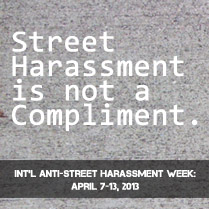
USA: International Anti-Street Harassment Week

April 2, 2013 By Contributor

By: Erin McKelle, SSH Correspondent

Did you know that Stop Street Harassment’s founder Holly Kearl also founded International Anti-Street Harassment Week? It takes place every spring, this year from April 7-13, and is a time where you can work even MORE actively to stop street harassment. Its purpose is to raise awareness about street harassment through active engagement and amplification.

Anti-Street Harassment Week gives you the tools to do practically anything you want to commemorate this week.

Want to go to an event? On their website, they have listings of events taking place around the world. Conduct a survey on street harassment? They have tips to show you how. Not sure what you want to do? They have a whole page full of ideas from street theatre to poster campaigns to sidewalk chalk!

Participating can even be as easy as raising awareness about street harassment to your followers on Twitter or your friends on Facebook. It’s amazing how a little awareness and education can go a long, long way. If you are posting to twitter, use the tag #EndSHWeek or #EndSH ! On Facebook, you can also change your profile picture to an image related to ending street harassment which can be found here http://www.meetusonthestreet.org/tools/.

On the tools page, there is also a myriad of content you can use in your efforts during the week! There are blank fliers that you can use to write a message on, bystander posters, logos and even pre-made fliers you can give out.

You can also support Anti-Street Harassment Week by donating to the cause! It’s a great way to show your support and is always welcomed and appreciated!

Becoming a co-sponsor is another option. The only requirements are that you advertise Anti-Street Harassment Week to your networks and participate in the week! So far, there are 128 groups in 19 countries that are participating.

Here is where you can sign up to officially participate! Anti-Street Harassment Week is important for raising awareness and doing anything, big or small, to join in is a great way to be actively partake in this work. Empower yourself and others on the street and meet us on the street during Anti-Street Harassment Week!

For more information, please visit: http://www.meetusonthestreet.org

Erin is an e-activist and blogger based in Ohio. You can find more of her work here and here.

Share

Filed Under: anti-street harassment week, correspondents, Resources, street harassment

Colombia: Promoting Masculinity that is Inclusive and Equitable

March 30, 2013 By Contributor

By: María Paulina López, SSH Correspondent

‘’The women’s fear to the violence of men, is the mirror of the men’s fear to fearless women.” – Eduardo Galeano

Recently, in the hallmark of a certification degree to educate and create conscience about preventing gender violence, given by the CES University and the Women’s Secretary  in Medellín, Colombia, there was published a book titled “Men caring for life.” This proposal of Denis Alonso Geldres, Rosamaría Vargas, Gladys Rocío Ariza y Silvia Gaviria Arbeláez, it’s dedicated to all Colombian women who have been victims of violence, and to the people committed to work for violence-free and equal societies.

With this model of awareness and formation they question the socialization of gender in the patriarchal model, educate men who multiply the feminist projects, involve them in the active struggle of women for equality and avoiding attitudes responsible for constant harassment.

One of the most important goals of this project is to make men conscious of the self-righteous respect women deserve in their constant interaction in the group they live in, and prevent street harassment. This abusive acts affects millions of people around the world, although there are a lot of actions we can take to try to stop street harassment, we can also make social conscience by community projects, and promote masculinities that search for inclusion and equality, compromised with women’s right to walk for our streets, to occupy freely our public spaces, to live safe and happy relationships and to have the same opportunities.

Maria is a psychology student, social investigator, and sexual educator. Follow her on Twitter, @MPaulinaLopez.

__________________________________________________________________________________________

En Espanol

“El miedo de la mujer a la violencia del hombre, es el espejo del miedo del hombre a la mujer sin miedo.” – Eduardo Galeano

Recientemente, en el marco del Diplomado de sensibilización y formación en masculinidades género sensibles y prevención de las violencias hacía las mujeres”, en convenio  de la Universidad CES con la Secretaría de la Mujer de la Alcaldía de Medellín, se ha publicado un libro titulado “Hombres cuidadores de vida”.  Esta propuesta de Denis Alonso Geldres, Rosamaría Vargas, Gladys Rocío Ariza y Silvia Gaviria Arbeláez, está dedicada a “las mujeres colombianas que han sido víctimas de feminicidios y a las mujeres y los hombres que están trabajando en pro de una sociedad equitativa, incluyente y sin violencia”

Con este modelo de sensibilización y formación se busca  cuestionar la socialización de género en el modelo patriarcal y formar hombres multiplicadores de propuestas feministas, involucrarlos para fomentar una transformación sostenible en el empoderamiento de las mujeres.

La importancia de esta iniciativa radica en la posibilidad de trabajar con los hombres para la prevención de la violencia hacia las mujeres, una de estas violencias es el acoso callejero, estos actos abusivos afectan a millones de personas en el mundo, y aunque existen muchas maneras de actuar cuando presenciamos que alguien está siendo acosada en la calle, también podemos realizar este tipo de ideas como una acción colectiva para prevenir el acoso callejero.

Sensibilizar y formar en nuevas masculinidades, es la manera de prevenir la violencia contra la mujer, incluyendo el acoso callejero. Masculinidades amantes de la inclusión y de una vida equitativa para todos, que se comprometan con los derechos de las mujeres a caminar tranquilas por la calle, a ocupar libremente los espacios públicos, a vivir relaciones de pareja seguras y felices y a tener igualdad de oportunidades.

Estudiante de psicología, investigadora social, educadora sexual MPaulinaLopez.

Share

Filed Under: correspondents, street harassment

« Previous Page
Next Page »

Share Your Story

Share your street harassment story for the blog. Donate Now

From the Blog

  • #MeToo 2024 Study Released Today
  • Join International Anti-Street Harassment Week 2022
  • Giving Tuesday – Fund the Hotline
  • Thank You – International Anti-Street Harassment Week 2021
  • Share Your Story – Safecity and Catcalls Collaboration

Buy the Book

  • Contact
  • Events
  • Join Us
  • Donate
  • Facebook
  • Instagram
  • Pinterest
  • Tumblr
  • Twitter
  • YouTube

Copyright © 2026 Stop Street Harassment · Website Design by Sarah Marie Lacy