• About Us
    • What Is Street Harassment?
    • Why Stopping Street Harassment Matters
    • Meet the Team
      • Board of Directors
      • Past Board Members
    • In The Media
  • Our Work
    • National Street Harassment Hotline
    • International Anti-Street Harassment Week
    • Blog Correspondents
      • Past SSH Correspondents
    • Safe Public Spaces Mentoring Program
    • Publications
    • National Studies
    • Campaigns against Companies
    • Washington, D.C. Activism
  • Our Books
  • Donate
  • Store

Stop Street Harassment

Making Public Spaces Safe and Welcoming

  • Facebook
  • Instagram
  • Pinterest
  • Tumblr
  • Twitter
  • YouTube
  • Home
  • Blog
    • Harassment Stories
    • Blog Correspondents
    • Street Respect Stories
  • Help & Advice
    • National Street Harassment Hotline
    • Dealing With Harassers
      • Assertive Responses
      • Reporting Harassers
      • Bystander Responses
      • Creative Responses
    • What to Do Before or After Harassment
    • Street Harassment and the Law
  • Resources
    • Definitions
    • Statistics
    • Articles & Books
    • Anti-Harassment Groups & Campaigns
    • Male Allies
      • Educating Boys & Men
      • How to Talk to Women
      • Bystander Tips
    • Video Clips
    • Images & Flyers
  • Take Community Action
  • Contact

“They’ve probably forgotten all about it already, but I haven’t”

June 14, 2014 By Contributor

The bus was late, as usual, so I was waiting at the street corner when a pick-up truck pulled up and I heard at least one of the three men inside whistle at me. I looked at them, and the whistling turned to kissing sounds. I turned my attention to my phone, but turned the volume down in my headphones so I could keep tabs on them. For a fleeting moment, I considered the fact that there wouldn’t be much stopping them from grabbing me, if they wanted to. I realized that would be highly unlikely, but the thought occurred to me all the same.

They were stuck at a red light, and I was waiting for my bus, so there was nowhere for me to go without risking missing my ride. I just stood there trying to ignore them. Finally, the light turned green and they drove off.

They’ve probably forgotten all about it already, but I haven’t. I feel angry and annoyed. They were so nonchalant about it, but I will spend the rest of my day thinking about what thoughts might have been running through their heads, how many other women they’ll objectify, and whether or not I’ll experience street harassment again today.

Oh, and not that it matters, but I was wearing jeans, a loose-fitting orange t-shirt with a high neck-line, and a grey hoodie. I daydreamed about slapping his puckered lips straight off his face, like a twisted Donald Duck cartoon.

Do you have any suggestions for dealing with harassers and/or ending street harassment in general?

People need to learn that it’s not okay. That seems to be the biggest issue. Men feel entitled to say something or whistle, and they expect us to allow it or even be appreciative. It’s not a compliment. It’s harassment and it’s got to stop. We need to teach our sons better.

– Anonymous

Location: Sherman Ave. & Columbia Rd., NW, Washington, D.C.

Share your street harassment story for the blog.
Check out the new book 50 Stories about Stopping Street Harassers!
Share

Filed Under: Stories, street harassment

“A growing trend for objectifying East Asian women in Western countries”

June 13, 2014 By Contributor

I am young East Asian girl and I experience stares from usually (over 40yrs old, White men) that makes me feel patronized, humiliated and angry. There is a growing trend for objectifying East Asian women in Western countries and many men seem to view Asian girls as some sort of pleasure giving objects. That is exactly the kind of gaze that I get from some men in the streets.

I am not wearing any revealing clothes and don’t have much make-up except eyeliner and it makes me angry to get these stares. It is hard for me to tell others as I am afraid to sound paranoid. Nowadays, if I sense any men trying to approach me in the streets, I would simply walk away, however just few days ago, there was this really old man who just keep standing next to me whilst I was waiting for a bus. I moved away but he would again come to the point where I was standing and just stare at me. I felt uncomfortable so I had to walk to next bus stop. I have been living in London for over 10 years and felt normally safe but these experiences are becoming nuisances to me and I feel not so safe anymore.

– Anonymous

Location: London, UK

Share your street harassment story for the blog.
Check out the new book 50 Stories about Stopping Street Harassers!
Share

Filed Under: Stories, street harassment

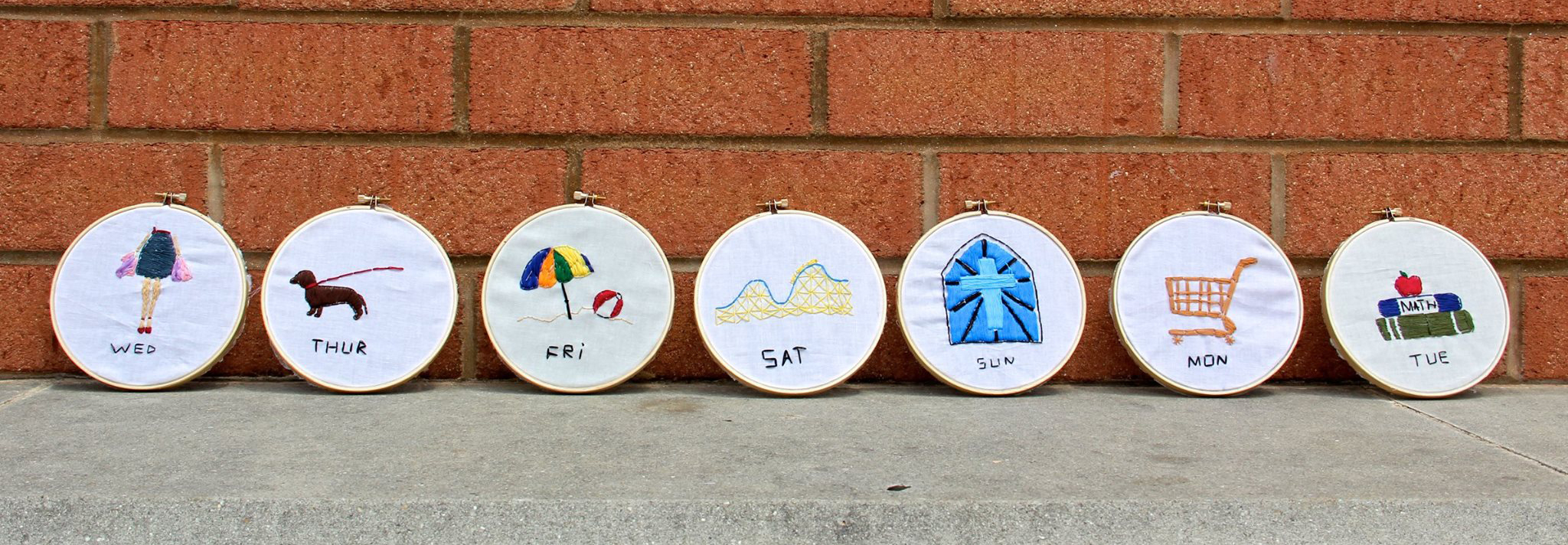
High School Student’s Embrodiery Project Raises Awareness

June 12, 2014 By HKearl

Muneera is a graduating high school student who reached out to SSH about her senior project that in part addressed street harassment. She agreed to an interview to share more about it.

SSH: Why did you choose to do a senior project that included street harassment? 

Muneera: Prior to this year, my awareness of sexual harassment was pretty limited. I knew the basic mantras we had learned growing up–don’t let anybody touch you but your parents or your doctor (a luxury, I learned through my project, many girls don’t even have), if you are uncomfortable tell an adult you trust– but I had assumed it was some horrible, distant tragedy that happened to a few, unfortunate, choice girls.

It wasn’t until I became familiar with feminism (through social media and my AP Literature class) that I began to notice something was amiss. “Shrinking Women,” a slam poem by Lily Myers especially pushed me to expect better for myself. I wanted to do a project that would be as important to others as the role of social media has been in my development in how I see myself and the world. The culture that enables street harassment functions entirely on a lack of respect, and I think it is so pervasive that women, including myself, begin to expect it, to make excuses for it.

Sometimes we even try to convince ourselves that we deserve harassment, when the only thing we “deserve” is the right to be respected and to feel safe. If people get anything out of my project, I hope it is the idea that you, your mother, your sisters, friends and neighbors all deserve better, and everyone can be a part of that shift.

SSH: How did you come up with the embroidery idea? Who did you ask to share their stories?

Muneera: Embroidery is something that has been on my radar as of late. I love the fairly recent trend of expressing some not-so-traditional values (Grrl power patches, anyone?) through a very traditionally “gender-safe” activity. Embroidery can be traditional or “confrontational,” and the versatility of it made it the perfect medium with which to express such a universal topic. I tried to embroider the pieces as if I were the girl in each story, which brought about the issue of gender roles and gender appropriated activities. For some girls, going home and working on something intricate may be comforting, for others, it may be too confining. Not only can limiting certain things to certain genders deprive someone of a positive coping mechanism, it can muffle what it is they are trying to express.

I started with just my friends and ended up branching out to many of my classmates. Not one of the approximately 30 female classmates interviewed did not have a story to tell. I narrowed it down to seven stories about quintessential summer activities; the days of the week are supposed to represent the last week of summer. Although I did not discriminate with gender when it came to who I asked, I was unable to find stories to share from any of my male classmates (which does not imply that it does not happen to men, but rather that either my classmates were fortunate or not comfortable sharing their stories with me). Since I did only have stories from people who identified as girls, I decided to do my project from that perspective, hence, Diary of a Girl.

SSH: Would you mind sharing another example of what one of the embroideries is of/the story behind it?

Muneera: Sure! Monday is about a girl walking to a grocery store. When she was crossing the street, multiple men at the stoplight got out of their car and began to make obscene gestures at her. Thursday is about being stalked while walking the dog. All seven experiences happened when the girls were considerably young, nine to fourteen at most.

SSH: What kind of response have you gotten to your project?

Muneera: Surprise. Always surprise. A few tears. I ask people to guess what the project is about from the front before flipping to the back, and you can almost see the flip switch in their head when it goes from quintessential last-week-of-school activities to something just as integral but much more insidious in any girl’s life. It’s not a fun thing to do, but it opens up a discussion about what happened and what can be done to prevent it again, which for now, is more than worth it.

Muneera is from Lowell, MA, a small city outside Boston. She currently resides outside of DC with her cat and plans to attend college in Richmond in the fall. The embroideries were photographed by Ariadna Rigol Prat

Share

Filed Under: Activist Interviews, Resources, Stories, street harassment

First harassed at age 7 on the streets

June 11, 2014 By Contributor

The first time I was sexually harassed by men while I was on the street, I was seven years old. I was crossing in front of my house when a carload of men drove by and hooted and whistled at me and yelled that I was sexy.

Although young, I knew the implication of their catcalls, and I ran as fast as I could into my house, my head ducked down and my cheeks hot with shame. I felt very embarrassed that I had been noticed by these much older men and had been seen in a sexual way – and I remember distinctly feeling it was because I had done something wrong. I even knew what it was I had done.

I was always an older-looking child. At seven years old, I probably passed for maybe 10 (not that this would be any improvement as far as the carload of men is concerned). I was still very much a kid though, and I loved Michael Jackson and wanted to learn to dance just like him. My mom, in a tragic effort to be ‘cool’, had taken my brand-new, favorite Michael Jackson t-shirt out of my drawer after I just got it, and had cut the sleeves and bottom hem into long strips of fabric on which she had affixed wooden, colored beads.

When she presented it to me as a birthday gift later, I was devastated. We were very poor. The four of us (me, mom, half-brother, mom’s creepy boyfriend) had been living in an actual school bus up until very recently. It had been hard enough to talk her into buying that shirt for me to begin with, and then she had taken it from my drawer and shredded it.

I didn’t like the look of that beaded t-shirt at all, it felt too grown up and attention-needy for me. The effect was more revealing and ‘sexy’ than a normal t-shirt, and was usually worn by girls more than twice my age, or by older hippies like my mom. But I loved Michael Jackson, and I really missed the other t-shirt I never got to wear.

So, that day I gave in and tried out this horribly revised/shredded t-shirt, crossing the street in front of our house when these men drove by and saw me, a tubby, tallish, seven-year old in an awful shirt that was very inappropriate for her, and they whistled, hooted, and yelled, “Hey sexy!!”

I felt that it was very much my fault, because I knew damn well how I looked in that shirt even if my mom was clueless (the reason why is a whole other story of my inappropriate childhood). I didn’t even want to wear that shirt, but I had worn it that day even though I had a bad feeling about it. And look what happened, it was my fault.

It didn’t save me from getting harassed by men again later as a child, teenager, or woman – but I never wore that f***ing t-shirt again.

Do you have any suggestions for dealing with harassers and/or ending street harassment in general?

Everyone should be taught how to confront street harassment the very moment that it happens. In the moment, without prior preparation, it is very hard to push back or respond in an assertive way because you’re humiliated and off-guard.

– Anonymous

Location: Cedaredge, CO

Share your street harassment story for the blog.
Check out the new book 50 Stories about Stopping Street Harassers!


Share

Filed Under: Stories, street harassment

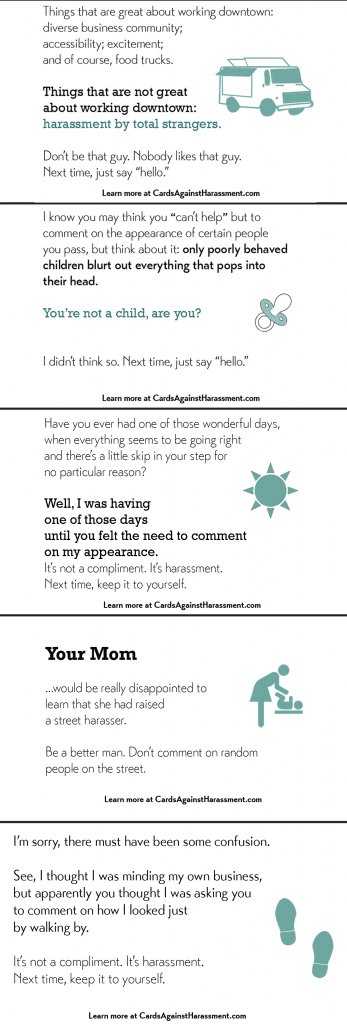
Talk Back to Your Harasser with These Cards!

June 10, 2014 By Contributor

Editor’s Note: Have you ever wished you could hand a harasser a card to explain why his/her behavior is inappropriate? The new Cards Against Harassment site is your answer! Creator Lindsey explains the story behind it

I’ve lived in Washington, D.C. and Philadelphia before moving to Minneapolis, and observing street harassment (of myself and others) has been a pretty regular part of my experience in all of those cities. Like many people who encounter harassment, my approach for the better part of a decade was just to ignore it.

If I had to pinpoint where that attitude shifted towards a more active approach, two particular experiences from a year or so ago come to mind.  I was taking the bus home alone after a night out with friends when a man sitting across from me started blowing kisses and asking why my “boyfriend” (another stranger, closer to my age and sitting to my right who was engrossed on his phone) wasn’t paying attention to me. The heckler was leaning far forward in his seat across the aisle at me, saying he’d treat me better if I was his woman and asking why didn’t I come sit on his lap so he could show me.  I ignored him, but once the heckler caught on that I was actually traveling alone, he shouted at the guy to my right to switch seats with him so he could “cozy up” to me. I kid you not, the loser to my right wordlessly stood up to switch seats with the heckler. Thankfully this all happened while the bus was at a stop, so I was able to immediately get up and leave the bus.

Not more than a month later, with that event still fresh in my mind, I had my first opportunity to be an ally to someone being harassed. I was taking the lightrail a few seats away from a young U of M student who started to get a lot of unwanted attention from another rider. She was clearly trying to read her book and he kept asking where she was going, what she was doing, getting in her space and blocking her physically into the row.  When it became clear that this woman was uncomfortable and unable to extricate herself, and he started commenting on how pretty she was, I tapped the guy on the shoulder, stuck my hand out to shake his hand, and said, “Look, I’m sure you’re just trying to strike up a conversation, but when a woman is traveling alone and has her nose in a book she probably isn’t looking to get talked to by strange men late at night. If you want to talk to me for a while, that’s fine, but let’s give her a break.”  He was clearly annoyed and surprised at being confronted, and after muttering about how that’s just “how they do things in Chicago,” he moved to the other side of the car.

Since then, I have been verbally confronting street harassers whenever I get the chance. Sometimes it’s gone really well: one time, a group of young men stopped and genuinely listened to me talk about street harassment for nearly 20 minutes when I pointed out that their attempt to “compliment” me on a poorly lit street when I’m walking home from work is incredibly insensitive and intimidating. By September of last year, an instance of particularly skeezy drive-by harassment left me fed up enough that I took to craigslist and wrote the venting post that ended up getting circulated beyond Minneapolis.

But recently, a confrontation didn’t go so well, and that’s what finally inspired me to make Cards Against Harassment.

Several weeks ago, there were two men in the skyway leading up to my office building heckling and dramatically checking out literally every woman they passed. I took a detour to avoid them but a moment later was on the same escalator, with one of the men right behind me calling me “Blondie,” invading my personal space, and asking why I was walking away so fast looking so cute. I turned and politely quipped, “You know, you can just say ‘Good Morning.’ You don’t have to make a comment about how I look.” Although we were surrounded by people, he started going off on me, shouting at me about how ugly I was and how I wasn’t even really cute enough for him to compliment and calling me a bitch. I spun on my heels, walked over to the security guard in our building, and am grateful to say he was incredibly responsive and immediately removed the men from the building, but the interaction reminded me that even if I am friendly or playful in my responding to harassers, there is risk in confrontation. I decided that a card would be the ideal middle ground, allowing me to provide feedback that harassment is unwanted without necessarily sticking around for an extended encounter.

So far I’m happy to say that since getting the cards back from the printer a few days ago I haven’t had the need to distribute any. I have had friends download the pdfs to print their own, and the sentiment shared with me is that even having the cards available makes them feel a bit more prepared and empowered to walk in their own neighborhoods with their head held high. Certainly my goal is not to pressure women to put themselves at risk if the situation isn’t right, but my hope is that the cards will start a dialogue and encourage men and women alike to defend everyone’s right to walk in public spaces without feeling unsafe or objectified.

Lindsey is a 28 year old woman living and working in Minneapolis, MN. When she isn’t fulminating on gender equity issues or working her day job, she enjoys improv comedy, cartooning, biking, and smack talking others over board games and whiskey.

Share

Filed Under: Resources, Stories, street harassment

« Previous Page
Next Page »

Share Your Story

Share your street harassment story for the blog. Donate Now

From the Blog

  • #MeToo 2024 Study Released Today
  • Join International Anti-Street Harassment Week 2022
  • Giving Tuesday – Fund the Hotline
  • Thank You – International Anti-Street Harassment Week 2021
  • Share Your Story – Safecity and Catcalls Collaboration

Buy the Book

  • Contact
  • Events
  • Join Us
  • Donate
  • Facebook
  • Instagram
  • Pinterest
  • Tumblr
  • Twitter
  • YouTube

Copyright © 2026 Stop Street Harassment · Website Design by Sarah Marie Lacy