• About Us
    • What Is Street Harassment?
    • Why Stopping Street Harassment Matters
    • Meet the Team
      • Board of Directors
      • Past Board Members
    • In The Media
  • Our Work
    • National Street Harassment Hotline
    • International Anti-Street Harassment Week
    • Blog Correspondents
      • Past SSH Correspondents
    • Safe Public Spaces Mentoring Program
    • Publications
    • National Studies
    • Campaigns against Companies
    • Washington, D.C. Activism
  • Our Books
  • Donate
  • Store

Stop Street Harassment

Making Public Spaces Safe and Welcoming

  • Facebook
  • Instagram
  • Pinterest
  • Tumblr
  • Twitter
  • YouTube
  • Home
  • Blog
    • Harassment Stories
    • Blog Correspondents
    • Street Respect Stories
  • Help & Advice
    • National Street Harassment Hotline
    • Dealing With Harassers
      • Assertive Responses
      • Reporting Harassers
      • Bystander Responses
      • Creative Responses
    • What to Do Before or After Harassment
    • Street Harassment and the Law
  • Resources
    • Definitions
    • Statistics
    • Articles & Books
    • Anti-Harassment Groups & Campaigns
    • Male Allies
      • Educating Boys & Men
      • How to Talk to Women
      • Bystander Tips
    • Video Clips
    • Images & Flyers
  • Take Community Action
  • Contact

South Africa: Perspectives on How Men Should Approach Women in the Street

October 28, 2013 By Correspondent

By: Gcobani Qambela, South Africa, SSH Correspondent

Via The Huffington Post

I recently read an interesting article in The Huffington Post titled “What We Wish People Would Say To Us On The Street”. The article covers the illustration by Norma Krautmeyer “which observes what people never say to women on the street.” This month I decided to talk to a small number of South Africans from across genders in various provinces in South Africa about the different ways they would like people to approach them in the street.

I believe street harassment in any form is unacceptable, but where necessary, how can men be better prepared to approach women in respectful and dignified ways in the street? What are the best ways to start a conversation with strangers across genders in a non-threatening way in the streets?

I spoke to gender activist and researcher, Rethabile Mashale, in Cape Town, in the Western Cape province of South Africa. She tells me that she has had her fair share of being subject to “catcalling and harassment” in the street. So what approach does she prefer when strangers, especially men approach her in the street? She says she has devised five basic alternatives. “The first is that a decent and genuine ‘hello’ and ‘how are you?’ which are followed by a genuine concern for whatever happens next” always work she says. Secondly she says “never lick your lips, or do a once over, over my body.

The person, thirdly, must look me in the eye instead of my tits” she continues. Fourthly she says while a clever joke can work, pick up lines are generally also unacceptable. She says lastly and mostly importantly “lead with getting my PERMISSION to engage in conversation, in fact, I would say that is the most important one” to get permission to talk and engage a person and quietly accept should she decline.

I also spoke to Amanda* in the province of KwaZulu-Natal. She told me she feels like street harassment is very degrading and that there is always a very “thin-line” between a stranger cracking a conversation and also at the same time harassing you. However the important distinction she made is that “Harassment is when I say ‘no’ and he doesn’t stop or if he feels the need to touch or say derogatory things to me.”

Tandokazi Mbopa, a university student in Port Elizabeth, in the Eastern Cape province, told me that she just does not want strangers approaching her in the street at all. This, she said, was born out of a horrible experience of being persistently harassed in the street. She told me that last year, she was walking and running late to school and a guy in a car kept hooting at her even though she ignored him. “He really didn’t get the hint ‘because he was driving next to me saying: ‘Oh, where are you going? Do you want a lift?’ as if I was going to get into that car after that hooting” she tells me.

Despite her declination to get into the car she says he refused to take a hint and kept driving slowly next to her saying, “Ooh, baby you’re hot. Baby you’re hot.”

“I felt like meat. The way he was looking at me. I was wearing track pants and a vest down to cover my butt… I wanted to change whatever was making him look at me like that and call me ‘sexy’” she tells me. “I don’t respect any guy approaching me on the street. I never will, unless if I’ve met you before – just not in the streets,” she concludes.

While these are only three interviews that I have included here, what emerged clearly from all the women I spoke to is that the key is consent and permission to approach and talk to women or anyone else in the street should be garnered clearly from the person who is being approached. If the women do not want to speak or engage then one should politely accept that. While Krautmeye’s illustration is encouraging, it is also important to remember that there are people with painful experiences like Tandokazi of dealing with harassers in the street even though the harassers probably thought they were saying something ‘nice’ to her. It is important therefore to treat even what appears to be ‘nice’ harassment with caution for it can also be traumatic for those on the receiving end. Consent and acceptance of a woman’s choice is thus critical in all cases, even if it appears that the guy is saying something that the woman would appreciate.

*The interviewee wished to remain anonymous.

Gcobani is completing his Masters in Medical Anthropology through Rhodes University, Grahamstown, South Africa. His research centres around issues of risk, responsibility and vulnerability amongst Xhosa men (and women) in a rural town in South Africa living in the context of HIV/AIDS. Follow him on Twitter, @GcobaniQambela.

Share

Filed Under: correspondents, Stories, street harassment

“So gross, and so disturbing.”

October 27, 2013 By Contributor

I was walking to our local corner market in the middle of the day when a man driving by stopped and rolled down his window. He asked me where the 210 Freeway was, and when I told him, “No, sorry,” and kept walking he proceeded to pull out his dick (in his Nursing scrubs, I might add) and started to jerk off. He then told me, “He knew I wanted to suck his dick” and became increasingly aggressive/excited. I told him to “Get the f*** out of here” and I walked back a block where I had seen a couple standing.

He then sped off. So gross, and so disturbing.

– Anonymous

Location: Marmion Way and 53rd, Los Angeles, CA

Share your street harassment story for the blog.

Share

Filed Under: Stories, street harassment

UNiTE to Make Public Places Safer!

October 25, 2013 By HKearl

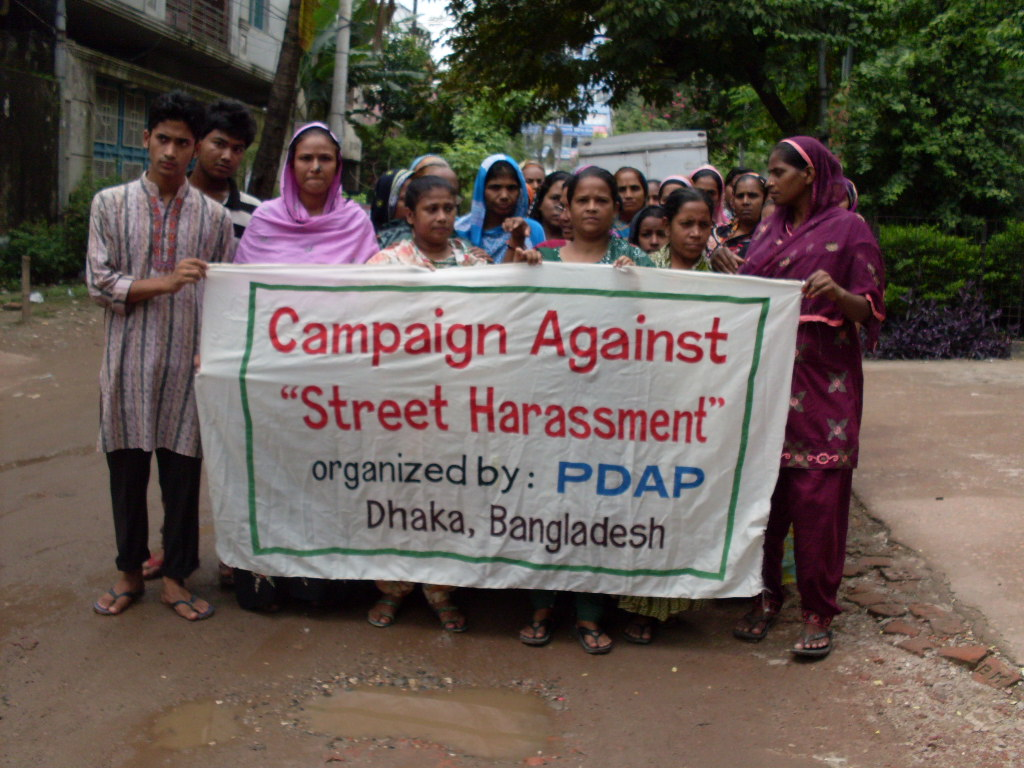
Community Members in Bangladesh recently met to discuss how to make their public places safer for girls & women.

On the 25th of every month, the UNiTE to End Violence against Women campaign focuses on different types of violence against women and girls. Today they are focusing on harassment and violence in public places and how we can make those spaces safer for women and girls. This is something we at Stop Street Harassment strive to do every day and we are happy to support the campaign!

From the UNiTE’s website:

“Violence and the fear of violence reduces women’s freedom of movement and rights to access education, work, recreation, and essential services, and can restrict their participation in political life. It also negatively affects their health and well-being. Despite these wide-ranging consequences, violence against women and girls in public spaces remains a neglected area, with few laws or policies in place to prevent and address it.

At the 57th Session on the Commission of the Status of Women, governments made specific commitments directed towards making public spaces safer for women and girls.

For the first time the Commission on the Status of Women, the highest global normative body on women’s rights, during its 57th Session specifically included several clauses in its Agreed Conclusions document devoted to safety of women and girls in public spaces, and particularly, in the cities.  It expressed “deep concern about violence against women and girls in public spaces, including sexual harassment, especially when it is being used to intimidate women and girls who are exercising any of their human rights and fundamental freedoms.”  (23, p4)

It called on the States “to increase measures to protect women and girls from violence and harassment, including sexual harassment and bullying, in both public and private spaces, to address security and safety, through awareness-raising, involvement of local communities, crime prevention laws, policies, programmes such as the Safe Cities Initiative of the United Nations. (ZZ, p13)“

What YOU can Do:

1. Learn more about the issue, why it matters, and what you can do about it. Here is an article I wrote for Ms. Magazine’s blog about how street harassment can escalate to assault – and three ideas for what we can do to change our culture so street harassment is no longer acceptable.

2. Join the Tweet chat throughout the day, led by UN Women and UN Habitat (#OrangeDay). Our friends at the Huairou Commission are hosting it at 10 a.m. EDT.

3. Donate to Stop Street Harassment — we’re working to fund the first-ever national study on street harassment. This data is sorely needed before we can adequately tackle the problem. We also do a lot of other work that is solely funded by donations.

 Update: Read what groups around the world did to speak out in support of space public spaces for women and girls!

Share

Filed Under: SSH programs, Stories, street harassment

UK: What am I supposed to do when I get harassed?

October 24, 2013 By Correspondent

By: Levi Grayshon, Manchester, England, SSH Correspondent

When you hear someone’s street harassment story, it is very easy to tell them “you should have…” or “If I was you, I would…”, but most of the time, it is not so simple.

Reacting in a certain way can only antagonise the harasser, placing the victim in a much more dangerous and/or hostile situation. In addition to this, it may be frightening for the victim to challenge their harasser, especially with aggression, particularly if they are alone and are being targeted by multiple people.

When harassed, it is easy to feel as though you are at fault. When a stranger is shouting lewd comments at you, or touching you, or wolf whistling at you, it is easy to feel small, hurt and under threat. It is hard to remember that it the harassers problem, and not yours. We are told as women to be polite, and that it happens because men are trying to show us that they find us attractive, but when telling friends about situations in which we were harassed we get asked why we didn’t act more assertively, so it’s little wonder that figuring out how to react to harassment is often so confusing, as well as scary.

Something that can make harassment situations a lot easier to handle is the involvement of allies in the street. When other men tell the harasser what he is doing wrong, it can soothe the problem. It is not ideal (and a world when harassers actually listen to the victim – wait, a world where there are no harassers – would be much better), but educating the harasser is a much better way to ease the problem, rather than fighting it with more aggressive behaviour. The recent youtube video, “Shit Men Say to Men Who Say Shit to Women in the Street” highlighted that not all men are on the same team as men who harass, and are willing to speak up against them. Unfortunately, in a lot of instances, bystanders feel uneasy about becoming involved.

Some more helpful Stop Street Harassment tips are to be firm with the harasser, and avoid being apologetic, whilst calling them out on their unsavoury behaviour, but without insulting them. Following on from this, try to avoid engaging further with the harasser (as tempting as it may be if they try to argue with you), and to keep moving, detaching yourself from the situation. As well as this, it may prove helpful to report the harasser, for instance, if they are wearing a uniform, or driving in a company vehicle. Even threatening to report them (especially to their employer) can encourage the harasser to see what they are doing wrong.

Even some institutions are going out of their way to ensure that women feel safer in public. For instance in Tokyo, women’s only carriages were introduced on the problematic Saikyo line a few years ago, the route used by many schoolgirls, and labelled a “gropers paradise” by many. Even male commuters welcomed the changes. But is segregation the answer? Would education not work better?

There is no right or wrong answer to the question “what should I do when I am harassed in the street?”, but there is one thing to remember– you are not the one in the wrong.

[Check out the new book 50 Stories about Stopping Street Harassers for more ideas.]

Levi graduated from university with a degree in Film and TV screenwriting this summer. As a freelance writer, she has been writing for The F-Word and Gamer-UK. You can follow her rants and ramblings on Twitter, @part_heart.

Share

Filed Under: correspondents, Stories, street harassment

Important Discussion with GBTQQI Men in D.C.

October 23, 2013 By Contributor

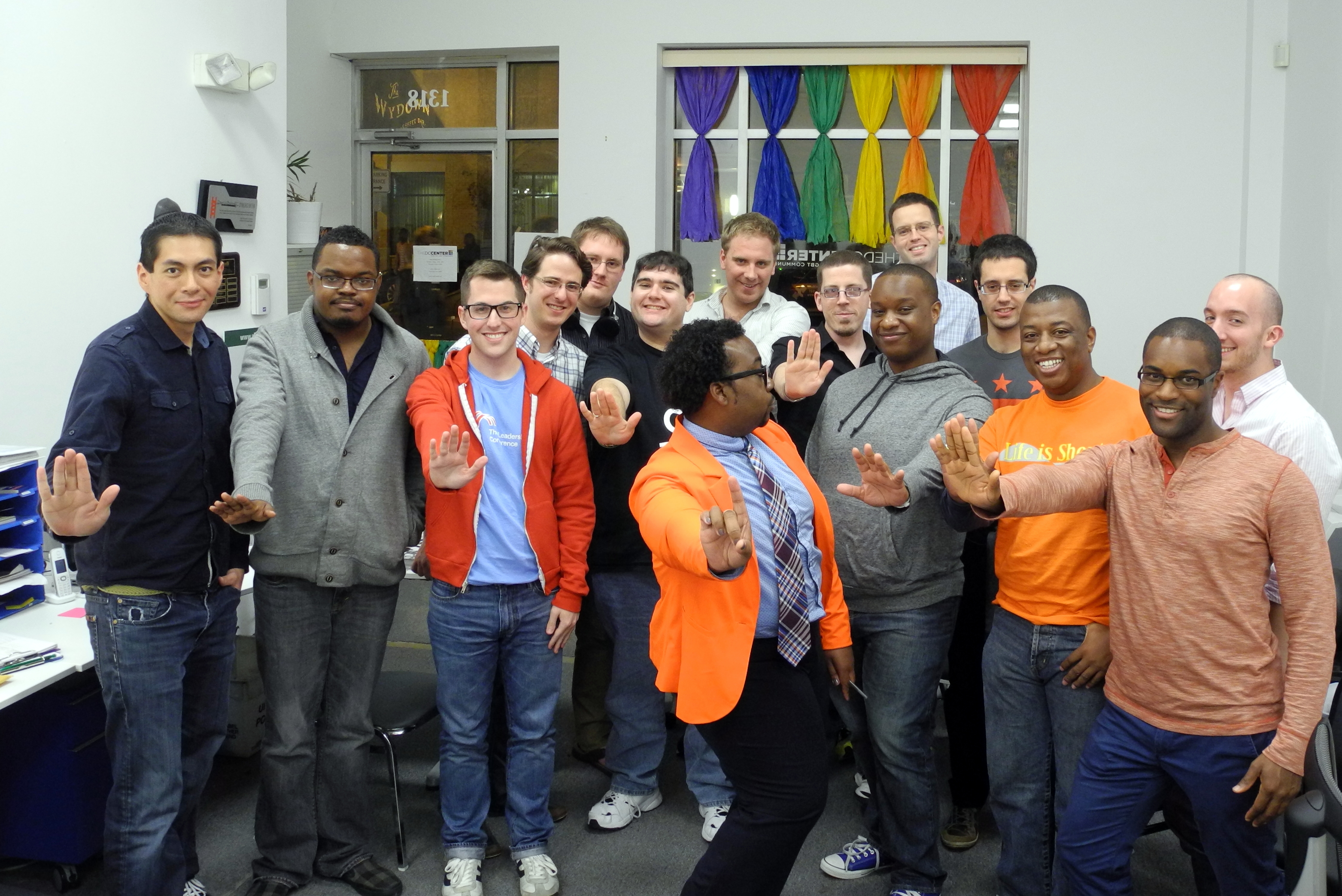
The Gay District says NO to harassment!

By: Patrick Ryne McNeil

On Friday, October 18, I joined Holly Kearl to co-facilitate a discussion group at Gay District, a “social and discussion group for 18-35-year-old GBTQQI men” that meets twice each month in Washington, D.C.

The discussion focused on sexual harassment and sexual violence experienced in public spaces specifically by this community of men in D.C. Stories about particular incidents of street harassment, how these experiences impact the way these men navigate public spaces, and solutions – both in D.C. and beyond – were of particular interest during the discussion.

I was incredibly appreciative for the number of men who attended this important discussion and was struck by just how many of them had stories to share. They underscored for me both how common this issue is for so many men in D.C. and just how many separate venues it permeates – not just on the street, but in stores, at bus stops, on the bus and on metro. And it starts so early. Several men discussed being harassed at alarmingly young ages, well before they identified as gay or some other non-normative identity.

One solution discussed that is specific to D.C. was making sure everyone knows they have access to WMATA’s anti-sexual harassment ad campaign, something that many men thought was really (perhaps exclusively) for the use of women. In addition, ensuring that everyone knows where they can report harassment is critical; one participant who experiences harassment at his bus stop was unaware that he could report harassment at that location, which is in fact an option on WMATA’s reporting page.

Friday’s discussion is one of ten taking place across the United States with various demographics as part of Stop Street Harassment’s national study on street harassment.

My master’s thesis focuses on how gay and bisexual men experience street harassment. To learn more about my research in particular, you can check out my op-ed from this year’s International Anti-Street Harassment Week, or contact me at patrickryne@gmail.com.

Patrick McNeil is finishing his master’s thesis at The George Washington University in Washington, D.C., where he is pursuing his Master’s in Women’s Studies. His work focuses on whether and how gay and bisexual men experience street harassment and how this form of harassment intersects with and diverges from the gender-based street harassment of women. Follow him on Twitter at @patrickryne.

Share

Filed Under: LGBTQ, SSH programs, Stories, street harassment

« Previous Page
Next Page »

Share Your Story

Share your street harassment story for the blog. Donate Now

From the Blog

  • #MeToo 2024 Study Released Today
  • Join International Anti-Street Harassment Week 2022
  • Giving Tuesday – Fund the Hotline
  • Thank You – International Anti-Street Harassment Week 2021
  • Share Your Story – Safecity and Catcalls Collaboration

Buy the Book

  • Contact
  • Events
  • Join Us
  • Donate
  • Facebook
  • Instagram
  • Pinterest
  • Tumblr
  • Twitter
  • YouTube

Copyright © 2026 Stop Street Harassment · Website Design by Sarah Marie Lacy