• About Us
    • What Is Street Harassment?
    • Why Stopping Street Harassment Matters
    • Meet the Team
      • Board of Directors
      • Past Board Members
    • In The Media
  • Our Work
    • National Street Harassment Hotline
    • International Anti-Street Harassment Week
    • Blog Correspondents
      • Past SSH Correspondents
    • Safe Public Spaces Mentoring Program
    • Publications
    • National Studies
    • Campaigns against Companies
    • Washington, D.C. Activism
  • Our Books
  • Donate
  • Store

Stop Street Harassment

Making Public Spaces Safe and Welcoming

  • Facebook
  • Instagram
  • Pinterest
  • Tumblr
  • Twitter
  • YouTube
  • Home
  • Blog
    • Harassment Stories
    • Blog Correspondents
    • Street Respect Stories
  • Help & Advice
    • National Street Harassment Hotline
    • Dealing With Harassers
      • Assertive Responses
      • Reporting Harassers
      • Bystander Responses
      • Creative Responses
    • What to Do Before or After Harassment
    • Street Harassment and the Law
  • Resources
    • Definitions
    • Statistics
    • Articles & Books
    • Anti-Harassment Groups & Campaigns
    • Male Allies
      • Educating Boys & Men
      • How to Talk to Women
      • Bystander Tips
    • Video Clips
    • Images & Flyers
  • Take Community Action
  • Contact

Canada: Street Harassment in Ontario A Century Ago

October 18, 2013 By Correspondent

By: Lisane Thirsk, Ottawa, Canada, SSH Correspondent

Criminal Assize Indictment, Algoma District, 1916. Available at the Archives of Ontario.

After reading SSH blog posts earlier this month about the history of street harassment in the U.S. (book review, author interview, and 100 years of activism), I was inspired to dig up some research I did a couple years ago for my master’s degree. For one assignment I went to the Archives of Ontario and uncovered criminal case files about street harassment around the turn of the 20th century.

According to historians, this period was characterized by “moral panic” in Canada. Social anxiety surrounded immigration, urban growth, and women’s shifting roles in public life.

My search at the Archives was guided by Karen Dubinsky’s Improper Advances: Rape and Heterosexual Conflict in Ontario, 1880-1929. I recommend this book to anyone interested in the history of street harassment – particularly Chapter Two on “The Social and Spatial Settings of Sexual Violence” in rural and northern areas of the province.

The legal records cited in Dubinsky’s book, as well as those I examined on microfilm reels at the Archives, provide vast documentation of sexual violence committed by strangers outdoors.

In rural communities, rape and sexual assault were often reported by women who had been attacked while walking through isolated farm fields. On small-town roads, women more often reported offences such as being chased, insulted or grabbed.

Just like in the U.S., street harassment was known as “mashing” at that time, and it was viewed as undesirable behaviour. The records show that these assaults didn’t just occur at night or when women were walking alone.

Panic emerged in numerous communities in Ontario. Mashers were stereotypically imagined as strangers in berry patches, tramps from Montreal, taxi drivers, and Indigenous men.

One of the most infamous predatory figures was known as Jack the Hugger, the nickname of a serial sexual assaulter (or more likely, several assaulters) appearing in the records from 1894 to 1916.

When confronted by a street masher, women were quite often assertive and resourceful. They defended their right to the street with defiant words, an umbrella, or by slapping the perpetrator.

Meanwhile, the prevalence of street harassment led commentators, including judges, to call for harsher punishment in the name of women’s freedom of mobility. And it was not uncommon for women – at least those who show up in the archives as “respectable” – to successfully pursue justice through legal avenues.

In her book Dubinsky reveals that the willingness of authorities to hold mashers accountable was due in part to the growth of the labour movement in Ontario.

As it became more acceptable for single women to migrate to towns and cities for jobs, scrutiny shifted to young lower-class men harassing female factory workers. Men’s public idleness and aggression were seen as threats to the values of self-control, restraint and productivity.

Below are the basic facts from one of the case files from Sault Ste. Marie that I examined at the Archives. It included statements from the complainants, the accused, and witnesses; and it illustrates some of Dubinsky’s conclusions about mashing in early 20th century Ontario.

* Around 7:30 a.m. in July 1916, Robert E. began following Emma B., a young woman who lived at a boarding house and was on her way to work at a tailor’s shop. Emma had been alerted to the Jack-the-Hugger stories circulating in her community, so she turned onto a busier street. Robert caught up to her, grabbed her hip, and said, “You would make good fucking.” He ran away, but Emma caught up to him and told him to keep his hands off her and to mind his own business.

* A few days later, Robert assaulted Louise P. around 5:15 in the evening. In her deposition Louise reported, “a young man caught hold of me by the bre[a]st … He turned around and put his hands down the front of his pants … I asked him what the devil he meant, and I started to follow him up, and then he ran.”

* In September 1916, Robert was charged with two counts of Indecent Assault on a Female. His defence focused on him having been steadily employed at the Steel Plant.

When we look back on the history of sexual violence, we tend to assume one of two things.

We either believe that in “the good old days” women were more respected in public and harassment wasn’t as explicit. Emma and Louise’s stories, along with many others I encountered at the Archives of Ontario, would suggest otherwise.

Or else we believe that as a society we’ve come a long way from the prejudiced thinking of the past. By reading between the lines in documents like Robert E.’s indictment, Dubinsky shows that it wasn’t always women’s wellbeing or principles of social equality that guided the prosecution of street harassers.

If we look carefully at today’s responses to street harassment – legal or otherwise – we might find many of these same patterns playing out.

Lisane works in the non-profit communications sector and supports local anti-street harassment advocacy through Hollaback! Ottawa. In 2012, she completed a Master’s in Socio-Legal Studies at York University in Toronto, where she wrote her Major Research Paper on gender-based street harassment. She holds a B.A. in Latin American Studies and Spanish from the University of British Columbia.

Share

Filed Under: correspondents, SH History, Stories, street harassment

“something to look at but not much to see”

October 17, 2013 By Contributor

I. Shame
I want to teach myself to not feel sick with guilt
when I tell you to shut the fuck up, and
I wish I could take back the quiet “thank you”
I politely whisper when you won’t leave me alone
and I don’t know what else to say.

II. Anger
“Smileformeyoungladylookingsobeautiful, canyougiveasmileforme?”
it’s a command given in two breaths.
May it subtract two of your last inhalations
for every time you’ve said it to me, every time you’ve seen me.

III. Violence
If you think my ass is yours to grab,
then I think your eye sockets are a good place
for me to jab my middle fingers, and twist.
I don’t want you to see—even in your mind’s eye—
the things you say you’d do to me if you could take me home.

IV. Shame
I’m told I “should be flattered”
As if I’m incorrect to feel
uncomfortable, unsafe, and degraded.
As if I lack emotional agency, and it’s somehow up to others
to decide how to respond to my body
with no regard for my brain.

Erica Motz is a third-year student at UW-Madison.  You can talk with her about street harassment, street respect, gender performativity, music, or making weird art at this address: ericarosemotz AT gmail.com.

Share

Filed Under: Stories, street harassment

Harassed at a wedding reception

October 16, 2013 By Contributor

At my boss’ wedding reception, a male who said he was my boss’ cousin kept asking if he could speak to me alone. He harassed me again at a table full of two other women. He kept asking if he could call me some time, and leaned in and patted me on my back as he was talking.

– Anonymous

Location: New York

Share your street harassment story for the blog.

Share

Filed Under: Stories, street harassment

USA: Street Harassment is Everywhere, but so are the People Fighting It

October 16, 2013 By Correspondent

By Britnae Purdy, SSH Correspondent

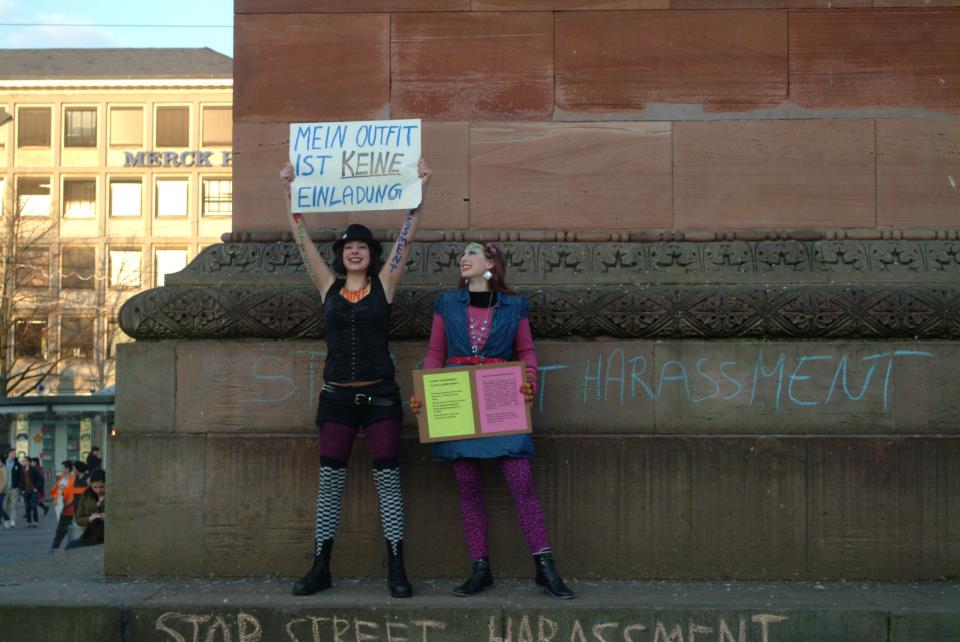
Germany: International Anti-Street Harassment Week 2013

Last summer I had the opportunity to study-abroad through a month-long tour of five European capital cities. It was amazing experience, it changed my life, but blah blah blah – that’s not the point of this story. The point is that I can’t think about street harassment now without remembering one distinct night in Berlin.

Our group was on the rail system coming back from a concert. At the next stop, a few young men got on. They had clearly been drinking already that night, and were shouting, pushing each other around, roughhousing –taking up as much space in the car as they could with their overt shows of “masculinity” and being a general nuisance to the rest of the riders. They proceeded to quite obviously make remarks about the women in my school group. It was one of the few times in my life I’ve actually been grateful not to speak the local language, because judging from the uncomfortable looks of other passengers, they were being quite crude. I pulled an old trick – I “borrowed” one of my guy friends, hanging close on his arm to give the illusion that we were together to try and avoid being a target of the harassment. A couple of stops later the guys disembarked and we all breathed a sigh of relief that the uncomfortable situation was over.

Back at the hotel, a few of the girls in our group made plans to go out on the town and enjoy the Berlin nightlife. I opted to stay at the hotel with some friends instead to catch up on the required readings (nerd alert). As they left, one of the remaining boys made the remark, “I can’t believe they still want to go out, after witnessing that display of what men are like here.”

I was angry before I fully knew why, and replied sharply without thinking, “That’s ridiculous. There are guys like that everywhere.”

Thinking back, I’m not sure what made me more angry – the idea that that particular male could have been so oblivious to the fact that women are harassed on every metro system in the world, or the fact that he thought that the girls should change their plans based on that one encounter.

Women walk a fine line between staying safe and not letting fear dictate their actions. When I want to walk downtown on a weekend night in the summer, I find myself weighing how much I want to wear my cute new skirt against how much I don’t want to get harassed on the street – and then immediately hate myself and the world around me for that even being a matter I have to consider. What’s most worrisome is that, in my personal experience, I find that I sometimes internalize society’s horrid habit of victim-blaming – well, I chastise myself, as the perpetrator roars off in his car, obscenities still dripping from his tongue, blissfully free from repercussion – it is a Friday night. I am wearing heels. It is a dimly lit street. What did I expect?

When I repeat those things to myself, I realize that it’s a weak coping mechanism – if I can identify some “mistake” that I made, I can vow not to let it happen again. It lets me forget for a moment that I’m terrifyingly lacking in power to control how my own body is treated in public.

Of course, those self-chastisements do nothing to explain why I’ve also been harassed on a Wednesday, wearing flip-flops, in broad daylight.

Translating this across the sexes, perhaps a male – such as the one in my group who muttered that off-hand remark – feels that if he can blame street harassment on the actions of some drunken fellows and women who “should have known better,” he can excuse his own complacency in the harassment. He can remain comfortable identifying as a “good guy,” who only has “good guy” friends – he doesn’t street harass, and so in his mind, he need not play a role in stopping street harassment.

Perhaps some of my anger came from the truth in my own anger – yes, there are guys like that everywhere, just like there are men (and women) who deny that street harassment is a problem everywhere.

However, I refuse to believe that they outnumber the decent men and self-respecting women who are also, in fact, everywhere.

Britnae is a graduate student at George Mason University, in Virginia, where she is pursuing a Master of Arts in Global Affairs with a specialization in Security and Conflict Studies. She also writes for First Peoples Worldwide and you can read more of her writing on their blog and follow her on Twitter.

Share

Filed Under: correspondents, Stories, street harassment

“Even older women…are at risk”

October 14, 2013 By Contributor

Trigger Warning

My husband of 38 years and I were just finishing up 31 miles of biking in the countryside when we pulled into a small Ohio town to retrieve our car. A small car with two adolescent males with a PA system announces loudly to my husband that they were going to “Rape your wife.”

They then pull their car up to me and start their sexual diatribe on me. At first I was confused because I didn’t understand what they were saying but then it sunk in. Being a woman of 60 who was exhausted after a long, hard bike ride, I could only muster a look of annoyance which seemed to make them more angry and they became even more verbally abusive.

Darn, I had my phone camera with me and I didn’t think to take a photo of them or their car nor did I call the police until a couple days later. I am in the process of writing a letter to the city paper and will include a description of what happened and links to websites such as yours, because women, even older women in this community are at risk. Thanks for this site!

– DAS

Location: Eaton, Ohio

Share your street harassment story for the blog.
Share

Filed Under: Stories, street harassment

« Previous Page
Next Page »

Share Your Story

Share your street harassment story for the blog. Donate Now

From the Blog

  • #MeToo 2024 Study Released Today
  • Join International Anti-Street Harassment Week 2022
  • Giving Tuesday – Fund the Hotline
  • Thank You – International Anti-Street Harassment Week 2021
  • Share Your Story – Safecity and Catcalls Collaboration

Buy the Book

  • Contact
  • Events
  • Join Us
  • Donate
  • Facebook
  • Instagram
  • Pinterest
  • Tumblr
  • Twitter
  • YouTube

Copyright © 2026 Stop Street Harassment · Website Design by Sarah Marie Lacy