• About Us
    • What Is Street Harassment?
    • Why Stopping Street Harassment Matters
    • Meet the Team
      • Board of Directors
      • Past Board Members
    • In The Media
  • Our Work
    • National Street Harassment Hotline
    • International Anti-Street Harassment Week
    • Blog Correspondents
      • Past SSH Correspondents
    • Safe Public Spaces Mentoring Program
    • Publications
    • National Studies
    • Campaigns against Companies
    • Washington, D.C. Activism
  • Our Books
  • Donate
  • Store

Stop Street Harassment

Making Public Spaces Safe and Welcoming

  • Facebook
  • Instagram
  • Pinterest
  • Tumblr
  • Twitter
  • YouTube
  • Home
  • Blog
    • Harassment Stories
    • Blog Correspondents
    • Street Respect Stories
  • Help & Advice
    • National Street Harassment Hotline
    • Dealing With Harassers
      • Assertive Responses
      • Reporting Harassers
      • Bystander Responses
      • Creative Responses
    • What to Do Before or After Harassment
    • Street Harassment and the Law
  • Resources
    • Definitions
    • Statistics
    • Articles & Books
    • Anti-Harassment Groups & Campaigns
    • Male Allies
      • Educating Boys & Men
      • How to Talk to Women
      • Bystander Tips
    • Video Clips
    • Images & Flyers
  • Take Community Action
  • Contact

UK: Street Harassment, the Initiation into Adulthood

September 26, 2013 By Correspondent

By: Tilly Grove, London, UK, SSH Correspondent

In Chicago, teenagers with the Rogers Park Young Women’s Action Team spoke out against the street harassment they faced.

I remember being jealous of my friend who confessed to being wolf-whistled by the waste collectors she passed on her way to school, regardless of the fact that it clearly distressed her and she was lodging a complaint with the council.

We were fourteen or fifteen years old then. I had already swallowed whole the idea that street harassment wasn’t just something that we had to accept, but it was something that we should appreciate, something that we should want, something that we should envy other victims for. At the same time, these men were harassing a girl in her school uniform. Whether they were behaving in the way they did because they found her sexually attractive, because they wished to intimidate her, or both, they could be fairly safe in the assumption that they were dealing with a child. Clearly, it didn’t stop them. Maybe it encouraged them.

As women, we are acutely aware that street harassment is an accepted part of our lives. In many ways, though, it is more than that; it is the rite of passage we must undertake to be considered women. The moment a girl receives her first catcall, her first wolf-whistle or her first grope, she can consider herself well on the way to adulthood – no matter how unwanted the action was, and no matter how uncomfortable it made her. Such is the brainwashing of our society, she feels that she should be grateful, because it’s a compliment.

If she dares to pluck up the courage and tell someone – a parent, guardian, or teacher, perhaps – she may find her concerns brushed off on the basis that, “It’s just something women have to put up with,” so she needs to get used to it. If she tells her friends, she might find her complaints rejected because, “You love it really!” They’ve been taught to view it as a compliment, too.

The entitlement that men perceive themselves to have over women, their bodies and their lives knows no boundaries, age-related or otherwise. When I tweeted out a request for girls and women to share their earliest memories of street harassment, the majority recalled that it started before they were even teenagers. The eleven-year-old catcalled by builders on her way to get ice-cream, the thirteen-year-old beeped and hollered at by men in cars for wearing shorts, and the sixteen year old who can’t leave the house for even five minutes in a skirt without a man passing comment, all learned that the hard way.

Men began to intimidate them and reduce them to sex objects the moment they hit puberty. That’s the initiation into adulthood.

One thing above all else sticks out as being universal in the stories I heard, though: from the moment these women had their first experience of childhood street harassment, that harassment immediately became a constant part of their lives, and remains so to this day. They graduated into womanhood.

Tilly is studying for a BA in War Studies at King’s College London, where she is writing her dissertation on the effect that perceptions of gender have on the roles which women adopt in conflict. You can follow her on Tumblr and Twitter, @tillyjean_.

Share

Filed Under: correspondents, Stories, street harassment

USA: How to Better Respond to Street Harassment?

September 25, 2013 By Correspondent

By: Taylor Kuether, Minnesota, USA, SSH Blog Correspondent

Last night I was walking to a friend’s house for her housewarming party. It was a Saturday night and I was dressed to go out – not that that should be relevant. I had done my hair and put on makeup, and I thought I looked pretty good.

I was walking alone, which in my mid-sized college town of about 65,000 people, I’ve always felt safe and comfortable doing. I was walking down the sidewalk on a well-trafficked street full of popular bars. Two men walked around the corner, turning onto the street I was walking along. Instinctively, I quickened my pace and averted my eyes as I walked past them, as I do when I pass anyone on a narrow sidewalk and I’m walking alone.

As I passed them, one of the men said (and these really are his exact words), “Well aren’t you just the prettiest little lady in the whole wide world.”

I had not expected that. I don’t know why I was so caught off guard – maybe because I’d been lost in thought as I walked to my friend’s house, maybe because I’d walked far enough down the street that I was no longer in the heavily-trafficked area and I hadn’t expected to run into anyone, maybe because his words were something straight out of a movie. I mean, who says that?

Taken aback, I laughed. I actually laughed! And it gets worse – I laughed and said “thank you.” What?! Why did I do that? I write for a blog that aims to combat street harassment (thanks for reading, by the way!), and I THANKED a harasser for his comment.

That’s why I’m writing about this. How does one respond to street harassment? What should I have said? I know I handled it all wrong, and I’ve been kicking myself for responding with a laugh and a smile instead of a terse retort in – probably vain – effort to quell his future comments. But I didn’t. I’d been so caught off guard and so surprised by actually hearing such a cliché catcall in real life that my first natural reaction was to laugh.

So, readers, what should I have done? Tweet me @taylorkuether with your thoughts!

[Editor’s Note: There is no “right” or perfect response to street harassment! It’s okay if we don’t always speak out against it, there may be a million reasons why. At SSH we hope people know there are a range of responses to try out and that ultimately the choice is YOURS.]

Taylor Kuether is a senior journalism student at University of Wisconsin-Eau Claire in northwestern Wisconsin. She has previously written for The Washington Post and Minneapolis’ Star Tribune, worked as a reporter at her city’s daily newspaper, The Leader-Telegram, and its arts and culture publication, VolumeOne, hosted a local-music centered radio show on Wisconsin Public Radio, and worked as Editor-in-Chief at her student newspaper, where she enjoyed writing biting, slightly rant-y columns about feminist issues.

Share

Filed Under: correspondents, Stories, street harassment

“I didn’t ask you to look at me. In fact, I wish you wouldn’t”

September 24, 2013 By Contributor

I had dressed up for an interview and was wearing a bight colored dress. I walked past these two men on the street and one said, “Wow, you are really beautiful.” The other one followed it up with a whistle.

I wasn’t in the mood to talk or argue, so I smiled and continued to walk by. It was only a few steps after that I heard one of them yell, “What, you can’t say thank you?”

That’s when it dawned on me. Why was I obligated to say thank you? He had payed me a compliment, but had I asked him to look me up and down a evaluate me?

For a moment I felt almost naked and a little awkward. Then I felt angry that a man expected me to be grateful that I passed his expectations of what is beautiful.

I turned to him and asked, ‘Why do I need to thank you? Did you do me a favor? Did you help me?”

He looked a little surprised. “You don’t have to be so uptight,” he said.

“I didn’t ask you to look at me. In fact, I wish you wouldn’t.” I then quickly turned around and quickly walked in to the nearest apartment building entrance I could find, scared and hoping they wouldn’t follow. Thank goodness they didn’t.

I’m a happy, confident woman and I consider myself to be pretty. Sometimes I like to wear nice clothes and dress up. But sometimes I feel like I can’t because some one is going to assume I’m doing it to get attention. That I ‘want it’ be it a compliment or sex. I think that’s incredibly assumptive.

Has it ever dawned on these harassers that maybe a person likes to dress up for themselves? That it makes them feel good to look nice. That they could have other things on their mind than ‘getting some’, when they dress up?

It feels like a lose/lose. I’m either pretty and ‘wanting it’, or I’m a stuck up B because I ‘can’t take a compliment’.

Do you have any suggestions for dealing with harassers and/or ending street harassment in general?

Educate your male friends. Yes I know women do it too, but I have to say that from my point of view it comes from men more.

Give them examples of ‘harmless’ comments and explain to them why a women might feel uncomfortable with it. It’s all subjective after all.

– Frustrated Fem

Location: Downtown Hamilton

Share your street harassment story for the blog.

Share

Filed Under: Stories, street harassment

Book Release!

September 23, 2013 By HKearl

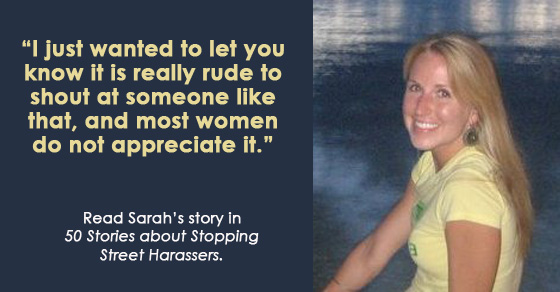
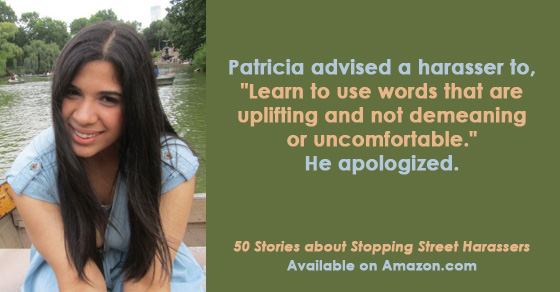
The new book 50 Stories about Stopping Street Harassers is officially out! Thank you so much to everyone who shared a story or a photo for inclusion in the book.

It’s available: In paperback for $10, Kindle for $6.99.

Proceeds: 50% of the book profits will fund SSH’s work.

Tweet chat: Join the book launch Tweet Chat tomorrow, Sept. 24, 1 p.m. ET, #50Stories, with @StopStHarassmnt and @FAANmail

Excerpt: Check out an excerpt of the book featuring seven stories on Bitch Magazine’s blog!

Share

Filed Under: Stories, street harassment

USA: “Titstare”, Harassment Videos, and Claiming Online Spaces

September 22, 2013 By Correspondent

By: Molly Redding, San Francisco, CA, USA, SSH Correspondent

My last blog post was about Carolyn Criado-Perez, who was harassed on Twitter after fighting to get a woman on British bank notes. I’m sad to say that Carolyn has since decided to shut down her Twitter account due to the barrage of threats she received. I’m incredibly upset by this, an action that says to me that we are a culture that can’t tolerate other people and their different beliefs. I only hope that Carolyn continues her fight for women’s rights both on and off the Internet.

Her story, and two other recent incidents, demonstrates how sexism in the tech sector is strong and how it can influence daily behavior, specifically, street harassment.

First, earlier this month, at the start of one of the biggest tech conferences of the year called TechCrunch Disrupt, two men from Australia kicked off the conference by introducing their new app called, ingeniously, TitStare. It was meant to be a parody, but all it did was highlight the idea that women’s bodies in public are men’s property.

The fact that (1) these guys thought up this app, (2) they not only thought it would be hilarious, they thought MANY other people would think it was hilarious and (3) whomever was approving the sessions ALSO thought it would be hilarious, demonstrates just how numb to the idea that women’s bodies on display are public property our culture has become.

Not only that, but it propagates the idea that being ogled is something to be taken lightly and laughed at, as well as accepts men’s behavior as “boys being boys.” All of these ideas, even in subtle humor, continue to perpetuate the acceptance of street harassment in our culture.

To add insult to injury, a 9-year-old girl was in the audience excited to give her own presentation on an app she had created. What kind of messaging about her body, at an incredibly vulnerable age, do you think she received?

(To be fair, TechCrunch has since issued an apology.)

Second, there’s this video: “Sweeping Women Off Their Feet.” In this video, which has been viewed more than one million times, two men walk around their campus grabbing women they don’t know and carrying them off without permission– under the guise of being “gentlemanly.”

This behavior reinforces strict constructs of masculinity and femininity, and what does it say about our culture that these men feel that it is their right to get into a woman’s space and pick her up without her permission? If this isn’t an example of women’s bodies being assumed as public property, I’m not sure I know what is.

Since this was done in a building on a college campus, the women, I assume, felt relatively safe. What if this had been done on a random street corner? At night? What messages are people who watch these videos consuming?

But technology and the Internet aren’t all bad. Websites like stopstreetharassment.org are using the power of Internet messaging to try and spread the opposite message, to try and make people stop, think, and discuss what appropriate interactions in public spaces are.

This week, I was excited to see Jezebel post about a woman who used the “missed connections” section of Craiglist to fight back against her harasser. She employed the power of language to make herself more “human” to her harasser,  an important idea when many of our interactions online and offline are anonymous, allowing harassers to separate their own humanity from the person they are harassing. The harassers never see their victim’s emotions, and so can ignore the fact that they have the same human feelings we all do.

Finally, if you’re like me, you might think that Tumblr posts are an amazing tool for disrupting the social world. Lucky for you, there are many Tumblr sites devoted to combatting street harassment:

http://stopstreetharassment.tumblr.com/

http://fuckyoustreetharassment.tumblr.com/

http://streetharassmenttumblr.tumblr.com/

http://www.tumblr.com/tagged/street-harassment

I love that these sites use a combination of pictures, words and videos to contest “normal” social order, help victims realize they are not alone, and provide many, many options for making women’s place in the public world just a little bit easier, and a little bit safer.

Just like the street, the internet is a public space where women can easily be harassed and shamed, but they can also claim the space for their own. So let’s keep claiming – keep writing, keep tweeting, keep posting!

Molly received a graduate degree in International Development and Gender from the London School of Economics in 2011, where her dissertation focused on websites allowing victims of harassment to post about their experiences. She has worked in the non-profit sector for over 10 years. You can follow her on Twitter, @perfeminist.

Share

Filed Under: correspondents, Stories, street harassment

« Previous Page
Next Page »

Share Your Story

Share your street harassment story for the blog. Donate Now
From the Blog

  • #MeToo 2024 Study Released Today
  • Join International Anti-Street Harassment Week 2022
  • Giving Tuesday – Fund the Hotline
  • Thank You – International Anti-Street Harassment Week 2021
  • Share Your Story – Safecity and Catcalls Collaboration

Buy the Book

  • Contact
  • Events
  • Join Us
  • Donate
  • Facebook
  • Instagram
  • Pinterest
  • Tumblr
  • Twitter
  • YouTube

Copyright © 2026 Stop Street Harassment · Website Design by Sarah Marie Lacy