• About Us
    • What Is Street Harassment?
    • Why Stopping Street Harassment Matters
    • Meet the Team
      • Board of Directors
      • Past Board Members
    • In The Media
  • Our Work
    • National Street Harassment Hotline
    • International Anti-Street Harassment Week
    • Blog Correspondents
      • Past SSH Correspondents
    • Safe Public Spaces Mentoring Program
    • Publications
    • National Studies
    • Campaigns against Companies
    • Washington, D.C. Activism
  • Our Books
  • Donate
  • Store

Stop Street Harassment

Making Public Spaces Safe and Welcoming

  • Facebook
  • Instagram
  • Pinterest
  • Tumblr
  • Twitter
  • YouTube
  • Home
  • Blog
    • Harassment Stories
    • Blog Correspondents
    • Street Respect Stories
  • Help & Advice
    • National Street Harassment Hotline
    • Dealing With Harassers
      • Assertive Responses
      • Reporting Harassers
      • Bystander Responses
      • Creative Responses
    • What to Do Before or After Harassment
    • Street Harassment and the Law
  • Resources
    • Definitions
    • Statistics
    • Articles & Books
    • Anti-Harassment Groups & Campaigns
    • Male Allies
      • Educating Boys & Men
      • How to Talk to Women
      • Bystander Tips
    • Video Clips
    • Images & Flyers
  • Take Community Action
  • Contact

USA: Street Harassment Abroad is Part of the Experience, Not the Sum

August 29, 2013 By Correspondent

By Britnae Purdy, SSH Correspondent

Photo from Britnae Purdy

When I first heard about Michaela Cross’s story, a young woman’s accountof how the street harassment she experienced while studying abroad in India left her with Post-Traumatic Stress-Disorder, I was intrigued. At the same time, I did not want to read it for fear of somehow either reliving or negating my own experiences with street harassment in a foreign country. Eventually I read her story, and decided that I wanted to share my own experiences with street harassment abroad and dealing with those experiences upon returning to the United States – an ordeal that I ultimately found more painful than the original harassment.

When I was eleven years old, my family moved to Kingston, Jamaica. Let me stop you right there, because if you’re not familiar with the country, I know what you may be thinking: I did not go to school under a coconut tree. Bob Marley was not the soundtrack of my life. I do not have dreadlocks.

Jamaica, much to many people’s surprise, is not the fantasy vacation-land that we see on TV commercials. Don’t get me wrong – I have seen some of the most incredible beauty of my life while living in Jamaica. Jamaica is a paradise – but the Sandals Resort-esque paradise that many Americans think of only exists for those who can afford it. I lived in the capital, Kingston, which was at the time the “murder capital” of the world. Just as vivid to me as the incredible blue ocean and the lush mountains are the rows of zinc-roofed shacks, starved dogs in the street, and the armored bus I took to school in the mornings. As an American living in Jamaica, sponsored by the embassy, I was incredibly privileged – luckily for me, my parents made a point of making sure I recognized that privilege and never took it for granted.

I experienced street harassment for the first time while living in Jamaica (I had never even heard the term before), and I experienced it consistently for the nearly four years that we lived there. Characteristics that made me one of a dozen in my previous hometown in Michigan – light skin, blond hair, blue eyes – meant I stuck out like a sore thumb in Kingston. I was hypersexualized by strangers and classmates, despite the fact that, at eleven, I had just gotten my first kiss and was still figuring out how to put on eye shadow. My sexually-based street harassment was also mixed with racial and economic tones– whereas in Michigan I was a level-headed middle-class scrawny kid, in Kingston I was often seen as the rich, white American – the spoiled foreigner. I ultimately thrived in Jamaica, but the harassment was very painful.

Still, the hardest experience was when I returned to the United States at fifteen years old. In my new town in Virginia, I once again blended entirely into the crowd – when I wasn’t harassed on the streets or in the school halls during my first couple of weeks back, I assumed that I deeply unattractive. While the harassment in Jamaica scared me, the sudden lack of sexual attention in the United States left my self-confidence floundering. I felt like I was melting into a new sense of invisibility. The anonymity was both painful and comforting, but most of all I felt lonely.

None of my new classmates could relate to my experiences living abroad – when I mentioned that I once got “riot days” off of school during elections, one girl stared at me blankly and said, “Wait, I thought you were from Jamaica? Aren’t they like, always happy there?” Another boy asked me “which island in Jamaica” I had lived on and when the last time I had seen Bob Marley was. And yes, I did get that wonderful Mean Girls rip-off line often – “If you’re from Jamaica, why are you white?” I had been a foreigner in Jamaica, and now I felt alienated in America as well. I couldn’t even talk about my day-to-day experiences in another country – talking about the sexual harassment I experienced abroad was out of the question, especially when at the young age of fifteen I was so deeply confused about what constituted negative and positive sexual attention. I buried the memories.

In fact, I didn’t talk or think about it again until I started college, which was also the next time I experienced regular street harassment. The first time I was harassed on an American street, I felt betrayed and shaken – up to that point, I had only experienced street harassment in Jamaica. I thought this practice belonged somewhere else; I wondered what I had done wrong. All those feelings from my earlier years in Jamaica came flooding back – bracing my shoulders walking down the street, a borderline irrational fear of walking alone, a prickly feeling down my spine whenever a stranger approached.

I’ve traveled extensively since living in Jamaica, but unfortunately my default setting when traveling abroad is still to expect that level of harassment. In some places I’ve been harassed, in others I haven’t – but I still find myself unable to keep from switching the rational side of my brain over to the side that is instinctively scared of strangers on the street. Michaela Cross was diagnosed with PTSD after her continued harassment – I don’t believe that applies to me, but my harassment has definitely changed my pattern of behavior and expectations when traveling abroad. It is exhausting to constantly be on alert like that, and it detracts from the pleasure of traveling. Traveling is about placing yourself outside of your comfort zone, without comparison to your daily routines – but for women, letting down our guard can also be dangerous.

I am grateful to Michaela Cross for pointing out a gap –there are very few safe spaces to discuss street harassment abroad. I believe that part of this stems from the fear of conveying racism or prejudices. Cross’s story has garnered quite a bit of attention – while some responses are well thought-out and point to varying opinions and experiences, others are disgustingly laced with bigotry, whether towards Indian men or towards Cross.

If we say that we experienced street harassment while in Country X, the mind may jump to assuming that all men from Country X are street harassers, or that sexual harassment is somehow a cultural, racial, or ethnic characteristic. That’s ridiculous. I would never attribute my street harassment in Jamaica to the entire Jamaican nationality. But like Cross, I also had difficulty learning how to speak clearly about my more negative experiences in a foreign country. If I casually mention to a friend at college that a man yelled profanities at me while I walked back from class, she would understand – our campus is generally very safe, but there is a certain road where everyone knows street harassment is common. If I try to discuss, however, the time I was harassed outside a popular restaurant in Kingston, she has no way of placing that experience into a larger concept of what Jamaica is really like. I don’t want to paint a false paradise of the cities I’ve traveled to – that locks me into a mindset that harassment isn’t a big deal, or that harassment is shameful issue that I must deal with personally and quietly. But I also don’t want to spread unnecessarily negative connotations about places that I, for the most part, loved.

Societal norms are not the same as cultural practices, and the level to which sexism and street harassment are publicly tolerated in any given society is not indicative of the “quality” of the people of that country. However, allowing experiences with street harassment abroad to fester without examining them and placing them into a larger context of gender inequality may result in a bias against that country that may border on bigotry. We need safer places to discuss harassment abroad, and perhaps more importantly we need a better language for both sharing and listening to others’ stories.

I applaud Michaela Cross for sharing her experience. Though I don’t relate to everything she said, I can respect her story for being just that – her story. I am sharing my story because it is mine and it is precious and it contains my truths. I do not expect my story to speak for others – I certainly hope Cross did not expect hers to do so. Take from it what you need, and leave what you do not. If my experiences are different from yours, that does not make either of us less valid or relevant. That is what feminist story-sharing is all about.

And for the record? I wouldn’t trade my time living in Jamaica for the world. The street harassment I faced there was a part of my experience – it by no means the sum of my experience.

Britnae is a graduate student at George Mason University, in Virginia, where she is pursuing a Master of Arts in Global Affairs with a specialization in Security and Conflict Studies. She also writes for First Peoples Worldwide and you can read more of her writing on their blog and follow her on Twitter.

Share

Filed Under: correspondents, Stories, street harassment

“Is it hard being so beautiful?”

August 29, 2013 By Contributor

I currently attend UC Berkeley. I’m a “returned student” here, so I’m older than the average student, but this does not stop the harassment. Mostly it’s the men who inhabit a park that is a homeless haven in the middle of living areas. (Every time the university – which now owns the park – has tried to improve the situation a very vocal homeless lobby overwhelms their efforts – though it appears that none of the members of this lobby lives here and deals with this.)

I have a dog, and an apartment, which means that I have to walk her 2 to 3 times a day, in the neighborhood. Other times, I’m on my way to class or picking up dinner on Telegraph Avenue. Today I was headed into the post office – it’s a door at the end of an alleyway – and just as I turned toward the entrance, a man said – quite close to my shoulder – “Hi, sweetie.” I pretended not to hear, but I was rattled.

One guy tells me to “Smile!” every time I pass him.

Three times now I’ve had a pair of (different) men approach me under the guise of petting my dog and before a few minutes pass, they have said, “Is it hard being so beautiful?” or “What’s your name? I bet I have it tattooed on my chest.”

The worst was, 4 p.m., with people all around, a guy who was careening toward me with his arms outstretched, on his way to embracing me. I shouted “NO! NO! NO!” and he swerved away repeating, “Sorry…sorry!”

These are just a few of many – and I can only imagine what the young girls here are dealing with.

This guy today, with his, “Hi, Sweetie” really bothered me. He was close and unexpected. Had I not been making a turn, he would have been walking with me up a long sidewalk. And it’s easy to see where I live, since I have to end up there – and the park is so close by…and the dog makes me recognizable…

I kept ruminating about what I should have or could have said in response. Something like, “Seriously??” Or repeatedly saying, “Excuse me? I still didn’t get that – excuse me?” forcing him to repeat it until he got how stupid it was.

I don’t know…I have no solution. And I never even saw his face. I just know that I feel invaded every single time it happens, as if just by walking my dog, I’m open to comment. I must smile upon command, just because some guy tells me to. I’m accessible. And I hate it.

– Anonymous

Location: Berkeley, CA

Share your street harassment story for the blog.

Share

Filed Under: Stories, street harassment

USA: Street Harassment in India and Beyond

August 28, 2013 By Correspondent

By: Delia Harrington, Massachusetts, USA, SSH Correspondent
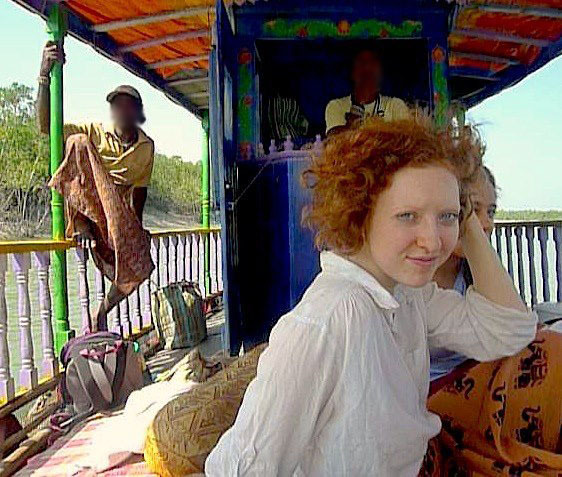
Michaela Cross in India. Photo credit: Caety Klingman.

Last week, under the username Rosechasm, University of Chicago student Michaela Cross published a CNN iReport that has shaken readers and spurred reactions across the web.  The piece, entitled “India, the Story You Never Wanted to Hear” details many terrifying examples of street harassment, staring, groping, and attempted or threatened rape that the author says happened to herself or fellow classmates during a semester abroad in India through their university.

CNN has since called for women all over the world to share their own stories of street harassment and perspectives on Cross’s original iReport as well as potential solutions or methods to mitigate street harassment and other gender-based violence.  Many women, including Stop Street Harassment’s founder Holly Kearl, have since heeded that call, and their stories are well worth a read.

Many have misread the article as a universal condemnation of Indian men and India in general.  The author expresses repeatedly that her experience in India was one of contradiction, including both those of the positive, once in a lifetime variety and those of a more traumatic nature.  While it is hard not to feel lately that some observers and media outlets are holding up India as a problematic “other”, that doesn’t mean people should stop telling their stories or reporting on the stories of others.

Another common criticism is that Cross’s article ignores the treatment Indian women receive within their own country.  That was not the focus of her article, and it seems reasonable that Cross would only write of her own experience and the experience of those she knew through her program, especially given iReport’s format.  However, since it bears repeating, here are some stories Indian women have since posted to CNN about their own treatment, good or bad.  Gender-based violence looks different for local women than it does for foreigners, but as travelers and allies in the struggle against such violence, we must remember that eventually we will leave, and many women don’t have that option.

Finally, many have highlighted the prevalence of street harassment and gender-based violence worldwide, especially within the writer’s (and my) native United states.  Again, I think this is rightfully outside the scope of Cross’s article, but the very existence of this blog and others like it demonstrates that street harassment is not limited to India or the developing world.  However, that doesn’t make Cross’s experience any less real or traumatic.

Cross’s experience shows how street harassment is unfortunately only one part of the spectrum of gender-based violence, which includes stalking, groping, sexual assault, and murder.  For a victim of this type of violence, even the more “minor” incidents can feel (and become) incredibly dangerous.   In a statement to CNN, the University of Chicago writes that all students are offered, “extensive support and advice to students before, during and after their trips abroad,” and yet Cross didn’t approach them during her program.  In her own words, she thought she was prepared to handle the stress of India:

“When I went to India, nearly a year ago, I thought I was prepared. I had been to India before; I was a South Asian Studies major; I spoke some Hindi. I knew that as a white woman I would be seen as a promiscuous being and a sexual prize. I was prepared to follow the University of Chicago’s advice to women, to dress conservatively, to not smile in the streets. And I was prepared for the curiosity my red hair, fair skin and blue eyes would arouse.  But I wasn’t prepared.”

Contrary to what many online commenters have accused, it appears Cross was as fully equipped as a person could be for the potential stresses of travel.  Not only that, she seems to have taken all the usual precautions advised to female travelers (and females in their own countries.)  If all of the University of Chicago’s years of experience sending students to India, as well as her personal knowledge from traveling to India previously weren’t enough to help keep her safe, would anything be enough?  Short of not going to India, which is not an option for many Indian women and isn’t a viable option for travelers, what more could a woman do to avoid this situation?  I think perhaps it’s time for the onus to prevent street harassment to come off of women, and be placed on perpetrators as well as our law enforcement and legislators.

I am impressed that Cross was able to share her story so publicly, and I love that so many women worldwide have taken to CNN’s iReport assignment to join her in sharing their lived experiences with street harassment.  I’m a firm believer that speaking up and supporting those among us who speak up is one way of fighting back.  Instead of devolving into an argument over where harassment is worse, I hope we remember that women in America, India, and the world over have something in common right now: we are speaking up, and we are fighting back.

Delia Harrington is a recent graduate of Northeastern University and calls Boston home. In recent years, she has found herself studying, working, and volunteering in Egypt, Cuba, France, Benin, the Dominican Republic, Turkey, Germany, and Greece.  You can read more of her writing on her blog, or follow her on Facebook and Twitter, @deliamary.

Share

Filed Under: correspondents, News stories, Stories, street harassment Tagged With: India, Michaela Cross

New Book Tackles Street Harassment, Other Feminist Topics

August 27, 2013 By Contributor

By: Julie Mastrine, USA

In the fight against street harassment other gender inequalities, our voices are our most powerful weapons.

This is something I’ve always believed. The fight for social justice is difficult and fraught with roadblocks, chief among them flawed cultural attitudes. The best thing we can do to create change and end issues like street harassment is to fight the fear in our bellies and give a face to these incidents. Stories have power, and they can provide the groundwork we need to help others understand the links between personal injustices and how they connect to a broader, global issue.

This was the thinking behind the creation of my new ebook, Make Your Own Sandwich: A 20-Something’s Musings on Living Under (And Smashing) The Patriarchy. Plenty of people have pegged Millennials as lazy, entitled and narcissistic, but the truth is, our generation has championed the use of new technologies as a way to create lasting change in the world away from our computer screens. Opening up about our experiences online through ebooks, blogging and social media has proven an effective and pervasive way to ignite the change we want to see.

And just what change do we want? My book delves into the more subtle ways we harm and oppress others, like creating conflicting media messages about how women should look or act, using language that pegs femininity as weak or trivial, criticizing how — or if — women wear makeup, taunting women who engage in self-portraiture like the selfie, and yes, street harassment.

The following excerpt from Make Your Own Sandwich delves into the issue of street harassment:

“At some point in their lives — often starting at a very young age — 99 percent of women will experience street harassment. One in four will experience it before the age of 12. Some will endure it every day. Some will experience hateful and sexualized comments. Some will be threatened with violence. Some will be assaulted. Some will replay the incident in their head for years, wondering how they could’ve retaliated, what it was they’d done to deserve being the victim of such behavior…

Too often, women and LGBTQ persons are told street harassment should be taken as a compliment, that it’s just “boys being boys.” But street harassment is not a compliment — it is scary, threatening, and a human rights violation.

Men and women have competed for access to public spaces since the beginning of time. Now that women are no longer expected to stay at home tending to house and children, we’re seeing these power struggles being doled out on the streets. And consequently, it’s made plenty of women afraid.

When I told my mother about my first street harassment incident at age 11 — I was catcalled while walking my dog — she brushed it off, saying, “Oh, that’s always happened around here.” We’ve created a culture in which women are often told to take harassment as a compliment, and if we don’t like it, to watch what we wear, travel with a companion, or otherwise police our own behavior to avoid being targeted. And plenty of women and LGBTQ folk simply accept that they should “choose” to restrict their actions to avoid harm…

“It wasn’t until I started to get wind of the anti-street harassment movement — efforts fueled nonprofits like Stop Street Harassment and Hollaback! — that I learned this wasn’t just an isolated incident, but an issue happening on streets worldwide. As a volunteer for Stop Street Harassment, I learned how powerful it can feel to share these incidents with others to take the power back, whether that means standing at a demonstration with the comment scribbled on a sign or simply sending out a tweet. Just telling other people what happened can be an effective tool that affords the incident less strength over our consciousness and sense of self. It opens up others to the idea that this isn’t something we should tolerate, but should fight back against.”

I hope you’ll give my book a read, and hopefully come away not just with an understanding of the complex sociopolitical landscape of gender issues, but with a sense of empowerment to affect change. Make Your Own Sandwich is available for download here.

Excerpted from Make Your Own Sandwich. Copyright ©2013 by Julie Mastrine. Reprinted with permission from Thought Catalog.

Julie Mastrine is an activist, feminist, and writer working in the PR industry. She holds a B.A. in Public Relations from Penn State University, and is a social media volunteer for Stop Street Harassment. You can follow Julie on Twitter.

Share

Filed Under: Activist Interviews, Resources, Stories, street harassment

USA: The Act of Cultural Imposition Through Street Harassment

August 25, 2013 By Correspondent

By Nikoletta Gjoni, Maryland, USA, SSH Correspondent

When I recently read about an American woman’s street harassment experiences in India and the negative impact they had on her, I couldn’t help but think about how a) it vaguely reminded me of stories and experiences from my native country of Albania and b) how unsurprised I felt overall reading about RoseChasm’s experiences in a foreign country. Not to say that sexual harassment and lewd behavior doesn’t occur in the good old U.S. of A, but there’s a distinctly different discomfort and fear that courses through you when it occurs in a new place you are unfamiliar with.

People who think street harassment is a form of a compliment driven by attraction are wrong. Street harassment, not unlike rape, is about control. It’s about men claiming their dominance over women and feeling that essential right to comment on or act upon whatever they want. Because boys will be boys.

This can come across as more muted in countries like the U.S. where it is essentially known that no, you cannot just scream out sexually explicit phrases to a passerby or touch someone without their permission. Though today this is general knowledge (or should be general knowledge) in most places a person may live in or visit, the lines become blurred when a society is historically patriarchal to the core, and while women may be respected, they are also kept at a safe distance from men. Just in case.

My country, Albania is steeped in rich tradition, old history, and vast contradictions. Traditionally a patriarchal society with “the man is the head of the house” cliché, it is a country that both honors its women but can easily shame them. Catcalling and whistling is the norm. Being followed for a few blocks by a gaggle of boys is the norm. Being singled out because of your accent is the norm. Most is harmless and amounts to nothing in the end, but sometimes you get the occasional stranger that makes you pick up your step a little bit.

A good family friend of mine (also Albanian) was visiting a few years ago. Out with her mom, aunts, and cousins, she was ahead of the group with one or two other girls. What essentially started out as the “typical” come on (whatever that is) turned into a more frightening experience with the man threatening to take her around the corner and “really show her what he could do to her.” Why? Because she retaliated when he grabbed her while walking by. His ego was bruised and he was humiliated in public.

Forget her humiliation. Forget the fact that she was minding her own business. Forget the fact that had she even noticed him in the first place or made eye contact, grabbing her would still have been a highly inappropriate way to reach out.  Forget the fact that he wasn’t even really interested in her as an individual. Forget everything but the fact that he asserted his dominance over a young woman walking down the street and then became verbally abusive when she reacted negatively instead of just walking on.

Is this experience special to Albania? Of course not. One of the first things my friend told me after sharing the story was: “I wished then I had my pepper spray with me.” She’s Albanian, as am I. But we haven’t been raised there. We didn’t grow up with the casual mentality that “girls ask for it” when they dress a certain way, speak a certain way, or act a certain way. And when they don’t—well—just keep on walking and don’t give the perpetrator ammo.

It was a little jarring to see just how often I would get hassled, for one absurd reason or another. And the fact that I didn’t know just how to respond (or whether to respond at all) was what added to the frustration. I am Albanian by blood, traditions, and rearing, but I was a stranger to the minute details that made someone quintessentially from there. And all I could think about was how this kind of behavior just doesn’t happen in the States—a common misconception about the sleek ‘modern’ world vs. everything else that’s old.

But it does happen in the States and it certainly does happen in Washington, D.C. Maybe not to me, not all the time, but to others it does.  What we have going for us here is that there is a cultural awareness slowly growing. There are programs, sites, people, and places one can refer to for help. We are becoming better at practicing bystander intervention. RoseChasm didn’t have that luxury in India and there are still so many places in the world that don’t understand the damage caused by victim blaming.

Albania, too is slowly getting there, though it is stuck in a crevice found between tradition and modernity. For all its collective machismo and testosterone driven decision making, it is a beautiful country with much to learn from. I just hope next time I go there will be one less car slowing down on the street just so heads can come out of the windows to whistle and gawk.

Nikoletta Gjoni graduated from UMBC in 2009 with a B.A. in English Literature. After graduation, she did almost four years of freelance work in a D.C. broadcast station, in addition to having worked as a literacy and linguistics assessor for pre-k classrooms in D.C.’s charter schools.  To get to know her better, she can be tracked on both her creative blog and Twitter, @nikigjoni.

Share

Filed Under: correspondents, Stories, street harassment

« Previous Page
Next Page »

Share Your Story

Share your street harassment story for the blog. Donate Now

From the Blog

  • #MeToo 2024 Study Released Today
  • Join International Anti-Street Harassment Week 2022
  • Giving Tuesday – Fund the Hotline
  • Thank You – International Anti-Street Harassment Week 2021
  • Share Your Story – Safecity and Catcalls Collaboration

Buy the Book

  • Contact
  • Events
  • Join Us
  • Donate
  • Facebook
  • Instagram
  • Pinterest
  • Tumblr
  • Twitter
  • YouTube

Copyright © 2026 Stop Street Harassment · Website Design by Sarah Marie Lacy