• About Us
    • What Is Street Harassment?
    • Why Stopping Street Harassment Matters
    • Meet the Team
      • Board of Directors
      • Past Board Members
    • In The Media
  • Our Work
    • National Street Harassment Hotline
    • International Anti-Street Harassment Week
    • Blog Correspondents
      • Past SSH Correspondents
    • Safe Public Spaces Mentoring Program
    • Publications
    • National Studies
    • Campaigns against Companies
    • Washington, D.C. Activism
  • Our Books
  • Donate
  • Store

Stop Street Harassment

Making Public Spaces Safe and Welcoming

  • Facebook
  • Instagram
  • Pinterest
  • Tumblr
  • Twitter
  • YouTube
  • Home
  • Blog
    • Harassment Stories
    • Blog Correspondents
    • Street Respect Stories
  • Help & Advice
    • National Street Harassment Hotline
    • Dealing With Harassers
      • Assertive Responses
      • Reporting Harassers
      • Bystander Responses
      • Creative Responses
    • What to Do Before or After Harassment
    • Street Harassment and the Law
  • Resources
    • Definitions
    • Statistics
    • Articles & Books
    • Anti-Harassment Groups & Campaigns
    • Male Allies
      • Educating Boys & Men
      • How to Talk to Women
      • Bystander Tips
    • Video Clips
    • Images & Flyers
  • Take Community Action
  • Contact

“I don’t like you, I like her”

July 20, 2013 By Contributor

So I take the train every morning to school and I noticed this guy had his phone pointed at me, and I assumed he took a picture of me since he kept looking at me and I saw he went on his picture gallery on his phone. When he noticed me looking at what he was doing on his phone, he put his phone in his pocket. The next day, he was at my train stop again, and I always take the train at a specific time, and I guess he does too or I’m not sure if he is stalking me now. Ever since, I see him everyday and I told my friends and he still keeps looking at me and my friend confronted him and she said in Spanish (he was Hispanic),

“What are you looking at?” (Que midas) He replied, “I don’t like you, I like her” (No me gusta tu, me gusta aya).

Excuse my Spanish but that’s what happened and now I’m permanently traumatized. Every time I see him he points his phone at me now and one time I saw an Asian wearing only under wear on his home screen. He is disgusting and a pedophile but I don’t have evidence to report him??? I even switched my ways getting to school, but the train is easiest and fastest for me to get to school. If he ever goes beyond this, I will call authorities and I even said that to him.

HE EVEN SITS NEXT TO ME ON THE TRAIN AND HE WHISPERED SOMETHING TO ME BUT I CANT SPEAK FLUENT SPANISH! So creepy!

– Anonymous

Location: Los Angeles, CA

Share your street harassment story for the blog.

Share

Filed Under: Stories, street harassment

“It’s not harassment to tell someone they are sexy.”

July 19, 2013 By Contributor

I know this might not be as bad as other people’s stories but I got hassled in the street this morning. Some random drunk man (yes it was 11 a.m.) started shouting, “Oi sexy!” over and over.

At first I didn’t think he was talking to me as it is a busy inner city street but them he adds ,”Yeah you in the white skirt,” (which was full length by the way. Not sure why I feel the need to say what I was wearing but it’s seems woman have to justify that they were not being provocative.).

At this point I sped up, still ignoring him. His female friend laughed out loud and said, “Shane, that’s sexual harassment.” You could tell by her tone that she was joking though. He replied with more shouting directed at me. “It’s not harassment to tell someone they are sexy. Is it sexy? Oi!”

Luckily I had to turn off at that point so I lost them in a crowd but the whole thing made me feel really uneasy and uncomfortable. I wish I had had the courage to tell him and his friend that yes actually it is harassment to heckle someone in the street like that. I feel silly for being so upset about it, especially as I’m not a young girl, I’m almost 30 and not used to this kind of thing.

– Vic

Location: Norwich, UK

Share your street harassment story for the blog.
Share

Filed Under: Stories, street harassment

USA: Unwanted and Unnoticed

July 18, 2013 By Correspondent

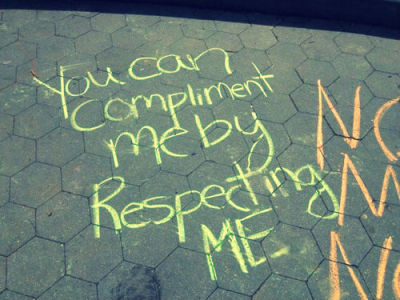
By Sara Schwartzkopf, Colorado, USA, SSH Correspondent

From “We Chalk Walk”

Like most women my age, I’ve experienced my fair share of street harassment. I remember the first time being when I was 14, as I was walking back to my school after lunch break. While I was waiting to cross the street, a man pulled up in a truck, rolled down the window and proceeded to make it perfectly clear that he was leering at my chest. He didn’t say a word, just gave me a suggestive eyebrow raise and a creepy smile before driving off. I remember shuddering, walking back into school and mentioning it to friends who seemed to think it a positive that an older man had “complimented” me.

I remember that instance, not so much because it was extraordinary, but because it was the first time I had a perfect stranger make clear to me that he felt entitled to make his opinion about my body known. It was also the first time that I wondered if this really was a compliment, or if my initial reaction was right that there was something deeply wrong about that encounter.

Since then I’ve had plenty of different interactions with strangers in public places. I’ve heard and witnessed people’s unsolicited opinions on my body when I was overweight, when I was a teenager, when I was out running, when I was with my mother, traveling, hiking, kayaking, walking, shopping, riding public transit, driving in my car, or simply out with friends in public. It’s a very rare occasion indeed when I count these interactions as a positive. It’s also very rare that these comments happen when I’m with a man, and I’ve noticed many of the men in my life are unfamiliar with what street harassment is.

Now both of those things are worth unpacking. As women, we’re frequently told that we are our bodies. Our self-worth becomes inherently tied to how attractive our bodies are. So when a stranger voices their opinion on our looks, it’s implied that we should take that as a compliment (or in some cases as valid criticism). The thing is we are a lot more than our bodies. We don’t need, or particularly want, random people’s opinions on how we look when we’re trying to get any myriad of things done.

The other part of not finding these interactions to be positive is that they frequently don’t come across as compliments so much as demands for attention. Ignoring a harasser on the street at night is often followed by the fear and sometimes reality of being followed. Telling someone to leave you alone sometimes escalates to insults and outright threats. I’ve heard thoughts that men who harass are just at a loss of how else to approach without getting rejected. I don’t think I buy this. I can’t believe how inept a man would have to be to think that yelling, “Nice ass!” at a passerby would net him a better response than, well, almost anything else.

The other thing is why I don’t get harassed if I’m around a man. I can only guess this: men don’t fear what I will do when they shout things at me in public. I am a woman, which means ideally I will smile when they tell me to and say thank you when a comment is offered. Regardless of whether I need or want this validation, I’m expected to take it and move on. Yet if I’m with a man it’s considered disrespectful to him, to address me. There’s a fear and a boundary line there that other men don’t cross. I think this goes a long way to explaining why most of the men I know say they’ve never seen street harassment, or even understand what it is. To them it’s an invisible problem.

Sara is a recent graduate of the University of Denver where she majored in Sociology, International Studies, and minored in Japanese. She has previously written on issues relevant to the Native American community at Le Prestige Du Monde, pulling heavily on her experiences as a mixed-race Kiowa and Chickasaw.

Share

Filed Under: correspondents, Stories, street harassment

Street Respect: “Nice Glasses!”

July 16, 2013 By Contributor

I was at an event and walking past a guy who looked like he was going to say something. It ended up being ,”Nice glasses,” in a totally friendly respectful tone. He was wearing a similar pair. I returned the compliment. It made me feel less afraid and happy that someone noticed my glasses. They are pretty cool!

– Anonymous

Location: Toronto, Canada

This is part of the series “Street Respect. “Street respect” is the term for respectful, polite, and consensual interactions that happen between strangers in public spaces. It’s the opposite of “street harassment.” Share your street respect story and show the kind of interactions you’d like to have in public in place of street harassment.

Share

Filed Under: Stories, Street Respect

USA: The Customer is Always Right (Even When He’s Harassing Me)

July 14, 2013 By Correspondent

By Angela Della Porta, SSH Correspondent

I live in a small town. It goes without saying that I see many of the same people over and over again. I also work at a convenience store for the summer, which certainly has its downsides. (I could write a book about the drags of working customer service, but now isn’t the time.)

I experience street harassment every time I’m walking down the street. Despite the bigoted assumptions people often make about where and by whom street harassment is perpetrated, I am often greeted with harassing comments by “family men” in the rural, racially homogenous area in which I live. Being in a small town, there are very few places to shop, and I’m constantly faced with the situation of forcing myself to be friendly, helpful, and polite to men who harassed me hours before. More often than not, their harassment doesn’t stop there – I get lewd comments on a regular basis, ones I have to accept jovially with a smile for fear of being scolded by my boss. While it’s never fun to paint on a smile for customers when you don’t really feel like it, it’s somewhat different to be forced to smile and accept sexually harassing comments from people you know you’ll see every day. If I had a dollar for every time a man made a comment about my appearance, told me he’d “show me a good time” when buying alcohol, or told me he’d like to buy me (people have actually said that) when asked how he can be helped, I’d double my wages. I’ve actually been told that I should be friendlier to these men and laugh because they’re just joking.

Now, as a community of people against street harassment, we’ve decided that saying something to your harassers is an excellent tactic to put them in their place. However, that’s not always easy – or even possible. When I’m harassed among my friends, I often feel hesitant about shouting back because I don’t want to embarrass or upset them. When I’m with my family, I know saying something to a harasser will seem like an overreaction and potentially cause a scene. If I feel as if I might be putting myself in danger by saying something, I won’t speak up. There are many reasons why the decision whether to speak up against street harassment may be ambiguous or difficult to make. However, until now, I had never had that decision taken away from me: I cannot respond to my harassers or I will lose my job.

While speaking up personally against harassment can be a huge tool for anyone who is constantly bombarded with comments and gestures, it’s not enough. We’ll have to continue to fight against misogyny and patriarchy to really change hearts and minds. That’s why the work that Stop Street Harassment does is so important, and why getting involved can really make a difference. Share your stories. Write, tweet, Facebook, submit your stories here! Until we’ve created a culture in which it is inappropriate to harass women, men will continue to do it whenever and wherever they can. So, make your voice heard whenever you can.

Because at the moment, I can’t.

Angela Della Porta is a recent graduate of Clark University in Worcester, MA. She will join with Teach for America in Detroit in the fall. Until then, she’s spending her time in rural Maine. Follow her on Twitter: @angelassoapbox

Share

Filed Under: correspondents, Stories, street harassment

« Previous Page
Next Page »

Share Your Story

Share your street harassment story for the blog. Donate Now
From the Blog

  • #MeToo 2024 Study Released Today
  • Join International Anti-Street Harassment Week 2022
  • Giving Tuesday – Fund the Hotline
  • Thank You – International Anti-Street Harassment Week 2021
  • Share Your Story – Safecity and Catcalls Collaboration

Buy the Book

  • Contact
  • Events
  • Join Us
  • Donate
  • Facebook
  • Instagram
  • Pinterest
  • Tumblr
  • Twitter
  • YouTube

Copyright © 2026 Stop Street Harassment · Website Design by Sarah Marie Lacy