• About Us
    • What Is Street Harassment?
    • Why Stopping Street Harassment Matters
    • Meet the Team
      • Board of Directors
      • Past Board Members
    • In The Media
  • Our Work
    • National Street Harassment Hotline
    • International Anti-Street Harassment Week
    • Blog Correspondents
      • Past SSH Correspondents
    • Safe Public Spaces Mentoring Program
    • Publications
    • National Studies
    • Campaigns against Companies
    • Washington, D.C. Activism
  • Our Books
  • Donate
  • Store

Stop Street Harassment

Making Public Spaces Safe and Welcoming

  • Facebook
  • Instagram
  • Pinterest
  • Tumblr
  • Twitter
  • YouTube
  • Home
  • Blog
    • Harassment Stories
    • Blog Correspondents
    • Street Respect Stories
  • Help & Advice
    • National Street Harassment Hotline
    • Dealing With Harassers
      • Assertive Responses
      • Reporting Harassers
      • Bystander Responses
      • Creative Responses
    • What to Do Before or After Harassment
    • Street Harassment and the Law
  • Resources
    • Definitions
    • Statistics
    • Articles & Books
    • Anti-Harassment Groups & Campaigns
    • Male Allies
      • Educating Boys & Men
      • How to Talk to Women
      • Bystander Tips
    • Video Clips
    • Images & Flyers
  • Take Community Action
  • Contact

USA: My Suit of Armor

December 30, 2015 By Correspondent

Sara Conklin, Washington, DC, USA, SSH Blog Correspondent

WDK874CAKTIt’s finally starting to get cold this winter and I’ve breathed a sigh of relief. As a girl from the Sunshine State, throwing on winter apparel shouldn’t feel empowering – the idea of stuffing my body into multiple layers of fleece and faux-fur hooded parkas is about as foreign of a concept as the idea an apartment wouldn’t come with an air conditioner or saying “you all” vs. “ya’ll.” But, I’ve noticed an important change in my attitude when winter arrives that directly correlates to my experience as a woman walking in the city.

You see, I wear my coat like armor. It might not look like it conventionally, but I do. My armor protects me from unsolicited attention and non-consensual interactions that I so desperately try to avoid. Whether the feminist inside me screaming, “dressing modestly is a patriarchal concept of oppression!..” likes it or not, the more layers I wear, the less harassment I experience.

You cringed reading that, didn’t you? I cringed typing it. The hairs on my neck stood up at the thought of disappointing my peers who are working so hard to overthrow the policing of women’s dress and bodies. After all, shouldn’t a woman deserve respect regardless of a skirt versus a long coat? Ah yes, that would be the day. But, we currently live in a world where countless individuals believe that the more skin I show is a direct invitation into conversation and interaction. And so, for my entire life, I’ve been instructed to dress modestly, appropriately, and decently to fit a standard of dress that doesn’t attract attention; clothes that allow me to slip by unnoticed in a world that has standardized expectation for nearly everything in my life.

I live in Washington, DC and some days are hot like Hell. Summertime heat waves hit like a tidal wave and the whole city is sloppy with sweat. On these days, I, like everyone else, want to wear clothes that keep me cool. But, there is also a part of me that knows more skin means more attention and that means more unsafe situations. Is the risk worth it? The real issue is that this scenario is characterized as a “risk” in the first place.

Would you believe me when I told you one of the worst moments of my life was witnessing a mother on the subway whisper to her young daughter, “Cover her mouth when you yawn or else boys might get the wrong idea?” That was a horrible moment. Other horrible moments include the day I saw a young woman in a beautiful sundress which she clearly loved, lose her confidence in an instant when a man yelled something about her legs. Or, when I told my friend I was frustrated being repeatedly harassed by the same man on the sidewalk and he replied, “Honey, that’s what sunglasses and iPhone headphones are for.”

Because if it isn’t just the coat, it’s sunglasses to block my gaze, headphones to drown out sound, and a change of suitable clothes in my gym bag that act as tools to blockade the unsafe pieces of the world around me. I was unconsciously creating a physical barrier between the world and myself to gain back a little more control, or rather, any control at all.

I am embarrassed that I feel somehow responsible for reinforcing a dictatorial concept. Each time I change what I wear to be perceived as more modest I feel progressively more angry and resentful. When I pop in headphones to silence potential commentary, they’re getting away with it. We all deserve respect no matter what we wear. But, until I get that respect, I will wear my winter coat like armor, my sunglasses like a mask, and my headphones like a personal white noise machine.

Sara works in fundraising events at an organization that empowers women who face homelessness through recovery, wellness training, and housing. She runs her own photography company (saraconklinphotography.com) and a popular website that seeks to connect the world through pictures, sarapose.com.

Share

Filed Under: correspondents, street harassment Tagged With: clothing, coats, winter

Nov. & Dec. 2015 News Round-Up

December 29, 2015 By HKearl

I haven’t made time to do news round-ups over the past two months (!!) but finally, here are some global highlights of stories about street harassment, broken out by country.

Afghanistan:

“On one recent weekend in Kabul, I sat on a ratty couch in one of the city’s beauty parlors, one of the few safe spaces for women in Afghanistan. Squeezed between a pile of handbags and a five-year-old boy waiting for his mother’s curls to set, a dozen women turned to look at me.

“Repeat your question,” one of them commanded. “Have any of you been sexually harassed in public?” I asked. The parlor exploded in bitter laughter. “Get ready,” Mariam said to me. “If you ask each of us, you’re going to fill that notebook of yours.”

The types of public harassment they described ranged from sexually charged comments about appearance, indecent whistling, and physical attacks like groping, pinching, and slapping. In Afghanistan, this objectification and mistreatment of women is all too common. Research shows that nearly nine out of ten Afghan women are forced to endure such treatment. And there’s seemingly nowhere for them to go. Women are harassed and assaulted in quiet areas when no one else is around, but also in busy public places like bus stations, markets, shops, and parks, where there are plenty of aiders and abettors.”


Australia:

Congrats to our ally MP Fiona Patten whose proposed legislation passed. The legislation “makes it an offence to film people without consent or block access to footpaths, roads and vehicles within the zone around GP clinics, hospitals and other health services offering abortions.”


Brazil:

“How old are young girls when they are “first harassed” by men? Women in Brazil are reflecting on their own childhood experiences – and sharing these stories on the internet in big numbers….

The tag ‪#‎primeiroassedio has been used more than 90,000 times, with women and girls sharing the stories of their first encounter with public sexual harassment. “At 11, I was heading to my dance class and a man touched my bottom,” tweeted one. “13 years old. I was going to the supermarket. Heard from a gentleman that I already had ‘beautiful boobs.’ ‪#‎firstharassment,” said another.”


Costa Rica:

“Cruz was best known as the man who confronted another man for filming an upskirt video in San Jose. He was then stabbed multiple times two days later while walking through San Sebastian…The upskirt videographer has been caught before and even received death threats. Mr. Cruz spent weeks in intensive care and was only able to communicate with blinks and eye gestures. He passed away in the hospital. He is survived by his partner Karol Zúñiga who is expecting a baby girl in 12 weeks.”

So tragic! A life that never should have ended this way or for simply challenging street harassment. Our thoughts go out to his loved ones and friends.


Egypt:

“Uber has announced it will start collaborating with HarassMap خريطة التحرش الجنسي, an Egyptian anti-sexual harassment initiative founded in 2010, to train its drivers in how to “recognize, prevent and take positive action” against inappropriate behavior. The training, which will be compulsory for all the app’s drivers, will be particularly important for female drivers, according to Uber’s Cairo general manager, Anthony Khoury. “This partnership has been done as a response to the general education and training needed against sexual harassment here in Cairo,” he said. “Education is key, which is why this partnership – and the training that comes with it – is a crucial step in stopping sexual harassment.”


ParisAnti-HarassmentTransitCampaignDec2015France:

“Stop – That’s Enough!” This is the tagline used by the French government in an active push to stop sexual harassment on public transport.

The government launched the awareness campaign on Monday together with rail operator SNCF and Paris transport chiefs RATP. It will see flyers handed out and a set of posters put up in key places around the capital, encouraging victims and witnesses to speak out with confidence about sexual harassment. The campaign also aims to remind the culprits that sexual harassment is punishable by law and groping can lead to five years in prison.”


India:

“What do women do when faced with sexual harassment on the streets [of Mumbai]? According to a recent survey of 1,000 women conducted by the We the People Foundation, 34 per cent glared or reacted verbally, 15 per cent asked bystanders for help and 35 per cent did nothing.”


Iran:

“TNS: What should be done then to counter the problem of street harassment? How can we ensure safety of women in public spaces in a broader sense?

HH: The fact is that veil isn’t the solution. The political will to end harassment is the solution because in the context of Egypt and Saudi Arabia, the veil hasn’t actually helped. Today if a veiled woman walks in a street in Egypt, relative to the 1980s when I was there, she would face as much harassment as a woman wearing western style clothing… because most women are also wearing the veil anyway. So it no longer signifies class like it used to. It was adopted in a way to negotiate, but when everybody does it, the value of negotiation comes down.”


Italy:

“Over 10 million tourists are expected to visit Rome during the Holy Year of Mercy. Hundreds of security men in uniform are patrolling our streets in order to protect the citizens. But when it comes to a girl strolling all by herself, it appears that the stereotypical Italian male traits take precedent over any official role. It’s an attitude that may Italians are used to, but it could prove uncomfortable for foreign visitors. We filmed a young woman walking on the streets of Rome all by herself, and we asked women – both Italian and foreigner – what do they feel when comments come from law enforcement men (video by Fabio Butera)”


The Philippines:

“The ‪#‎FreeFromFear social media campaign is part of the program that aims to resolve the problem of women experiencing street harassment. Through the campaign, women share their experiences to raise awareness and join calls for the end of street harassment. The incidents are very common in crowded spaces like public vehicles where people are sitting or standing very close to each other.”


Morocco:

“A man was reportedly left unconscious for more than two hours after being knocked out by a woman whose bottom he had pinched. CCTV footage taken in the town of Inezgane in Morocco shows the woman wearing yellow robes and standing next to a motorcycle when the man approaches. The balding attacker then moves close to the victim and appears to grope her bottom. Without missing a beat, the woman spins around and delivers a single punch to the back of the unidentified man’s head, sending him careering into a stack of rugs in a nearby shop.”


UK:

“What traveling with a man taught me about street harassment à ‘Not having to deal with this bullshit and all the other seemingly harmless infractions in between has made me realise just how pernicious it is, just how unfair. These past four months of freedom have taught me that what I accept as life in London is unacceptable. I’m not yet sure if this realisation, this newfound intolerance, is a good or a bad thing. All I know for sure is that I’m not looking forward to finding out.’”


UK:

“A group of teenage girls are taking action to stamp out groping at venues – in a drive to make live performances safe spaces for music fans of both genders. The five girls aged 15 to 17 – Hannah, Ava, Anna, Anni and Bea – launched Girls Against last month to raise awareness of sexual assaults at concerts. Their ultimate aim is to eliminate mosh-pit groping “for good”. In the short term, they want to see the perpetrators identified and stopped from entering future gigs. With several indie bands including Peace, Slaves and Wolf Alice backing the campaign, and more than 7,000 Twitter followers, the girls are already claiming practical results in their drive to create a zero-tolerance approach. ”


USA:

“In the window of a gallery in San Francisco’s Mission district, Mirabelle Jones paced the enclosed space in nothing but nude underwear. Razor blades suspended from balloons hung just over her head. In this pink-tinted, claustrophobic exhibition, the San Francisco performance artist stripped down and endured a barrage of real (recorded) catcalls. For eight hours. The idea behind the exhibition To Skin A Catcaller is to change what we see when we hear the term “catcall.”…

In its rawness and brutality, Jones’s performance showed the reality of street harassment that women encounter everywhere, especially in supposedly pedestrian-friendly cities like San Francisco or New York. This is why women have a newfound sense of urgency in the ongoing effort to effect change by, say, criminalizing street harassment and finding effective ways to prevent these all-too-common attacks on our personal safety. Misogyny in America is not a neat and tidy issue. It’s the kind of trauma that sticks with you and festers until you’re a little afraid to go anywhere alone.

Jones’s exercise in exposure speaks to the sad fact that most victims of a sexual assault do not file a police report. When people try to excuse catcalling as harmless or downplay it as a compliment, it only increases trepidation about seeking help for fear of being blamed or slut-shamed. The reality is that being sexually harassed makes women feel exposed, vulnerable, defensive. Catcalling is ultimately somewhere between micro-aggression and actual threat, the kind of imperative grey area that sometimes only art alone can translate.”


USA:

“Gay, bisexual, transgender and queer men need to elevate their own narratives and use the examples provided by feminism to stage sustainable interventions and engage in consciousness raising about eradicating toxic masculinity from the community once and for all.

The community has long prided itself on celebrating and enjoying an array of sexual proclivities, but not every unsolicited advance, or act of sexual aggression, is fun for every man. The only reason that’s hard to recognize is that we’re still being held back by the heterosexual masculinity that so much of queer culture has worked to reject. We must foster community that celebrates a healthy, pleasurable sexuality – one that respects bodies and boundaries.”


USA:

“”We do an annual Halloween rally every year to protest against street harassment and rape culture [in Santa Barbara, CA],” fourth year global studies and feminist studies double major and TBTN Co-Chair Ashley Morgan said. “It gets pretty hectic during the holidays; there’s a lot of grabbing and sexual comments that are very much unwelcome. We just want to make sure that people understand that’s not a joke, it’s not a compliment — it’s violence.”

The demonstration began at 11 AM at Harold Frank Hall, and students marched to the front of the UCen. Several groups of people touring campus looked on as participants chanted “Hey-Ho, Hey-Ho, Catcalling has got to go,” “Whistles are for dogs, not for women,” “However we dress, wherever we go, yes means yes, no means no,” among other statements.

“We’re having a safe space this Friday and Saturday from 10 PM to 2 AM in the Pardall Center,” Morgan said. “We’re going to have…advocates there as well as CAPS counselors for anyone; it’s specifically for sexual assault, but it’s also for anyone that’s feeling unsafe or triggered.”

Share

Filed Under: LGBTQ, News stories, street harassment, weekly round up Tagged With: bystander murdered, girls, performance art, story sharing, transit campaign, young age

Canada: Video – “Dear Stranger”

December 29, 2015 By HKearl

Watch “Dear Stranger,” created by Hanna Cortés, a student at the Vancouver Film School.

Hanna wrote the following about the project:

“Dear Stranger” is a project that reflects the situation of a woman being harassed on the streets. It was inspired from watching lots of women (including myself) feeling uncomfortable when walking to work, school or just home.

One evening, I was getting ready to go to a bar close to my place and I realized how much I change my clothes to try to “not grab attention from men.” I thought it was absurd, because that night I wasn’t even showing that much skin. I was wearing a simple skirt and a plaid shirt. I was confused but decided to be myself and that’s what I’ve been doing. It shouldn’t matter how much or how few clothes you are wearing, people should have respect for others.

I hope this video helps men understand how bad it is for a woman to be followed, looked at and talked to without any respect. I encourage women to be themselves everyday, that’s a beautiful thing, and it should not be taken away because of someone in the street.

Again, thanks so much to Stop Street Harassment for their everyday labour. Thanks to Holly Kearl for all the support.”

Thank you for using your talents to bring attention to this issue, Hanna!

Share

Filed Under: Activist Interviews, Resources, street harassment Tagged With: dear stranger, film, Vancouver

France: Comic Exhibit is Spreading Far!

December 29, 2015 By Contributor

This post is from our Safe Public Spaces Team in Lyon, France. The SPSM projects are supported by SSH donors. If you would like to donate to support the 2016 mentees, we would greatly appreciate it!

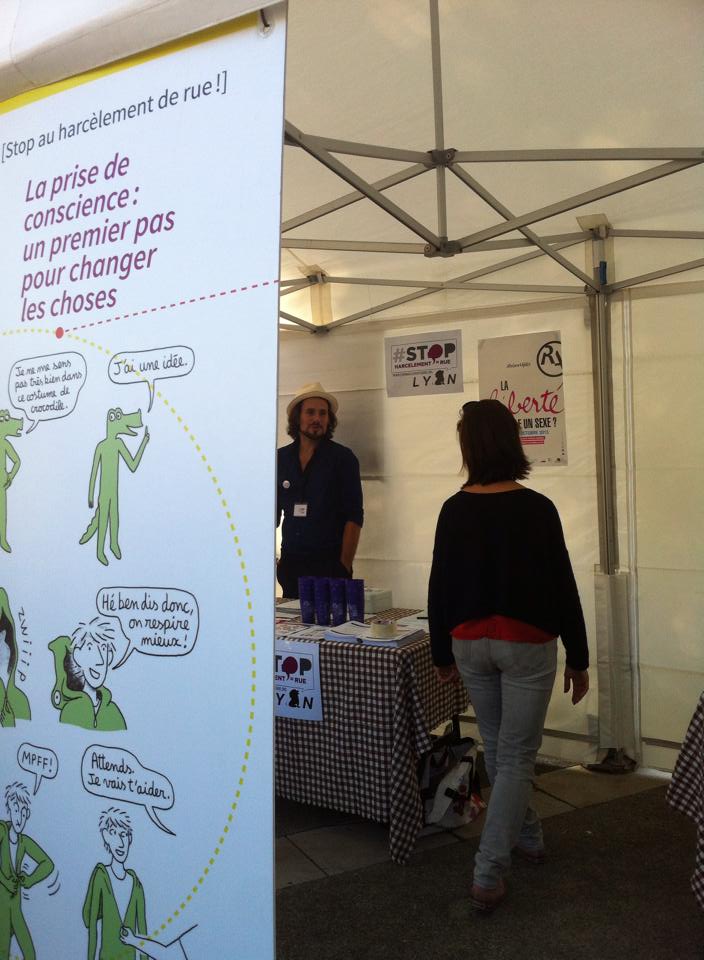
Exhibit - Oct 2015The Stop Street Harassment mentoring program comes to an end with the holiday and we must confess, it’s so good to rest! Especially so when having accomplished everything you had in mind and more, and looking forward to even bigger developments!

From a material point of view, we’ve manage to print three copies of our exhibition, all on thick laminated paper. Two in size A4 and one in size A3. This allowed us to use it in different places at the same time and, since the posters are very light, to send it via regular post without any difficulty. Also, the city council of Grenoble, who displayed it on huge panels, was so thrilled about the outcomes of the project that our contact asked us permission to re-print the version we came up to together on roll-ups and already booked six one-week-long exhibitions in different places of the city for 2016.

We’ve received several other requests for renting our exhibition, coming from city councils, universities, high schools or non-profit organizations. The variety of organizations wishing to use it is proof to us that street harassment is an issue that a lot of people feel concerned about, as everyone should, that people are ready to speak up whenever offered an opportunity to do so and that public representatives are willing to broach the subject with us. The latter has been proved recently by the French government launching a campaign on his own against sexist harassment in public transportation. We feel very proud to have achieved such a recognition of the problem.

Since our mid-way blog post in October, we have had time to compile the many feedback we’ve got from places we showed our exhibition and from its visitors as well. And it has been very positive ! People reported that this was a really fun way to approach such a subject and, whatever the age or profile of the visitor, having learned or discovered at least one thing they’d never thought about. Here lies the real achievement for us, and it was great to collect all kinds of comments.

Last but not least, our project is far from done, and it fills us with joy and great expectations ! Stop Harcèlement de Rue is composed by several groups in different cities, and some of them feel comfortable to use the exhibition for their school workshops and presentations. So it will be sent to Paris and another city yet to be chosen. But the big news is we made a new partner, the team organizing the Lyon BD Festival, a comics festival taking place in June. Together, we’ll launch a fundraising campaign at the beginning of February to be able to pay new artists for added posters and design to the exhibition. We’re already in touch with half a dozen of illustrators and comics authors who are willing to participate. The augmented exhibition will be printed on big roll-ups and presented during the week of the festival in a well frequented place in the city center. We will then use this new version for our own events and workshops.

So this has been four exciting months for us, we feel that we’ve been able to start making a difference on the street harassment matter and that strong enriching partnerships have emerged and will allow us to continue.

We wish to thank Holly and Stop Street Harassment again for their support and kindness, and hope we’ll be able to meet in the flesh someday!

Anne Favier co-directs Stop Harcèlement de Rue – Lyon.

Share

Filed Under: SSH programs, street harassment Tagged With: art, comic, exhibit, france

USA: Florida Chalking Awareness Day

December 28, 2015 By Contributor

This post is from our Safe Public Spaces Team in Florida, USA. The SPSM projects are supported by SSH donors. If you would like to donate to support the 2016 mentees, we would greatly appreciate it!

By Tena Gordon

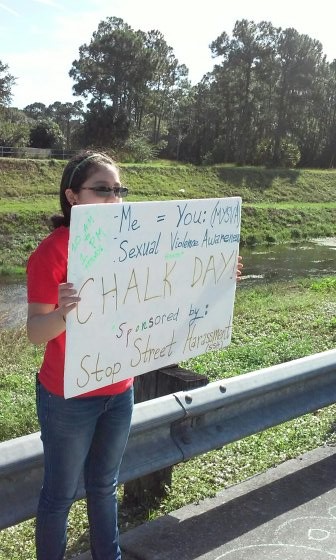
12.6.15 chalk awareness day - FL5In addition to our library event in October educating teens about street harassment, on December 6, 2015, Me=You: Sexual Violence Awareness (MYSVA for short) held our first Chalk Day! We set up on the sidewalk along Degroodt Road, outside our local library. Jineth (the member of MYSVA pictured to the left) held a sign to attract the drivers in passing vehicles to participate. Unfortunately, this was not a successful strategy. Next time, we are going to host Chalk Day at a place with less vehicle traffic and more foot traffic.

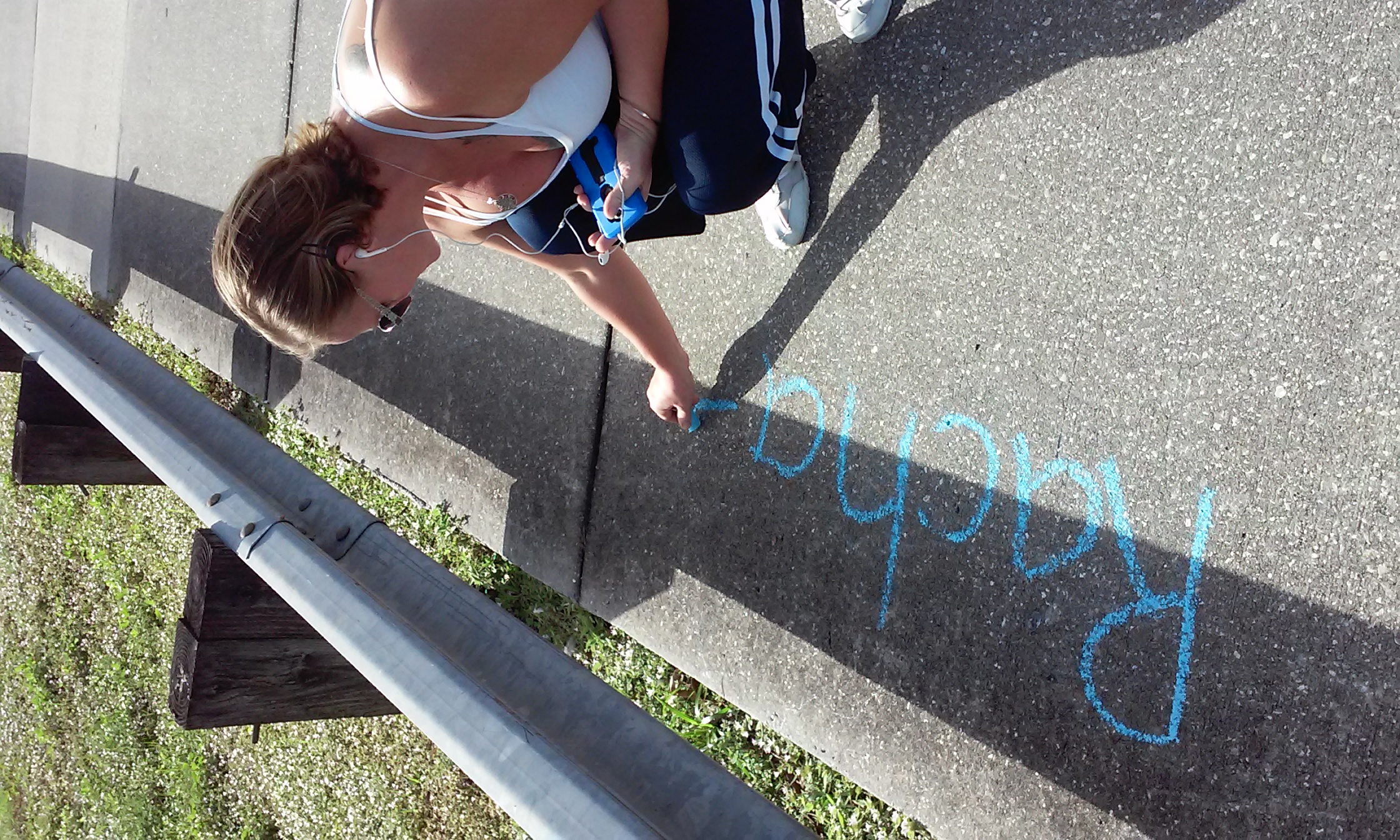
12.6.15 chalk awareness day - FL 1Anyway, people on foot and bike stopped and wrote messages against street harassment or just signed their name. We offered them a free informational, promotional package and free water. The most touching part of the day was when Rachael (the jogger pictured to the right) came back and brought her daughter of high-school age to sign her name, too.

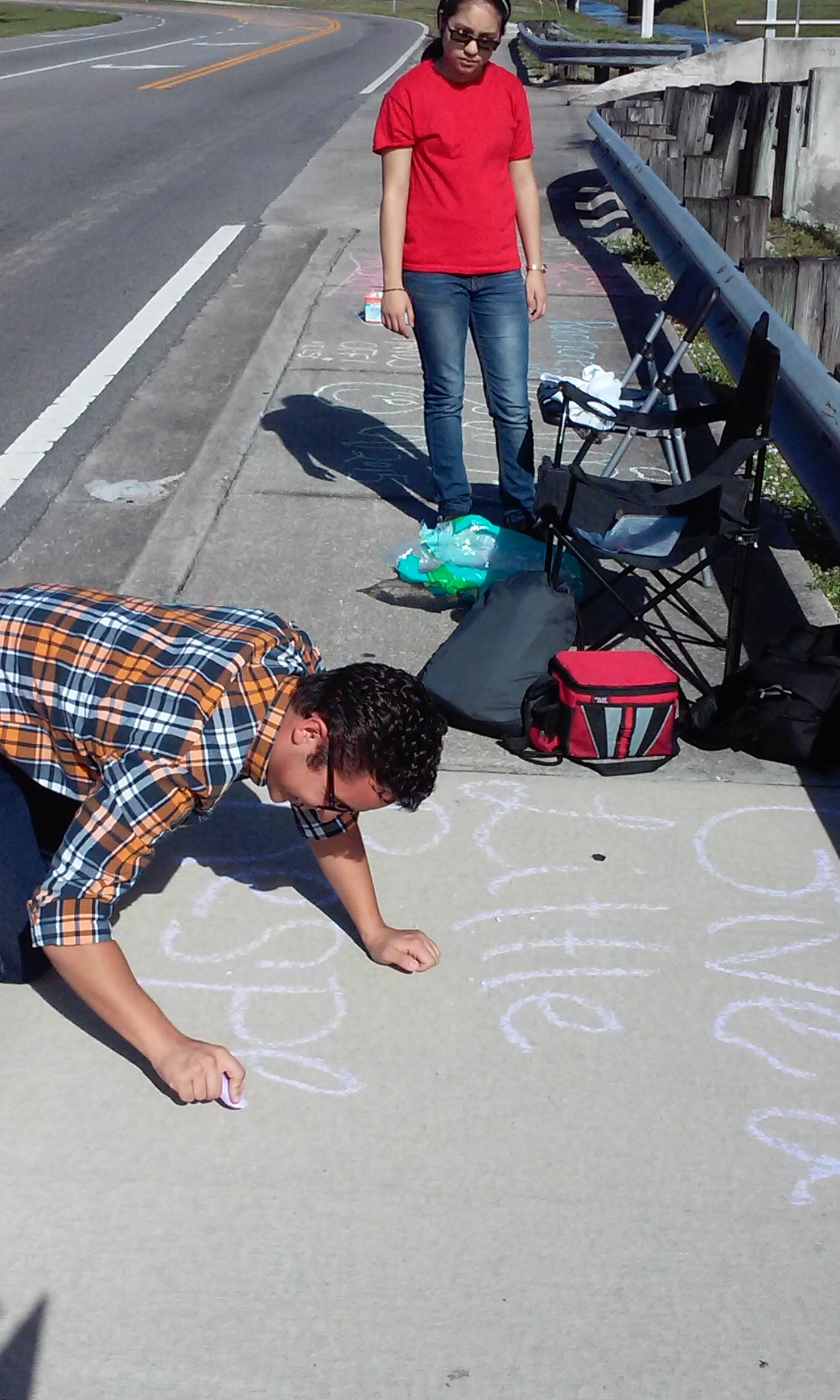
Also, to our surprise, Sergio (the student journalist pictured below) from our school came and participated. He took pictures of us chalking, and he did a story on our event that aired on the school news.

In total, about 10-15 people participated. They were mostly of middle-age, not our targeted demographic, so next time we will have it in a place where teens hang out more frequently. Overall, Chalk Day raised awareness about street harassment, our main goal.

 12.6.15 chalk awareness day - FL 3  12.6.15 chalk awareness day - FL

Tena Gordon is the MYSVA Coordinator and a high school student in Florida.

Share

Filed Under: SSH programs, street harassment Tagged With: florida, sidewalk chalking

« Previous Page
Next Page »

Share Your Story

Share your street harassment story for the blog. Donate Now

From the Blog

  • #MeToo 2024 Study Released Today
  • Join International Anti-Street Harassment Week 2022
  • Giving Tuesday – Fund the Hotline
  • Thank You – International Anti-Street Harassment Week 2021
  • Share Your Story – Safecity and Catcalls Collaboration

Buy the Book

  • Contact
  • Events
  • Join Us
  • Donate
  • Facebook
  • Instagram
  • Pinterest
  • Tumblr
  • Twitter
  • YouTube

Copyright © 2026 Stop Street Harassment · Website Design by Sarah Marie Lacy