• About Us
    • What Is Street Harassment?
    • Why Stopping Street Harassment Matters
    • Meet the Team
      • Board of Directors
      • Past Board Members
    • In The Media
  • Our Work
    • National Street Harassment Hotline
    • International Anti-Street Harassment Week
    • Blog Correspondents
      • Past SSH Correspondents
    • Safe Public Spaces Mentoring Program
    • Publications
    • National Studies
    • Campaigns against Companies
    • Washington, D.C. Activism
  • Our Books
  • Donate
  • Store

Stop Street Harassment

Making Public Spaces Safe and Welcoming

  • Facebook
  • Instagram
  • Pinterest
  • Tumblr
  • Twitter
  • YouTube
  • Home
  • Blog
    • Harassment Stories
    • Blog Correspondents
    • Street Respect Stories
  • Help & Advice
    • National Street Harassment Hotline
    • Dealing With Harassers
      • Assertive Responses
      • Reporting Harassers
      • Bystander Responses
      • Creative Responses
    • What to Do Before or After Harassment
    • Street Harassment and the Law
  • Resources
    • Definitions
    • Statistics
    • Articles & Books
    • Anti-Harassment Groups & Campaigns
    • Male Allies
      • Educating Boys & Men
      • How to Talk to Women
      • Bystander Tips
    • Video Clips
    • Images & Flyers
  • Take Community Action
  • Contact

“Harassment is a serious crime that can emotionally damage a person”

December 10, 2015 By Contributor

An ex-boyfriend of mine posted flyers with my personal phone number, address, and work location. On the flyer it stated I was a drug addict/ dealer. Which I am not, I’m a pharmacy technician, and what he said on the flyer could of really hurt my career. I felt scared for my life, because people were actually believing the flyers harassing my phone, my residence, and even at my job. I went to the police, and they basically said they can’t help me until I was physically assaulted. So I put a restraining order against him. Now I’m just trying to recover, it’s very hard I’m still very fearful and a lot of anxiety. I go through therapy now, because I know that guy is still out there, apparently really close to where live I spoke up, because no one should ever have to go through or feel how I felt. Harassment is a serious crime that can emotionally damage a person.

– Tiana Sayas

Location: Oahu, Hawai’i

Share your street harassment story for the blog.
See the book 50 Stories about Stopping Street Harassers for more idea
.

Share

Filed Under: Stories, street harassment

#16Days of Activism: 16 Empowering Responses (Day 15)

December 9, 2015 By HKearl

This is cross-posted from Pixel Project’s website.

The Pixel Project is pleased to share the fifth annual blog list of 16 memorable stories of women dealing with street harassment which has been kindly compiled by Holly Kearl, Founder of our partner, Stop Street Harassment, and one of our 16 Female Role Models of 2010.

Empowering Response #1: #WhatMySHSaid – Instagram

Chloe Parker has been harassed since she was 12 years old. Now 17, she started an Instagram hashtag #WhatMySHSaid where people write their age and location and what their street harasser said to them. Many posts are liked thousands of times. Chloe wrote, “The average age is twelve [for the story submissions] and the average reaction is disbelief, but with the topic comes horrible responses as well. I have heard people defending these pedophiles who creep on these girls, or say that street harassment is because of what the girl was wearing. We live in a culture of blaming the victims, and by saying a twelve-year-old is asking to be followed as she walks home from school is a testament to this. We as a society can and should change this culture that we promote and live in. It should not be up to the victims to change their lives and patterns to make harassers comfortable. This is not a problem that should be ignored.”

Empowering Response #2: Parking Attendant Woes – Charlotte, North Carolina, USA

Every day for two weeks as a woman left a parking garage in Charlotte, North Carolina, the parking attendant would stare at her and say he wanted to see her smile and other similar remarks. She felt uneasy, and, as he continued day after day, she felt anxious and stressed. One day she pa0nicked and drove away while he was still talking. She resolved to talk to him and the next day. She asked him to stop telling her to smile as it made her feel uncomfortable. He said okay. She wrote, “I hope he’ll think before he makes these unwanted comments to anyone else. I didn’t complain to the company since he made an indication of respecting my wishes. I don’t plan to park there any more since I don’t want to see him again, but being able to say something took such a weight off my shoulders. I didn’t even realise how much this was affecting me until after I said something.”

Empowering Response #3: Standing Up Against Harassers – Kabul, Afghanistan

After witnessing a friend drop out of school because of harassment, Shafi in Kabul, Afghanistan, began standing up to harassers. She wrote, “Whenever I see people harassing girls or women in streets and university, I go to them and talk reasonably with them to stop them and explain to them that their act is wrong. I ask what if it happens to their sister or mother, what then? Now it is the time for everyone to start vanishing this bad and shameful culture. Yes, if we want to change then we can. We can start it right now!”

Empowering Response #4: Ladders Are Useful Items

ladder

Empowering Response #5: Caught on CCTV

After a drunk man grabbed a woman on a subway and kissed her, she reported him to the transit police. They found him on the train’s CCTV and circulated his image to local police stations. She wrote, “If you experience street harassment, report it to the police. It will make you feel proactive and powerful – and they might even catch the perpetrator.”

Empowering Response #6: No Free Pass for the Police – San Jose, CA, USA

A woman in San Jose, California, noticed a police sergeant (not in uniform) exposing himself and masturbating in a car. She turned away but he drove his car and parked so she had to see him again. She took photos of him and his license plate and he fled. She filed a police report and the investigators discovered he was a 13-year veteran of the police department. He was arrested and placed on administrative leave.

Empowering Response #7: Taking Harassment Seriously – Liverpool, United Kingdom

Two men in a car in Liverpool, UK, harassed a Russian woman. She felt too scared to say anything, but she ran back, called the police, reported what happened and gave their license plate number. She wrote, “The inspector rang me back to make sure I know they take it seriously. Then after an hour a female officer came to see me. It turned out it was a crime as section 5 public order offence, besides it was gender-based. The officer visited his house, etc. He now has a criminal record. Ladies, you don’t have to take this shit!”

Empowering Response #8: Facing Down Harassers… and Winning! – Tennesee, USA

When Bryanna was in college in Tennessee, a group of men would hang out by the door and harass her daily with sexual slurs. She felt humiliated and would try to run past them before they could say anything. But one day she decided to confront them. She wrote, “They whistled and said, ‘Damn!’ really loudly. So I turned around, marched right up to them (at least eight of them) and shouted, ‘What do you expect to happen from this? Do you really think a girl will turn around and say ‘Oh wow that’s such a compliment, being told my ass is fine by these complete strangers. Do you want to hook up?’ Has it worked for you yet?’ By the look on their stunned faces, I answered for them, ‘No, I didn’t think so. Get a life!’ and stormed off. The rush I felt was incomparable to anything else. I felt strong – like I could take care of myself.”

Empowering Response #9: Singing Against Harassment

Singer Empress Of wrote a song about street harassment called “Kitty Kat.” She said in an interview, “I remember a stranger saying something nasty to me on the street while walking home. I was so mad, but I couldn’t say anything back at that moment. What would be the point? When I got back I started to work on this aggressive sound on a track. As soon as I turned the mic on to record, I started to sing what I wanted to say to that guy on the street, but now I get to sing it every night in front of a crowd.”

Empowering Response #10: “That’s NOT a compliment!” – San Diego, CA, USA

A woman was walking her dog through downtown San Diego, California, when a man told her, “You have no idea how badly I want to play with your boobs.” She told him that his comment was inappropriate and he apologised. But then he told her she should “take it as a compliment.” She had already passed him, but turned around to yell back, “That’s NOT a compliment!” She wrote, “Let the harasser know what he is doing is wrong and unwelcome and that it’s not a compliment in order to help convert him to viewing it as a bad thing.”

Poppy SmartEmpowering Response #11: Sparking a National Debate – United Kingdom

After weeks of trying various tactics for dealing with street harassers along her route to work in the UK (the harassment included men purposely blocking her path), Poppy Smart took the matter to the police. She said in an interview, “It made me feel really uncomfortable and the fact it went on for so long was the main reason I reported it. If it had just been an isolated incident – one, two, three, four times – maybe I could probably brush it off because these things happen and you have to kind of accept these people’s ignorance.” Poppy says she spoke to the owner of the building site. “He just sort of apologised. He obviously can’t control all of his staff all of the time and I appreciated that. I just wanted them to realise it is offensive and I wanted it to stop.” Her story sparked a national debate about the issue.

Empowering Response #12: Sanctuary from Harassment – New York City, USA

A man on the train in New York City rubbed his penis against a woman’s butt. She elbowed him but he kept doing it. Because of the crowd, she couldn’t easily get away. A woman nearby noticed what was happening and gave up her seat for her saying, “Come sit down, that man is trying to rub himself on you!”

Empowering Response #13: Not Remaining Silent – London, United Kingdom

Y.E. in London, UK, was the target of public masturbation on the Tube. No one else was on and when she moved away, he followed her, only zipping up his pants after a man entered the carriage. When YE got off the train, he followed and she ran to report him to a transit worker. The police took her report. She also decided to write about what happened. “I hesitated several times whilst starting to write this and contemplated just keeping it to myself, considering the crude nature of this incident. However, it has come to my attention that this is no longer becoming a ‘once in a blue moon issue’ and it could have easily been burdened on a child, family member, or another member of the public. Looking back at the past struggles in history, since when has any change occurred from remaining silent?”

smallstepsEmpowering Response #14: Anti-Street Harassment Workshops – Romania

Aila in Romania used to face harassment from high school students as she walked from her hostel to the university. Now she and a group of other women at the NGO FILIA are in the process of working with that high school to bring street harassment awareness workshops to the students. She wrote, “Change can be done. I am not a victim anymore, I am a person who can bring change and can help the other girls who are still living in that hostel.”

Empowering Response #15: Open Letter Tactic – Washington D.C., USA

 Sara in Washington, DC wrote an open letter to the man who harassed her. In it, she thanked a woman who spoke up. “To the woman on the sidewalk who said, ‘That’s so rude’ and shook her head when he drove off, thank you. Your three simple words in solidarity were my saving grace and snap back to reality, that no one, not even myself, has the right to disrespect my body. So, dear man in the blue minivan, I will use my body in the best way I know how — to share this story and inspire others to feel a little braver when they step into a crosswalk. To be what the woman on the sidewalk was to me: solidarity.”

Empowering Response #16: Reporting an Unwanted Grope – San Francisco, CA, USA

After a man groped AB at a shopping mall in San Francisco, California, she dropped her bag and ran after him. She lost him, but filed a police report. She wrote, “I’ve been harassed many times, but I’d never run after someone. Something snapped in me. And something broke when no one would help. I was proud that enough was finally enough, and I did something, even though he got away with it. At the very least, it’s caused me to talk about it and snap back when I get hollered at on the street.”

Share

Filed Under: 16 days, Advice, Resources, Stories, street harassment Tagged With: responding to harassment

#16Days of Activism: Creative Youth Projects (Day 14)

December 8, 2015 By HKearl

Nov. 25 – Dec. 10 are the 16 Days of Activism Against Gender-Based Violence. To commemorate the week, we are featuring 1 activism idea per day. This information is excerpted from my new book Stop Global Street Harassment: Growing Activism Around the World (Praeger 2015).

Whether it’s by making art or a video or organizing a march, youth from Azerbaijan to the United States are undertaking creative ways to address street harassment.
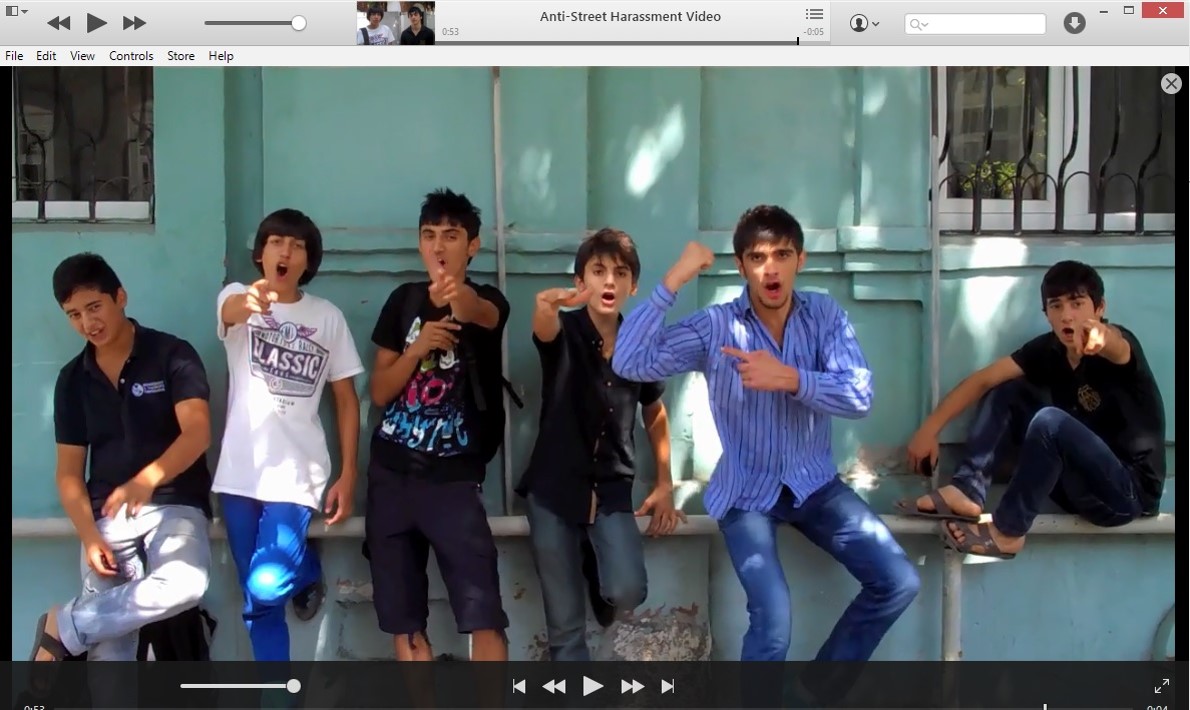
beagentleman“What do you get when you annoy girls? They just think you are a bad person,” “You shouldn’t do it, bro,” and “Be a good man,” six teenage boys tell their peers in a mixture of Azerbaijani and English in a 2012 YouTube video. Jake Winn, an American youth development Peace Corps volunteer was in Azerbaijan, from 2010 to 2012 and had daily interaction with many young boys and men. He told me he noticed that “street harassment was a learned behavior and most were sincerely ignorant to the dangers and problems with street harassment.”

When he brought it up with them, there was little resistance to the idea that it needed to stop. It was just something they had never thought about. And for the boys and men who did think there was something wrong, he said, “they didn’t know how to bring it up, how to resist, how to convey a message to their peers that it wasn’t OK.”

After Winn showed the youth an American video of men telling other men to stop harassing women, the boys decided to make their own. “They wrote it, filmed it, edited it. … They loved making the video and were proud to show it,” Winn said. “Few had ever taken the time to think and reflect. It was great to see how inspired girls were to realize how many allies they had among the young men.”

To date, it has been viewed more than 6,000 times, and it received a standing ovation when it was shown at a youth film festival in Azerbaijan’s capital, Baku. Winn also developed a lesson plan and discussion questions for other Peace Corps volunteers to use with their own students, and more than a dozen volunteers did so. The materials are available on the SSH website in both Azerbaijani and English.
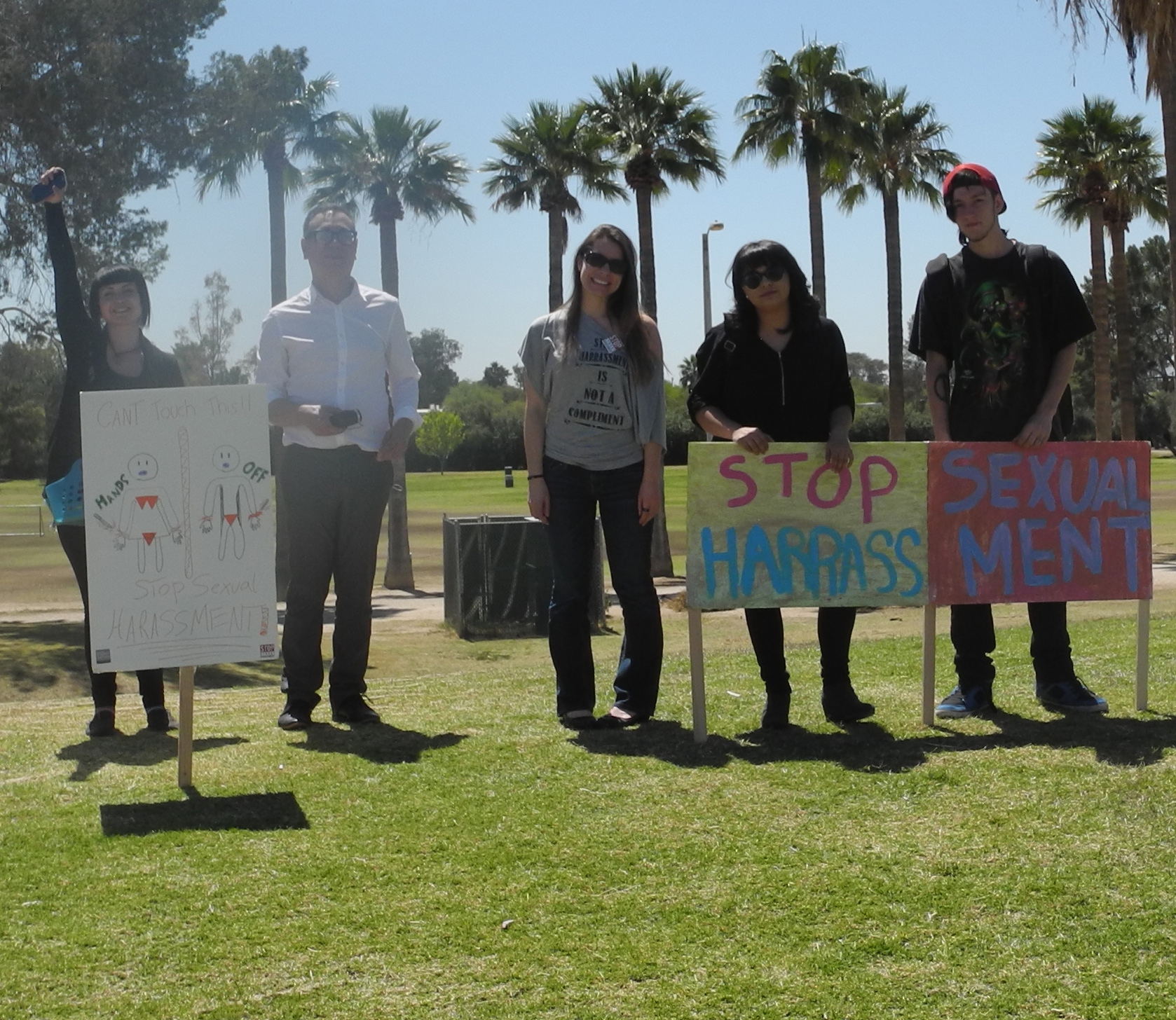
2014 Hey Baby art in Tucson
2014 Hey Baby art in Tucson (Abril is two in from the left)

Hey Baby | Art Against Sexual Violence launched in Tucson, Arizona, through the Southern Arizona Center Against Sexual Assault in 2009. Inspired by an art-centric Hey Baby project in North Carolina, up to 50 students and 30 adults participate in the Tucson initiative each spring. Their artwork addresses themes of prevention and support for survivors of homophobia, street harassment, relationship abuse, rape, and child sexual abuse.

While the program is currently evolving, in the past, the art has been displayed in public libraries across Tucson during Sexual Assault Awareness Month and online. “I think it is important for youth to engage with troubling social issues in a context where they have control over the processes used to solve that problem,” the program’s manager (and SSH board member) Manuel Abril told me. “This means that instead of making youth [feel they] have to identify with social issues (social systems dispense blame for social problems affecting them onto marginalized communities) they are able to investigate it, to unravel it aesthetically, and to give it back to society.”

Share

Filed Under: 16 days, male perspective, public harassment, Resources, street harassment Tagged With: arizona, Azerbaijan, boys, hey baby art, youth

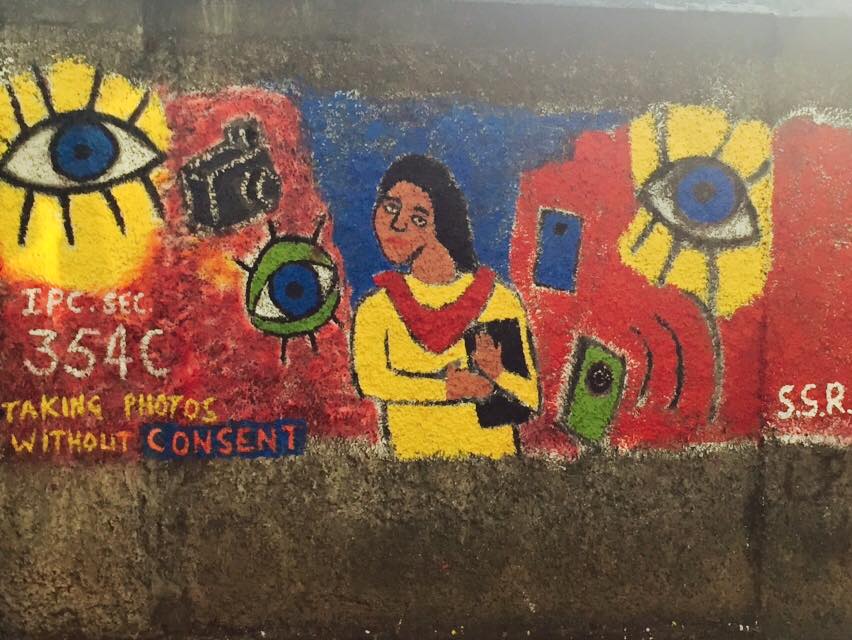
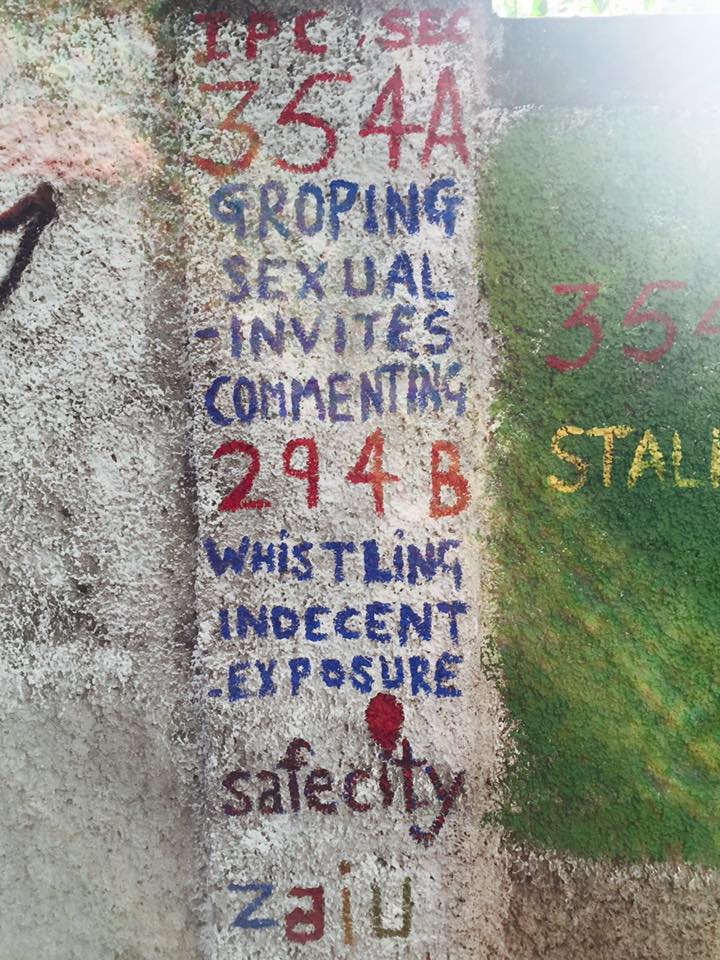
Mural Against Harassment in Mumbai

December 7, 2015 By HKearl

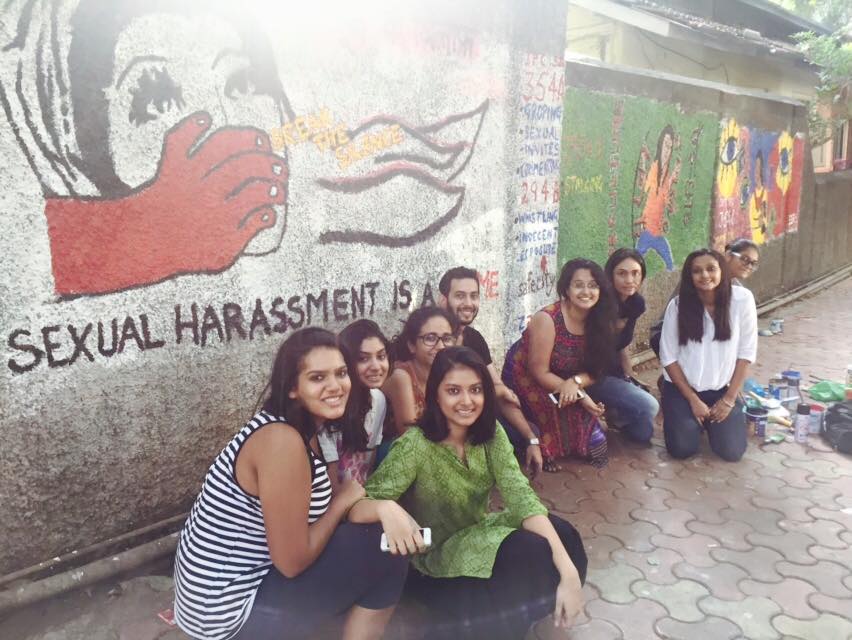
Safecity and students in Mumbai painted the ‪#‎TalkingWall along Peddar Road, outside Sophia College.

SafeCityMumbaiMural-Dec2015-2

SafeCityMumbaiMural-Dec2015-3

SafeCityMumbaiMural-Dec2015-4

Share

Filed Under: Resources, street harassment Tagged With: college students, India, mumbai, Mural, safecity

Italy: Street Harassment and Gender Stereotypes

December 6, 2015 By Correspondent

Sara Rigon, Italy, SSH Blog Correspondent

You are walking down the street and a man screams at you “hey, you are beautiful, babe”. You ignore him and keep walking. A million thoughts cross your mind: “Oh no, not again”, “Should I thank him so he doesn’t get mad”, “Does he look hostile?”, “Should I cross or walk faster?” etc.

The bottom line is you just want it to be over and with no consequences, so you rarely ask yourself why. It has happened so many times and it will happen again: it feels so pointless to wonder why.

Nonetheless, if we want to put an end to this we should learn from the best and follow Sun Tzu’s art of war rule: know your enemy. So, where does street harassment and violence against women come from? Where does it all start?

Vintage Sexist Ad
Vintage Sexist Ad

Social norms often view violence against women as a private matter and street harassment as women’s responsibility. Basically it is your fault: the way you walk, the clothes you wear, the way you look or don’t look, you are causing the problem: it is you. But it is not, it is a matter of gender and power. As the United Nation Declaration on the Elimination of Violence against Women, adopted by the General Assembly on 20 December 1993, states “[violence against women] is a manifestation of historically unequal power relations between men and women, which have led to domination over and discrimination against women by men and to the prevention of the full advancement of women, and that violence against women is one of the crucial social mechanisms by which women are forced into a subordinate position compared with men”.

In other words gender violence is a matter of gender equality and street harassment is the daily proof that despite of what some people think in 2015 men and women are not equal, not even in the civil and democratic western world. This is when I get the feeling life is like monopoly: we got the “go back 3 spaces” card. Back to gender equality and the question remains: how do you fight historically unequal power? I say we start from stereotypes and prehistoric clichés.

They say stereotypes are not a bad thing, on the contrary they can save your life as they help you categorize the world and quickly make sense of the mass of data that compose your day which will take forever to interpret if taken individually. However I’m not so sure this is always the case as nothing is entirely good (or bad, of course). Clichés and stereotypes about women, for example, are not necessary true and they definitely don’t simplify your life, especially if you belong to that group of people who is believed to be superficial but caring and maternal, good listener and compassionate but also gossipy and bitchy, ornamental and absolutely not good at STEM.

You may have heard of the term STEM, it seems like everyone is talking about it, creating hashtag and launching campaign to increase the number of students in such an innovating field. For those who are not familiar with it, STEM (previously SMET) is an acronym that refers to the academic disciplines of science, technology, engineering and mathematics.

Women in STEM
Women in STEM

I have never really thought about it, but with all this talking about STEM and the lack of women in STEM education I started reflecting on my relationship with math and science. Did an old and narrow-minded stereotype put me off STEM? That’s not possible, I love science, I am a doctor, after all, and I have plenty of women colleagues. As a recent bmj career article reports that back in 2009 the Royal College of Physicians predicted that by 2017 most doctors would be women. I thought we were doing well, however I was forgetting that medicine is not strictly considered science, but more of an art and doctors artist armed with basic scientific knowledge in medicine.

STEM is more about hard science and so my studying to become a physician doesn’t really count. To be totally honest, I’ve always thought I wasn’t good at math and I’ve never contemplated the idea of pursuing a career in engineering. Now that I think about it, even with good grades in math I’m not so sure I would have enrolled in a STEM program at Uni knowing what the boys in my class thought and said about girls who majored in engineering and mathematics.

Reading the recent L’Oréal Foundation international report on the perception of women in science I can say it is not just me, conscious and unconscious bias and cliché on women in STEM are real and they discourage girls from undertaking a scientific education and ultimately a STEM job and career, the same and old cliché that undermine women and sustain gender inequality. Now more than ever, we know the limiting factor is not women’s brain but culture. Science needs diversity, we need a cultural shift.

Unfortunately, cultural changes are known to be slow and painful, especially when they are lead by grown-ups, in such cases it gets a lot easier if you start from posterity. It is not simple to separate nature from nurture and all different aspect of creating gender role in kids, however studies shows that drawing clear distinction in gender roles plays a role in pushing kids toward a specific career and gender stereotype.

So it’s up to us, to you, to be the change you want to see in the world: enroll your daughters to math camp and football teams, ask Santa to bring your son cooking and baking toys and dancing shoes: this could be the first step to stop street harassment for good.

Sara is a registered General Practitioner in Italy and New Zealand. She is the founder and current lead of the newly established Equally Different group within the European Junior General Practitioners Organization, the Vasco da Gama Movement, branch of the World Organization of Family Doctors. Follow her on Twitter @rgn_sr.

Share

Filed Under: correspondents, street harassment Tagged With: gender stereotypes, STEM

« Previous Page
Next Page »

Share Your Story

Share your street harassment story for the blog. Donate Now

From the Blog

  • #MeToo 2024 Study Released Today
  • Join International Anti-Street Harassment Week 2022
  • Giving Tuesday – Fund the Hotline
  • Thank You – International Anti-Street Harassment Week 2021
  • Share Your Story – Safecity and Catcalls Collaboration

Buy the Book

  • Contact
  • Events
  • Join Us
  • Donate
  • Facebook
  • Instagram
  • Pinterest
  • Tumblr
  • Twitter
  • YouTube

Copyright © 2026 Stop Street Harassment · Website Design by Sarah Marie Lacy