• About Us
    • What Is Street Harassment?
    • Why Stopping Street Harassment Matters
    • Meet the Team
      • Board of Directors
      • Past Board Members
    • In The Media
  • Our Work
    • National Street Harassment Hotline
    • International Anti-Street Harassment Week
    • Blog Correspondents
      • Past SSH Correspondents
    • Safe Public Spaces Mentoring Program
    • Publications
    • National Studies
    • Campaigns against Companies
    • Washington, D.C. Activism
  • Our Books
  • Donate
  • Store

Stop Street Harassment

Making Public Spaces Safe and Welcoming

  • Facebook
  • Instagram
  • Pinterest
  • Tumblr
  • Twitter
  • YouTube
  • Home
  • Blog
    • Harassment Stories
    • Blog Correspondents
    • Street Respect Stories
  • Help & Advice
    • National Street Harassment Hotline
    • Dealing With Harassers
      • Assertive Responses
      • Reporting Harassers
      • Bystander Responses
      • Creative Responses
    • What to Do Before or After Harassment
    • Street Harassment and the Law
  • Resources
    • Definitions
    • Statistics
    • Articles & Books
    • Anti-Harassment Groups & Campaigns
    • Male Allies
      • Educating Boys & Men
      • How to Talk to Women
      • Bystander Tips
    • Video Clips
    • Images & Flyers
  • Take Community Action
  • Contact

Nepal: Fuel Shortages Lead to Carpooling… and then to Harassment (Part 2)

November 28, 2015 By Correspondent

Smriti RDN Neupane, Nepal, SSH Blog Correspondent

In Part 1, I discussed how a fuel shortage in Nepal has led to an increase in carpooling. However, carpooling has not been free from harassment for girls and women, and so a few young women created a closed Facebook group called “Carpool Nepal (Women).” Part 2 is my interview with one of the women (who wants to be anonymous).

Carpool Nepal (Women) 1edited finalWhat do you mean by carpool or carpooling?

Simply, carpooling is ride-sharing. To elaborate, carpooling is a way of sharing rides by several participants to save on fuel and the cost. However, in Nepal’s context, most of the time, the owners have shared a ride out of generosity.

Ok, so what is Carpool Nepal (Women) – closed group and how does it work?

Carpool Nepal (Women) is a closed women’s group on Facebook for carpooling. We are a small group of individuals. We have also created a Facebook profile with the username “Carpoolers” to keep people updated personally and by best to our collective abilities.

The women in the group mention hashtags such as #Ask to ask and #Offer to offer rides to each other.

How do you want to be addressed as – administrators, initiators, campaigners, others?

We saw some people already sharing rides and many groups already being created to help one another through ride-sharing because people were starting to have problems getting rides due to shortage of fuel. So, we do not identify ourselves as being initiators. However, we started and administered the group Carpool Nepal (Women) which was made specifically for women.

Are the administrators of Carpool Nepal open group and women only group page same?

No, we are different. After 5-6 days of Carpool open group page started, we formed a women-only closed group. We requested the admins of open group to help by posting about the women’s group page so that women would be more secure and comfortable because clearly most of them weren’t. We did not receive any reply from the administration. However, we received a message from a woman saying that there is no need for our group. But we only wanted to feel safe while carpooling by asking and offering rides for and by women.

Some people also harshly said that there was no need to divide the group. Their logic was that creating a different “women’s only” group is like segregating the country on the basis of religion, caste and ethnicity, and that the creator and members of this “women’s only” group are the narrowest of minds. It was ironic because toilets are divided based on gender; dormitories are divided based on gender, but all that they saw were us being as one of the culprits. Despite seeing so many women being bullied and harassed on Facebook, all they saw was us dividing and somehow failed to see that specific segment of women that we were targeting to help.

Were there many instances of harassment?

Women who asked for offers were bombarded with harsh comments, were teased and made fun of. One time, one of the women expressed that she felt uncomfortable while receiving a ride with strange men and that was met with so many derogatory comments from many men and few women as well. Some (or most) men made outrageous comments and that made women feel harassed and bullied. Then women who asked and offered rides to women only were ridiculed as being discriminatory towards men.

Many women were skeptic of the rides because there were some posts stating that some women were harassed. Also, some men asked for rides with needing one, just for the excuse of riding with a woman on her scooter.

There were women who needed rides and some were willing to offer rides but were too uncomfortable to post on the Facebook page because they knew they would be attacked by dreadful, awkward, perverted and crazy comments.

Also, the purpose of the initial group was to post to ask and offer with respective hashtags. However, people used to post irrelevant posts, spam posts and jokes and a lot of selfies. So, the important posts used to pile below thus very few people were getting rides. We also wanted to make it clean, so we stuck to no other things being posted except asks and offers.

What has been the overall reaction from members and non-members?

Our group is clean as there are no irrelevant posts. However, the posts have been decreasing in number. Although many women were getting rides, the stacks of posts for asking and offering that the women made would pile below and it is inconvenient to search for posts on Facebook group. Another reason is that, people would get a lot of posts in there news feed, which may have forced them to turn off notification. This has happened in both the groups and happens in Facebook groups often.

We believe that it is because of just having it as a Facebook Group. A mobile app would have helped a lot of women in need. The negative feedback which we received, we have mentioned it. The good ones, the ones who have personally sent us a message to ask us for help have thanked us a lot and we feel as much thankful to them as well for giving us an overwhelming share of delight.

Though there are only 6K+ members, women were active, very comfortable and happier than in the other group.

Do you intend to continue the campaign and your page even after easy availability of fuel?

We will help the group as long as we can from our Facebook profile. We have also helped a few by personally finding rides for them. We thought of creating a mobile app specifically for women, however the cost and time constraints kept us away from doing it. Despite that, we want to keep on helping our women by whichever way we can and we have been as well to the best of our abilities and resources.

Smriti coordinated Safe cities campaign in Nepal with a team of feminist activists of various organisations, networks and community groups from 2011 to 2014 and is still voluntarily engaged with it. She is currently engaged in an action research and advocacy on women’s leadership in climate change adaptation focusing on women’s time use.

Share

Filed Under: Activist Interviews, correspondents, street harassment Tagged With: carpooling, fuel shortage, Nepal

Nepal: Fuel Shortages Lead to Carpooling… and then to Harassment (Part 1)

November 27, 2015 By Correspondent

Smriti RDN Neupane, Nepal, SSH Blog Correspondent

In Nepal, due to “unofficial blockade” by India since September, 2015, no fuel could be imported via the border. The blockade of borders has been causing a crisis in lives of Nepali people since it is a landlocked country surrounded by India on three sides. They have been suffering from shortage of many basic amenities in life most importantly, fuel (petrol, diesel and gas) and medicinal supplies. Fuel shortage was the first thing that hit and caused impact on daily lives of people.

Public and private vehicles became scarce, creating difficulty in mobility for everyone. During the initial days, it worsened in a way that schools had to shut down and people started walking or working from home in Kathmandu. Although there were Safa Tempos (battery-run three wheelers), there were not enough to accommodate everyone.

After the first few days, young people from Kathmandu started initiating various campaigns from a cycle rally with slogan “No Petrol, No Problem” to peaceful protests in front of the Indian embassy and Nepali government offices. The campaigns were not limited to protests and strikes but were also focused on adaptation and how to be self-sustainable.

The people who had free seats on their two wheelers or four wheelers started offering rides to others who were traveling through the same route. Similar, a campaign on Facebook called “Carpool Nepal,” which is an open group where people who had access to Facebook could #offer and #ask for rides. This became an instant hit among the young students and office workers. This fostered a very communal feeling among people towards one another in Kathmandu valley and many people benefitted through it.

Unfortunately, a campaign initiated purely to help people became a site for discomfort for women, both on the page itself and also during rides in the public roads. Various instances of harassment against women started happening. Women and girls shared their stories on the Facebook page and they were mostly met by ridicule and derogatory comments, mostly by men.

The instances of harassment started increasing at such a rate that in almost a week, a few of the young women came up with a closed Facebook group named “Carpool Nepal (Women).” Some commented that the new group was useless because it served the same purpose as “Carpool Nepal” but many women are glad that it exists.

I had a conversation with one of the administrators of the closed group, who wished to remain anonymous. Part 2 contains my conversation with them.

Smriti coordinated Safe cities campaign in Nepal with a team of feminist activists of various organisations, networks and community groups from 2011 to 2014 and is still voluntarily engaged with it. She is currently engaged in an action research and advocacy on women’s leadership in climate change adaptation focusing on women’s time use.

Share

Filed Under: correspondents, News stories, street harassment Tagged With: carpooling, fuel shortage, harassment, Nepal

#16Days of Activism: Distributing Cards (Day 3)

November 27, 2015 By HKearl

Nov. 25 – Dec. 10 are the 16 Days of Activism Against Gender-Based Violence. To commemorate the week, we are featuring 1 activism idea per day. This information is excerpted from my new book Stop Global Street Harassment: Growing Activism Around the World (Praeger 2015).

Distributing cards about street harassment to harassers or to educate passersby is a tactic that’s been used for years, especially when it became easy to post the cards online for others to download. The Street Harassment Project, for example, has offered cards on its site since the early 2000s and Stop Street Harassment has made cards available since 2008. But in recent years, individuals have been creating their own. In 2012, for example, American Mirabelle Jones created “catcalling cards” with a phone number printed on them for women to give to men who won’t leave them alone. If the men call the number, they will hear pre-recorded messages from women telling harassers exactly what they think of them. On her Tumblr I Am Not an Object, she invites women to leave recordings and download the cards.
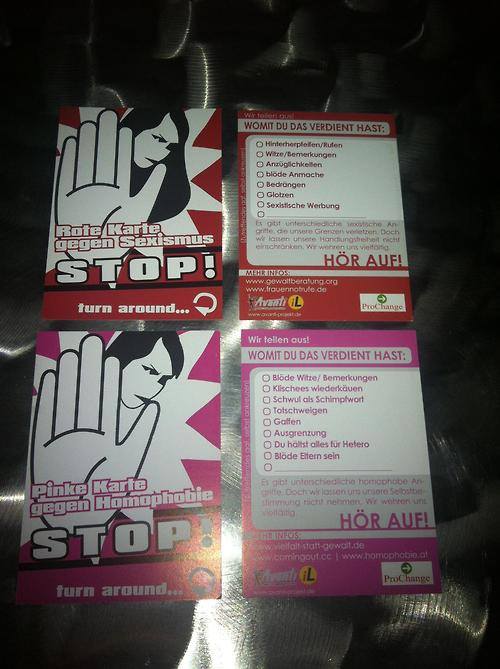
ProChange Germany
ProChange Germany

In Dortmund, Germany, the women in the feminist group ProChange devised another clever way to use cards. Living in a country that is obsessed with football (American soccer), they created “Red Cards” against sexism, “Pink Cards” against homophobia and “Purple Cards” of courage. Individuals can hand out these cards to challenge or commend others’ actions without having to directly talk to them. “This can be easier than having any other reaction,” the women told me. A group called Avanti had the same idea and had already created cards that they let ProChange adopt. ProChange also created special coasters with information about street harassment for the pubs, bars, and clubs of Dortmund.
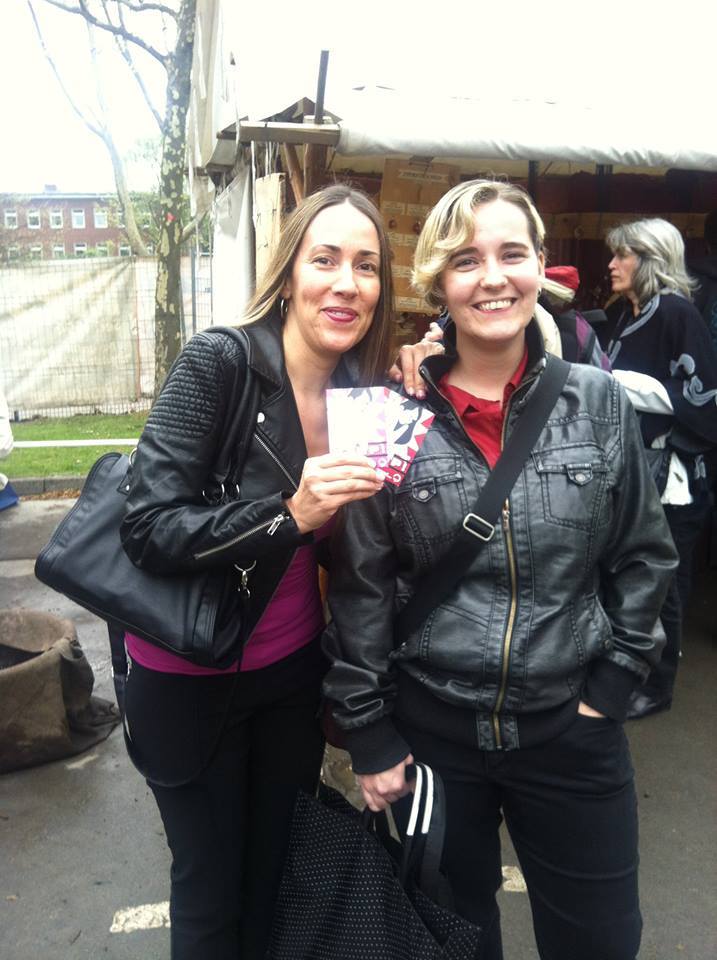
ProChange Members in Germany, 2014

One of their first distribution occurred during International Anti-Street Harassment Week 2012 when they handed out 2,000 of these cards and coasters. They have distributed thousands more since, often coinciding with specific days like Equal Pay Day, One Billion Rising (against gender violence), Frauenkampflag (Women’s Day), and Fahnentag (the International Day for the Elimination of Violence against Women).

“We get mostly positive feedback regarding the cards,” the group members informed me. “Even men approach us to ask for more cards they can give to their partners or daughters. Often people email us to ask for our cards. Our favorite story was when we were in front of the city hall distributing cards. It was too cold and only a few people passed by. An old grumpy-looking man approached us. He took one of the cards and looked at it. Then he shook everybody’s hands and thanked us for standing in the cold for women and girls.”

Help fund our work in 2016, donate to our end-of-year giving campaign!

Share

Filed Under: 16 days, Resources, street harassment Tagged With: 16 days of activism, activism, distributing cards, gender-based violence, Resources

#16Days of Activism: Sidewalk Chalking (Day 2)

November 26, 2015 By HKearl

Nov. 25 – Dec. 10 are the 16 Days of Activism Against Gender-Based Violence. To commemorate the week, we are featuring 1 activism idea per day. This information is excerpted from my new book Stop Global Street Harassment: Growing Activism Around the World (Praeger 2015).

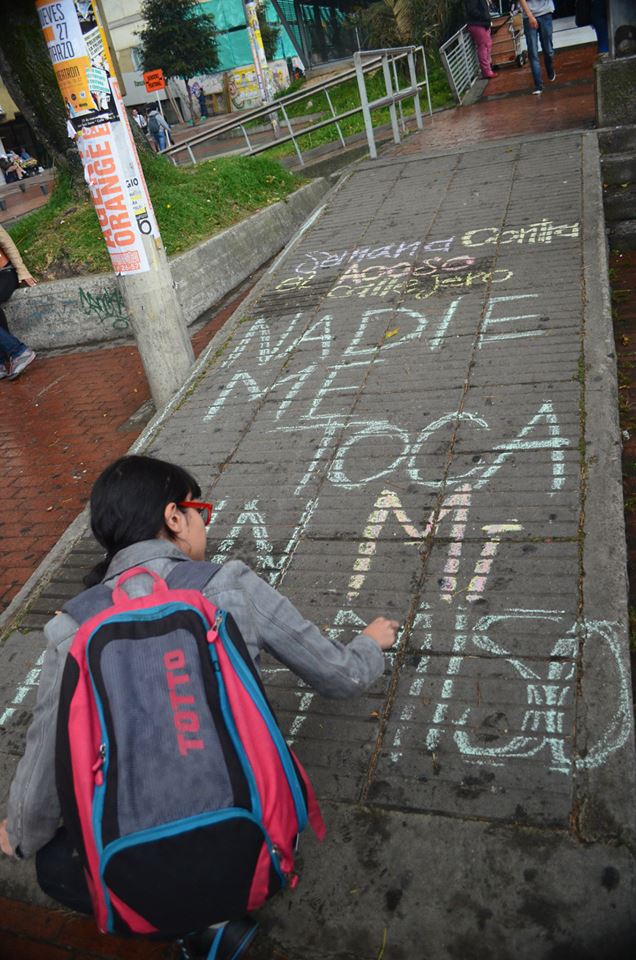
Colombia, 2014
Colombia, 2014

Using sidewalk chalk to write messages like “My body is not public space” has become a popular way to quickly raise awareness about street harassment. It is inexpensive, easy, and something an individual or a small group can do, and the impact can be huge. In addition to raising the awareness of people passing by while the chalking happens, dozens, hundreds, or even thousands of people can see it as they pass by—barring rain or other conditions that might wipe out the message. Anti-street harassment chalking parties have taken place all over the world, including in Melbourne, Australia; Ottawa, Canada; Bogota, Colombia; Berlin, Germany; and Dublin, Ireland, as well as in American states like California, Florida, Georgia, Hawai’i, Illinois, Massachusetts, New York, Oregon, Pennsylvania, and South Dakota.

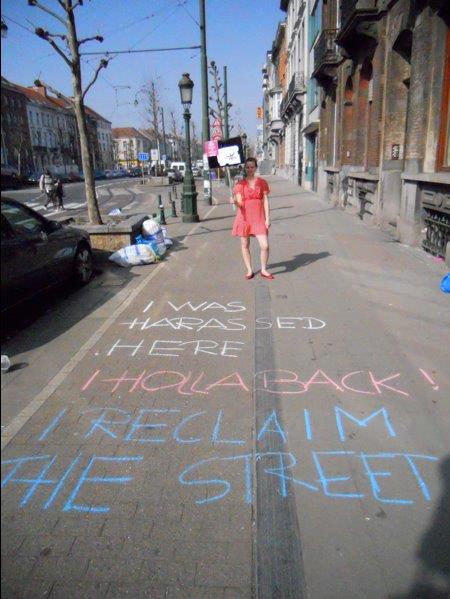
A unique approach to chalking is the Chalk Walk the group Rebellieus, formerly Hollaback! Brussels, held in 2012. Four young women met at Ribaucourt, Molenbeek in Brussels, Belgium, on a spring morning. Their meeting place was significant because it was where one of the women, Angelika, had been harassed. With a bright-colored piece of chalk, Angelika stooped down and wrote on the sidewalk, “I was harassed here. I Hollaback. I reclaim the street.”

Brussels, 2012
Belgium, 2012

She proudly stood by her message as her friends hugged her and congratulated her on reclaiming the space. Together, they made a pilgrimage to other spots where they had been harassed: a busy four-lane boulevard for Anna, the sidewalk of a busy bridge for Julie, and the staircase at the Metro stop De Brouckere for Ingrid. At each place, they shared their stories, reclaimed the space with chalk, and hugged. Several people stopped to talk to them, to hear their stories, and to support their message.

Bahamas Chalk Walk 2014
The Bahamas, 2014

“AWESOME is not even a strong enough word to describe it! EMPOWERING comes close!” the women wrote on their Facebook wall. “What we discovered was that writing with chalk on the sidewalk, on the street, on the bridge, telling Brussels: “I was harassed here’ ‘I reclaim the street’ is a powerful, liberating ritual and an amazing [experience].” In 2013, they launched a We Chalk Walk Tumblr where anyone can submit anti-street harassment chalk messages.

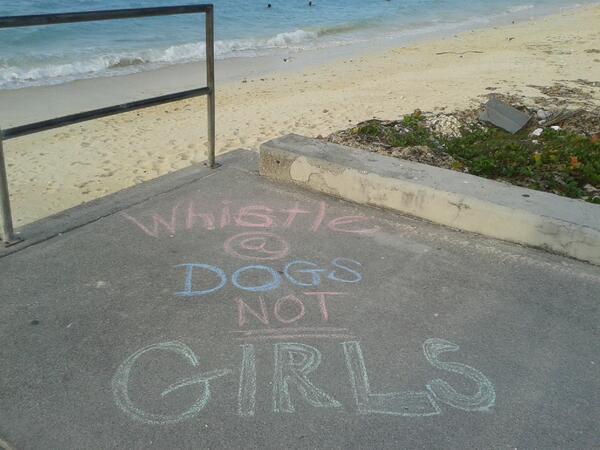
Chalking can be an effective way to start conversations and change minds. In Nassau, the Bahamas, two young women wrote messages such as “Whistle at dogs, not girls” and “Respect girls” on a sidewalk along the beach. They said that among the people who stopped to talk to them was a man “who thought we were writing the message specifically to him. We explained what we were doing to him and told him what he did WAS in fact street harassment. He, of course, did not believe us, and we had to break it down for him. He ended up understanding what we were saying, so we hope we have a converted man in Nassau!”

This is exactly the kind of impact they hoped to have. Alicia Wallace, one of the women, told the local newspaper: “Chalk messages are not common here, and we knew it would attract the attention of pedestrians. … It is unacceptable, and educating the general public on the definition and everyday examples of street harassment is the first step to combating this problem.”

Help fund our work in 2016, donate to our end-of-year giving campaign!
Share

Filed Under: 16 days, Resources, street harassment Tagged With: 16 days of activism, gender-based violence, sidewalk chalking

#16Days of Activism: More Global Action (Day 1)

November 25, 2015 By HKearl

Nov. 25 – Dec. 10 are the 16 Days of Activism Against Gender-Based Violence. To commemorate the week, we will feature 1 activism idea per day, starting tomorrow.

Today, I wanted to express gratitude and acknowledgement that gender-based street harassment, or sexual violence in public spaces, is gaining much more widespread recognition as a problem. Here are two examples from this year that clearly illustrate this.

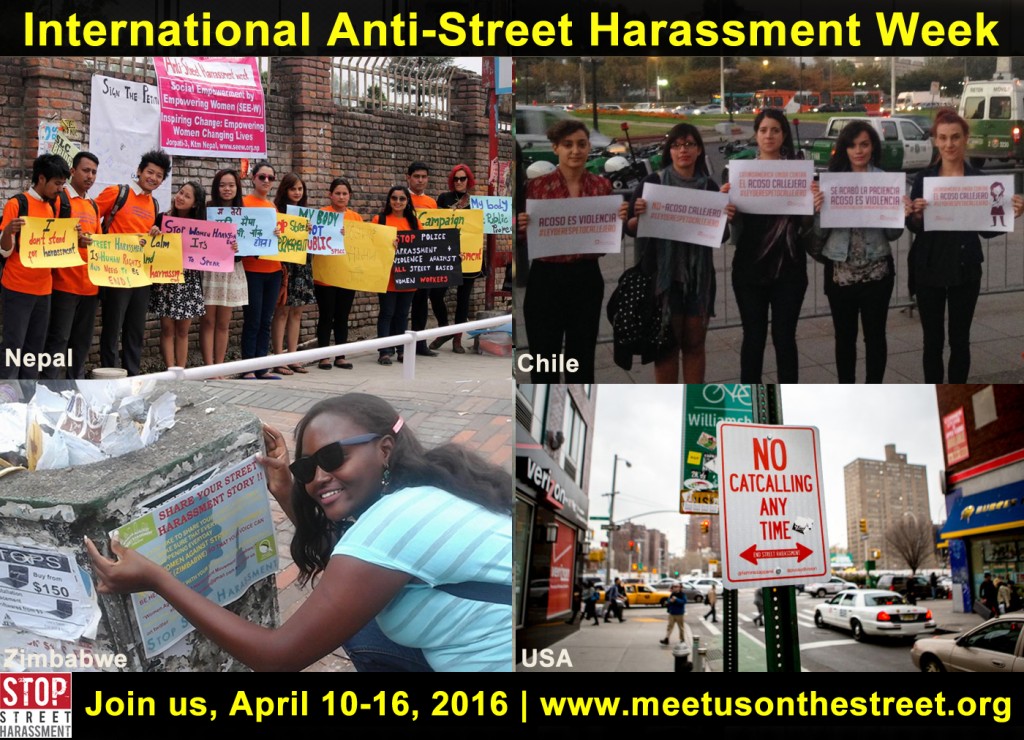
1. In April groups in 41 countries took action in support of safe public spaces through our International Anti-Street Harassment Week, from Australia to Zimbabwe and dozens of countries in between. You can view photos and read a recap (and plan to join us April 10-16, 2016!). It’s heartening to see so many people dedicate time and energy to this cause.

EndSHWeekpostcard2016

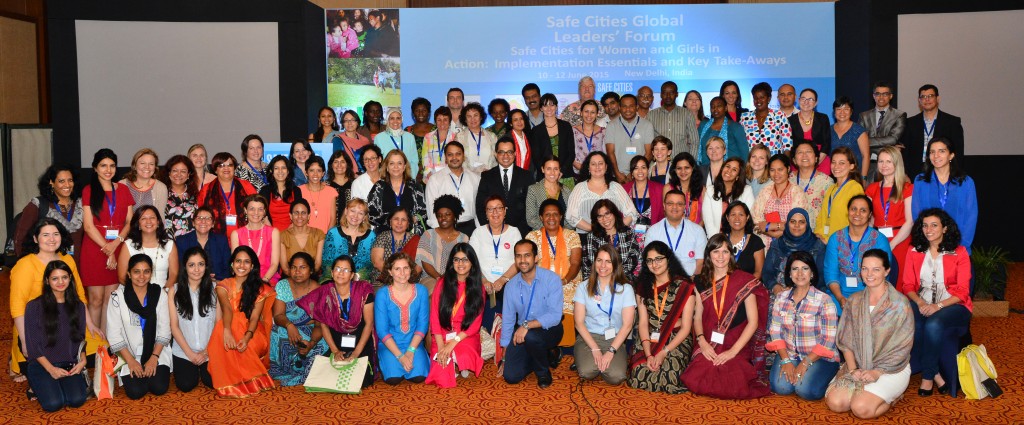
2. UN Women hosted a Safe Cities Global Leaders’ Forum in June, and 140 people from 24 countries gathered in Delhi, India, to share ideas about the best strategies to address sexual violence in public spaces. Attendees included government officials, grassroots women, researchers, and staff from UN agencies that are implementing programs that form part of the agency’s Safe Cities Global Initiative (SCGI).

The SCGI works with local organizations and governments to tackle sexual harassment and other forms of sexual violence in public spaces. Launched in New Delhi in November 2010 with five cities, it now includes 22 cities. Representatives from these cities, as well as from other groups working on safe cities work, were present at the forum.

Read the wrap-up report.

SafeCitiesForumIndia-cropped

For too long, street harassment has been seen as normal, no big deal, or the fault of harassed persons. Those attitudes are quickly falling away and in their place are thousands of people worldwide who are dedicating time, energy, and expertise to making public places safer for everyone. For that, I am grateful.

Help fund our work in 2016, donate to our end-of-year giving campaign!
Share

Filed Under: 16 days, anti-street harassment week, SSH programs, street harassment Tagged With: 16 days of activism, gender-based violence, global efforts, UN women

« Previous Page
Next Page »

Share Your Story

Share your street harassment story for the blog. Donate Now

From the Blog

  • #MeToo 2024 Study Released Today
  • Join International Anti-Street Harassment Week 2022
  • Giving Tuesday – Fund the Hotline
  • Thank You – International Anti-Street Harassment Week 2021
  • Share Your Story – Safecity and Catcalls Collaboration

Buy the Book

  • Contact
  • Events
  • Join Us
  • Donate
  • Facebook
  • Instagram
  • Pinterest
  • Tumblr
  • Twitter
  • YouTube

Copyright © 2026 Stop Street Harassment · Website Design by Sarah Marie Lacy