• About Us
    • What Is Street Harassment?
    • Why Stopping Street Harassment Matters
    • Meet the Team
      • Board of Directors
      • Past Board Members
    • In The Media
  • Our Work
    • National Street Harassment Hotline
    • International Anti-Street Harassment Week
    • Blog Correspondents
      • Past SSH Correspondents
    • Safe Public Spaces Mentoring Program
    • Publications
    • National Studies
    • Campaigns against Companies
    • Washington, D.C. Activism
  • Our Books
  • Donate
  • Store

Stop Street Harassment

Making Public Spaces Safe and Welcoming

  • Facebook
  • Instagram
  • Pinterest
  • Tumblr
  • Twitter
  • YouTube
  • Home
  • Blog
    • Harassment Stories
    • Blog Correspondents
    • Street Respect Stories
  • Help & Advice
    • National Street Harassment Hotline
    • Dealing With Harassers
      • Assertive Responses
      • Reporting Harassers
      • Bystander Responses
      • Creative Responses
    • What to Do Before or After Harassment
    • Street Harassment and the Law
  • Resources
    • Definitions
    • Statistics
    • Articles & Books
    • Anti-Harassment Groups & Campaigns
    • Male Allies
      • Educating Boys & Men
      • How to Talk to Women
      • Bystander Tips
    • Video Clips
    • Images & Flyers
  • Take Community Action
  • Contact

Romania: Organizing a Street Harassment March

January 14, 2015 By Correspondent

Simona-Maria Chirciu, Bucharest, Romania, SSH Blog Correspondent

Credit Simona Chirciu

Bucharest, the Capital of Romania feels like the capital city of street harassment too! Everyday women are harassed by strangers on the streets, on the busses and underground, in parks. No public space is safe for girls and women! This problem is completely invisible, ignored and trivialized in our society but street harassment constrains women’s choices to go where they please without fearing unwanted sexual attention or sexual assault.

I really love activism and I wanted to organize a march or a protest against street harassment in Bucharest. Volunteers of FILIA, an amazing feminist NGO, wanted to help, too. First we had to go through a legal procedure and gain authorization at the Bucharest City Hall.  The procedure is not very complicated, but unpleasant because it takes time. One of FILIA’s volunteer and I went to get this approval. We were so nervous and anxious..

There was a large room, all men (important men – the Head of the Police, Head of Romanian Intelligence Service, Head of Gendarmerie (Jandarmerie) – a military branch of police forces) and other important men. They seemed nice at the beginning, but then they started with “harassment jokes” and stereotypes about sexual violence against women. They all assumed that women like to be harassed because they dress provocatively and act in a promiscuous manner, even because they simply go outside! The cherry on top was when one of them made an “innocent” joke about inviting us for a juice. My volunteer, who is a feminist too, and I glanced at each other with sheer horror and disgust. After a couple of days we received our march authorization for the Center of Bucharest. We were so happy!

Next, some of my volunteers and I worked on banners and slogans for the march and we did a good job. We used slogans like “STOP street harassment!” “Harassment is violence!” “My body is not a public space,” “We don’t need your validation,” “I don’t feel flattered to be harassed!” “I don’t walk on the street for your amusement” and “It is NEVER ok to harass people! So stop doing it” We really wanted to make our voice clear and loud!

The solidarity march against street harassment took place on 19th October 2014, across two hours and gathered approximately 100 people: women and men including persons of many sexual orientation, and 1-2 pets J.

I organized the march through FILIA with their wonderful volunteers and we were supported by feminist and women’s rights NGOs like the Association for Liberty and Gender Equality (Asociatia pentru Libertate si Egalitate de Gen), FRONT Association, AnA Society for Feminist Analyses (Societatea de Analize Feministe AnA, Centre Partnership for Equality (Centrul Parteneriat pentru Egalitate),  E-Romnja Association.

The march was peaceful, quite nice and without incidents. People on the streets interacted with us, greeted us, and asked questions about our march: “Hey, do you think a march will solve the problem? Boys need to be educated or legally punished for doing this.” Yes! Maybe a march doesn’t solve the street harassment issue, but it can raise awareness and is empowering for the march participants.

Unfortunately, after the march, on her way home, in the Center of Bucharest, one of the participants was sexually harassed on the street by a stranger. He addressed her with obscene words, violently pulled her hair and punched her in the face when she wanted to get a picture of him with the mobile phone. None of the bystanders did anything! After the incident, she went to the Police station to make a complaint.

There, a Police officer – a woman – said to her that she wasn’t even dressed in a provocative way. Wow! Such a horrible way to interact with a woman who was just harassed and hit in the face by a violent man and comes to you for seeking justice! Sadly, this is an example of how stereotypes about sexual violence and victim-blaming attitudes are very internalized and hard to eradicate.

Shortly after the incident, the women’s rights NGOs who are part of the informal network “Breaking the Silence about Sexual Violence” (FILIA, ALEG, FRONT, AnA, E-Romnja, CPE, Transcena Association, Sensiblu Foundation, East European Institute for Reproductive Health) wrote an open letter to authorities and especially to the Bucharest Police, demanding a proper investigation of this case, to identify the aggressor and press charges on him. In the open letter, we also asked for a warning campaign for people living in Bucharest, to be alerted about this violent harasser and to get informed about street harassment against women as well.

This incident showed all of us that street harassment can escalates into violent aggression, so street harassment is a major and urgent problem all around the world! The streets are public spaces and we all need to feel free to use them, without fear, without compromises and without back-up plan in case we get sexually harassed!  October 19 was an ordinary day, a day when girls and women were harassed on streets but also a day when feminism and activism confronted street harassment! And that was just the beginning of it. We plan to hold another event during International Anti-Street Harassment Week in April.

Simona is the Vice President of a feminist NGO – FILIA Center and a PhD student in Political Sciences, working on a thesis on street harassment in Bucharest. You can follow her on Facebook.

Share

Filed Under: correspondents, street harassment

“I feared he would continue to prey on others”

January 14, 2015 By Contributor

I was minding my own business walking down a semi-busy street when a middle aged, older man made eye contact with me from his car. Used to unintentional eye contact, I paid no mind and kept on walking; however a few minutes later, the same person stopped his car beside me and asked if I needed a ride. I politely refused and continued walking, but he was persistent.

For the next five minutes, he would drive alongside me and periodically stop and try to persuade me to go with him. He said that we were going the same direction, so he would not mind to give me a ride. Every time, I politely refused. In those five minutes, I tried to make eye contact with several passing drivers, but none actively responded. Therefore, I took an active role in protecting myself with an uncompromising attitude. Although he tried to reassure me that his intentions were pure, his actions were too suspicious; it made no sense why a middle aged man would persistently offer a teenage girl a ride. Finally, he gave up, drove straight for a few meters, and u-turned away. So much for same direction.

This encounter was unsettling, for another middle aged male had once followed me to my house before. What I feared the most was that some girls may be too scared to react and give into his persistence. This area was near a local high school, and this event happened approximately an hour before school would end. Thus, I feared he would continue to prey on others.

I fear for the safety of high school girls, younger girls, and any person walking on the streets of this seemingly safe suburb. No person should be subjected to this experience because gender and/ or sexuality should not play a role in a person’s safety on the streets.

– Anonymous

Location: Temple City

Share your street harassment story for the blog.
See the book 50 Stories about Stopping Street Harassers for more idea

Share

Filed Under: Stories, street harassment

Harassment for Holding Hands

January 14, 2015 By HKearl

Check out the latest Huffington Post article by our board member Patrick McNeil. Here’s an excerpt:

“During a talk called “All The Little Things” posted on the TEDx Talks YouTube channel last week, Irish drag queen Panti Bliss – appearing before a crowd in Dublin last September – explained why an act like holding your partner’s hand isn’t so thoughtless for everyone.

“I am 45 years old and I have never once unselfconsciously held hands with a lover in public,” Bliss says. “I am 45 years old and I have never once casually, comfortably, carelessly held hands with a partner in public.”

Why? Because around the world still today, street harassment is a major problem for women, LGBT people, people of color, people with disabilities, and low-income people. Bliss’ focus is on homophobia, as was her similarly personal and impassioned speech about a year ago when she asked, “Have you ever been standing at a pedestrian crossing when a car drives by and in it are a bunch of lads, and they lean out the window and they shout “fag!” and throw a milk carton at you?”

“Now it doesn’t really hurt. It’s just a wet carton and anyway they’re right – I am a fag. But it feels oppressive.”

Bliss’ experiences aren’t unusual. Actually, they’re common. In the United States, LGBT people are more likely than straight people to report experiencing street harassment (both verbal and physical), according to a national study released last year by the nonprofit organization Stop Street Harassment. And the harassment starts young: 70 percent of LGBT people said they experienced it by age 17, compared to 49 percent of straight people (still a significant figure).”

Share

Filed Under: LGBTQ, street harassment

USA: “Tough but Necessary Conversations”

January 13, 2015 By Correspondent

Dylan Jane Manderlink, Arkansas, USA, SSH Blog Correspondent

As a recent transplant to the rural south from Boston, MA, I have experienced a great deal of shock that comes from the geographical and cultural differences between a northern city and a rural town in the south. I have also faced differences in human experiences that have propelled me into conversations that I never thought I’d have.

One of the biggest changes I noticed in my new life is how I now felt while walking through a public space. Walking along my town’s quaint Main Street, I am greeted with warm southern hospitality and have not been subjected to catcalls, leery eyes, and unwanted attention. Now, that’s not to say that catcalling doesn’t exist in southern areas, but at least in my personal experience so far, I have not yet been exposed to it. My existence in a public space feels different now and because of that, I feel motivated to speak out about the street harassment that plagues urban environments and spread awareness of it in my new community.

As a 20-something first-year teacher, my students feel very comfortable seeking advice from me, sharing their concerns, venting about their stressors, and updating me on their lives. I have been grateful for the opportunities I’ve had to build meaningful relationships with my high school students. The connections I’ve been able to make with my students have helped us develop a common ground, despite our geographical and cultural differences. Through establishing this common ground, an important dialogue has been opened between me and my students concerning a variety of hard-hitting and sensitive issues.

Recently, one of my female students expressed frustration and discomfort with the way male students look at her and talk about her outfits and body. She asked me if I had ever experienced uninvited and uncomfortable situations like that. I told her that because of street harassment I had, especially while living in Boston.

Despite living in very different regions of the United States, the conversations I have had about street harassment with my students have helped develop a vital and ongoing dialogue about female empowerment and the unfortunate objectification of female bodies in the public and media. Most of my students were unaware of street harassment until I opened up to them about my personal experiences, the experiences of my friends, and the reality of it in our society today. Through these productive conversations and teachable moments, I have realized how important opening up a channel of dialogue amongst young people in a rural area about street harassment, gender-based violence, and the treatment of self-identified women in society can be.

Our geographical differences should not equate to an unawareness of social injustice. I believe it is our duty as civilians and social activists to generate meaningful conversations that spark change, awareness, and genuine concern for the well-being of others across our nation’s zip codes and beyond our country’s borders. Of course it’s important to note that there are many regional differences in our nation that bring about challenges, injustices, and ailments that are unique to that environment, but I think we are doing a disservice to our nation and world’s social injustices by not equalizing awareness and attention to these issues. The injustices that plague one community, affect us all.

The more we are unafraid to approach these tough but significant conversations, the more we can   rally around solutions to issues that are debasing populations and the basic humanity of people. These cross-cultural and cross-geographical conversations have the potential to defy the physical barriers that separate us and create more unity than we may have thought.

As a teacher, I have the privilege of initiating and partaking in important conversations like these everyday with my students. But I understand that some careers don’t allow this to happen as frequently or accessibly as mine. With that said, my charge to you is to fearlessly approach these conversations with people who you share commonalities with but also differ greatly from. Often, it’s through our differing human experiences that we can construct a diverse, deep, and productive conversation that has the potential to lead to solutions to some of our society’s most complex and murky problems. Despite my students not having been exposed to street harassment before, they have gained a new perspective on a societal injustice that impacts us all.

Dylan is a recent graduate of Emerson College and currently teaches 8th, 10th, and 11th grade Digital Communications and Audio/Visual Technology in an Arkansas high school. You can visit her personal blog and follow her on Twitter @DylanManderlink.

Share

Filed Under: correspondents, street harassment

#WhatMySHSaid

January 13, 2015 By HKearl

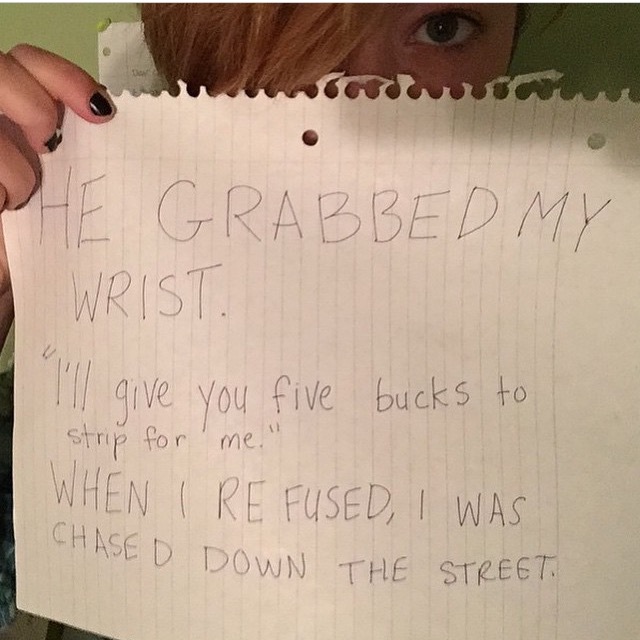
Jessica Frankovich wrote a great article about street harassment for GirlSpeak.org and in it she highlights this new awareness-raising project. Here’s an excerpt, but check out her whole piece!

“California teen Chloe Parker came up with an idea to help combat the problem of street harassment. On her Instagram, @rebel.grrrl, women from all over the world submit pictures of themselves holding up a piece of paper. The words a street harasser said to them are written on the paper. (Here’s your warning: they get pretty creepy.)

The project has helped Chloe, who was first street harassed at the age of 12, feel less alone. ‘I hope this will open people’s eyes to the trouble women so often face on a daily basis,’ she said.

You can submit your own #WhatMySHSaid to Chloe through Instagram direct message or by posting the picture on Instagram with the hashtag #WhatMySHSaid. She asks that you include your location (state, province, city, county or whatever else) and age, if possible, tag her in the photo you post, and let her know if you’d like to remain anonymous.”

Share

Filed Under: Activist Interviews, street harassment

« Previous Page
Next Page »

Share Your Story

Share your street harassment story for the blog. Donate Now

From the Blog

  • #MeToo 2024 Study Released Today
  • Join International Anti-Street Harassment Week 2022
  • Giving Tuesday – Fund the Hotline
  • Thank You – International Anti-Street Harassment Week 2021
  • Share Your Story – Safecity and Catcalls Collaboration

Buy the Book

  • Contact
  • Events
  • Join Us
  • Donate
  • Facebook
  • Instagram
  • Pinterest
  • Tumblr
  • Twitter
  • YouTube

Copyright © 2026 Stop Street Harassment · Website Design by Sarah Marie Lacy