• About Us
    • What Is Street Harassment?
    • Why Stopping Street Harassment Matters
    • Meet the Team
      • Board of Directors
      • Past Board Members
    • In The Media
  • Our Work
    • National Street Harassment Hotline
    • International Anti-Street Harassment Week
    • Blog Correspondents
      • Past SSH Correspondents
    • Safe Public Spaces Mentoring Program
    • Publications
    • National Studies
    • Campaigns against Companies
    • Washington, D.C. Activism
  • Our Books
  • Donate
  • Store

Stop Street Harassment

Making Public Spaces Safe and Welcoming

  • Facebook
  • Instagram
  • Pinterest
  • Tumblr
  • Twitter
  • YouTube
  • Home
  • Blog
    • Harassment Stories
    • Blog Correspondents
    • Street Respect Stories
  • Help & Advice
    • National Street Harassment Hotline
    • Dealing With Harassers
      • Assertive Responses
      • Reporting Harassers
      • Bystander Responses
      • Creative Responses
    • What to Do Before or After Harassment
    • Street Harassment and the Law
  • Resources
    • Definitions
    • Statistics
    • Articles & Books
    • Anti-Harassment Groups & Campaigns
    • Male Allies
      • Educating Boys & Men
      • How to Talk to Women
      • Bystander Tips
    • Video Clips
    • Images & Flyers
  • Take Community Action
  • Contact

India: Report street harassment by ATM

January 7, 2015 By HKearl

Really interesting innovation out of India. I’d like to learn more about the process after someone makes the report.

Via CityMetric:

“In the Indian state of Odisha, the state government estimates that around 60 per cent of sexual assaults against women go unreported…

For Joydeep Nayak, the head of the state’s police human rights unit, part of the problem lies in the practical barriers preventing women from reporting assault and harassment…So, spurred on by reports of the gang-rape and death of a Delhi woman in Deceber 2012, Nayak came up with a solution, in the form of what looks like a police-sponsored ATM machine.

The ICLIK, developed by the Odisha government and OCAC, a local computer company, allows women to log a report of assault or harassment while appearing to visit a bank machine. The machine is located inside a Bank of Baroda indoor ATM area in Bhubaneswar, the state capital…

Users start by choosing a category of assault. They then leave further details…by typing on the screen, scanning a written report or recording an oral message. The information is sent directly to the local police control room, for officers to investigate.

The machine’s location in an ATM area means it’s open 24 hours a day, and is under the watchful eye of a security guard. Since its introduction in January 2014, the ICLIK has reportedly received around five reports a day, with harassment being the most commonly reported crime.”

Share

Filed Under: News stories, street harassment

Video: Fashion Institute of Technology Project

January 6, 2015 By HKearl

Devon is a student at the Fashion Institute of Technology. This past semester, her class was given the task of creating a video about a social cause of their choosing. Being a young woman living in New York City, she felt the topic of street harassment was a personal and meaningful cause she wanted to address in hers.

Share

Filed Under: Activist Interviews, Resources, street harassment

“I was dumbfounded that someone would actually say that”

January 5, 2015 By Contributor

My earliest interaction of catcalling came when I was 12 years old. My friend was gorgeous and physically mature for her age, and told me she got catcalled a lot. Once, we were walking downtown together, and a 30-ish man yelled from a car, ʺHey baby, you lookin gooood today,” equipped with kissing noises. My (keep in mind, 12 year old) friend just frowned, looked at her shoes, and sighed. I was dumbfounded that someone would actually say that, and thinking back, it’s quite disgusting.

– Anonymous

Location: Los Angeles, CA

Share your street harassment story for the blog.
See the book 50 Stories about Stopping Street Harassers for more idea

Share

Filed Under: Stories, street harassment

DC’s New Mayor is a Safe Public Spaces Champion!

January 2, 2015 By HKearl

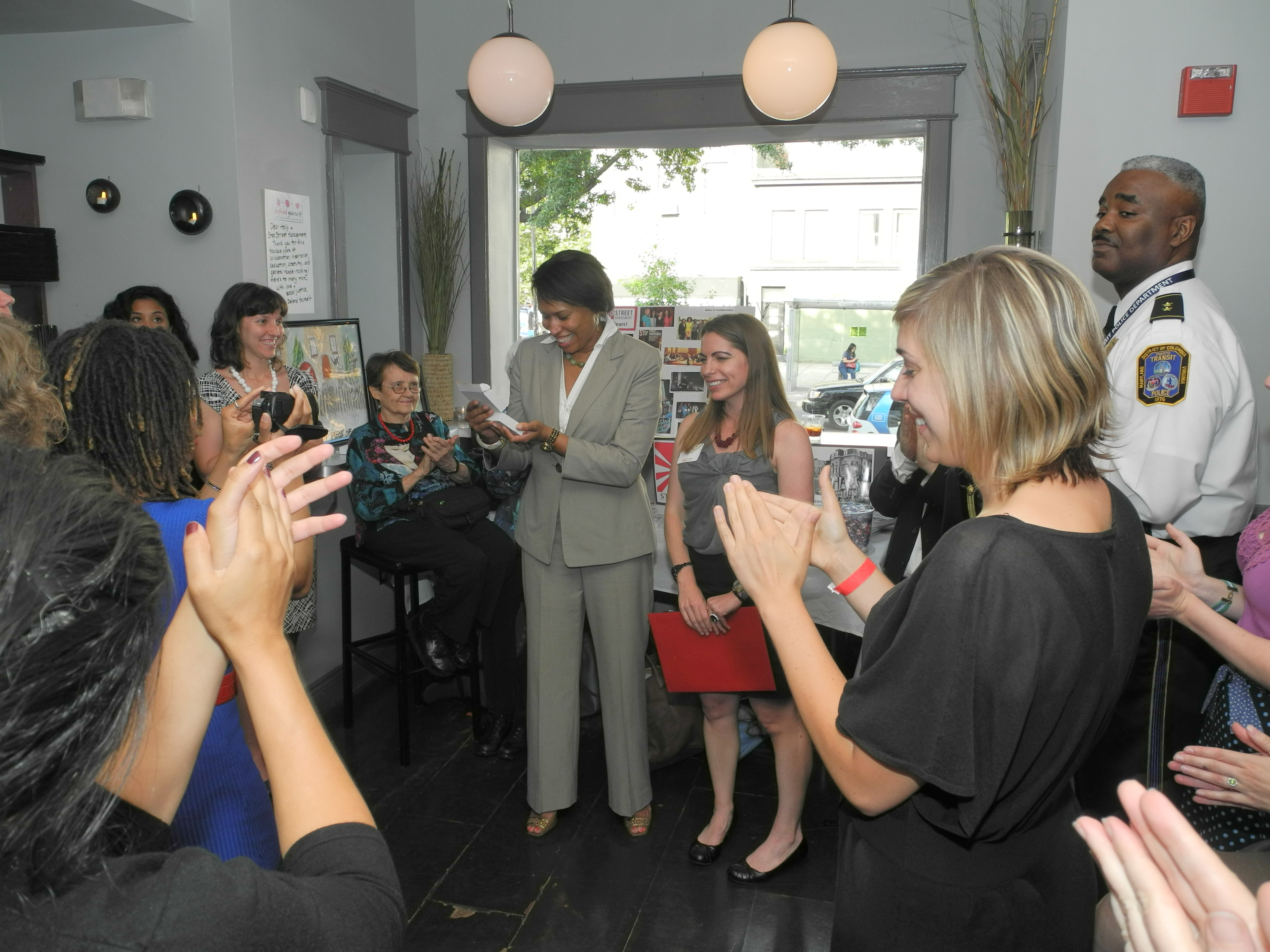
I’m so excited that our Safe Public Spaces Champion awardee Muriel Bowser is MAYOR of Washington, DC!

Via NBC News:

“”It’s my charge to make [D.C.] greener, healthier, safer and more fiscally stable than we find it today,” she said.

Formerly D.C.’s Ward 4 councilmember, Bowser is now just the second woman to lead the District. Early in her inaugural remarks, she thanked the female mayors of other major cities, saying, “Today, because of you, I am one too.”

It’s in large part thanks to her that the Washington Metropolitan Area has an anti-harassment transit campaign. In 2012 when I was part of a group organized by Collective Action for Safe Spaces (I was one of their board members at the time) that testified about harassment before the DC city council and the all male WMATA leadership responded by saying harassment wasn’t a problem, Bowser told them “as a woman I feel differently” and told them to do something. And they did. #WomenLeaders

Share

Filed Under: News stories, SH History, SSH programs, street harassment

Harassment in North Korea and Jordan

January 2, 2015 By HKearl

Two quick news hits ~

 Via UTNE.com:

“’Harassment is a culture,’ says Khadra, a 24-year-old graduate student at the University of Jordan in Amman. Physical, verbal and cyber, harassment happens in the streets, in parks, on public transportation, and at schools and universities.

Despite its prevalence, official research and statistics on street harassment in Jordan do not exist, according to Asma Khader, secretary general of the Jordanian National Commission for Women (JNCW). Manal Sweidan, head of the gender statistics division at the Jordanian Department of Statistics, confirmed that the department did “not have … any official data regarding sexual harassment.” Khader estimated offhand that 80 percent of women face harassment, and “it is increasing.” The lack of formal data makes quantifying and addressing the issue difficult.”

Via NK News:

“In February the UN Commission of Inquiry on Human Rights in the Democratic People’s Republic of Korea published its report. Its findings included large-scale sexual abuses, mostly directed at women, across all sectors of society.

“Witnesses have testified that violence against women is not limited to the home, and that it is common to see women being beaten and sexually assaulted in public,” the report officially said.

Regardless of who you speak to about North Korean women – researchers, activists, journalists, academics – one thing is clear: North Korean women are subject to abuse on a monumentally large scale.

This is not a new phenomenon in North Korea; rather this long-standing history of silent persecution of women’s sexuality is based on the strong foundations of a patriarchal system where women are expected to overcome any challenge at work or home with absolute loyalty towards the Great Leader, as mothers of the nation.

The social expectation and pressure exerted on these women, particularly in the post-famine period where the private economy has seen women enter into new realms of society, has created new problems and threats both in the home and workplace.”

Share

Filed Under: News stories, street harassment

« Previous Page
Next Page »

Share Your Story

Share your street harassment story for the blog. Donate Now

From the Blog

  • #MeToo 2024 Study Released Today
  • Join International Anti-Street Harassment Week 2022
  • Giving Tuesday – Fund the Hotline
  • Thank You – International Anti-Street Harassment Week 2021
  • Share Your Story – Safecity and Catcalls Collaboration

Buy the Book

  • Contact
  • Events
  • Join Us
  • Donate
  • Facebook
  • Instagram
  • Pinterest
  • Tumblr
  • Twitter
  • YouTube

Copyright © 2026 Stop Street Harassment · Website Design by Sarah Marie Lacy