• About Us
    • What Is Street Harassment?
    • Why Stopping Street Harassment Matters
    • Meet the Team
      • Board of Directors
      • Past Board Members
    • In The Media
  • Our Work
    • National Street Harassment Hotline
    • International Anti-Street Harassment Week
    • Blog Correspondents
      • Past SSH Correspondents
    • Safe Public Spaces Mentoring Program
    • Publications
    • National Studies
    • Campaigns against Companies
    • Washington, D.C. Activism
  • Our Books
  • Donate
  • Store

Stop Street Harassment

Making Public Spaces Safe and Welcoming

  • Facebook
  • Instagram
  • Pinterest
  • Tumblr
  • Twitter
  • YouTube
  • Home
  • Blog
    • Harassment Stories
    • Blog Correspondents
    • Street Respect Stories
  • Help & Advice
    • National Street Harassment Hotline
    • Dealing With Harassers
      • Assertive Responses
      • Reporting Harassers
      • Bystander Responses
      • Creative Responses
    • What to Do Before or After Harassment
    • Street Harassment and the Law
  • Resources
    • Definitions
    • Statistics
    • Articles & Books
    • Anti-Harassment Groups & Campaigns
    • Male Allies
      • Educating Boys & Men
      • How to Talk to Women
      • Bystander Tips
    • Video Clips
    • Images & Flyers
  • Take Community Action
  • Contact

Sri Lanka: The psychological effects of street harassment

November 3, 2014 By Correspondent

Menusha Gunasekara, Matale, Sri Lanka, SSH Blog Correspondent

Yesterday I was terrified with fear and uncertainty. What was disturbing my mind, my confidence and my dreams was seeing my harasser that day. It was not an unexpected event since I knew the harasser lived in the same area I live; I knew someday I would see him again. Unconsciously, I was checking the vehicle number of every red-colored three-wheeler taxi that passed me in the road. I was trying to avoid seeing him, but yesterday I failed.

Two years ago I was harassed by a taxi driver. Not just one time but three times. Although my mother got involved and met with the perpetrator, I never felt I was safe at home. For almost one year I had nightmares about worst-case scenario related to this incident. It was producing a lot of anger inside me.

Many think of street harassment as just an everyday “normal event” but the psychological trauma from a single incident can ruin your life. Nobody would think my hesitation and my reluctance to go in the village area alone comes from the negative side effects of street harassment. On top of that, my knee injury puts me in a vulnerable stage reminding me that I cannot even run for my safety. As a result, after coming home from university, I feel like I have been sentenced to house arrest. The freedom I had to stroll wherever I want seems far away in Sri Lanka.

Moving on from the personal experience to the increased number of harassment incidents in public places, including public transportation, I am aware that my experience is not just a single event alone. Although after the Wariyapola incident there was public and media dialogue about taking actions and social awareness on street harassment, that voice has disappeared. The wave of media attention has gone until the next incident, and there is no steady attention to combat the gendered mentality or to support women who faced street harassment.

A few days ago, I learned about a new initiative from the Women & Children Bureau that allows you to report sexual harassment on public transportation. They have created a SMS service to collect data and an easy way to complain about harassment through the following number: 0716550000. Let’s think positively that this initiative will be reached by the public since many women use mobile phones. At least it is a better way to report to a responsible authority than by going to a police station.

Still, the support for mental trauma has not been addressed by any authority. Places where women can have easy access to counseling and advice to deal with the negative emotions that can hinder their productivity and self-esteem should be established. As the President Rajaphaksha recently claimed that Sri Lanka is a better place for women & children to live in Asia, I just want to remind the responsible authorities, NGOs and public that that statement can be misleading if the root of the problem of harassment is not addressed.

Public awareness and actions are the impetus for creating safe environment for women and everyone.

Menusha is a recent graduate of Asian University for Women, Bangladesh and holds a B.S in Public Health. She is an advocate for Peace and Human Rights, Women Issues and Environmental Protection. She can be reached via LinkedIn.

Share

Filed Under: street harassment

“College-aged men on the patio felt it was important to yell at me that I was ugly”

November 3, 2014 By Contributor

Drove through Taco Cabana one evening. I’d spent the day taking care of a sick relative. I was tired and I just needed to get something to eat. College-aged men on the patio felt it was important to yell at me that I was ugly. I was 48-years-old at the time. When I get up in the morning, my goal isn’t to titillate college-aged, beer-swilling man-children. How would they feel if someone acted that way to their mother? I was in a moving vehicle and I just kept going, but in retrospect I should have gone in and told the manager, or better yet, just thrown my soda at them.

Optional: Do you have any suggestions for dealing with harassers and/or ending street harassment in general?

Next time I am harassed, and unfortunately I know there will be a next time, I’ll tell the manager so they have the opportunity of making the harassers leave. If I’m in my car, I’m going to nail them with a soda.

– Anonymous

Location: Denton, TX

Share your street harassment story for the blog.
See the book 50 Stories about Stopping Street Harassers for more idea

Share

Filed Under: Stories, street harassment

What is street harassment & what can I do?

October 31, 2014 By HKearl

Street harassment is the top story on The Today Show this morning and has been covered by every major media outlet this week.

So if you’re just learning about this issue and/or us, welcome. Here are a few quick things to know:

What it is:

Street harassment is any unwanted action or comment between strangers in public places that is disrespectful, unwelcome, threatening and/or harassing and is motivated by gender or sexual orientation or gender expression. It happens in every country and disproportionately to all women and to men in the LGBQT community.

It impacts harassed persons’ ability to navigate through and be in public spaces and thus is a human rights violation. It is part of the same continuum as sexual violence as it can escalate into it (and we never know when) and it can be retriggering for survivors of sexual violence.

History of the Issue:

Since at least the late 1800s, women have been speaking out and challenging street harassment. The term was first used in 1981 and the first website about it where women could share their stories launched in 2000 by the Street Harassment Project.

Women of color have led many of these efforts, in more recent times, they have done amazing work through the Rogers Park Young Women’s Action Team, Girls for Gender Equity, Stop Telling Women to Smile, Brooklyn Movement Center, the Window Sex Project, and #YouOkSis?

History of Stop Street Harassment:

This website began in 2008 to fill a gap in information/resources about the topic — it grew from my master’s thesis on the subject at George Washington University, which I began research for in 2006. I wrote one of the only books on street harassment in 2010, Stop Street Harassment: Making Public Places Safe and Welcoming for Women, and commissioned a nationally representative survey on street harassment this year.

What we Do/Get involved:

Currently, SSH does a lot of education and community mobilization work.

* You can share your story.

* You can find suggestions for dealing with street harassers as well as the relevant USA laws

* You can find information on being a male ally and how to talk to women with respect.

* You can find toolkit guides for taking action in your community on this topic.

* You can read articles from our blog correspondents in 9 countries to learn about the problem globally. (We will be recruiting a new cohort of correspondents in December.)

* You can get an update on the community projects our Safe Public Spaces teams are doing in this fall in 6 countries and DONATE to support the 2015 programs (and apply to be one of those programs in 2015).

* You can plan to participate in the 5th annual International Anti-Street Harassment Week.

* You can request me to lead a workshop or give a talk in your community, to your business, or in your school or community (in 4 years I’ve given 130+ talks).

* You can donate to support our work, which currently is largely done on a volunteer-basis and anything we do fund comes solely from individual donors.

 

Share

Filed Under: street harassment

A viral video cannot be the only way to understand street harassment

October 30, 2014 By HKearl

Whenever I left my college campus in California, inevitably at least once man would honk, whistle or call out to me from his car. Usually it was several. It annoyed me, it made me dread going places, and I felt there was little I could do about it as these men whizzed by, safely removed from me in their cars.

I will never forget the day a man harassed me while I was on the phone with my dad and my dad heard it. He asked me in surprise if that man was talking to me. I said something like, “Yes, dad, it happens all the time when I’m walking along this street.”

He was shocked. In that moment I realized he had no idea how many times men harassed me.

At that time, I didn’t know the term “street harassment” but a few years later in 2006, I found the term on the Street Harassment Project website and wrote my master’s thesis on it. During the course of my research, I began not only educating myself about the issue, but also the men in my life, like my dad and my male partner.

They, like many straight men, were clueless about how often the women they knew faced unwanted comments, following and even touching in public spaces. So I made it a point to mention when and where I was harassed to help them understand. They believed me, they cared, and now they are outspoken against it.

In the nearly 8 years that I’ve been studying, writing and speaking out about this topic, I’ve encountered countless people who similarly have no idea how common street harassment is or how bad it can be and also those who willfully believe it doesn’t happen and that we are exaggerating or lying.

Over the past four months, there have been four different viral videos of street harassers filmed with hidden cameras on the streets of Washington, DC, Minneapolis, Cairo, Egypt, and this week, New York City. Two years ago, there was a similar video made in Brussels, Belgium. They show just how common street harassment is and provide visual examples of what it looks like. These videos are easy to digest and they are raising many people’s awareness about the problem. They prove street harassment is not made up.

But these hidden camera videos only go so far and they cannot and should not be the only way to understand the problem and raise awareness about it. This is why.

First, the women who are the subjects of these films comprise just one demographic: they are all young adult, able-bodied, seemingly heterosexual, attractive women walking alone in big cities, and the three women in the USA and in Belgium are all white. Collectively, they make the experiences of everyone else invisible. To help see the bigger picture of who experiences harassment, you can turn to Twitter, blogs, art projects, and to a nationally representative survey conducted earlier this year by GfK.

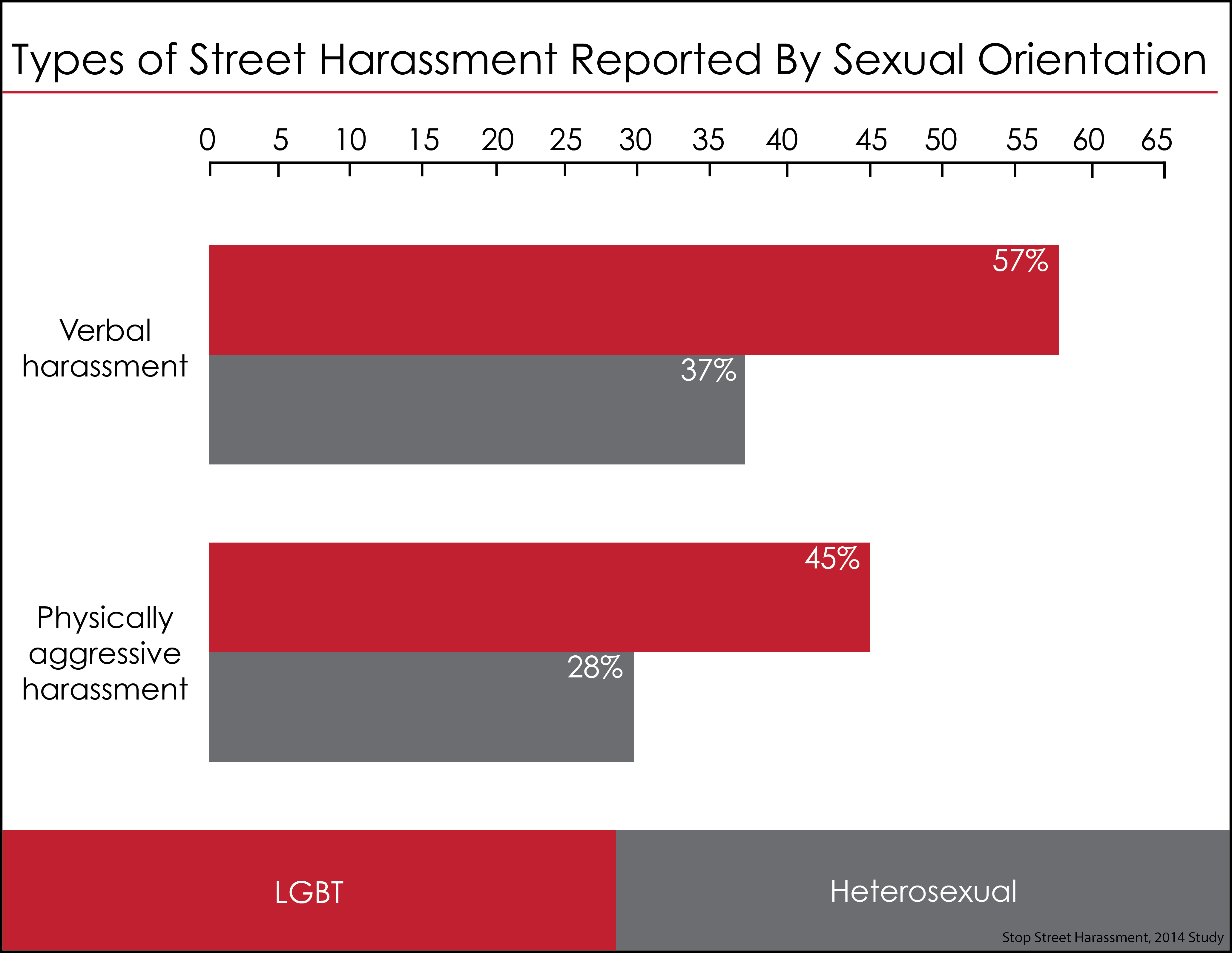
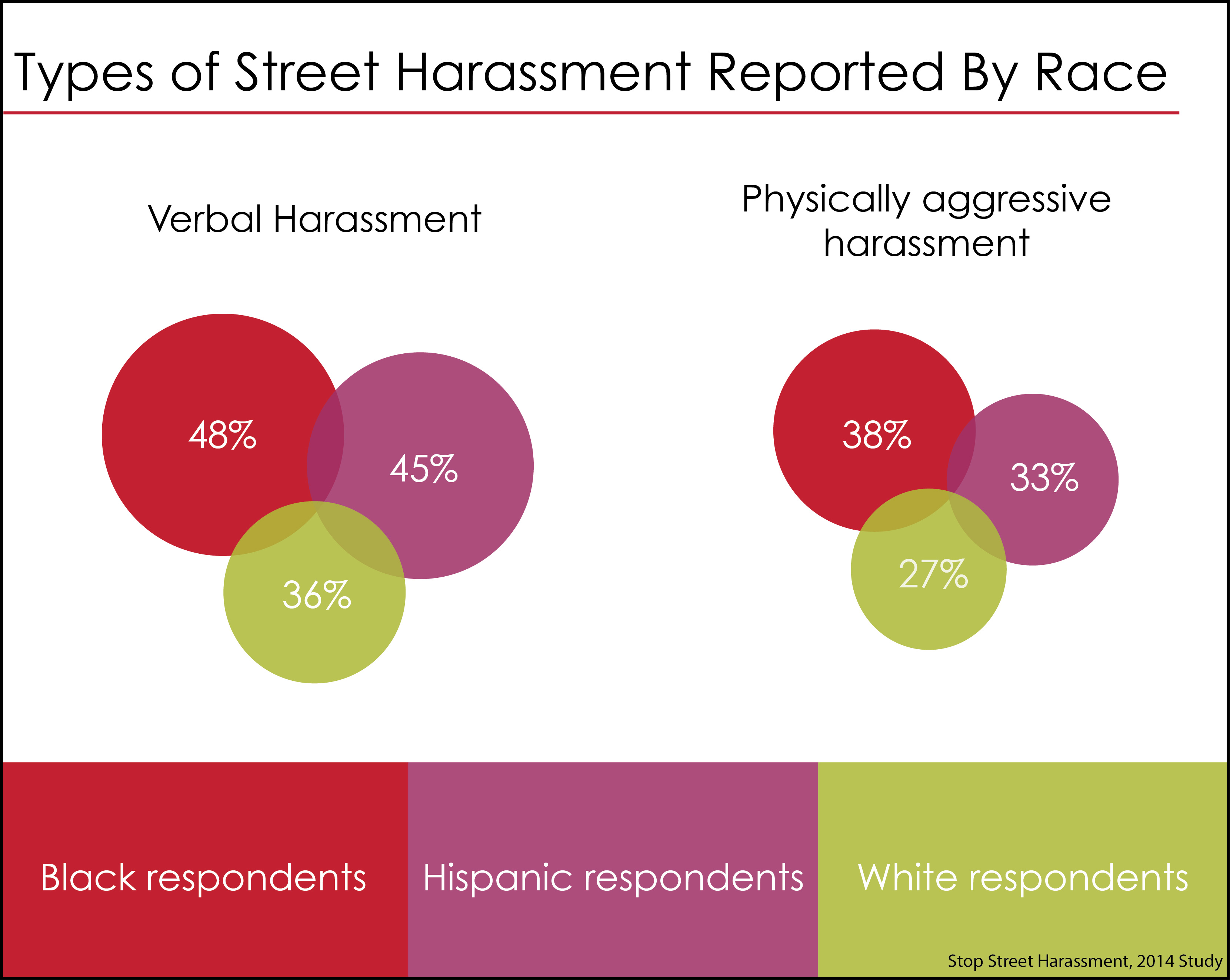
In the survey, 25% of men – largely in the LGBQT community – said they had been street harassed, as had 65% of women. Half of all harassed persons said it began before they were age 17, so lots of teenagers are harassed. Persons of color were more likely than white people to say they had been harassed. People from every region of the country and every income level reported experiencing harassment. While the survey did not ask specifically about disability or include enough transgender individuals to speak about their experiences statistically, there is no doubt from people’s stories that that they face a lot of street harassment, too.

Second, the videos do not show the full extent of harassment people experience, like being grabbed or flashed or assaulted. In the national survey, nearly one in four women had been sexually touched or groped, one in five had been followed, and nearly one in ten had been forced to do something sexual. Recently, a woman in Detroit was murdered by a harasser, while a woman in New York City was slashed by another. These scary, violent experiences is what makes a lot of the “just verbal” experiences upsetting. And of course that underlying discomfort and fear is hard to depict in a short video.

Third, by limiting the video taping to the streets, you don’t see the full range of harassers. Like men – and most harassers of women and men are male — who harass from their vehicles. Men who harass on public transportation. Men who harass in stores, restaurants, clubs, bars, parks, movie theaters, and beaches. Men who stand outside their college fraternity house or sports field and harass women walking by. I believe there would be more racial diversity, age diversity and income-bracket diversity among the harassers than the viral videos depict if it was possible to capture harassment in all of these places.

Since it is impossible to video tape every type of harasser and harassee to document – to prove – this is a problem, we need to listen to and believe everyone who speaks out to share their stories. Believe the gay man who says he is called a fag or queer; believe the transgender person who says they are called tranny and he/she; believe persons of color when they say they are called racial slurs, misidentified as a criminal or as a sex worker; believe persons with disabilities when they say they are laughed at, pointed at, and harassed; believe the teenagers who say they are harassed while commuting to and from school.

Then go a step further beyond belief, try to empathize with their experiences — even though they are not like your own — and commit to helping create a world that is safer and more welcoming for them.

Share

Filed Under: street harassment

“Excuse me, Mr. Stranger? I’m fifteen!”

October 30, 2014 By Contributor

I am half black, half white and people, no – men – in South Africa often give me strange looks. I live in Czech Republic, where people do that just because I have a dark skin, but they don’t approach me out of nowhere and chat.

My aunt took my older sister and me to the hairdresser’s. I was sitting in a chair while the hairdresser was straightening my hair. Three men were sitting next to me, staring at me occasionally. I got used to it a little bit over time, people do that there. But when we were leaving the place, me stepping out last, one of the men grabbed my arm, making me turn around. He let my arm go, smiled at me, waved and said ‘hi’. I froze, then almost-waved back with a stoic expression, my eyes widened in panic, mumbled ‘hi’ and ran away to the safety of my family. We laughed about it, when I told them. But wow, was I scared. It wasn’t because of my clothes, it was cold outside, but I look older than I am. Some people even mistake me for my mom’s (married) friend. But excuse me, Mr. Stranger? I’m fifteen!

– C

Location: South Africa

Share your street harassment story for the blog.
See the book 50 Stories about Stopping Street Harassers for more idea

Share

Filed Under: Stories, street harassment

« Previous Page
Next Page »

Share Your Story

Share your street harassment story for the blog. Donate Now

From the Blog

  • #MeToo 2024 Study Released Today
  • Join International Anti-Street Harassment Week 2022
  • Giving Tuesday – Fund the Hotline
  • Thank You – International Anti-Street Harassment Week 2021
  • Share Your Story – Safecity and Catcalls Collaboration

Buy the Book

  • Contact
  • Events
  • Join Us
  • Donate
  • Facebook
  • Instagram
  • Pinterest
  • Tumblr
  • Twitter
  • YouTube

Copyright © 2026 Stop Street Harassment · Website Design by Sarah Marie Lacy