• About Us
    • What Is Street Harassment?
    • Why Stopping Street Harassment Matters
    • Meet the Team
      • Board of Directors
      • Past Board Members
    • In The Media
  • Our Work
    • National Street Harassment Hotline
    • International Anti-Street Harassment Week
    • Blog Correspondents
      • Past SSH Correspondents
    • Safe Public Spaces Mentoring Program
    • Publications
    • National Studies
    • Campaigns against Companies
    • Washington, D.C. Activism
  • Our Books
  • Donate
  • Store

Stop Street Harassment

Making Public Spaces Safe and Welcoming

  • Facebook
  • Instagram
  • Pinterest
  • Tumblr
  • Twitter
  • YouTube
  • Home
  • Blog
    • Harassment Stories
    • Blog Correspondents
    • Street Respect Stories
  • Help & Advice
    • National Street Harassment Hotline
    • Dealing With Harassers
      • Assertive Responses
      • Reporting Harassers
      • Bystander Responses
      • Creative Responses
    • What to Do Before or After Harassment
    • Street Harassment and the Law
  • Resources
    • Definitions
    • Statistics
    • Articles & Books
    • Anti-Harassment Groups & Campaigns
    • Male Allies
      • Educating Boys & Men
      • How to Talk to Women
      • Bystander Tips
    • Video Clips
    • Images & Flyers
  • Take Community Action
  • Contact

Why We Shouldn’t Lose Sight of Full Equality

October 30, 2014 By Contributor

Cross-posted with permission from the author Patrick McNeil, our board member, from the Huffington Post

Late last week, the U.S. Office of Special Counsel found that the Department of the Army had discriminated against Tamara Lusardi based on her gender identity in a significant ruling that said Lusardi’s restricted daily movement “constituted discriminatory harassment under the guiding principles of Title VII [of the Civil Rights Act].”

At the same time, marriage equality is becoming the new normal, and the United States has suddenly become a nation where nearly two-thirds of same-sex couples live in a state where they can get married. Just this past Saturday morning, Attorney General Eric Holder announced that same-sex couples in six more states would receive federal benefits and have their marriages recognized by the federal government.

This is all very good news, but GLSEN’s annual school climate survey, also released last week, is a good reminder that – while LGBT Americans live in an increasingly evolving society – there’s still a long way to go.

At school, according to the survey, LGBT students really don’t feel safe. More than half (55.5%) of LGBT students feel unsafe because of their sexual orientation – and more than a third because of their gender expression. In the past month, almost a third missed at least one day of school because they felt uncomfortable, while more than a third avoided certain gender-segregated spaces (like bathrooms and locker rooms) for the same reason. More than two-thirds frequently or often heard homophobic remarks, and more than half heard negative comments about gender expression – like not being “masculine enough” or “feminine enough.”

LGBT students are particularly susceptible to verbal and physical harassment at school, and about half (49%) said they’ve experienced electronic harassment in the past year – such as via texting or on social media. What this all leads to is higher levels of depression and lower levels of self-esteem.

These findings, which are actually much improved from just a few years ago, are still very terrifying, given that schools are meant to be safe spaces where children spend a significant portion of their day. The findings are also very parallel with what we know about how LGBT people navigate and experience public spaces.

According to Stop Street Harassment’s (SSH) national study released earlier this year, LGBT people were more likely than straight people to report experiencing street harassment (both verbal and physical) – and it starts young. Seventy percent of LGBT people said they experienced it by age 17, compared to 49 percent of straight people (which is still very significant). In the same way that students in GLSEN’s survey reported avoiding certain activities because they felt unsafe, SSH’s study found that LGBT people were more likely to give up an outdoor activity for the same reason.

In my own research on the street harassment of gay and bisexual men – an admittedly much narrower group – survey respondents also reported high levels of avoiding specific areas or neighborhoods and crossing the street or taking an alternative route in order to sidestep unwanted interactions in what they felt were unsafe environments. In addition, 71.3 percent said they constantly assessed their surroundings when navigating public spaces.

That’s not healthy.

Whether at school or in public spaces, many LGBT youth don’t feel safe and continue to face disgraceful levels of discrimination (and some don’t feel safe at home, either). But when they enter the workforce, disadvantages persist.

In the absence of federal legislation like the Employment Non-Discrimination Act (ENDA), it’s still legal in a majority of states to discriminate against employees simply on the basis of sexual orientation or gender identity (even in some states where same-sex marriage is now legal). On the job, report after report notes the existence of persistent harassment and discrimination for LGBT people. And this is layered on top of pervasive race and gender discrimination.

This year, 50 years after the Civil Rights Act of 1964 was signed, it’s certainly satisfying to know that the Act continues to guide favorable, groundbreaking rulings, like in the case of Tamara Lusardi. But we shouldn’t allow extraordinary advances to overshadow the amount of progress we still need to make toward full equality at school, in public spaces, in the workplace – and everywhere in between. Indeed, we’ve only just begun.

Share

Filed Under: LGBTQ, male perspective, street harassment

“How much do you charge?”

October 30, 2014 By Contributor

I had an idiot pull up in his car and ask me if I wanted to “go on a date”.  I ignored him so he screamed at the top of his lungs “How much do you charge?” – I got hit on a lot on the streets because I was beautiful; however, my looks disappeared when I hit my 40’s; but it’s nice to be invisible…older women are just not seen….

Optional: What’s one way you think we can make public places safer for everyone?

Men still haven’t got it.  We need to start raising boys differently.  Pure and simple it has to start in childhood.

– Diva

Location: San Francisco’s Delores Street, CA

Share your street harassment story for the blog.
See the book 50 Stories about Stopping Street Harassers for more idea

 

Share

Filed Under: Stories, street harassment

“Your legs made me miss my stop”

October 29, 2014 By Contributor

Today on the way to work, a guy came up behind me on the subway and whispered, “Your legs made me miss my stop. I ain’t even mad.”

I want to bathe in acid.

– Bonnie

Location: NYC Subway

Share your street harassment story for the blog.
See the book 50 Stories about Stopping Street Harassers for more idea
Share

Filed Under: Stories, street harassment

Bolivia: El extremismo de una idea primitiva

October 29, 2014 By Correspondent

Andrea Flores Hernández, Santa Cruz, Bolivia, SSH Blog Correspondent

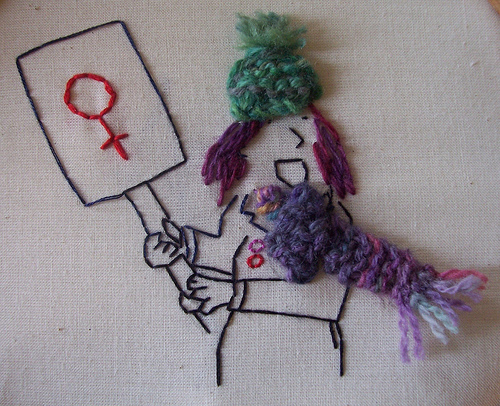
Image via Illustration Friday

59 mujeres. 59 mujeres de distintas regiones del país, de distintas edades, con distintas ambiciones. Todas ellas fueron víctimas de feminicidio en el primer semestre de este año. El feminicidio, se refiere al asesinato de mujeres por razones de género, y este tipo de asesinato ha cobrado más vidas femeninas que aquellos por inseguridad ciudadana.

Si bien el 9 de marzo de 2013, el Presidente de Bolivia, Evo Morales, promulgó la ley n° 348 “Ley Integral para garantizar a las mujeres una vida libre de violencia”, aún falta mucho por hacer. La burocracia frena a la justicia y esto ocasiona que muy pocos casos terminen con una sentencia. “Mientras no se implemente la Ley 348 y la mujer no tenga que peregrinar institución por institución para ser atendida cuando va a denunciar  violencia de género; y  la policía, fiscales y jueces dejen los prejuicios machistas, va a ser muy difícil que los casos de violencia contra la mujer lleguen a sentencia. Hay que cambiar la mentalidad colonizada y patriarcal de nuestra sociedad.” sentencia Carmen Sandoval, abogada con amplio conocimiento sobre la violencia contra la mujer boliviana.

Es bueno que existan leyes que protejan a la mujer. Pero, ¿no sería excelente si esa ley no tuviera motivo para existir? Quizá suene utópico, irreal, o algo imposible; pero el imaginar una mejor sociedad ¿no es acaso el origen de comenzar acciones que la hagan posible?

En Bolivia, las autoridades denuncian y condenan la violencia contra la mujer, pero pocos alzan la voz en contra del diario acoso callejero, que también es violencia. ¿Por qué? ¿Acaso hemos tomado el acoso como algo “normal” en nuestra sociedad?

El feminicidio es la manera más extremista del hombre para demostrar que la mujer es un objeto, y la manera cotidiana de demostrar esta idea es el acoso en las calles. ¿Por qué debemos esperar a que una mujer sea víctima mortal para recién comenzar a hacer algo?

La idea de que la mujer es un objeto es el verdadero virus de la sociedad. Un hombre que piense que esa idea es verdadera jamás podrá respetar plenamente a una mujer. Un hombre que vea a la mujer como objeto nunca comprenderá que la mujer es un ser independiente de él.

No dejemos que las víctimas de feminicidio que hay en tu país o en el mío, se conviertan solamente en cifras. No dejemos que se conviertan en simples números que alimentan los miles de reportes acerca del tema. No olvidemos que luego de la cifra se encuentra la palabra “mujeres”. No olvidemos que esa palabra contiene fuerza, voluntad, sueños y deseos. Para esas 59 mujeres víctimas de feminicidio todo eso se extinguió. Pero nosotras seguimos aquí. Y mientras sigamos aquí, actuemos. Hagamos algo por evitar que otras mujeres se conviertan en víctimas. Hagamos algo para que tú y yo no seamos víctimas. Tratando de eliminar esta idea despreciable de ver a la mujer como mero objeto, extinguiremos de a poco la violencia más cotidiana, como es el acoso callejero, hasta la más extremista, como es el feminicidio.


Bolivia: The extremism of a primitive idea.

59 women. 59 women from different regions of the country, of different ages, with different ambitions. All these women were victims of femicide in the first half of the year. Femicide refers to the murder of women because of their gender, and this type of murder has claimed more lives than those of insecurity.

Even though the 9 of March 2013 the President of Bolivia, Evo Morales, promulgated the Law No. 348 “Integral Law to guarantee women a life free of violence,” much remains to be done. The bureaucracy slows justice and this causes very few cases end with a conviction. “While Law 348 is not implemented and the woman does not have to “pilgrimage” institution by institution, to denounce violence; and the police, prosecutors and judges do not leave male prejudices, will be very difficult for this type of violence come to judgment. We must change the colonized and patriarchal mentality of our society.” Says Carmen Sandoval, a lawyer with extensive knowledge on violence against Bolivian women.

It is good that there are laws to protect women. But would it not be great if that law had not reason to exist? It may sound utopian, unrealistic, or impossible; but imagine a better society is not perhaps the origin of starting actions that make it possible?

In Bolivia, authorities denounce and condemn violence against women, but few of them speak out against daily street harassment, which is also violence. Why? Have we taken the harassment as “normal” in our society?

Femicide is the most extreme way of a man to show that the woman is an object, and the daily way to prove this is the harassment on the streets. Why should we wait for a woman to be fatality to start doing something?

The idea that the woman is an object is the real virus of the society. A man who thinks that this idea is true will never fully respect a woman. A man who sees women as objects will never understand that woman is a human being independent of him.

Do not let the victims of femicide in your country or mine, become only numbers. Do not let them become simple numbers that feed the thousands of reports on the subject. Do not forget that after that number is the word “women.” Do not forget that words have power, will, dreams and desires. For these 59 women victims of femicide are dead. But we’re still here. And while we’re still here, we have to act. Let’s do something to prevent other women from becoming victims. Let’s do something in order that you and I cannot be victims. Trying to delete this despicable idea of seeing women as mere objects, we will slowly extinguish the daily violence, such as street harassment, to the more extreme, as is the femicide.

Andrea is in her second year of university, studying Social Communication. You can follow her on Twitter: @AndreaFlores116

Share

Filed Under: correspondents, street harassment

A Guide to Approaching Women on the Street

October 29, 2014 By Contributor

By Julie Mastrine

When I first became a social media volunteer for Stop Street Harassment, curating the Twitter and Facebook feeds for the nonprofit was tricky — I could find very few articles, blog posts, or tweets on the matter. Fast forward to 2 years later, and I can barely keep up with all the stories coming from women and LGBTQ folks exposing this cultural issue. The latest content to go viral is a video of a woman walking around New York City for 10 hours and being harassed more than 100 times.

Women have been taught street harassment is normal or even a compliment, but you can see from the video how sobering these incidents are when taken together over a few hours (now imagine them amassed over a lifetime).

And yet, many people take away a twisted message from calls to end street harassment. They assume ending street harassment means squashing all communication with strangers in public. They think women never want to be approached by people they don’t know. Usually the conversation goes like this:

Me: “We need to work to end street harassment.”

Opponent: “So you’re saying we should never approach anyone in public? What will that do to our communities!?”

This argument is a straw man. Feminists fighting street harassment are not trying to end all public interactions. We are simply asking that public interactions be respectful, mindful of personal space, free of unwanted sexual or objectifying remarks, and mutually desired.

Street harassment is rooted in a need to assert power, objectification of women’s bodies, and entitlement to women’s time and attention. But it is possible to have respectful street interactions — we just have to learn how to distinguish street harassment from street respect.

Street Harassment:

1. Saying (or yelling or shouting) sexual or objectifying comments. Some examples from stories women have submitted to Stop Street Harassment’s blog:

“Show me your tits!”

“Hi babe, would you like to touch my dick?”

“Have you got hair on it yet, love?” (said to a 15-year-old)

“That’s what I like, a woman on her knees.”

“Sluts!”

“Bitch!”

“I like your boobies!”

“Fine ass.”

“Take off your top!”

“Wanna f**k?”

Etcetera. Honestly, the examples of lewd comments go on and on and on.

2. Making sexual or objectifying gestures/disrespecting personal space:

Kissy noises

Following via car, bike or foot

Leering/staring

Pinching/groping

Blocking someone’s path

Taking photos up someone’s skirt or dress

Masturbating in public (do I really have to note this one? Apparently, yes.)

It should be pretty clear these actions and comments are disrespectful. So what constitutes street respect?

If you genuinely just want to make a new friend or are interested in speaking to someone who piques your interest on the street, you can absolutely go about it in a respectful way.

Street Respect:

1. Give compliments (but tread lightly).

* Steer clear of compliments that are actually just objectification of someone’s body or body parts.

* Try complimenting an actual object: “Great dress!” “I love the color of your shoes.” “Where did you get that awesome bag?”

2. Find common ground by asking questions.

* “I’ve read that book and really liked it. Are you enjoying it?”

* “Have you visited the bistro on 11th St.? I might go there for lunch and would love to hear an opinion.”

* “I used to have a beagle just like yours. Is he friendly?”

* “Do you use Lyft? I’m trying to get to Market St. and wondered if it’s worth installing the app.”

* “Can you recommend any good cafés nearby?”

3. Read body language. Take the following gestures to indicate someone is not interested in talking:

* Headphones in

* Walking briskly (like the woman in the aforementioned video!)

* Head down

* Lack of eye contact

* One-word answers

Too many women and LGBTQ folks live in fear of violence after a lifetime of being sexualized and approached aggressively in public. It’s absolutely possible to end street harassment while fostering respectful street interactions. Spread positivity on the streets, and exhibit genuine interest in and respect for those around you — don’t resort to harassing and intimidating others.

[Editor’s Note: Check out more of our resources on this subject.]

Julie Mastrine is a writer and feminist. She is the Social Media Manager at Care2 and is a social media volunteer for Stop Street Harassment. Follow Julie on Twitter and check out her e-book.

Share

Filed Under: Resources, street harassment

« Previous Page
Next Page »

Share Your Story

Share your street harassment story for the blog. Donate Now

From the Blog

  • #MeToo 2024 Study Released Today
  • Join International Anti-Street Harassment Week 2022
  • Giving Tuesday – Fund the Hotline
  • Thank You – International Anti-Street Harassment Week 2021
  • Share Your Story – Safecity and Catcalls Collaboration

Buy the Book

  • Contact
  • Events
  • Join Us
  • Donate
  • Facebook
  • Instagram
  • Pinterest
  • Tumblr
  • Twitter
  • YouTube

Copyright © 2026 Stop Street Harassment · Website Design by Sarah Marie Lacy