• About Us
    • What Is Street Harassment?
    • Why Stopping Street Harassment Matters
    • Meet the Team
      • Board of Directors
      • Past Board Members
    • In The Media
  • Our Work
    • National Street Harassment Hotline
    • International Anti-Street Harassment Week
    • Blog Correspondents
      • Past SSH Correspondents
    • Safe Public Spaces Mentoring Program
    • Publications
    • National Studies
    • Campaigns against Companies
    • Washington, D.C. Activism
  • Our Books
  • Donate
  • Store

Stop Street Harassment

Making Public Spaces Safe and Welcoming

  • Facebook
  • Instagram
  • Pinterest
  • Tumblr
  • Twitter
  • YouTube
  • Home
  • Blog
    • Harassment Stories
    • Blog Correspondents
    • Street Respect Stories
  • Help & Advice
    • National Street Harassment Hotline
    • Dealing With Harassers
      • Assertive Responses
      • Reporting Harassers
      • Bystander Responses
      • Creative Responses
    • What to Do Before or After Harassment
    • Street Harassment and the Law
  • Resources
    • Definitions
    • Statistics
    • Articles & Books
    • Anti-Harassment Groups & Campaigns
    • Male Allies
      • Educating Boys & Men
      • How to Talk to Women
      • Bystander Tips
    • Video Clips
    • Images & Flyers
  • Take Community Action
  • Contact

Afghanistan: Harassment and driving, government action?

October 14, 2014 By HKearl

Check out my article for the Washington Postabout Afghan women braving harassment and family disprovable to drive:

Zainab Zawol Shahidy

“Seventeen-year-old Zainab Zawol Shahidy >was driving her Toyota 4Runner home from school in Kabul recently when she noticed two men in a vehicle following her. “One of them pointed a gun at me and threatened me to drive along in their direction, but I refused and kept driving faster to reach home as soon as I could,” she said.

She was forced to pull over when they blocked her. One of the men threw a slip of paper at her with his phone number and said if she didn’t call him, he would kidnap her. She made it home and called security. Thankfully she has not seen these men since.

Although there are a growing numbers of women drivers in Kabul, the sight of Shahidy behind the wheel is still unusual. Everywhere she goes, she gets curious stares and frequent harassment, ranging from people making fun of her for driving to threats. “I can’t drive to places too distant from where I live due to the risk of kidnapping,” she told me through the translation of her brother, Ali Shahidy, a psychology major at Norwich University in Vermont.

Despite the risk and danger, Shahidy says she loves to drive. Besides, she said, she faces more harassment when she walks or takes public transportation.”

Related, from Human Rights Watch:

“Afghanistan’s new government should take urgent steps to combat sexual harassment of women in education, employment, and public life, Human Rights Watch said today. There are no laws in Afghanistan that specifically prohibit sexual harassment or protect victims.

Government institutions lack effective policies to prevent and punish sexual harassment, Human Rights Watch said.  On October 5, 2014, President Ashraf Ghani described levels of sexual harassment in schools as “shocking.” He ordered the Ministry of Education to report every incident of sexual harassment in schools to enable action against harassers, and directed relevant ministries to develop a plan to counter sexual harassment in educational institutions.

“President Ghani’s recognition of sexual harassment in Afghanistan as ‘shocking’ is spot-on,” said Heather Barr, senior women’s rights researcher at Human Rights Watch. “The Afghan government should promptly enact a law against sexual harassment and ensure that every government institution develops and implements an anti-sexual harassment policy.”

Share

Filed Under: News stories, street harassment

Cameroon: Street Harassment is an Attack on Women

October 13, 2014 By Correspondent

Ngwentah Berlyne Ngwalem, Buea, Cameroon, SSH Blog Correspondent

My younger sister recently told me that she never really understood what harassment meant. Not that she doesn’t have to deal with it on a daily basis, but that she had not found a name before to describe the repulsive rude behavior committed by men towards her. She found it hard articulating her feelings as she sadly said to me:

“I mean sometimes you just want to be left alone but these men don’t get it. Is it harassment when you get in a taxi and a guy starts narrating the story of his life, even though you show no interest? They immediately jump into chatting you up, and you don’t respond, but they keep talking and try to teach you how you should act back? I feel really irritated by what these guys do.”

I listened and felt how difficult it was for her to explain what happens to her and a lot of other women on a daily basis. I told her that it was harassment.

As these things are now being talked about, a lot of girls are realizing that what happens to them — what hurts them so much, but they couldn’t find words to explain it — is actually called “harassment.”

To many men, toying with women’s lives is like a game, or like a remote controller in their hands and they can press any button and expect women to dance according to their tune. The acceptance of harassment in the culture encourages men to see women as play things.

One of the biggest causes of harassment I’ve seen is the permission society gives to men to be the primary and sole initiators of “chatting”. Playing the main role in chatting gives men the power to be in control. When street harassers want you to act nice you have to be subservient whether you approve of what they do or not. Many men have been groomed to focus on what they want and not what women want.

Recently, in response to one of my Facebook posts teaching people about the difference between a compliment and harassment, one of my friends whom I viewed as someone who is very accepting and open to compliments complained to me after reading my posts that she felt insulted about the way guys on the streets treat her.

This made me think differently. I started asking myself if sometimes these women I deem as being open to compliments smile at these aggressive random men out of fear or due to the fact that they are tired of being harassed and have no other choice than to act like they love what these guys say to them?

She had talked about how groups of guys jumped into insulting her after being in her face, demanding that she accept their harassment as complimentary words about her beauty. I could feel in her writing how insecure and insulted she felt.

Talking about harassment is a way for the Cameroonian population to know what harassment is and its impact on women’s peace and security in our society. Talking about street harassment unceasingly acts as a motivator for other women to speak out, to share their stories and frustration at the fact that nothing, or very little, is being done by the Cameroonian society and law enforcement to stop this demeaning disturbing madness.

I have heard cries from young women saying street harassment needs to be addressed. One of my former classmates Melvis Loh, an English Language master’s student at the University of Buea, explains what happens to certain women when they do not act according to the demands of men in her community in Sandpit, Buea;

“Some guys even go as far as trashing up girls who turn down their advances to chat up or date them”

Melvis recounted painfully how her younger sister was continuously molested psychologically and severely beaten by a young guy who could not stand the fact that this young lady turned down his continuous approach to be his lover. He had made it clear to her that he would not take no for an answer. If not for the help of passersby, this girl would have probably have lost her life. She had to be pulled out of the grips of this young man who felt insulted being turned down by this young lady.

It has to take persistence, severe brutality or even death for law enforcement to respond to acts of harassment with will and desire to protect the women involved. If you come from a family where there is not much status, education or wealth, that family might find themselves negotiating with harassers to no avail to make sure the harassed is safe.

Young boys are being taught how to chat up a woman, but how many of them are taught to chat up a woman or compliment them the right way? I strongly think if our society creates a balance in the milieu of who gets to ask who out, propose to whom, how and when, there might be a reduction in female street and sexual harassment.

Berlyne is a Cameroonian-based women’s human rights activist, passionate and determined to put an end to social injustice of any kind. You can find her on twitter @Luvequalityrule and Facebook.

Share

Filed Under: correspondents, street harassment

“Blowing kisses while licking his lips”

October 12, 2014 By Contributor

I’d like to share my story to show that it happens to men as well.  I’ve actually experienced it several times since I moved here.  And I don’t mean the “faggot” or “queer” kind of catcalling that many gay men experience – that doesn’t seem to be an issue in most parts of this city.

As a runner, I’ve often had men – often homeless – jeer and compliment my “juicy ass,” and, while it has been bothersome, nothing has come close to what happened yesterday.  I was walking home in a hoodie and gym shorts (so I definitely wasn’t “asking for it” – whatever that means) and this guy screams “nice ass” out of his car window.  I didn’t even realize he was talking to me until I saw him waiting at the corner.

He rolled his windows down and began jeering and blowing kisses while licking his lips.  It just so happens that I live at that corner and very stupidly ran inside.  He waited outside for about 5 minutes, backing up to peer in the windows and laugh while I cowered in fear.  I’m kicking myself for not wearing my glasses, so I couldn’t get his plate.

Optional: What’s one way you think we can make public places safer for everyone?

Make the discussion less gendered – it happens to everyone

– D

Location: Washington, DC

Share your street harassment story for the blog.
See the book 50 Stories about Stopping Street Harassers for more idea

 

Share

Filed Under: male perspective, Stories, street harassment

Day of the Girl 2014

October 11, 2014 By HKearl

Via Teen Library Toolbox

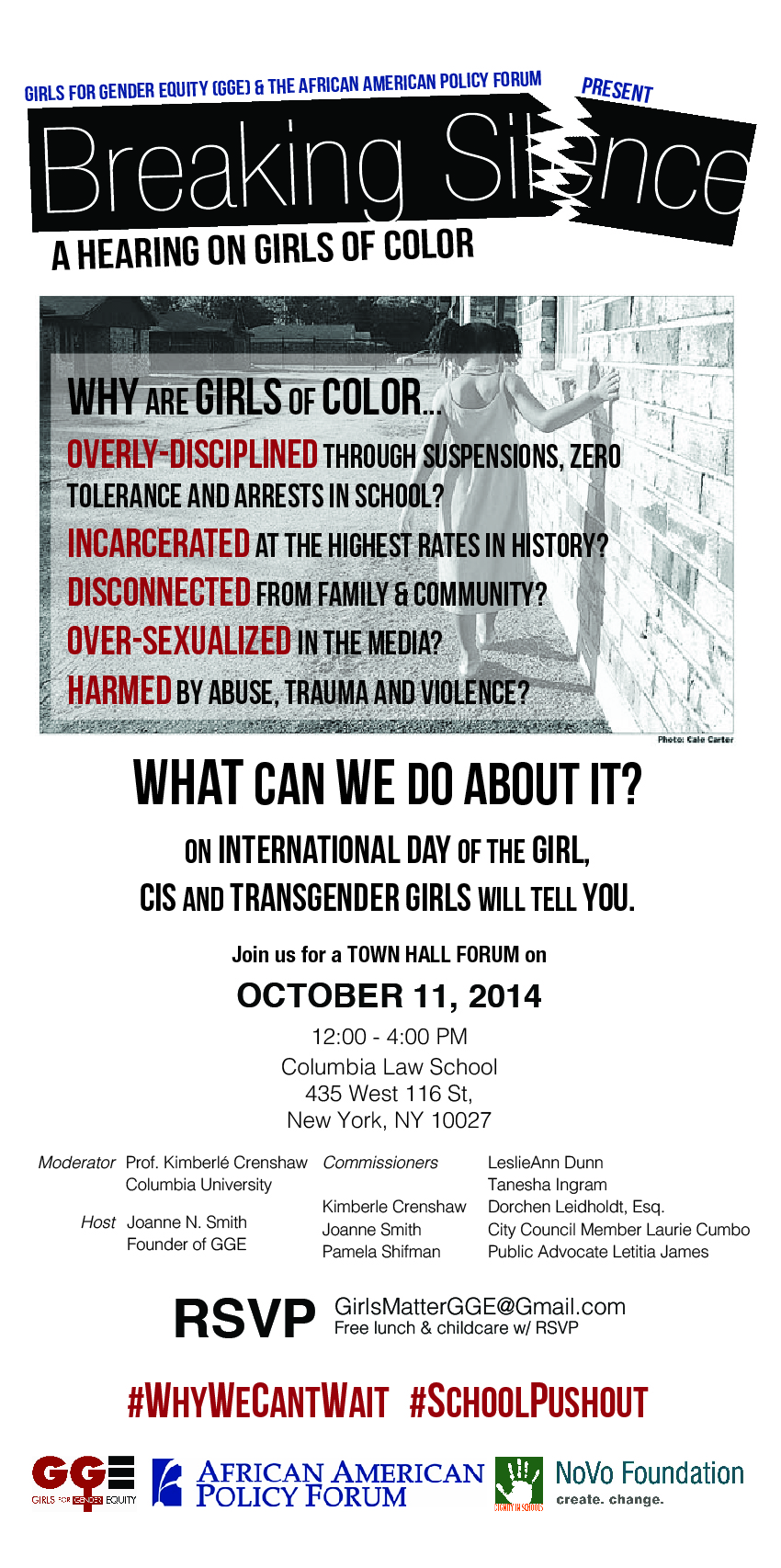
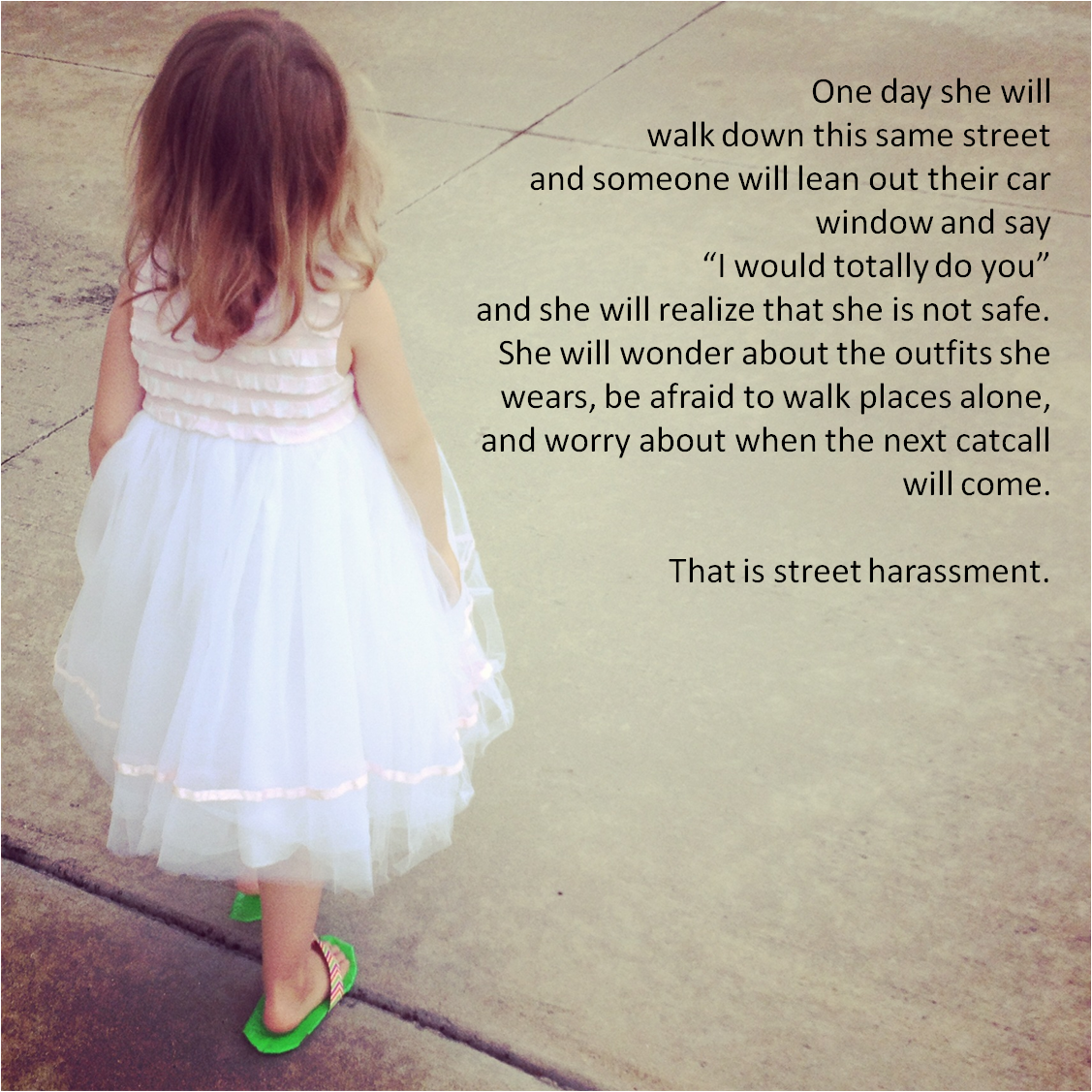
Today is the 3rd annual International Day of the Girl, an opportunity to reflect on the status of girls in the world and their needs.

I, of course, always think about street harassment. I was harassed as a teenage girl and the older I get, the more outraged I am about my experiences and about the harassment and assault girls and teenagers continue to face today in public spaces. It angers me that the depictions of street harassment in the media would like us to believe it “only” happens to adult women and is no big deal, but the reality is, teenagers are targeted the most — and often by adult men. In fact, our national survey found that most people who are harassed (female and male) begin to experience it before age 17.

You can read stories on our blog showing this too,

Like K in New York shared her story… “I’ll never forget being in middle school and walking around my neighborhood and having these middle-aged men cat calling me. I was a 12-year-old girl, I wanted to dress pretty but the constant stares and whistles from older men made me feel insecure. It felt as if I wasn’t a person just a body with a vagina walking around.

At times I would yell and say you are disgusting but I was afraid that they might chase me down, so I didn’t do it as often. The majority of the time I would look down and walk away quickly. I was in middle school and these men were older and stronger than I was; all the news story scared me of what these men could do.”

Or Anonymous in CA who reflected on a lifetime of harassment…”I started being harassed as a pedestrian the summer I turned nine. A driver honked, catcalled, and threw a penny that hit me. Now I am 39 and I keep thinking I will eventually grow old enough to fall off the radar. Being honked at, whistled at, shouted at, followed, groped, and grabbed makes me angry, shaken up, and stressed out.”

Summer Al-Saleh, a high school senior at Foothill Technology High School in Ventura, California, wrote about street harassment for her school paper this week. She gave me permission to excerpt it:

“Over the past few months, I cannot begin to count how many times I have been harassed when I was by myself or accompanied with friends.

As I was on a run earlier in the summer, two middle-aged men drove by, stared, and whistled at me. They drove away, probably laughing at the fact that they caught me off guard and caused me to jump out of initial shock. They drove away, not even considering that I was on a run, trying to concentrate, existing in such a way that has no relative bearing on their existence, something that is very difficult for street harassers to understand.

When I was walking out of the grocery store two young men started following me into the parking lot, while asking questions and making comments about my appearance. As I briskly walked away they got the satisfaction of knowing that I was angry, disturbed, and threatened. They, just like the other men, did not see me as a person with somewhere to be, something to do, and something on my mind.

While finishing a run with my teammates, two middle-aged men drove by, slowed down to get our attention, yelled something that was incomprehensible and made kissy faces at us. The thing about this specific encounter, the former encounters, and other women’s experiences is that they are all much too similar: each and every act of harassment is steeped in entitlement. So much entitlement that it’s difficult to grasp how someone could do something so inconsiderate, objectifying, and privileged that they won’t even accept or may not even realize that what they’re doing is harassment.

Their over-flowing sense of entitlement coupled with their lack of sensibility creates a situation that makes women feel unsafe and uncomfortable in public spaces. It can and does determine where women choose to go, what we choose to wear, and where we choose to live. Ultimately, it limits our choices and freedom to be safe in public.”

What is different from when I was a teenager is that there is a lot more awareness about this issue. And thanks to social media and sites like mine, I know there are places teenagers can go to for advice, for support and to share their stories. Which is so important.

So today, I honor all the girls who are bravely speaking out and demanding the right to be safe in public spaces!

Share

Filed Under: News stories, street harassment Tagged With: day of the girl, harassment, teenagers

“That same guy had been creeping on women before”

October 10, 2014 By Contributor

There weren’t very many people on the tram. I was wearing a black dress just above the knee and brown boots and jacket. Slutty? Why is that even part of the question- IT HAS NOTHING TO DO WITH HOW GUYS TREAT US. I had a bag of groceries and I was tired.

This older guy, maybe late 40’s, kept looking at me. I was on my way home and the ride was a little long. I finally looked at him in the eyes hoping to get him to stop. With no holding back he looked up and down my body and into my eyes again. I looked away. I looked back and he was still staring. Finally I motioned “What?” to him and he came up to me! He asked me what the problem was and I asked him why he kept staring at me. I was a bit shocked he walked up to me…

Then he got closer and said, “NO, you were staring at ME.”

I was shaking by now, “Yes, to try and get YOU to stop.” I said.

He was yelling, “You were staring, should I call the authorities?”

I was baffled. What was this guy talking about? As if I were the one harassing him! “The difference is, I looked away.”

“So did I.” He argued loudly. (I know he had not. He stared at me the ENTIRE time.)

Finally 3 men came up and stood around us, one guy separated me and the other guy. I was so thankful my legs felt weak.

The rude guy finally left for the front of the tram. One of the guys made a comment that that same guy had been creeping on women before…
I almost wanted to cry. I don’t know why. I guess because of how the guy treated me. How weak I felt. I don’t know. I am usually pretty strong and things don’t usually bother me. I am still shaking just thinking about it even though nothing happened….

I got home and told my boyfriend about it and his response?

“Why did you give him attention?”

WHAT! It hurt that his response was saying I was in the wrong. I can’t believe it. I told him I didn’t give him attention, the guy gave ME attention and any normal person would look away in the same circumstance and this guy did the opposite… if I felt uncomfortable didn’t I have a right to try and get him to stop? I am so offended by how my boyfriend reacted the feelings have come rushing back as fresh as if the event had just happened. (It happened an hour ago.)

I felt more security from the guy who stood between me and the disgusting guy than I did telling my own boyfriend. I am so confused over that.
He told me I should have just looked away. I explained that I had but the guy was blatantly staring at me. I had a right to try and get him to stop. If I felt uncomfortable I was not in the wrong to stand up for myself. People make eye contact on a regular basis- but usually they look away. They don’t keep staring.

We all have common courtesy and this guy did not show me this at all.

Optional: Do you have any suggestions for dealing with harassers and/or ending street harassment in general?

More women standing up and saying NO. By staying silent it will continue. Even having someone stare- there is a cultural accepted amount of time for eye contact. A person doesn’t have a right to look at someone else as if they are a piece of meat. SAY SOMETHING. If it escalates get authorities. This person obviously needs to be reminded that it is NOT okay and needs to be put straight.

– E. Nicole

Location: Yarra Trams, Coburg, VIC

Share your street harassment story for the blog.
See the book 50 Stories about Stopping Street Harassers for more idea
Share

Filed Under: Stories, street harassment

« Previous Page
Next Page »

Share Your Story

Share your street harassment story for the blog. Donate Now

From the Blog

  • #MeToo 2024 Study Released Today
  • Join International Anti-Street Harassment Week 2022
  • Giving Tuesday – Fund the Hotline
  • Thank You – International Anti-Street Harassment Week 2021
  • Share Your Story – Safecity and Catcalls Collaboration

Buy the Book

  • Contact
  • Events
  • Join Us
  • Donate
  • Facebook
  • Instagram
  • Pinterest
  • Tumblr
  • Twitter
  • YouTube

Copyright © 2026 Stop Street Harassment · Website Design by Sarah Marie Lacy