• About Us
    • What Is Street Harassment?
    • Why Stopping Street Harassment Matters
    • Meet the Team
      • Board of Directors
      • Past Board Members
    • In The Media
  • Our Work
    • National Street Harassment Hotline
    • International Anti-Street Harassment Week
    • Blog Correspondents
      • Past SSH Correspondents
    • Safe Public Spaces Mentoring Program
    • Publications
    • National Studies
    • Campaigns against Companies
    • Washington, D.C. Activism
  • Our Books
  • Donate
  • Store

Stop Street Harassment

Making Public Spaces Safe and Welcoming

  • Facebook
  • Instagram
  • Pinterest
  • Tumblr
  • Twitter
  • YouTube
  • Home
  • Blog
    • Harassment Stories
    • Blog Correspondents
    • Street Respect Stories
  • Help & Advice
    • National Street Harassment Hotline
    • Dealing With Harassers
      • Assertive Responses
      • Reporting Harassers
      • Bystander Responses
      • Creative Responses
    • What to Do Before or After Harassment
    • Street Harassment and the Law
  • Resources
    • Definitions
    • Statistics
    • Articles & Books
    • Anti-Harassment Groups & Campaigns
    • Male Allies
      • Educating Boys & Men
      • How to Talk to Women
      • Bystander Tips
    • Video Clips
    • Images & Flyers
  • Take Community Action
  • Contact

“Now that I am more aware of how that makes people feel I am not doing that”

October 3, 2014 By Contributor

I haven’t been the victim of street harassment. In fact, I had no idea how bad it is for some people just to walk down the street. I would be getting into fights if I had it that bad. I am guilty of checking out girls but now that I am more aware of how that makes people feel I am not doing that. Thank you for spreading the word about this.

– Anonymous

Location: Chicago, IL

Share your street harassment story for the blog.
See the book 50 Stories about Stopping Street Harassers for more idea

Share

Filed Under: Stories, street harassment

Part 2 of Street Harassment on The Daily Show

October 3, 2014 By HKearl

Woo!! The Daily Show‘s Jessica Williams did another spot-on segment about street harassment last night (here was her first one from last month). She demonstrates how her walk to work is different from that of her male colleagues because she has to try to dodge harassers, often going out of her way to avoid spots with known congregations of them. Then she brings together a group of women from across the city — including women from Girls for Gender Equity and HollaBack! and @FeministaJones who started the #YouOkSis? hashtag — to share their stories and talk about how it makes me feel.

I am SO happy The Daily Show is continuing to put the spotlight on this really important topic AND that they connected this issue to women’s equality and safety concerns, which is important.

Jessica Williams really does a perfect job.

The Daily Show
Get More: Daily Show Full Episodes,The Daily Show on Facebook,Daily Show Video Archive

Share

Filed Under: News stories, street harassment

Transit Agencies in DC and NYC do more to Address Harassment

October 3, 2014 By HKearl

This is going to be a big month for anti-harassment efforts on public transportation. In Washington, DC, Collective Action for Safe Spaces and I have been working with our transit agency on an updated PSA campaign that we hope will launch on Oct. 25 for the UNiTE’s #OrangeDay around sexual harassment in public spaces. CASS is also launching its RightRides services on October 31, to give women and LGBQT folks a safe, free ride home late that night.

And this week, big changes were announced in New York City. Via Metro:

“The MTA is taking new approaches to combating sexual harassment, including adding cameras in new trains and an improved reporting system for victims and witnesses.

Public Advocate Letitia James and community activist groups Hollaback!, the Straphangers Campaign and the New York City Anti-Violence Project, announced the new measure Wednesday morning outside the Brooklyn Bridge/City Hall Station.

The public advocate’s office said recent data showed some 3,000 women reported sexual misconduct incidents in the subway between 2008 and 2013, and that the majority of the incidents occurred on the 4, 5 and 6 trains during the morning rush.

James previously called for improved measures, outlined in an Aug. 1 letter to MTA Chairman Thomas F. Prendergast. Prendergast responded to James’ requests in a Sept. 25 letter.

Prendergast said the MTA has been running announcements on inappropriate touching since 2009, and will take further steps in hopes of improving rider safety and reporting. They are: links on the MTA homepage; reviewing with subway employees or how to handle improper conduct reports; a revised map that shows NYPD Transit Bureau locations and a new public service announcement that focuses on bystanders.

MTA spokesman Kevin Ortiz said 940 new trains set to replace old cars as part of the 2015-209 Capital Program will have cameras installed. Ortiz said the MTA is considering adding cameras in a new fleet of 300 trains. Currently, no MTA trains have cameras in the cars, Ortiz said.

Ortiz said the new PSA is still in development, and does not have a set launch date.”

Share

Filed Under: hollaback, News stories, SSH programs, street harassment

Kansas City, MO, Passes Anti-Harassment Ordinance

October 3, 2014 By HKearl

Our Safe Public Spaces Mentoring Program mentee BikeWalkKC has been working hard to pass an anti-harassment ordinance in Kansas City. It just passed last night. From Sarah Shipley:

“Ordinance 140777 is a success, with a unanimous vote from the city council. During the process to pass it, we found an ally in the ACLU, rekindled a relationship with our local ADA advocacy organization, and really solidified our relationship with council members at city hall. It has quite frankly been an amazing experience….

Also, Lee’s Summit, Missouri, is voting on a very similar ordinance tonight, and Kansas City, Kansas, will consider this in November!”

Congratulations to them on their hard work.

Here is the text for the ordinance:

140777 (Sub.)Amending Chapter 50, Article VI, Offenses Against Public Safety, by enacting a new Section 50-205 which will prohibit certain acts against bicyclists, pedestrians, and wheelchair operators.

SECOND COMMITTEE SUBSTITUTE FOR ORDINANCE NO. 140777, AS AMENDED

Amending Chapter 50, Article VI, Offenses Against Public Safety, by enacting a new Section 50-205 which will prohibit certain acts against bicyclists, pedestrians, and wheelchair operators.

WHEREAS, Kansas City wants to encourage modes of transportation other than motor vehicles; and

WHEREAS, it is desirable to create a healthy, safe environment in Kansas City for all people; and

WHEREAS, harassment of bicyclists, pedestrians (including those walking with a guide dog or a white cane), and wheelchair operators increases the hazards already posed to these persons operating on our City streets; NOW, THEREFORE,

BE IT ORDAINED BY THE COUNCIL OF KANSAS CITY:

Section 1. That Chapter 50, Article VI, Offenses Against Public Safety, is hereby amended by enacting a new Section 50-205, Harassment of a Bicyclist, Pedestrian or Wheelchair Operator, to read as follows:

Sec. 50-205. Harassment of a Bicyclist, Pedestrian or Wheelchair Operator

(a)    The following words, terms and phrases, when used in this section, shall have the meanings ascribed to them below, except where the context clearly indicates a different meaning:

Bicycle means any device upon which a person may ride, which is propelled by human power through a system of belts, chains, or gears, and may include an electric assist motor, and has wheels at least 16 inches in diameter and a frame size of at least 13 inches.

Wheelchair means any manual or motorized device designed specifically for use by a person with a physical disability for means of conveyance.

(b)   No person shall, for the purpose of intimidating or injuring any person riding a bicycle, walking, running, or operating a wheelchair or for the purpose of intimidating or injuring such person’s service animal:

(1)               Throw an object, direct a projectile, or operate a vehicle at or in such person’s direction or at or in the direction of such person’s service animal; or

(2)               Threaten such person; or

(3)               Sound a horn, shout or otherwise direct loud or unusual sounds toward such person or toward such person’s service animal; or

(4)               Place such person in apprehension of immediate physical injury; or

(5)               Engage in conduct that creates a risk of death or serious physical injury to such person or such person’s service animal.

(c)    Any person convicted of a violation of this chapter shall be punished for that violation by a fine of not less than $50.00, but not more than $500.00 or by imprisonment of not more than 180 days or by both such fine and imprisonment.

Share

Filed Under: News stories, SSH programs, street harassment

USA: Traveling While Female: Five Things India is Doing Better

September 30, 2014 By Correspondent

Angie Evans, Washington, DC, SSH Blog Correspondent

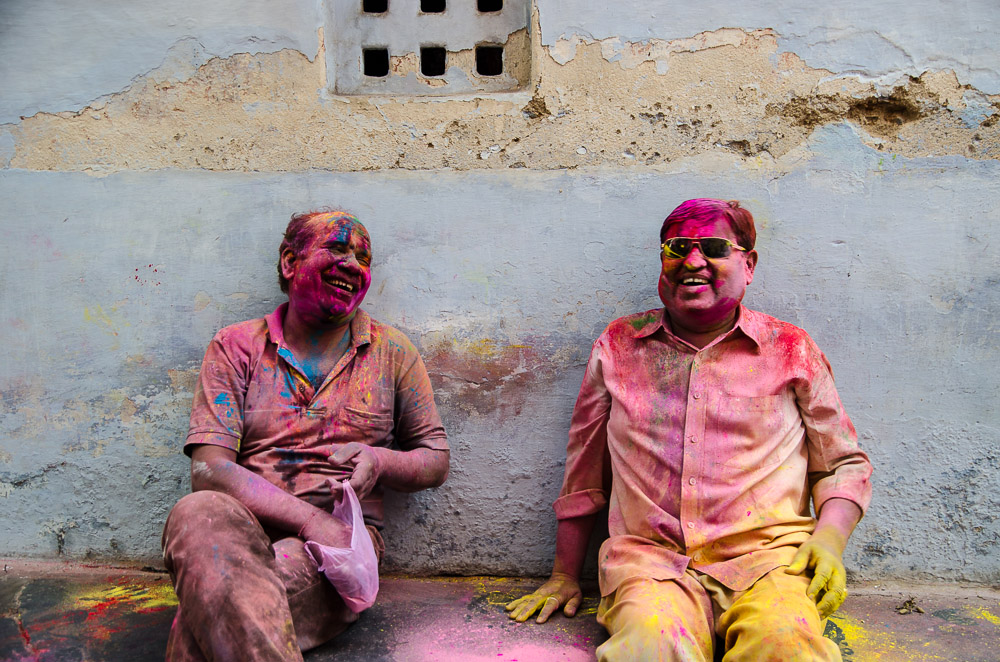
Photo provided by Angie

You can’t emotionally prepare yourself for sexual harassment or assault. It’s 11:15 a.m. and I am sitting on the rooftop of a guesthouse in Udaipur, India. My teeth are covered in purple chalk. From my fingertips to my elbow there is a splash of bright pink dye, later I will have to accept that my arm is going to be fuchsia for weeks. In the street I can hear kids laughing as they toss colors into the air. Two Grandfathers sit on a stoop below, chuckling with each other. I slump into a chair and breath for the first time in hours. Two other women sit with me. One had her shirt nearly ripped off by a group of teenagers and the other had to slap someone in the street for trying to run his hand across her chest. I’d had chalk smeared into my eyes by a man while his friend came up from behind me and grabbed by breasts.

Although Holi, the Hindu festival of colors, tops the bucket list for tourists all over the world, it isn’t the same experience for for all genders. The playful celebration that was traditionally held with family and friends relaxes many social norms between men and women, allowing some to use it as an excuse for groping, fondling, and grabbing women in the streets. In a culture so deeply rooted in spiritual practice and values, what is bubbling beneath the surface?

Reports of sexual assault in India have increased over the years, resulting in a continuous decline in the foreign tourism sector. In 2013, female travelers decreased by over a third in just 3 months. Hotel operators, travel agents, and others in the industry were undone by such a steep decline.  The international community was enraged by story after story of sexual assault. The first female chief justice was assigned to the the Delhi high court, immediately taking notice of some negative gender dynamics. An urgency prompted governmental investigations in national, state, and local Indian agencies.

Change is hard in a country with 1.2 billion people, but it’s an inevitable part of growth. A number of new policy measures have made female residents and travelers more safe in India. So what lessons can we learn from the policy changes and movement building in India around sexual harassment and assault?

1. Female Participation

When the Indian state of Gugarat decided to make a strong statement on sexual harassment, they set up a council to educate, mediate, and set policy framework within the high court. They made sure to prescribe exactly what kind of position in the system each member should have, and set a minimum quota for female participants. This isn’t the only governing body that set up a review board or fixed the number on the board, but it set a strong precedence for local communities.

2. Police Consent and Government Engagement

It is hard to know the true impact of sexual harassment in communities because it continues to be underreported for many reasons. In Delhi, they recognized that many victims felt uncomfortable calling the police so they set up a separate hotline just for sexual harassment and assault victims. They also started an on-going series of free self defense courses to female residents. In Ahmedabad, the police posted billboards in high traffic areas, offering a free ride home to any women who feel unsafe. The court systems are undeniably slow, and until this is changed, law enforcement officials need to play a strong role.

3. Education

India is slowly working on implementing one of their new laws, which protects women from workplace sexual harassment. A key part of that has become educating staff. This is important because the onus cannot be on women to stop the harassment, it must be on how men treat their female counterparts. Like all sexual harassment interventions in India, it must be about the perpetrator and not the victim in order to see fundamental change.

4. Make Streets Safe

Delhi is known worldwide for it’s confusing streets, lack of addresses, and chaotic traffic. Following the UN Safe Cities Global Initiative, the municipal government set up an audit for urban planning, identifying key ways that they could improve the safety of their city. Things as simple as street lights and better designed public restrooms can vastly improve safety records in a city. There are a number of Indian cities reviewing this checklist to find areas of improvement.

5. Support Survivors

Setting up sexual harassment and assault hotlines is the first step in a community response. Some organizations in India are making this the focus of their intervention because for many victims, it is a silent daily battle. In equipping these women with an emotional outlet, as well as the tools to respond to future experiences, you build an intervention that empowers each woman.

Organizations all over India are continuing to bring up problems with sexual harassment and assault, and will continue to fight for systemic and societal changes, because they haven’t reached a point where the laws represent the real values of the country. For a nation to truly grow and thrive, the equality of women must be central. And with women and children representing 70% of the population, this isn’t just the right thing to do in India, it’s good economic sense.

Angie is a community organizer and social worker. Last year she quit her job to travel around the world with her husband. They have just returned and are continuing to write about travel and adventure at http://whereisseangie.com

Share

Filed Under: correspondents, street harassment

« Previous Page
Next Page »

Share Your Story

Share your street harassment story for the blog. Donate Now

From the Blog

  • #MeToo 2024 Study Released Today
  • Join International Anti-Street Harassment Week 2022
  • Giving Tuesday – Fund the Hotline
  • Thank You – International Anti-Street Harassment Week 2021
  • Share Your Story – Safecity and Catcalls Collaboration

Buy the Book

  • Contact
  • Events
  • Join Us
  • Donate
  • Facebook
  • Instagram
  • Pinterest
  • Tumblr
  • Twitter
  • YouTube

Copyright © 2026 Stop Street Harassment · Website Design by Sarah Marie Lacy