• About Us
    • What Is Street Harassment?
    • Why Stopping Street Harassment Matters
    • Meet the Team
      • Board of Directors
      • Past Board Members
    • In The Media
  • Our Work
    • National Street Harassment Hotline
    • International Anti-Street Harassment Week
    • Blog Correspondents
      • Past SSH Correspondents
    • Safe Public Spaces Mentoring Program
    • Publications
    • National Studies
    • Campaigns against Companies
    • Washington, D.C. Activism
  • Our Books
  • Donate
  • Store

Stop Street Harassment

Making Public Spaces Safe and Welcoming

  • Facebook
  • Instagram
  • Pinterest
  • Tumblr
  • Twitter
  • YouTube
  • Home
  • Blog
    • Harassment Stories
    • Blog Correspondents
    • Street Respect Stories
  • Help & Advice
    • National Street Harassment Hotline
    • Dealing With Harassers
      • Assertive Responses
      • Reporting Harassers
      • Bystander Responses
      • Creative Responses
    • What to Do Before or After Harassment
    • Street Harassment and the Law
  • Resources
    • Definitions
    • Statistics
    • Articles & Books
    • Anti-Harassment Groups & Campaigns
    • Male Allies
      • Educating Boys & Men
      • How to Talk to Women
      • Bystander Tips
    • Video Clips
    • Images & Flyers
  • Take Community Action
  • Contact

Middle-Aged Men Harassed Her When She was in Middle School

September 30, 2014 By Contributor

I’ll never forget being in middle school and walking around my neighborhood and having these middle-aged men cat calling me. I was a 12-year-old girl, I wanted to dress pretty but the constant stares and whistles from older men made me feel insecure. It felt as if I wasn’t a person just a body with a vagina walking around.

At times I would yell and say you are disgusting but I was afraid that they might chase me down, so I didn’t do it as often. The majority of the time I would look down and walk away quickly. I was in middle school and these men were older and stronger than I was; all the news story scared me of what these men could do.

I hated my parents for telling me that if I was a boy things would be different, I would have more freedom and be able to be outside later than 6 p.m. These men made me want to destroy myself because I could not be a regular pre-teen/teen without having them make statements about my clothes and body. I really wanted to tell them “what if I was your daughter, the daughter you never had? Would you then be disgusted and change?”

To this day I’m too scared to say it. The fear that they could overpower me physically and no legal system will believe the victim is why I shut my mouth. The only difference is I do not look down, I look past them and continue with my day.

– K

Location: Queens, NY

Share your street harassment story for the blog.
See the book 50 Stories about Stopping Street Harassers for more idea

Share

Filed Under: Stories, street harassment

USA: Music, Urban Space, and Me

September 30, 2014 By Correspondent

Pamela Segura, NY, USA, SSH Blog Correspondent

Via Unique New York Tours

When I was younger, I delighted in music videos. I enjoyed how fantastical and formulaic they seemed. Pop music videos featured a series of dancers, many of whom were female and often displayed a great deal of coordination and agility. Hip-hop videos were equally as methodical: men delivered rhymes with fervent hand motions while women pranced about.

Many of these videos sent a complicated, deeply fraught message to me: girls were spectacles to be admired and assessed in a particular setting.

The hip-hop videos, however, engaged me because they frequently contained women in a decidedly urban space.

Of course, I didn’t understand the notion of “urban space” when I was eight. To me, every child knew the same images and sensations I did while growing up on East 198th Street and Grand Concourse in the Bronx: stairs leading to the B and D trains, fading streetlights, blaring music and shouts from passersby, greens trees sporadically playing with the grayness of concrete. I felt comfortable in this environment, in this home that would only later become an “urban space.”

I gravitated to hip-hop music and videos because they felt like an extension of that home. I heard rap tracks swimming through my building’s hallways, or down by the corner of the street during mixing with the ice cream truck’s refrain. And I saw those buildings in the same videos. My younger self was engaging in an affirmation of her identity: there’s me, there’s my home, and there’s my music.

This changed when I was eleven. My sister and I were making our way home from our school, a quaint parochial school that sat on the left side of Grand Concourse right before Bedford Park Blvd. We were in uniform: skirts, knee-high socks, heavy black shoes. I noticed a group of teenage boys walking towards us, one of whom carried a radio playing Nelly’s “Hot in Herre.” One boy said something quite loudly to his friends: “I love Catholic school girls. They give the best head.”

Even now, at the age of 22, the vulgarity of that statement shocks and shames me. It strikes within me a strange mixture of anger and frustration, sadness and confusion. These teenagers perhaps didn’t possibly understand what they were indirectly doing: fetishizing girls and their Catholic school uniforms. These teenagers perhaps didn’t realize that they limited my ability to feel safe, to feel empowered and healthy in my own space. These teenagers perhaps didn’t realize how young my sister and I were.

As a young girl, however, I just knew that it was…not right. I obsessed about the comment—and the uniform and music that contextualized the comment—for several days. I wrote about it in my diary and slowly began to interpret Nelly’s lyrics and video. There isn’t much of an urban space in this video. Much of the video’s narrative consists of men and women packed tightly into a nightclub; the women eventually take off their clothing because it’s “hot in herre.” The lyrics dictate the visuals: Nelly eyes women in the club and clothes slide off bodies.

But I heard the song in my urban space.  And the specific attention to women’s clothing in Nelly’s song altered something in me. The connections were too vivid, too coincidental to ignore. My sister and I were walking, enjoying our time on Grand Concourse, chatting away the day and passing the train station. A comment from some other place, a far different and darkly mature place, penetrated that naïveté.

As I got older, the streets that shaped my childhood perspective became an “urban space,” a locale to be probed, theorized, considered, and written about. I developed a fear of the train when I was entering my teenage years. The train system in New York City seemed the ultimate irony. It gets you everywhere, opens up your world to the most famed and most hidden corners of the city, grants you that liberty with limited economic commitment. Yet, it’s all about cramped spaces; it removes the idea of privacy. Certain stops, moreover, had—and still, unfortunately, have—no lighting.

While my awareness of the “urban space” grew, my experiences with street harassment increased. And so did those of my other female friends.

Now that I’ve graduated from college, the Bronx still seems like a geographical puzzle, one that is shaped and reshaped by so many different factors. Hip-hop is a culture that sprang from there, and its nuances—musical sampling, lyrical realism and sensationalism, awareness of social ills—highlight just how beautiful and complex the Bronx will always be. But this music also reveals the strangeness “urban space” and, most important, how that space makes the body seem open, public, ready to be expressed.

Pam recently graduated from Manhattan College and she writes for SciArt in America. You can follow her on Instagram or Twitter @pamlivinlovin.

Share

Filed Under: correspondents, Stories, street harassment

USA: “Men harassing women represents a loss for everyone “

September 30, 2014 By Correspondent

Daniel Burdick, CA, USA, SSH Blog Correspondent

I’m truly honored to be a correspondent for the Stop Street Harassment blog.  As you have probably noted by my photo, I could actually be one of the perpetrators of sordid public-performance graffiti.  The intention of Stop Street Harassment is to include men in this discussion; and this has to be duly appreciated; as it seems to happen far too often that men’s paltry contributions to various gender issues tend to be defensive, apologist, arrogant, offering irrelevant advice, neurotic, hostile, or otherwise opportunistic efforts at presenting themselves as feminists; when in fact, they are actually more analogous to wolves trying to conceal themselves in sheep-suits.  I’m fastening the shoulder harness for this hot seat.  It’s going to be a bumpy ride…

I hope you are truly interested in solving this issue and are reading this because you understand that street harassment is a serious problem for men as well as women…   and not that, heaven forbid, men might get harassed as well; but that men harassing women is not only embarrassing for the men who aren’t into it, but represents a considerable loss for everyone in our society.  I’m also really hopeful that males of all ages and stages are reading this, because this is the group for whom I’m pitching.  You may have seen the title of the recent effort expressed by the executive branch of the U.S. government to end sexual assault on college campuses: “It’s On Us.”  Yes, it truly is.

Avoid blaming – This is not really anyone’s “fault,” per se – for harassment is only one of the more visible tips of a larger iceberg representing a fatal flaw institutionalized into our society.   Even though many of us may have unsubscribed to the western religions that brought us this and other sublime forms of enslavement and control of masses, this philosophical heritage of systematically demeaning females may prove a rather difficult cancer to eliminate.  Therefore, I propose a top-down approach.  I will elaborate more about the strategy later. For now, it remains up to us men to fix this problem, even if the “nice guys” are uncomfortable with accepting responsibility for actions of “those other jerks.” I urge you to visit the website HeForShe.org and accept the challenge of addressing the human rights issue of preventing violence and discrimination against women and girls worldwide.

An exceptionally thorny obstacle in the way of addressing this subject is while gender-based street harassment is mainly a little tour-de-force favoring continued entrenchment of male power, it also contains the component of human sexuality; a realm where every adult has a diverse opinion; usually based on their personal experiences, tendencies, preferences, hang-ups, and self-valuation.   A funny thing I’ve noticed about this hot button (pardon the pun) issue is that our differences of opinion regarding sex tend to mimic our political polarizations… there exist sexual conservatives, sexual liberals, libertarians, radicals, and so on.  There are sometimes alternative labels for these divisions; for example, self-described “sex-positive” women represent a libertarian faction of feminism.

Street harassment has no positive side.  It cannot be considered a form of release for its perpetrators; in fact, it would appear to instead promote the opposite effect – exciting and inspiring the perpetrator or perpetrators to continue.  By definition, it can never be accepted as complimentary by the recipients.  Why?  In cases when the recipient truly doesn’t mind being shouted at, then the incident is simply no longer considered as “harassment.”

This question of acceptability is where the dark gray area of public relations is haunted by the specter of ambiguity.  Admittedly, there are circumstances under which it is entirely possible to communicate unsolicited via a shout to another stranger in a manner that is not a problem.  On the other hand, it is also possible that an identical exchange, yet under slightly different and unforeseen circumstances, can be rightfully perceived by the recipient as annoying, undesired, and thus as harassment.  It’s not always possible to recognize all the contributing circumstances in advance.  Therefore, it is a more prudent course of action to avoid initiating an unsolicited exchange; unless it is quite obvious the potential recipient or recipients are open to public communication and will be agreeable with its message.

Even though the true intent of the message may be purely harmless or even complementary by the perpetrator; intent cannot be considered a factor in determining whether an exchange is harassment or not.  It is often said that “The road to hell is paved with good intentions.”  It’s the recipient’s call.

This outlines the basic theories I must try to communicate to my fellow men to actualize.  Now my bro’s tend to be a bunch that do not ask for, nor read, directions; they are also being bombarded with fantasy-sex advertising, when too often they feel like they get the short end of the stick with their real relationships. I don’t expect this quest to be easy…   so please keep your seat belts fastened, and your emotional shields up.

Daniel is a longtime activist for peace, the environment, and social equality. He currently works as a design engineer and is an avid bicyclist.

Share

Filed Under: correspondents, male perspective, street harassment

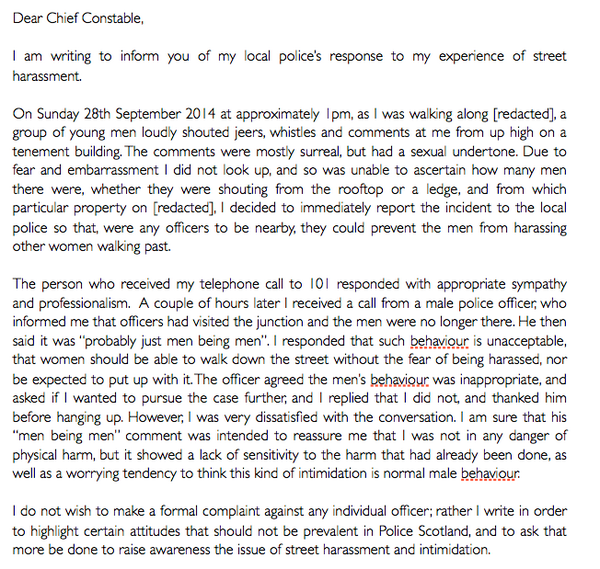
Anna’s Letter to Police in Scotland

September 29, 2014 By Contributor

Editor’s Note: Anna gave permission for her story to be shared here.

@anna_e_fisk [I’ve] written a letter to Chief Constable about yesterday’s experience of street harassment and #EverydaySexism

Share

Filed Under: Stories, street harassment

“I encourage every one not to turn a blind eye when someone needs your help”

September 28, 2014 By Contributor

I’ve been commuting to and from my house since I reached high school. I’ve had my fair share of catcalls and whistles. I did not mind those men because in my mind I am above them.

When I graduated high school, I went to a college that is far from our home but still I commute everyday. I ride a bus going to college and going back home.

One morning, I rode the bus like I always do. I chose a seat that’s far from the driver’s seat, though it is not all the way at the back of the bus. If you have been in Manila, you’ll know that the buses will be full of people. At one point, a man dressed appropriately like he is going to his office sat beside me. At first, he just sat there not minding me. But as the ride went on, he started feeling me. He was trying to touch my breast. My instinct was to scoot farther from him, closer to the window. I was very afraid because he was also making sounds that I thought he was pleasuring himself under his jacket that was strategically placed on his lap. The bus was full and even the aisle have people standing. I know someone could hear him because he was not quiet but they did not do anything. They turned a blind eye. After a while, the man alighted from the bus. That’s when I realized that my phone was missing.

I was not only harassed, I was also robbed. I did not reported it to the police because no one helped me. When I screamed that I was robbed, the people looked at me like I was disturbing them. All I felt that time was their apathetic stares.

That is why I am very vocal about my stand on any form of harassment. And I encourage every one not to turn a blind eye when someone needs your help especially in the streets because no one should feel alone.

– L.

Location: Bus. Manila, Philippines

Share your street harassment story for the blog.
See the book 50 Stories about Stopping Street Harassers for more idea

Share

Filed Under: Stories, street harassment

« Previous Page
Next Page »

Share Your Story

Share your street harassment story for the blog. Donate Now

From the Blog

  • #MeToo 2024 Study Released Today
  • Join International Anti-Street Harassment Week 2022
  • Giving Tuesday – Fund the Hotline
  • Thank You – International Anti-Street Harassment Week 2021
  • Share Your Story – Safecity and Catcalls Collaboration

Buy the Book

  • Contact
  • Events
  • Join Us
  • Donate
  • Facebook
  • Instagram
  • Pinterest
  • Tumblr
  • Twitter
  • YouTube

Copyright © 2026 Stop Street Harassment · Website Design by Sarah Marie Lacy