• About Us
    • What Is Street Harassment?
    • Why Stopping Street Harassment Matters
    • Meet the Team
      • Board of Directors
      • Past Board Members
    • In The Media
  • Our Work
    • National Street Harassment Hotline
    • International Anti-Street Harassment Week
    • Blog Correspondents
      • Past SSH Correspondents
    • Safe Public Spaces Mentoring Program
    • Publications
    • National Studies
    • Campaigns against Companies
    • Washington, D.C. Activism
  • Our Books
  • Donate
  • Store

Stop Street Harassment

Making Public Spaces Safe and Welcoming

  • Facebook
  • Instagram
  • Pinterest
  • Tumblr
  • Twitter
  • YouTube
  • Home
  • Blog
    • Harassment Stories
    • Blog Correspondents
    • Street Respect Stories
  • Help & Advice
    • National Street Harassment Hotline
    • Dealing With Harassers
      • Assertive Responses
      • Reporting Harassers
      • Bystander Responses
      • Creative Responses
    • What to Do Before or After Harassment
    • Street Harassment and the Law
  • Resources
    • Definitions
    • Statistics
    • Articles & Books
    • Anti-Harassment Groups & Campaigns
    • Male Allies
      • Educating Boys & Men
      • How to Talk to Women
      • Bystander Tips
    • Video Clips
    • Images & Flyers
  • Take Community Action
  • Contact

“We made it clear that we were uncomfortable”

February 3, 2014 By Contributor

My friend and I, both 15, were on the city’s public transit just talking to each other when a man started talking to us. He asked how old we were, where we were from, personal questions he had no right to ask. It was a cold day and we were both wearing thick winter jackets, the only visible skin was our faces and hands. We made it clear that we were uncomfortable, but he kept talking to us even knowing we were minors. He was probably twice our age, or close to it. At the next station we got off the train.

– Anonymous

Location: Calgary, Alberta, Canada

Share your street harassment story for the blog.
Check out the new book 50 Stories about Stopping Street Harassers!

Share

Filed Under: Stories, street harassment

USA: The Effects of Street Harassment on Political Speech

February 2, 2014 By Correspondent

Andrea Ayres-Deets, San Francisco, CA, USA, SSH Blog Correspondent

Street harassment forces us to question our safety. It compels us to reconsider our environment and surroundings. So many of us are far too familiar with the quickening of our pace, while we plan an escape route. Just in case. Your pulse races, and you grab your phone, or put a key in-between your knuckles. Just in case. Walking down the street should not have to be an act of heroics.

We often discuss street harassment at the personal level, and there is no doubt of the psychological trauma it causes. Talking about street harassment in this way is essential. The sharing of our communal experiences enables us to breakdown the culture of tolerance that has long permitted the continued existence of street harassment. We cannot forget to discuss the importance of the societal cost street harassment has.

It’s been well documented that street harassment alters the way we move about in public spaces, but what about the limitations it puts on our ability to engage in political speech? In Tahir, Egypt, we saw how extreme violence against women was used to limit their political participation in the uprising against then President Hosni Mubarak. The freedom to express ourselves through political speech is perhaps not always at the forefront of our minds, but when we are denied this right––we are being denied a right that harasses have and use freely. We need to unpack what this means for our representation and involvement in a Democratic society.

In order to demonstrate how street harassment is used to limit political participation, let’s take a look at a few examples. It’s important to note that the intention of the harasser does not matter, an individual does not have to intend to limit an individuals political participation in order to do so.

For example, if we look at the assaults that occurred during the Occupy Wall Street movement, we see women who are engaged in a political demonstration who were then assaulted. The overall effect of these assaults meant that women and others who are common targets of harassment, had to change their behavior in order to continue their participation. Those in public spaces should not have to disrupt or alter the manners in which we engage in political speech for fear of reprisal, harassment, or abuse.

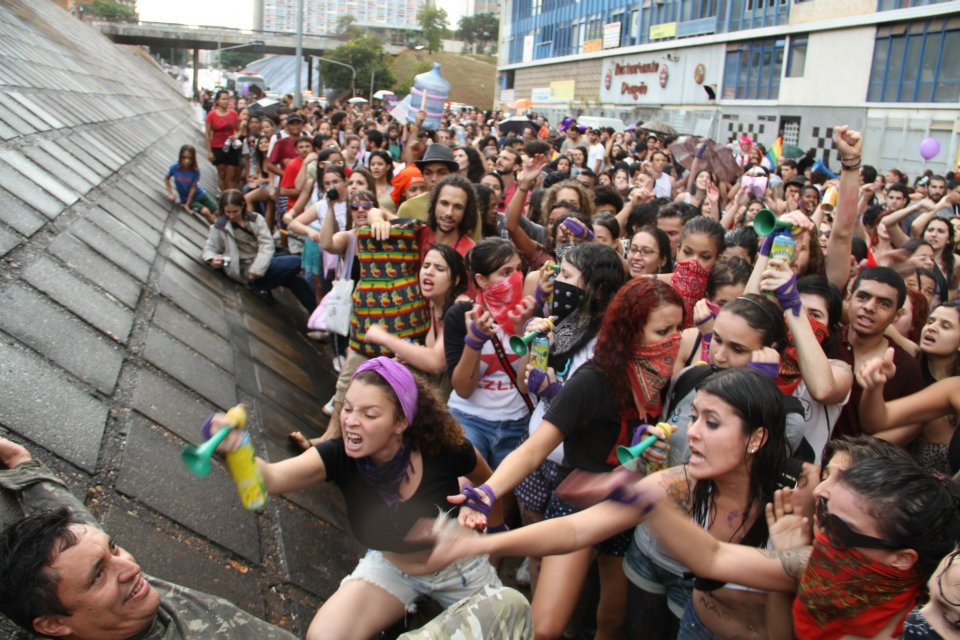
Brazil SlutWalk. Image via The News Junkie

What we see in the photo on the right is a man who exposed himself during a Slut Walk march. Regardless of what this man’s intentions were, he was engaging in a violent act while people were participating in political speech. He sought to devalue their message, their numbers, to make a mockery of their protest. It is a prime example of how street harassment is used to tell individuals that their very presence, is not wanted––is not protected. There are still other images of women who are participating in political speech, whose images and protests are altered in an effort to silence them.

For many, even the thought of participating in a demonstration represents a risk they are just unwilling to take for fear of being harassed. In this way, we do not currently possess the proper framework for understanding how many are affected. Though research does indicate that prior victims of street harassment are more likely to avoid certain areas or streets “all or more of the time.”

That is perhaps what is so troubling about street harassment: too often its effects silence us. The effects of silencing can manifest themselves both physically and mentally. Either we alter our physical being, or we avoid areas, or we stop engaging in political activity. If we do not feel welcome and safe in public spaces each day, then how we will feel welcome and safe when engaged in a political activity?

What we are really discussing here is the denial of our ability to live our lives to the fullest, to exercise our lives without policing our actions and selves out of fear. This is one of the many important reasons why street harassment must stop.

Andrea Ayres-Deets worked as a politics intern at PolicyMic and field organizer. She currently consults with startups in the SF area on content and how to better engage users. You can follow her on twitter: @missafayres or check out her website ayres-deets.com.

Share

Filed Under: correspondents, street harassment

We’re #NotBuyingIt This SuperBowl Sunday

February 1, 2014 By SSHIntern

Kendra Corbin. SSH Intern

Via iTunes

This year’s Super Bowl XLVIII will air on Sunday, February 2 at 6:30 PM. Millions of viewers will lounge in front of their TVs with junk food and beer. Instead, I will be parked on my couch, rolling my eyes and making that, “ugh,” sound under my breath, awaiting the inevitable sexism that plagues Super Bowl commercials.

In the past, Super Bowl Sunday has been a breeding ground for sexist ads. Go Daddy notoriously receives backlash for its ill-fated attempts at making Internet domain names sexy. Take a look at last year’s cringe-worthy commercial. As a warning, it’s painfully awkward to watch. The slogan is, “When sexy meets smart, your small business scores.” Aside from being genuinely gross, this commercial implies that beautiful people, women in particular, cannot be smart and smart people cannot be beautiful.

In 2012, Teleflora released a steamy commercial with questionable implications. The flower company’s commercial features a beautiful woman slowly slipping into lingerie. She looks into the camera and seductively says, “Guys, Valentine’s Day is not that complicated. Give and you shall receive.” Get it? If you buy a woman flowers, you’ll automatically get laid. What an adorable message to send to millions of Super Bowl viewers.

Also in 2012, Fiat released a commercial that features a woman that catches a man gawking at her in the streets. At first she is angered, though her anger quickly turns into heated passion. The man then wakes up from his daydream just as the beautiful woman turns back into a car. This commercial is problematic because it objectifies women while simultaneously making light of street harassment. Leering at women in streets is not a sexy turn-on. It’s creepy.

Luckily, this year viewers can combat sexist commercials by using The Representation Project’s new #NotBuyingIt app. During the Super Bowl, viewers can publicly call out companies for their offensive advertising tactics. Although #NotBuyingIt has previously been available on Twitter, it is now easily accessible via the iPhone app. The goal is to spread the word about sexist advertisements, grab the attention of the offending companies, and spark a positive change within the media and society.

Stop Street Harassment’s similar operation Campaign Against Companies calls out offensive ads that specifically trivialize street harassment. Along with using the #NotBuyingIt app, we encourage viewers to submit offensive ads related to street harassment, as well. In the past, Stop Street Harassment and supporters have been able to convince several companies to refine their distasteful advertisements.

During the game, I do not want to see any scantily clad women used as a marketing ploy. I do not want to see women objectified for profit. I do not want to see female actresses pretending to be strippers. The hypersexual Super Bowl commercials say a great deal about how the public views real life women. The media has the influential power to make us view women as sexualized objects. This alarming mindset can have a tremendous impact on the amount of street harassment that real life women experience.

This Sunday, take note of the messages that companies are sending to their consumers. If you spot sexism in a commercial and it offends you, tell someone about it! #NotBuyingIt is a great way to start spreading the word. If you plan on traveling to Super Bowl parties, stay safe.

Kendra Corbin is senior at Shenandoah University. She is majoring in Mass Communications and minoring in Women’s Studies.


Share

Filed Under: offensive ads, street harassment Tagged With: #notbuyingit, MissRepresentation, super bowl

USA: From Egypt to Baltimore — Meet Us on the Streets

January 31, 2014 By Correspondent

Brittany Oliver, Baltimore, MD, USA, SSH Blog Correspondent

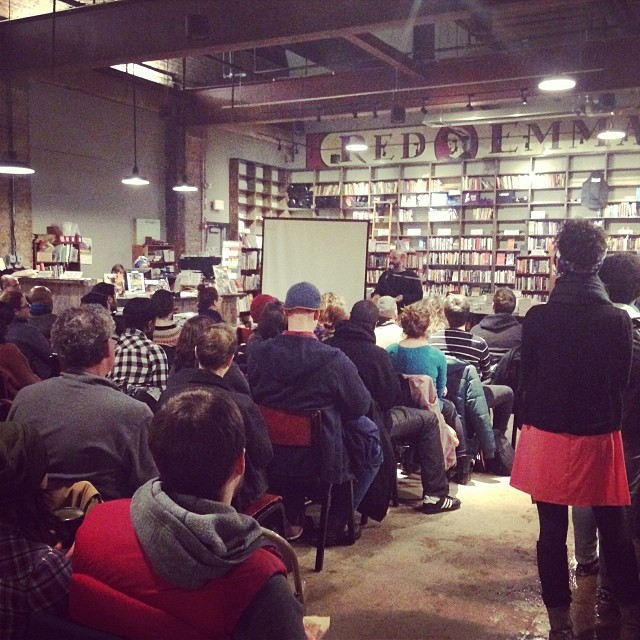
Photo from the event “The Egyptian Revolution: It’s Context, the Feminist Movement, and the 3 Years Since”

Last week, Egyptian feminist Nana Elhariry and DC-based Arab/Muslim writer Rami el-Amin shared their personal reflections at the event “The Egyptian Revolution: It’s Context, the Feminist Movement, and the 3 Years Since,” held at Red Emma’s Bookstore and Coffeehouse in Baltimore, MD.

Both women were distinctively able to recall instances of street harassment they witnessed during the movement. They mentioned that women were subjected to vulgar remarks, insults, indecent exposure, stalking and fondling despite advocating for the same issues among their male counterparts. I attended because I wanted to learn about the experiences women faced during the Egyptian Revolution and, aside from reading about it, I wanted to have a face-to-face discussion about it.  Their mentions of street harassment definitely hit home for me.

The reason why I connected with these instances so much is because I’ve experienced street harassment myself and I know others who have as well, but who are afraid to speak out about it. Because these acts are very likely to happen if you are a woman, walking along the streets of Baltimore at certain times can get very scary. And with the countless number of stories, reports and facts, you would have to wonder – what exactly is Baltimore doing about it?

According to Stop Street Harassment, studies around the world show that 80 to 100 percent of women experience street harassment. In a study of 811 women from 23 countries, almost one in four had experienced street harassment by age 12 (22%) and nearly 90% by age 19. So, there should never ever be an issue on whether or not street harassment is a current form of gender-based violence because the research and facts are there. It’s an issue that more people need to be educated on because not only is it rarely reported, but also the least legislated against.

So what IS being done? Aside from Stop Street Harassment, Hollaback! Baltimore is a local movement of activists who are making some serious moves to ending street harassment within the area. Just this week, Hollaback! Baltimore hosted a Street Harassment 101 workshop for the volunteers of Repair the World, which was intended to help them become better allies to the movement.

One of the best ways to stop street harassment is by educating as many people as we can on ways to better interact with women and LGBT individuals in our communities. As Baltimore ranks as the seventh most dangerous city in the country, I still believe there are a lot of actions we can take to make it a better place to live. We may not be able to change it all at once, but every bit of work towards making our streets safer will help make a difference for the future.

March 30th to April 5th will be the 3rd annual of International Anti-Street Harassment Week and I’m looking forward to seeing what activists in Baltimore will do in continuing the fight.

Brittany Oliver is a recent graduate of Towson University and works in the non-profit communications sector and supports local anti-street harassment advocacy through Hollaback! Baltimore. She blogs at brittuniverse.wordpress.com and publicly rants on Twitter, @btiara3.

Share

Filed Under: correspondents, Stories, street harassment

Survey: Harassment Common in Public Spaces in Bangladesh

January 30, 2014 By HKearl

Here’s another study showing just how common street harassment is — this time in Bangladesh.

Via The Daily Star:

“Women almost regularly face sexual harassment in public places, mostly on streets, in markets and on public transport, according to a government survey.

About 43 percent of the 12,600 women surveyed recently have said public places are the most common spot where they are sexually harassed.

The survey, jointly done by the Bangladesh Bureau of Statistics and United Nations Population Fund, covered all the seven divisions of the country. The women were randomly chosen from city, urban and rural areas.

“I hardly know a woman who has not been verbally harassed or groped in the streets,” said Umme Nahar, an official of a private firm in the capital.
She claimed she was first groped at the age of twelve and that she is sexually harassed every day on the streets….

Asked for her comments, Ayesha Khanam, president of Bangladesh Mahila Parishad, said women’s attire was not the issue here. “Women wearing all types of clothing face sexual violence. It cannot be generalised that women wearing a certain kind of clothing face more sexual harassment,” she said.”

Share

Filed Under: News stories, Resources, street harassment

« Previous Page
Next Page »

Share Your Story

Share your street harassment story for the blog. Donate Now

From the Blog

  • #MeToo 2024 Study Released Today
  • Join International Anti-Street Harassment Week 2022
  • Giving Tuesday – Fund the Hotline
  • Thank You – International Anti-Street Harassment Week 2021
  • Share Your Story – Safecity and Catcalls Collaboration

Buy the Book

  • Contact
  • Events
  • Join Us
  • Donate
  • Facebook
  • Instagram
  • Pinterest
  • Tumblr
  • Twitter
  • YouTube

Copyright © 2026 Stop Street Harassment · Website Design by Sarah Marie Lacy