• About Us
    • What Is Street Harassment?
    • Why Stopping Street Harassment Matters
    • Meet the Team
      • Board of Directors
      • Past Board Members
    • In The Media
  • Our Work
    • National Street Harassment Hotline
    • International Anti-Street Harassment Week
    • Blog Correspondents
      • Past SSH Correspondents
    • Safe Public Spaces Mentoring Program
    • Publications
    • National Studies
    • Campaigns against Companies
    • Washington, D.C. Activism
  • Our Books
  • Donate
  • Store

Stop Street Harassment

Making Public Spaces Safe and Welcoming

  • Facebook
  • Instagram
  • Pinterest
  • Tumblr
  • Twitter
  • YouTube
  • Home
  • Blog
    • Harassment Stories
    • Blog Correspondents
    • Street Respect Stories
  • Help & Advice
    • National Street Harassment Hotline
    • Dealing With Harassers
      • Assertive Responses
      • Reporting Harassers
      • Bystander Responses
      • Creative Responses
    • What to Do Before or After Harassment
    • Street Harassment and the Law
  • Resources
    • Definitions
    • Statistics
    • Articles & Books
    • Anti-Harassment Groups & Campaigns
    • Male Allies
      • Educating Boys & Men
      • How to Talk to Women
      • Bystander Tips
    • Video Clips
    • Images & Flyers
  • Take Community Action
  • Contact

USA: When Street Harassment Dictates Social Behavior

July 23, 2013 By Correspondent

 By Nikoletta Gjoni, Maryland, USA, SSH Correspondent
The many times that I’ve gotten on the metro recently I’ve thought about an article I read a few weeks ago in The New York Times, How Not to Be Alone. The author, Jonathan Safran Foer, writes about the diminishment of daily human interaction due to the ever-rising use of technology and its tendency to isolate us. What I found to be both intriguing and significant in the article was Foer writing about a recent occurrence on the streets of Brooklyn:

A girl, maybe 15 years old, was sitting on the bench opposite me, crying into her phone…I was faced with a choice: I could interject myself into her life, or I could respect the boundaries between us. Intervening might make her feel worse, or be inappropriate… an affluent neighborhood at the beginning of the day is not the same as a dangerous one as night is falling. And I was me, and not someone else. 

 The significance of what Foer writes (with absolute knowingness) is that 1) an older man approaching a young girl on the street would be perceived as shady to most bystanders, and 2) that he confuses an ‘affluent’ neighborhood for a safe one; street harassment doesn’t discriminate according to zip code. The very real concern that he would come off as an intrusive and possibly threatening man to a teenaged girl is strong enough for him to want to keep his nose in his contacts list and completely ignore the situation. Foer doesn’t tell us what he ultimately decides to do, though he admits that “there’s a lot of human computing to be done.”

Though street harassment is by no means a new problem for women, it is perhaps more widely acknowledged today than it may have been in years past. Like countless of other women all over the world, I have had my fair share of unwanted gazes, comments, and contact. The only time I’ve had backup is when I’ve been out with friends. On any other occasion of simply walking to and from work or trying to look for a street name, help is almost never readily available.

It is disheartening to think that even though people can spot and disapprove of street harassment, few will say anything against the perpetrator. So when I stumbled upon an Avon Foundation tweet regarding a bystander behavior training program for sexual harassment, it reminded me of the work being made out there by different organizations to create awareness of when someone is being verbally or physically assaulted, and to step in when one can. It’s a reminder that when one is being attacked in a public space, it should be the duty of others around that person to jump in and strike down the harassment taking place. One would hope that if enough people partake in bystander intervention, it would eventually become the normalized behavior. Sometimes all it takes is a quick acknowledgment to let the victim know that she has not slipped through the cracks in the middle of a crowd.

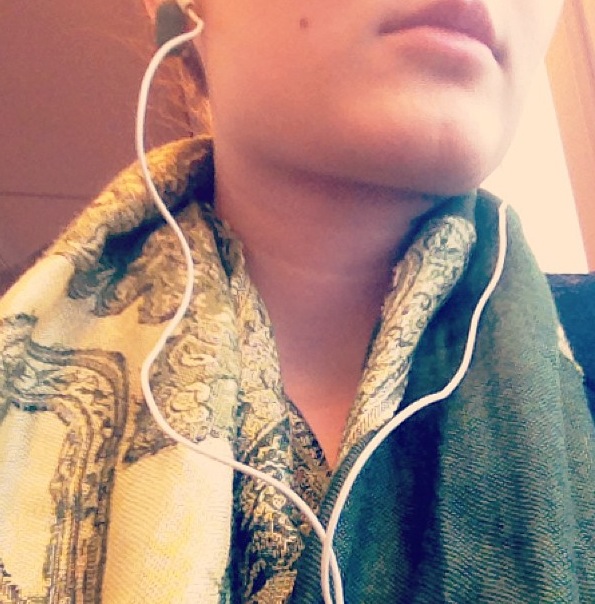
So what do I do to deter unwanted advances? Precisely what Foer continues to write about in his article. I pull out my phone, plug in my earbuds, and blast my music. My girlfriends and I joke about how it’s a hassle whenever we forget our phones/ipods/ipads/kindles/earbuds. We joke about how we try to avoid eye contact in a crowded metro car – just in case! – because we have all had that one experience, that one time when we were approached just to be told that we look sad/angry/bored.

I sometimes wonder if it’s the healthiest fix to the problem. I know that in the process of trying to avoid unsavory people, you may miss out on conversing with the interesting ones. Foer recognized that his intentions may have come off as creepy or impure, and while I appreciate and also sympathize with his sensitivity to the matter, I would actually encourage him and other men to step up and speak up when their incentive is to be a good Samaritan. Being prejudged as a harasser is as sad as the harassment problem itself, and it’s something I consciously try to remind myself of whenever I am out in public.

Nikoletta Gjoni graduated from UMBC in 2009 with a B.A. in English Literature. After graduation, she did almost four years of freelance work in a D.C. broadcast station, in addition to having worked as a literacy and linguistics assessor for pre-k classrooms in D.C.’s charter schools.  To get to know her better, she can be tracked on both her creative blog and Twitter, @nikigjoni.

Share

Filed Under: correspondents, Stories, street harassment

“As if it’s their god-given right”

July 23, 2013 By HKearl

These people say things I’m supposed to feel flattered about, but I still feel harassed & dirty afterwards. Sometimes the words are just insinuated, like they ‘say’ it by singing it, kind of like an indirect way of telling you what they think – as if you asked for their opinion or harassment.

I think we have a long way to go with this one, especially in the Third World, but it would be nice if this street harassment could stop at some point, hopefully soon, but definitely eventually. This harassment is something that has always bothered me, & has affected me on a considerable level. What I hate is that people feel COMFORTABLE in saying whatever it is they wish to say without thinking about things or weighing their words first, as if it’s their god-given right to just call people names or hurt them verbally.

But if they can arrest people “joking” about mass murders, then surely something can be done about verbal harassers. Maybe they can be fined, but it seems like a tricky thing to do. What if the harassers are under-age, or what if they merely ‘insinuate’ things, & won’t own up to the harassment? What about people that say this is something that is natural?

– Anonymous

Location: street, mall

Share your street harassment story for the blog.

Share

Filed Under: Stories, street harassment

Matt Smith Makes Street Harassment Seem Okay

July 22, 2013 By HKearl

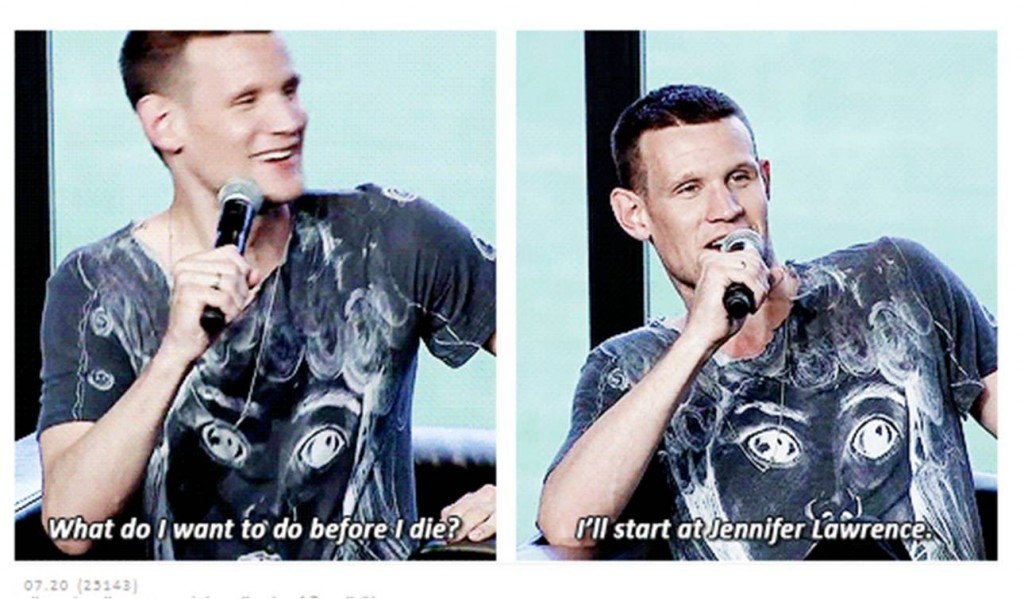
This is what actor Matt Smith said at the recent Comic Con in San Diego when a fan asked him what he’d like to do before he dies. Karen Jensen, a mother and librarian, took offense at this – as she should – and wrote a really great letter to him.

An excerpt:

“Many people will think that you paid Jennifer Lawrence a tremendous compliment in your answer.  Some will say you were simply trying to be funny.  Others will realize that you stripped her away of all her hard work and accomplishments, demeaned her, and reduced her to a physical object.  Imagine what a different impact you would have had if you had chosen to say before you died you wanted to make great art, or to learn new things, or to make the world a better place.  But no, your first desire was to “do” Jennifer Lawrence. You were basically engaging in a large scale moment of Street Harassment…

You took the stage and perpetuated a culture that others are working tirelessly to end because it harms others.  Teenage boys hanging their heads out their car windows telling women on the street that they “want to do them” will think nothing of it because, well, Matt Smith did it at Comic Con and everyone thought it was cool.  Bow ties are cool, street harassment is not.”

Thank you, Karen, for taking a stand and calling him out.

Share

Filed Under: street harassment

Ottawa: Street Harassment Survey Results

July 22, 2013 By Contributor

Cross-posted with permission from Hollaback! Ottawa

July 22, 2013 (Ottawa, ON).  A new survey released today finds 97% of respondents experienced street harassment in the past year and only 10% reported it to the authorities. The survey findings are outlined in a new report compiled by Hollaback! Ottawa, the local chapter of an international movement dedicated to ending all forms of street harassment.

Download the full report here.

“The results are in line what we already know about sexual violence: It’s ubiquitous and yet, we rarely talk about it. It’s difficult to talk about with our friends, let alone reporting it to the police”, says Hollaback! Ottawa site director Julie Lalonde.

Our city, our space, our voice: A report on street harassment in Ottawa is the result of an open forum held in May by Hollaback! Ottawa and WISE: Women’s Initiatives for Safer Environments and a subsequent online survey. The forum focused on safety on transit with the survey addressing street harassment more broadly.

“What we’ve seen in the media over the past few months and what we saw quite clearly during our forum is that harassment on transit is a critical issue for residents” says Lisane Thirsk, policy and research officer for Hollaback! Ottawa. “With 44% of survey respondents indicating that they had been harassed on public transit at least once in the last year, it’s clear that we’re not talking about a few isolated incidents.”

Although there has been immense support for bystander intervention strategies, the survey found only 6% of respondents had a bystander intervene on their behalf.

Street harassment predominantly affects women and LGBT2QQI* folks and the impact on their daily lives is tremendous. 38% of respondents indicated that street harassment made them fearful to go out alone and 32% would routinely change their route or final destination.

“It was important for us to quantify the impacts of street harassment because we hear so often from people about how their experiences are trivialized. And yet, what we’re talking about are experiences of being yelled at, stalked, groped and flashed. There is nothing trivial about street harassment”, says Julie Lalonde.

The report calls for the creation of public awareness campaigns, tools for bystander intervention and mechanisms for anonymous reporting.  It also announces the creation of a new safe(r) spaces campaign, initiated by Hollaback! Ottawa with the focus of engaging the broader community.

It is evident that there is a great deal of interest in creating change. One survey respondent summarized it perfectly: “If we all come together and fight this, not just a few individuals, but everyone who has been, will be or knows someone who has been harassed, we can make waves.”

For more information:

Julie S. Lalonde, Director, Hollaback! Ottawa
ottawa@ihollaback.org

Share

Filed Under: hollaback, Resources, street harassment

England: “Everyday Lesbophobia”

July 22, 2013 By HKearl

By: Tilly Grove, London, England, SSH Correspondent

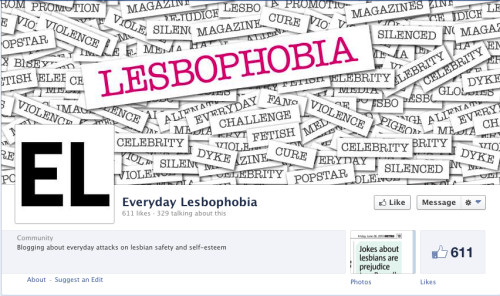
When people talk about the street harassment of women and the street harassment of the LGBT community, it is not always acknowledged that whilst sexism and homophobia are different oppressions, they meet at a significant intersection, too. This phenomena, known as lesbophobia, sees lesbian and bisexual women subjected to abuse that although certainly fueled by bigoted views regarding sexuality, has a distinctly misogynistic tone to it as well. It is a very tangible reality for many lesbian and bisexual women, as the Everyday Lesbophobia project endeavours to document.

Of course, women who are perceived to be intimate with other women still face the same hostility, threats and actual violence that the LGBT community face generally. But they also receive harassment of a different kind, which is not just underpinned by the assumption that only heterosexual relationships are natural or legitimate, but that this is the case because women exist for the pleasure of men.

Having asked on Twitter for women to share their experiences on the matter, I immediately had a woman describe how she and her partner had been accosted in the street by men declaring that a “good f**k would sort them out” – implying that lesbian relationships are not real, that there is something wrong with them, and that a man can ‘fix’ it. This incorporates the homophobic belief that same-sex relationships are inferior to heterosexual relationships into the idea that all women do and should want men, and that men are entitled to each and every one.

The men making these kinds of comments probably think that they are making a joke, in an attempt to reassert the masculine dominance undermined by a woman not being interested in them, but it has very real implications. Corrective rape is a threat for lesbian women across the world. Some men are so sure that a “good f**k” will make lesbians interested in men that they give it to them, forcibly and without consent. All it actually does is cause unnecessary harm, fear and possibly lead to death. That’s no joke.

It doesn’t help that lesbian sexuality is heavily constructed in the public perception to cater for male consumption. This is no surprise; all women are portrayed in the patriarchy as a sexual conquest of some kind. But for lesbian and bisexual women, the fetishisation of their relationships in anything from pornography to sitcoms means that in public they are treated as novelties, or masturbatory tools. Women intimate with each other in public are cheered on, jeered at, and openly leered upon, with tales of male harassers doing everything from asking if they can join in to actually masturbating.

Any woman who strikes up the courage to protest this objectification is invariably told that “they know it’s hot” and thus, apparently, cannot complain. This is entitlement to the extreme – the idea that lesbian and bisexual women must accept threatening behaviour and invasions of their privacy because men are used to viewing images of their relationships for pleasure. As if this is the natural way of things.

All the while society and its institutions present women as things for men to play with, and not human beings with their own desires and a right to respect, this will be the natural way of things. And street harassment won’t end.

Tilly is studying for a BA in War Studies at King’s College London, where she is writing her dissertation on the effect that perceptions of gender have on the roles which women adopt in conflict. You can follow her on Tumblr and Twitter, @tillyjean_.

Share

Filed Under: correspondents, LGBTQ, street harassment

« Previous Page
Next Page »

Share Your Story

Share your street harassment story for the blog. Donate Now

From the Blog

  • #MeToo 2024 Study Released Today
  • Join International Anti-Street Harassment Week 2022
  • Giving Tuesday – Fund the Hotline
  • Thank You – International Anti-Street Harassment Week 2021
  • Share Your Story – Safecity and Catcalls Collaboration

Buy the Book

  • Contact
  • Events
  • Join Us
  • Donate
  • Facebook
  • Instagram
  • Pinterest
  • Tumblr
  • Twitter
  • YouTube

Copyright © 2026 Stop Street Harassment · Website Design by Sarah Marie Lacy