• About Us
    • What Is Street Harassment?
    • Why Stopping Street Harassment Matters
    • Meet the Team
      • Board of Directors
      • Past Board Members
    • In The Media
  • Our Work
    • National Street Harassment Hotline
    • International Anti-Street Harassment Week
    • Blog Correspondents
      • Past SSH Correspondents
    • Safe Public Spaces Mentoring Program
    • Publications
    • National Studies
    • Campaigns against Companies
    • Washington, D.C. Activism
  • Our Books
  • Donate
  • Store

Stop Street Harassment

Making Public Spaces Safe and Welcoming

  • Facebook
  • Instagram
  • Pinterest
  • Tumblr
  • Twitter
  • YouTube
  • Home
  • Blog
    • Harassment Stories
    • Blog Correspondents
    • Street Respect Stories
  • Help & Advice
    • National Street Harassment Hotline
    • Dealing With Harassers
      • Assertive Responses
      • Reporting Harassers
      • Bystander Responses
      • Creative Responses
    • What to Do Before or After Harassment
    • Street Harassment and the Law
  • Resources
    • Definitions
    • Statistics
    • Articles & Books
    • Anti-Harassment Groups & Campaigns
    • Male Allies
      • Educating Boys & Men
      • How to Talk to Women
      • Bystander Tips
    • Video Clips
    • Images & Flyers
  • Take Community Action
  • Contact

Digest of Street Harassment News: July 21, 2013

July 21, 2013 By HKearl

** Sign up to receive a monthly e-newsletter from Stop Street Harassment ***

Street Harassment Stories:

Share your story! You can read street harassment stories on the Web at:

Stop Street Harassment Blog

Collective Action for Safe Spaces

HarassMap in Egypt

Bijoya in Bangladesh

Resist Harassment in Lebanon

Ramallah Street Watch in Palestine

Name and Shame in Pakistan

Safe City India

Safe Streets in Yemen

Street Harassment in South Africa

Many of the Hollaback sites

Everyday Sexism

Street Harassment In the News, on the Blogs:

* Urban Times, “Street Harassment In Public Places: A Global Issue“

* Truth-Out, “Combating Sexual Harassment in Egypt“

* The Raw Story, “Sexual Harassment Is A Grassroots Political Movement“

* Thought Catalog, “Changing The Politics Of Street Harassment Means Men Must Step Up“

* PolicyMic, “It’s 2013, Guys — Stop Catcalling Women Like Animals“

Hollaback Philly’s cards

* City Paper, “Hollaback Philly fights street harassment with pocket-sized cards“

* City Beat, “Let’s Talk About Street Harassment“

* International Business Times, “Sexual Assaults on Women Rise at Spain’s Pamplona Bull Run“

* The Feminist Wire, “My Tattoos are Not an Invitation“

* Huffington Post, “What We Wish People Would Say To Us On The Street“

* SLOG, “Street Harassment with a Happy Ending“

* Bust, “Guess How Many Women Find Street Harassment Flattering? This Tumblr is Great“

* Nursing Clio, “Who has your Back? Harassment on our Streets“

Announcements:

* SSH just launched a brand new Safe Public Spaces Mentoring Program to advice/guide and provide a small amount of money to groups or individuals who want help with an anti-street harassment initiative in their community.

* Watch Kara Lieff’s video “Meet Us on the Subway“

* Do-it-yourself anti-street harassment art!

* New studies about harassment of transgender people in Washington, DC and people in Ottawa, Canada

10 Tweets from the Week:

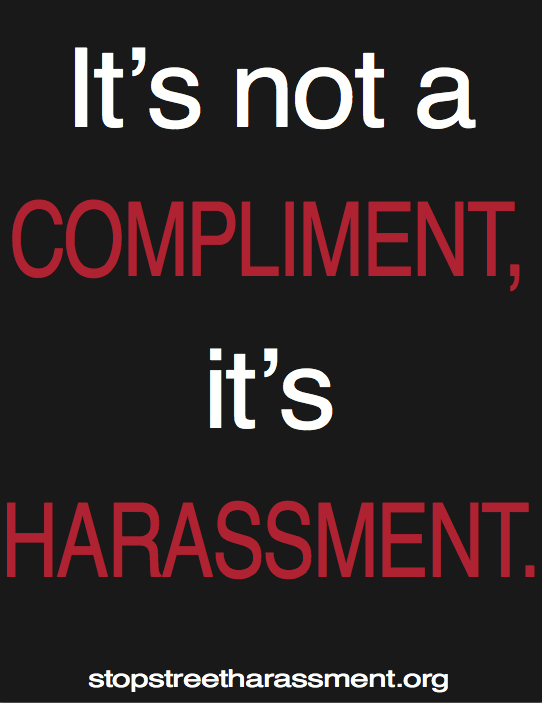
1. @brassiest It’s 2013 and men still think street harassment is a “compliment” and not terrifyingly creepy and dangerous behavior

2. @LadyT523 Men who act like caveman street harrass women. #T2Q #streetharassment

3. @BertLoch One stranger can take #StreetHarassment as a compliment. Another a threat that creates great unease. Point is YOU DON’T KNOW WHICH IS WHICH.

4. @empascall Since when is it okay for an old creepy ass man three times my age to blow kisses at me while I walk down the street? Fuck you!!!!

5. @lilly_GG  Street harassment happens everywhere not just big cities, it happens in the mountains, the country and the suburbs as well…

6. @lov3yourself Thanks for letting me know I look nice but I don’t walk around for your visual pleasure #ShoutingBack #streetharassment

7. @mcbyrne  Women should be able to bill @wmata for cab costs when they make mistakes and our safety isn’t secure

8. @mykasobering “Hey sexy, nice tits. Whoa, why are you so upset? It’s a compliment. I’m only being nice to you, you stupid bitch.” – Male proverb.

9. @Renegade_Blog Sooo, when is the last time you got street harassed? Where? Today? Yesterday? #stopstreetharassment #streetharassment

10. @sistrenista Can Black men in #CrownHeights just give me a few days without #streetharassment ?? I’m still seriously grieving one of your own #ugh

Share

Filed Under: News stories, SSH programs, Stories, street harassment, weekly round up

Street Harassment: Pervasive, But Not Unstoppable

July 21, 2013 By Contributor

Cross-posted with permission from JulieMastrine.com

Image by Julie and her sister Amy

Street harassment is a global human rights problem, one that I’ve been working to combat for about two years now. As a Stop Street Harassment volunteer,  I’m educated on the issue and work to help others identify these incidents and fight back when they occur, but I’m still left reeling and uncomfortable when it happens to me. And in the span of just one day this week, I was harassed four times by men in my area.

I’m currently living in State College, PA, a “college town” by any means. Home to Penn State University, every four years a new crop of undergraduate students take over the area, bringing with them the customs, norms and attitudes they’ve picked up from their respective hometowns. Penn State students hail from many corners of the country, whether it be a small town in Western PA, a suburb in New Jersey, or a city block in New York. I’ve met students from as far and wide as Hawaii, Florida, and Alaska.

But the fact that many of these students assert their power over women and LGBTQ persons by harassing them in public spaces — mostly by making sexual comments — speaks volumes as to the pervasiveness of street harassment globally. Each of these students come from different corners of the world, but street harassment is a societal norm they’ve all managed to pick up on. Year after year, it’s astonishing that this is an activity they all seem to know of and perpetrate, despite their varied backgrounds.

This weekend, I grabbed a book and threw on my bathing suit, heading to a nearby grassy knoll to sunbathe with my twin sister, Amy. We were able to enjoy just a few minutes of peace in the July heat when a man in a truck drove by, honking, leering and waving at us from the road. He had to have been over the age of 60, and I was thoroughly grossed out. I took solace in the fact that there was some physical distance between us, him on the road and me in the grass, so I flipped him off with a wry smile and continued reading. But that wasn’t the last of the objectification we’d experience that day.

Fast forward to 10 p.m. My sister and I were heading to a friend’s apartment for drinks when a group of three guys walking in front of us turned around, looked at us and started to slow down until they were walking next to us. Feeling my personal space violated by these strangers, I immediately tensed up and went silent.

“Hey, where are you girls from?” one of them asked.

Summer in State College is generally made up of permanent residents and freshmen getting a jump start on their classes, downing one too many Natty Lights in the process. My sister, sensing from their scrawny legs and general unease that they were freshmen, let out a groan and replied, “I graduated…sooo I’m way older than you,” hoping they’d get the hint we were young working professionals who were uninterested in their advances.

The guys sauntered off, but later that night, yet another group approached us on the street. It was a pack of an intimidating number of men — about 10 by my count, bleary-eyed from too many shots and walking in a triangular formation with one shorter dude leading the pack.

“Hey ladies!” he shouted in our faces as we passed.

“Ugh, dammit!“ Amy yelled back.

“Stop harassing me!” I shouted over my shoulder.

We were met with confused looks by the entire posse, clearly shocked that a female stranger on the street didn’t appreciate their scrutiny.

Three incidents of harassment in one day is enough, but a few hours later, as we headed to a birthday party, the same group of guys passed us again.

“Oh, we already tried to talk to those girls,” the pack leader said, smirking at us and then turning to his friend to make some other inaudible comments about our outfits. It would appear they’d been making a sport of harassment that night.

“Oh my GOD,” Amy shouted, even more exasperated this time. “My outfit is NOT an invitation!”

We were a few beers deep by this point and continued to yell at the men about how they should stop feeling entitled to women’s attention. But the damage had been done. During each of these instances the unwanted attention made me uncomfortable to the point that I froze up and even stumbled when it came to reasserting my power by shouting back, something I’d made a point to do as a personal rebellion against this type of behavior when it occurs (at least when I felt safe enough).

It’s also important to remember that instances like this can escalate into something much scarier and threatening. The day before my fourfold experiences with street harassment, a friend pulled me aside to spell out what happened to her on the way to work that week. On an otherwise silent 8 a.m. bus, a man sat down near her and started watching porn on his mobile device, then got an erection. Because she was going to work, she couldn’t just get off at the next stop to avoid him — she was forced to ride the entire trip with him nearby. What’s worse: he exited the bus at her stop.

My friend was able to make it safely to work despite the scare, and I encouraged her to alert the bus driver or even snap a picture and alert the police should he appear again. These incidents show that street harassment is something you never really “get used to” or accept as a compliment, as society would have women do. Each incident is jarring — annoying at the least and downright threatening and scary at the worst.

As the summer months wind down, I know this won’t be the last I’ll endure or hear about street harassment — but it sure feels good to let harassers know you’re on to their shtick and aren’t going to let them continue without knowing you’re pissed. Check out this list of assertive responses to street harassment to arm yourself if it happens to you. We may not be able to control when this problem targets us, but the least we can do is tackle it on an individual basis. Street harassment is pervasive, yes — but not unstoppable.

Julie Mastrine is a writer, PR professional, digital strategist, and experienced community outreach coordinator based in State College, PA. She’s currently a ghostwriter whose work is regularly featured in Mashable, Forbes, Business Insider, Inc. Magazine, and Inside Higher Ed. When she’s not helping clients boost their online presence, Julie volunteers in community outreach positions. She’s a social media volunteer for Stop Street Harassment and has a passion for educating others on social justice issues and organizing civic engagement efforts.

Share

Filed Under: Stories, street harassment

USA: “Expectations of gender performance need to stop”

July 21, 2013 By Correspondent

“This is not an excuse for harassment”
Via http://fashionsco0p.blogspot.com

By: Molly Redding, San Francisco, CA, USA, SSH Correspondent

An experience I had the other day got me thinking about how much street harassment has to do with heteronormativity and the presentation of gender in public spaces.

It was Pride weekend and the streets around my apartment in San Francisco were filled with revelers coming to soak in the atmosphere of pure elation after the Defense of Marriage Act was killed and Proposition 8 – a California ballot initiative restricting marriage to one woman and one man – was overturned.

My roommate and I ventured out to get dinner, and as we were walking down the street a gentleman looked at both of us and called, “Hey, lesbi-ans!” Now, given that the Dyke parade had passed not 20 minutes earlier, his assumption wasn’t crazy, but it made me stop for a second, because it was the first time someone had assumed for me a sexuality that I didn’t claim.

For me, this happened once. For many people, this is a daily experience.

Heteronormativity (one of my favorite words, btw), is exactly what it sounds like – the assumption that everyone is heterosexual unless proven otherwise. Much of street harassment rests on this notion, since many (but certainly not all) street harassment incidences are men sexualizing women’s bodies or body parts. They assume the woman is heterosexual, and thus, available to interact with them under the guise of “courting.” That any of the harassers ever think their actions are going to actually win them a date is a whole other blog topic.

On the flip side, non-compliance with heteronormativity also begets street harassment, when the person walking down the street does not fit within the heteronormative framework. This is why there is a high incidence of street harassment aimed at the LGBQT community. Being in a public space and outside of what the harasser might consider “normal” allows them power to point out and ridicule those differences (this, of course, seems insane to many of us who at one point in our lives learned that differences are opportunities for learning, not ridiculing).

And finally, there’s the issue of performativity – the “performance” of one’s gender. A large focus of street harassment has to do with clothing – how much or how little a woman was wearing when she was harassed. Wearing too little clothing is considered a sexualization and “overperformance” of the female gender – and leaves the situation open to blaming the victim.

But “underperformance” of one’s gender can also leave a person vulnerable to harassment. Judith Butler outlines this in a video where she discusses a young boy who was killed by his classmates because of a certain “swish” in his walk (start around minute 4:30 until 6:45):

“So then we have to ask why would someone be killed for the way they walk? Why would that walk be so upsetting to those other boys that they feel they must negate this person, must expunge the trace of this person, they must stop that walk, no matter what . . . it seems to me that we are talking about an extremely deep panic or fear, an anxiety that pertains to gender norms.  If someone says you have to comply with the norms of masculinity otherwise you will die, or I kill you now because you do not comply, then we have to start to question what the relation is between complying with gender and coercion.”

Expectations of gender performance need to stop. Heternormative assumptions need to stop. Their outcome, street harassment, needs to stop.

Molly received a graduate degree in International Development and Gender from the London School of Economics in 2011, where her dissertation focused on websites allowing victims of harassment to post about their experiences. She has worked in the non-profit sector for over 10 years. You can follow her on Twitter, @perfeminist.

Share

Filed Under: correspondents, LGBTQ, street harassment

“I don’t like you, I like her”

July 20, 2013 By Contributor

So I take the train every morning to school and I noticed this guy had his phone pointed at me, and I assumed he took a picture of me since he kept looking at me and I saw he went on his picture gallery on his phone. When he noticed me looking at what he was doing on his phone, he put his phone in his pocket. The next day, he was at my train stop again, and I always take the train at a specific time, and I guess he does too or I’m not sure if he is stalking me now. Ever since, I see him everyday and I told my friends and he still keeps looking at me and my friend confronted him and she said in Spanish (he was Hispanic),

“What are you looking at?” (Que midas) He replied, “I don’t like you, I like her” (No me gusta tu, me gusta aya).

Excuse my Spanish but that’s what happened and now I’m permanently traumatized. Every time I see him he points his phone at me now and one time I saw an Asian wearing only under wear on his home screen. He is disgusting and a pedophile but I don’t have evidence to report him??? I even switched my ways getting to school, but the train is easiest and fastest for me to get to school. If he ever goes beyond this, I will call authorities and I even said that to him.

HE EVEN SITS NEXT TO ME ON THE TRAIN AND HE WHISPERED SOMETHING TO ME BUT I CANT SPEAK FLUENT SPANISH! So creepy!

– Anonymous

Location: Los Angeles, CA

Share your street harassment story for the blog.

Share

Filed Under: Stories, street harassment

“It’s not harassment to tell someone they are sexy.”

July 19, 2013 By Contributor

I know this might not be as bad as other people’s stories but I got hassled in the street this morning. Some random drunk man (yes it was 11 a.m.) started shouting, “Oi sexy!” over and over.

At first I didn’t think he was talking to me as it is a busy inner city street but them he adds ,”Yeah you in the white skirt,” (which was full length by the way. Not sure why I feel the need to say what I was wearing but it’s seems woman have to justify that they were not being provocative.).

At this point I sped up, still ignoring him. His female friend laughed out loud and said, “Shane, that’s sexual harassment.” You could tell by her tone that she was joking though. He replied with more shouting directed at me. “It’s not harassment to tell someone they are sexy. Is it sexy? Oi!”

Luckily I had to turn off at that point so I lost them in a crowd but the whole thing made me feel really uneasy and uncomfortable. I wish I had had the courage to tell him and his friend that yes actually it is harassment to heckle someone in the street like that. I feel silly for being so upset about it, especially as I’m not a young girl, I’m almost 30 and not used to this kind of thing.

– Vic

Location: Norwich, UK

Share your street harassment story for the blog.

Share

Filed Under: Stories, street harassment

« Previous Page
Next Page »

Share Your Story

Share your street harassment story for the blog. Donate Now

From the Blog

  • #MeToo 2024 Study Released Today
  • Join International Anti-Street Harassment Week 2022
  • Giving Tuesday – Fund the Hotline
  • Thank You – International Anti-Street Harassment Week 2021
  • Share Your Story – Safecity and Catcalls Collaboration

Buy the Book

  • Contact
  • Events
  • Join Us
  • Donate
  • Facebook
  • Instagram
  • Pinterest
  • Tumblr
  • Twitter
  • YouTube

Copyright © 2026 Stop Street Harassment · Website Design by Sarah Marie Lacy