• About Us
    • What Is Street Harassment?
    • Why Stopping Street Harassment Matters
    • Meet the Team
      • Board of Directors
      • Past Board Members
    • In The Media
  • Our Work
    • National Street Harassment Hotline
    • International Anti-Street Harassment Week
    • Blog Correspondents
      • Past SSH Correspondents
    • Safe Public Spaces Mentoring Program
    • Publications
    • National Studies
    • Campaigns against Companies
    • Washington, D.C. Activism
  • Our Books
  • Donate
  • Store

Stop Street Harassment

Making Public Spaces Safe and Welcoming

  • Facebook
  • Instagram
  • Pinterest
  • Tumblr
  • Twitter
  • YouTube
  • Home
  • Blog
    • Harassment Stories
    • Blog Correspondents
    • Street Respect Stories
  • Help & Advice
    • National Street Harassment Hotline
    • Dealing With Harassers
      • Assertive Responses
      • Reporting Harassers
      • Bystander Responses
      • Creative Responses
    • What to Do Before or After Harassment
    • Street Harassment and the Law
  • Resources
    • Definitions
    • Statistics
    • Articles & Books
    • Anti-Harassment Groups & Campaigns
    • Male Allies
      • Educating Boys & Men
      • How to Talk to Women
      • Bystander Tips
    • Video Clips
    • Images & Flyers
  • Take Community Action
  • Contact

Workshop Idea: Fight Harassmet 101

July 10, 2013 By Contributor

Here’s an example of a workshop you can hold in your community. Find more event & workshop ideas.
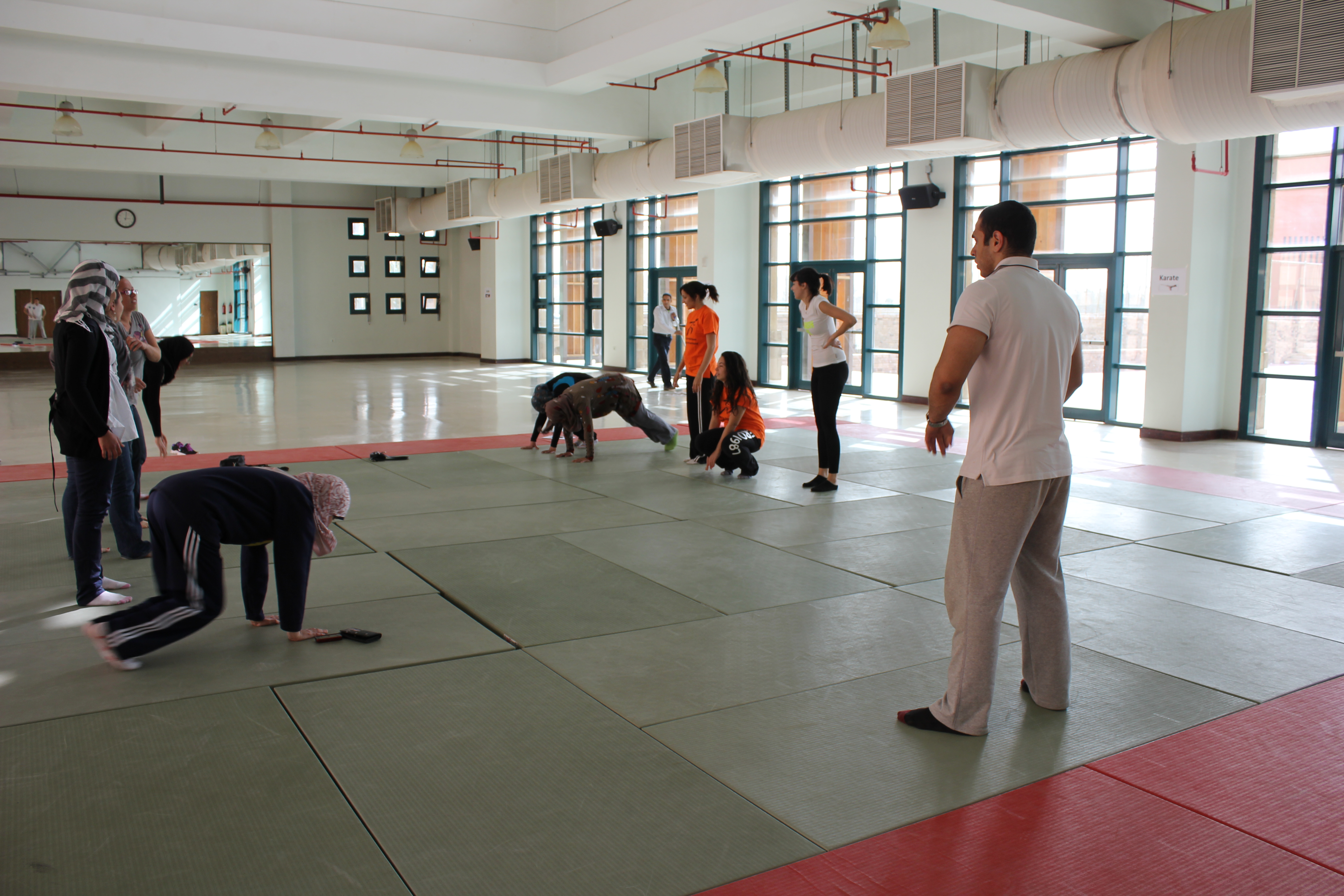
Fight Harassment 101 (FH101) was created to educate female Egyptians and non-Egyptians about harassment and the use of self-defense. Once a week at the American University of Cairo, 15 students would take part in FH101 for two hours for about 10 weeks.

Weekly, 2-3 young women as well as a black belt Judo instructor hosted the initiative. At the beginning of class, an information page was provided to the attendees, mostly copied from Holly Kearl’s website, Stop Street Harassment, that provided information about: what to do if harassed, what harassment is, and the contact information for the organization HarassMap in Egypt.

During the first 30 minutes, the young women would discuss harassment and any incidents they experienced in the past to encourage them to no longer feel ashamed or blamed for the harassment they experience.

The next hour and half focused on learning self-defense. Not all young women were active in exercise, but they were taught not only the basic defense mechanisms, but also more physicals ones such as how to punch, or throw a person over if they grab them from behind, et cetra. We did not expect these young women to be able to do this if they experienced a physical assault, but we hoped by providing these tools, they would feel more able to defend themselves and perhaps ward away any potential attackers.

Out of the 15 students, about 13 wore hijab, countering the notion that harassment is correlated with the way someone is dressed. Although these women were trained with the basics, it gave them a sense of empowerment to defend themselves in the worst-case scenarios. At first they were shy about sharing their experiences, but once they found it was a common occurrence and learned that it was not their fault, they felt the need to fight against it. Many did not know that in some parts of the world, sexual harassment is considered to be a human rights violation.

Here are two articles I wrote about the class.

1. Fight Harassment 101: Egypt’s Obstacle to Ending Sexual Harassment

2. Enough Talk on Harassment, Egypt — Do Something About It

Holly Dagres, an Iranian American, is an analyst and commentator on Middle East affairs. Currently living in Egypt, she is a researcher at the Cairo Review of Global Affairs and pursuing a master’s degree in political science at the American University in Cairo.

Share

Filed Under: Events, Resources, street harassment

Video: Epidemic of Sexual Violence in Egypt

July 9, 2013 By HKearl

Trigger Warning –

Via Heya:

“A total of 186 mob sexual harassment/assault cases have been documented by Op Anti-Sexual Harassment/Assault قوة ضد التحرش/الإعتداء الجنسي الجماعي and Nazra for Feminist Studies starting June 28 till July 7, including at least 3 rape cases. The rampant sexual attacks during the Tahrir Square protests highlight the failure of the government and all political parties to face up to the violence that women in Egypt experience on a daily basis in public spaces.

Very compelling Human Rights Watch video shot by Matt Ford and Tara Todras-Whitehill.”

Share

Filed Under: News stories, Resources, street harassment Tagged With: Egypt

On July 13: NYC Area – share your stories!

July 9, 2013 By HKearl

Filmmaker Charla Harlow and researcher/author Holly Kearl (me) are teaming up to hold TWO discussion group on street harassment on Saturday July 13, 2013, in Brooklyn, NY, hosted by the Brooklyn Movement Center and we’re looking for participants.

Discussion Group 1:

Community members of the Bed-Stuy Neighborhood area are invited to share their experiences and stories with street harassment in the area, 12 – 1 p.m. EST.

Discussion Group 2:

Queer women of color from anywhere in the New York City region are invited to talk about their experiences and stories with street harassment. 2-3 p.m. EST.

Info:

The discussion groups are part of  Stop Street Harassment‘s “Documenting Street Harassment in America” initiative that includes a 2,000 person, nationally representative survey and 10 discussion groups with different demographics across the country.

They’re also part of the Harlow Project‘s Anti-Street Harassment initiative.

The discussion groups will be held at the Brooklyn Movement Center, 375 Stuyvesant Ave  Brooklyn, NY. (Directions). Light refreshments will be provided.

Note:

The sessions will be both tape recorded and then transcribed and videotaped, but to make it a safe space for participants to share their stories, they can have their names be anonymous if they would like.

RSVP:

If you can attend one of the sessions, please contact me, Holly, at hkearl@stopstreetharassment.org, by the end of the day on Friday, July 12, and let me know which one.

More info about the study:

Read more about the SSH study. I hope to complete the rest of the discussion groups this summer, conduct the survey in the fall, and release a report in early 2014.

Questions or concerns? Contact me at hkearl@stopstreetharassment.org or Charla at info@harlowproject.com.

Share

Filed Under: national study, street harassment

“I just wanted to go home”

July 9, 2013 By HKearl

I was out with my boyfriend and before I was even able to pay for our parking a man started yelling at me from across the street. I ignored it initially, not even turning around and look at him. My boyfriend was still getting out of the car when it started, but yelled back at the stranger when he walked up. I flipped the man off for his rudeness, which I think made him uncomfortable (the goal I’d hoped to achieve), and he yelled a few more things while walking around the sidewalk.

Though I was glad to have done something and glad for the support from my boyfriend, it still bothered me a lot and for a while I just couldn’t bring myself to hold hands with my boyfriend or even make eye contact. I just wanted to go home. Luckily we went to an art gallery where I could wander around alone for a while.

I hate disrespectful men like that and I hope he’ll live his life lonely and sad until he learns to act respectfully to others.

– Anonymous

Location: Uptown Charlotte, NC

Share your street harassment story for the blog.

Share

Filed Under: Stories, street harassment

USA: Why I Tolerated Harassment in High School

July 8, 2013 By Correspondent

By Natasha Vianna, Jan. – June 2013 SSH Blog Correspondents

For a chunk of my adolescence, I genuinely believed that sexual and street harassment were the ultimate forms of flattery. If a guy was willing to whistle, call out nicknames, or harass me, then hey… that must mean I am attractive. And heck, for most of my life, I was told to always appreciate a compliment; so I did.

At the time, part of me enjoyed the harassment because it meant I was sexy or pretty to someone else. In high school, there was an overwhelming pressure to look good, dress well, and “bring all the boys to my yard.”  There was jealousy, bitterness, lust, innocence, naivety, and tons of harassment. In fact, by the time I finished my freshmen year of high school, I already believed that if I wasn’t getting attention in the hallways of my school, I was boring and unattractive and needed to do something about it.

The guys in my school were so easily predictable. I knew that if I wore tighter pants or a shorter skirt, I may get a compliment here and there or a stare from the hot football player from across the room. It all seemed like a fun game and I liked having that type of power.

It wasn’t until the harassment quickly shifted from “Hey, you look cute in that shirt” to “You have a fat ass” to “Hey, come and suck my dick bitch,” that I realized I wasn’t enjoying this game anymore. The harassment began to escalate, quickly, and I began to hate walking through the hallways of my high school.

The hot football player would approach me regularly now to see if I wanted to have sex with him. And just like that, he would ask. I’d uncomfortably say no, but it didn’t matter anymore. “So why have you been eyef***ing me from across the room in that short skirt?”

Instead of standing up and shouting, “Because I can wear whatever the f***I want and stare at whomever the f*** I want without wanting to ever f***.” like I would today, I adopted this false belief that what I wear, how I behave, and what I say ultimately determines the treatment I deserve from men. And for years, I worshipped this idealogy.

School became uncomfortable but there was nothing I felt I could do about it anymore. Sexual harassment is rarely addressed in schools the right way. Instead of telling boys to keep their hands to themselves and respect women, girls were told to wear longer skirts and looser clothing. We were blamed when we were mistreated. We were asking for it or just begging for attention.

Here’s an example: My teacher once sent me to the office because my middrift was slightly showing and it was a distraction to the boys in the class. Pissed, I pulled my shirt down and walked down the hallway to meet with the principal. Standing uncomfortably in front of the male principal, who was now looking up and down at me, told to put on a sweater from my locker. For the rest of the day, I covered my 15 year old body in school so the boys could focus on their schoolwork.

When I graduated high school and walked away from those horrible hallways, it didn’t end. The voices of, “Hey baby” and echoes of whistling followed me down many streets… literally. But based on what I endured and learned in high school, I believed this was just normal treatment and how women were supposed to be treated. I trekked on and just tolerated the street harassment never once thinking I was a victim but believing that this is how I would eventually meet my husband.

Thanks to friends and social networking, I was able to talk about (and blog) about my experiences to people who could really help me understand the complexities of harassment. It was an eye-opening, and sometimes painful, experience but one that has changed my life for the better.

Natasha Vianna, a fearless activist and young feminist, is a freelance writer and blogger based out of Boston, MA. Follow her on twitter!

Share

Filed Under: correspondents, Stories, street harassment

« Previous Page
Next Page »

Share Your Story

Share your street harassment story for the blog. Donate Now

From the Blog

  • #MeToo 2024 Study Released Today
  • Join International Anti-Street Harassment Week 2022
  • Giving Tuesday – Fund the Hotline
  • Thank You – International Anti-Street Harassment Week 2021
  • Share Your Story – Safecity and Catcalls Collaboration

Buy the Book

  • Contact
  • Events
  • Join Us
  • Donate
  • Facebook
  • Instagram
  • Pinterest
  • Tumblr
  • Twitter
  • YouTube

Copyright © 2026 Stop Street Harassment · Website Design by Sarah Marie Lacy